
The Hanging Pillar of Lepakshi: One of Ancient India’s Greatest Unsolved Engineering Mysteries
The Hanging Pillar of Lepakshi stands as one of India’s most puzzling architectural wonders, drawing curious travelers, history buffs, and engineering enthusiasts from around the world. This 500-year-old pillar appears to float in mid-air, defying gravity in a way that has stumped visitors and experts for centuries.
Perfect for anyone fascinated by ancient mysteries or planning a trip to Andhra Pradesh, this guide reveals what makes this pillar so special. We’ll explore the scientific theories behind how this stone column manages to hover without touching the ground, and share practical tips for visiting Lepakshi Temple to witness this incredible phenomenon yourself.
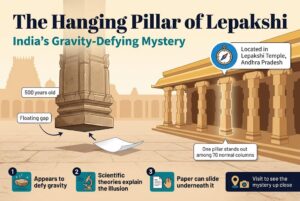
Get ready to discover why this single pillar has become more famous than the temple’s 70 other perfectly normal columns – and why you can actually slide a piece of paper underneath it.
Lepakshi Temple Andhra Pradesh: The 16th Century Vijayanagara Marvel Behind the Mystery
The Veerabhadra Temple Lepakshi: Built by Two Brothers During the Golden Age of the Vijayanagara Empire
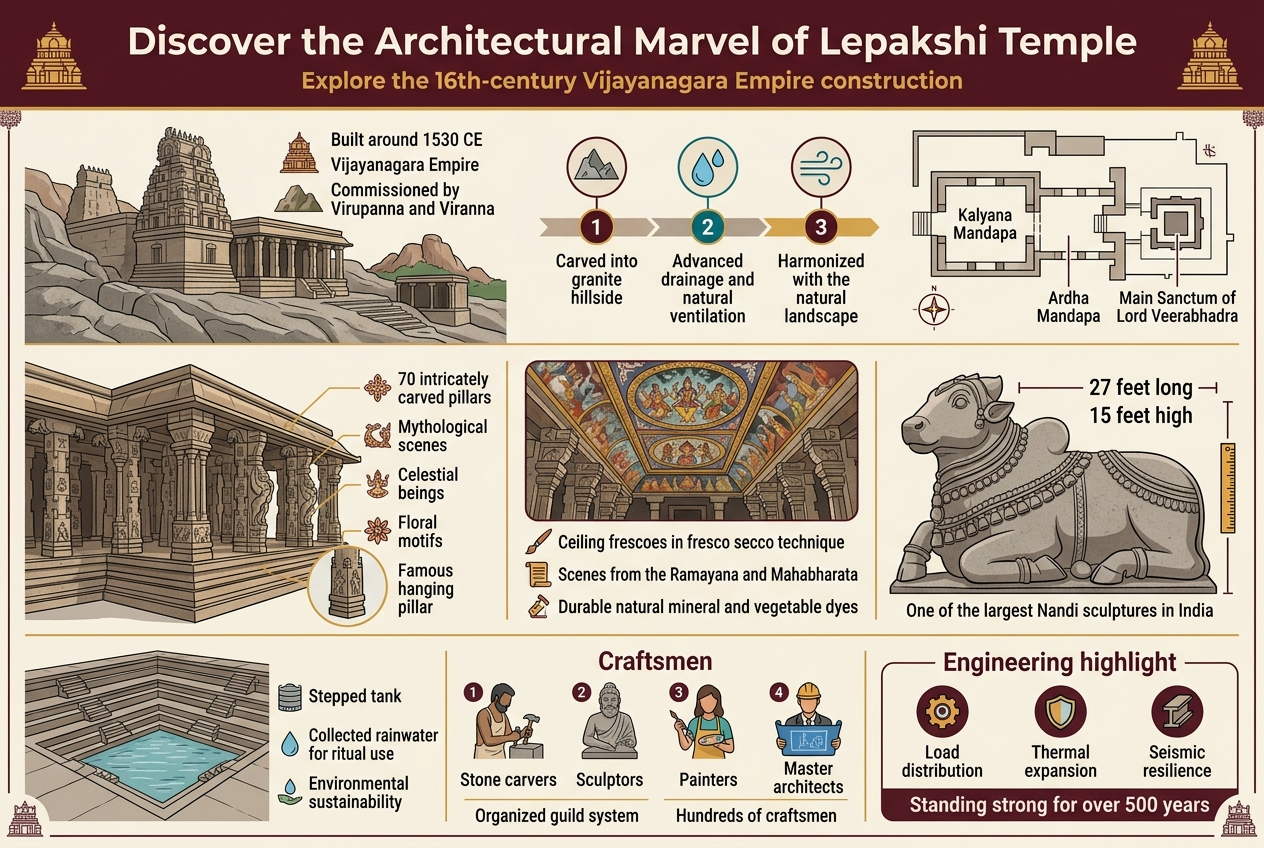
The Lepakshi Temple stands as a breathtaking testament to the architectural brilliance of the Vijayanagara Empire, built around 1530 CE during the reign of King Achyuta Deva Raya. This magnificent structure represents the pinnacle of South Indian temple architecture, showcasing the empire’s prosperity and artistic refinement during its golden age.
The temple was commissioned by two brothers, Virupanna and Viranna, who served as governors under the Vijayanagara administration. Their vision transformed this rocky outcrop in present-day Andhra Pradesh into a spiritual and artistic wonder that continues to mesmerize visitors nearly five centuries later.
What makes this construction remarkable is how the architects seamlessly integrated the temple with the natural landscape. The builders carved directly into the granite hillside, creating a harmonious blend between human craftsmanship and natural formation. This approach reflects the Vijayanagara philosophy of working with nature rather than against it.
The temple complex demonstrates the empire’s sophisticated understanding of engineering and acoustics. The builders incorporated advanced drainage systems to protect the structure from monsoon rains, while the positioning of various halls creates natural ventilation that keeps the interior cool even during scorching summers.
The Vijayanagara Empire that built Lepakshi, also created some of the most extraordinary ruins in the world at Hampi, Karnataka. Our Hampi tours take you through the heart of this magnificent lost civilisation, including the musical pillars of Vittala Temple, the stone chariot and the village of Anegundi, one of the most extraordinary heritage experiences in South India. Guided tours are available from Bangalore to the Bewitching Ruins of Hampi.
The 70 Pillars of Lepakshi Temple and Why Only One Has Never Touched the Ground
The Lepakshi Temple follows the distinctive Vijayanagara style, featuring an intricate layout that serves both spiritual and practical purposes. The complex consists of three main sections: the Kalyana Mandapa (marriage hall), Ardha Mandapa (half hall), and the main sanctum dedicated to Lord Veerabhadra, a fierce form of Lord Shiva.
The Kalyana Mandapa steals the show with its 70 intricately carved pillars, each telling a different story through stone. These pillars showcase various mythological scenes, celestial beings, and floral motifs that demonstrate the artistic mastery of the period. The famous hanging pillar sits among these architectural gems, defying conventional understanding of structural engineering.
The temple’s ceiling features stunning frescoes that rival the best Renaissance art. These paintings depict scenes from Hindu epics like the Ramayana and Mahabharata, rendered in vibrant colors that have somehow survived centuries of exposure to elements. The artistic techniques used show clear influences from both local traditions and international styles, reflecting the cosmopolitan nature of the Vijayanagara Empire.
One striking feature is the massive Nandi bull sculpture carved from a single granite block. This monolithic wonder measures 27 feet in length and 15 feet in height, making it one of the largest Nandi sculptures in India. The attention to anatomical detail and the serene expression carved into the stone face demonstrates extraordinary skill.
The temple also features a unique stepped tank design that collected rainwater for ritual purposes. This practical element shows how the architects balanced spiritual requirements with environmental sustainability.
The Legend of Virupanna: The Builder Who Gouged Out His Own Eyes and the Blood Stains Still Visible Today
The creation of Lepakshi Temple required an army of master craftsmen, each specializing in different aspects of temple construction. Stone carvers, sculptors, painters, and architects worked together under a sophisticated guild system that ensured quality control and artistic consistency throughout the project.
The stone carvers who worked on Lepakshi possessed extraordinary skills in manipulating granite, one of the hardest stones to work with. They developed specialized tools and techniques that allowed them to create incredibly detailed sculptures and intricate lacework patterns in stone. These artisans often signed their work with small symbols or inscriptions, showing the pride they took in their craft.
The painters who created the ceiling frescoes used a unique technique called “fresco secco,” applying pigments to dry lime plaster. They created their own paints from natural minerals and vegetable dyes, developing color formulations that have proven remarkably durable. The sophisticated understanding of color theory and composition evident in these paintings suggests these artists had exposure to artistic traditions from across the known world.
Master architects designed the temple using principles of Vastu Shastra combined with practical engineering knowledge. They calculated load distributions, planned for thermal expansion, and incorporated seismic considerations into their designs. The fact that the temple has survived major earthquakes over five centuries speaks to their engineering expertise.
The project likely employed hundreds of craftsmen working in organized teams over several years. Each team had specific responsibilities, from quarrying and transporting stones to the final finishing touches on sculptures. This collaborative approach created a unified artistic vision while allowing individual craftsmen to showcase their unique talents within the overall design framework.
The Hanging Pillar of Lepakshi: One of Ancient India’s Greatest Unsolved Engineering Mysteries
What Makes the Hanging Pillar of Lepakshi Different From Every Other Temple Pillar in India
Walking into the Veerabhadra Temple at Lepakshi, visitors often stop dead in their tracks when they encounter the most talked-about architectural wonder – a massive stone pillar that appears to hang freely from the ceiling. This isn’t an optical illusion or a tourist gimmick; it’s a genuine 16th-century engineering marvel that continues to baffle experts and visitors alike.
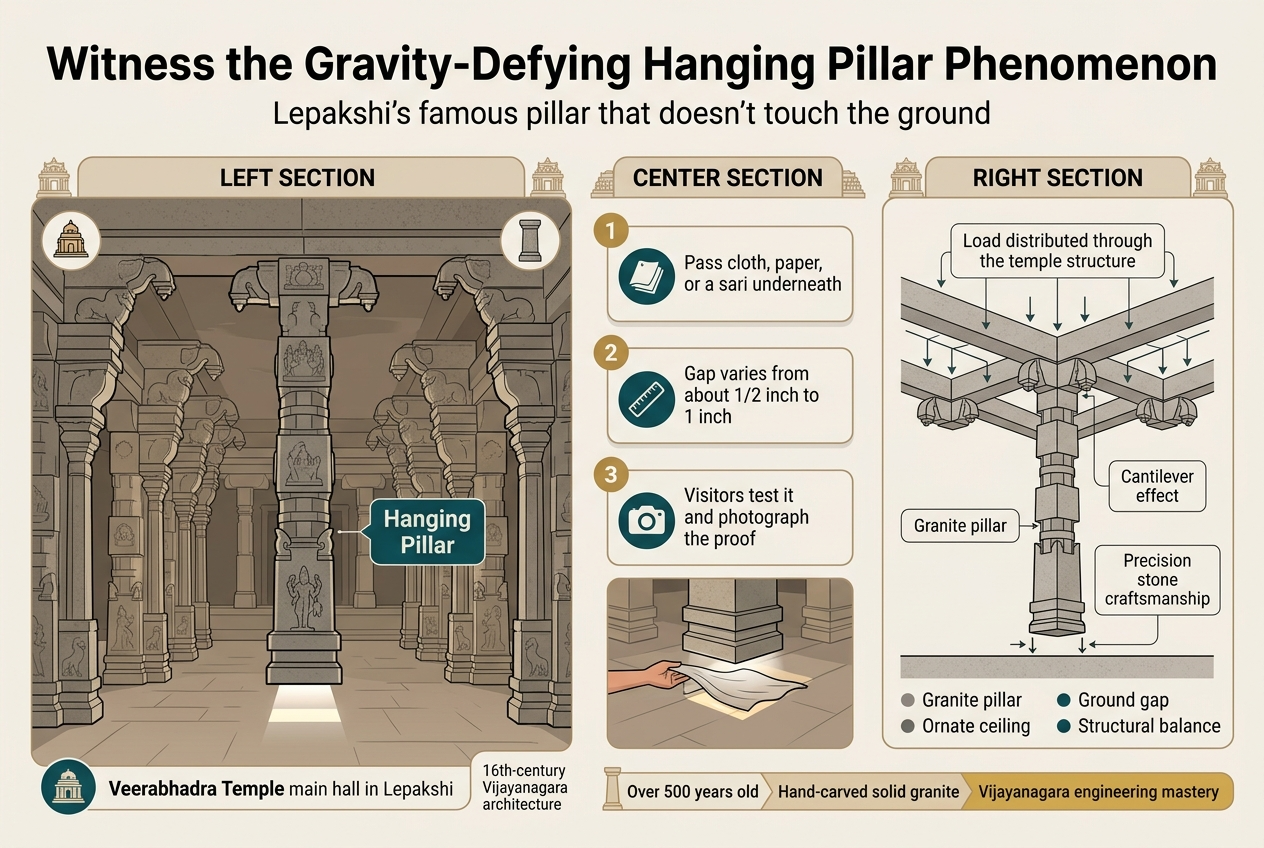
The hanging pillar stands among 70 other pillars in the temple’s main hall, but this one is different. While its companions rest firmly on the ground, supporting the weight of the ornate ceiling above, this pillar hovers just inches above the floor. The gap is clearly visible, and you can actually see daylight streaming through the space underneath.
What makes this phenomenon even more remarkable is the pillar’s substantial size and weight. Carved from solid granite, it measures several feet in circumference and extends from near the floor to the intricately decorated ceiling. The craftsmanship displays typical Vijayanagara style architecture, with detailed sculptures and patterns that match the temple’s overall aesthetic perfectly.
Local legends suggest that a British engineer once attempted to move the pillar to understand its mechanics, but stopped when the entire structure began to shake. Whether this story holds truth or not, the pillar remains untouched and continues to demonstrate the incredible skill of ancient Indian architects.
How to Test the Hanging Pillar of Lepakshi for Yourself and What You Will Experience
One of the most fascinating aspects of visiting the hanging pillar is the opportunity to test its authenticity yourself. Temple guides encourage visitors to take a thin cloth, piece of paper, or even a sari and pass it underneath the pillar. The fabric glides through easily, confirming that there’s indeed a genuine gap between the pillar’s base and the temple floor.
This simple test has become a ritual for countless visitors over the decades. Families gather around the pillar, taking turns sliding various objects through the space while marveling at the impossible sight. Children especially love this interactive element, often using their school notebooks or handkerchiefs to verify what their eyes are seeing.
The gap isn’t uniform – it’s slightly wider on one side than the other, measuring roughly half an inch to an inch at different points. This variation adds to the mystery, as it suggests the pillar isn’t simply resting on an invisible support but is genuinely suspended through some ingenious structural design.
Photography enthusiasts often capture this moment, creating images that show the clear separation between pillar and floor. These photos serve as proof of the phenomenon, though many people still find it hard to believe until they witness it firsthand.
The Gravity-Defying Gap That Has Baffled Engineers, Architects and Scientists for 500 Years
The hanging pillar represents the pinnacle of Vijayanagara engineering expertise, showcasing techniques that modern architects still struggle to fully comprehend. The builders of Lepakshi Temple demonstrated an understanding of weight distribution, structural engineering, and architectural balance that was centuries ahead of their time.
The secret likely lies in the sophisticated load-bearing system designed throughout the temple structure. The pillar appears to be supported through a complex network of interconnected stone beams and ceiling supports that distribute its weight across multiple points. This creates a cantilever effect, allowing the pillar to remain stable without ground contact.
What’s particularly impressive is the precision required to achieve this feat using only hand tools and human labor. Every measurement had to be perfect, every stone cut and placed with mathematical accuracy. A single miscalculation could have resulted in structural collapse, yet these ancient engineers succeeded in creating something that has stood firm for over 500 years.
The pillar also serves as a testament to the advanced knowledge of physics and mathematics possessed by Indian architects of the 16th century. They understood concepts of tension, compression, and gravitational forces long before these principles were formally documented in modern engineering texts. This achievement places the Lepakshi Temple among the world’s most significant architectural marvels, deserving recognition alongside more famous structures like the Pyramids of Giza or the Roman Pantheon.
The Science and Engineering Behind the Hanging Pillar of Lepakshi
Modern Engineering Theories That Try to Explain the Lepakshi Hanging Pillar Mystery
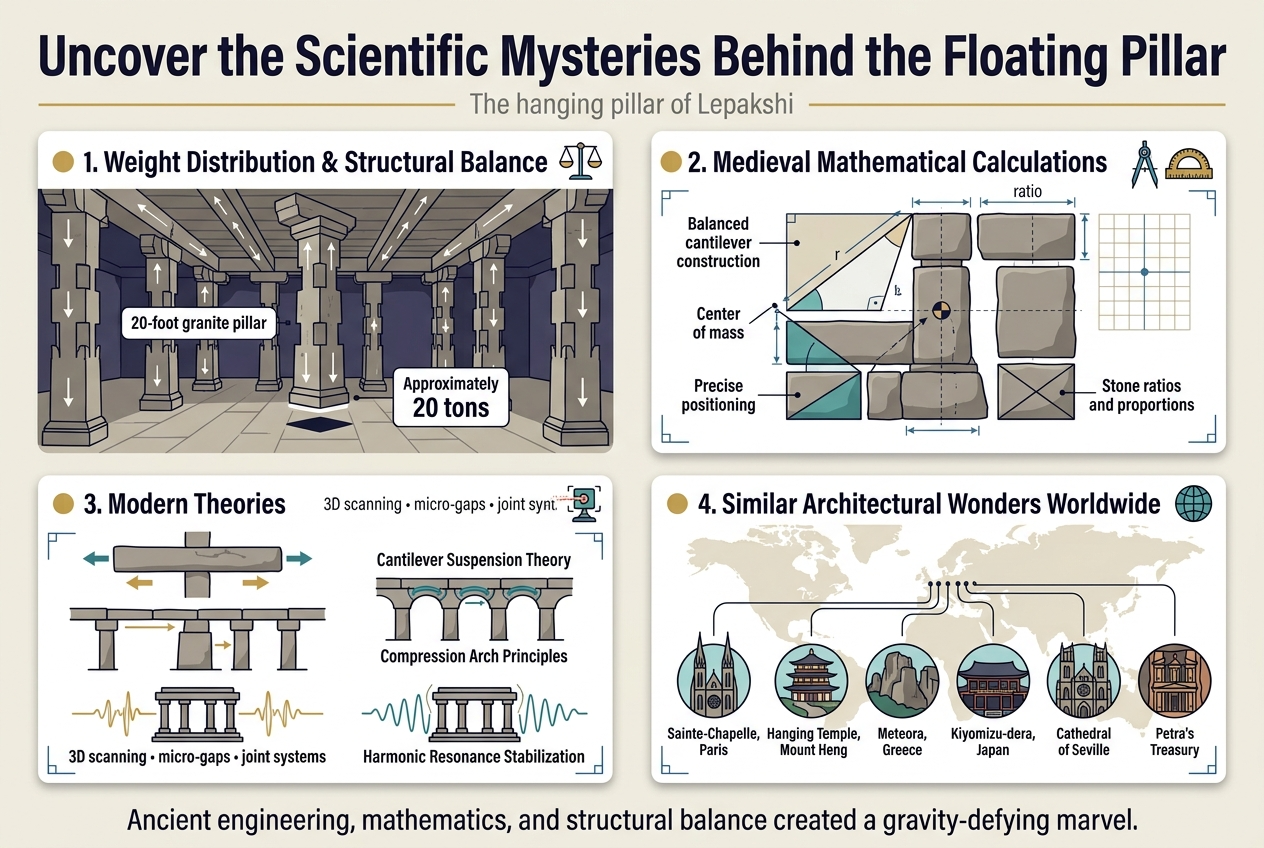
The hanging pillar of Lepakshi defies conventional understanding through its remarkable weight distribution system. The 20-foot granite column weighs approximately 20 tons, yet maintains perfect equilibrium without touching the ground. Master craftsmen positioned this massive stone with millimeter precision, creating a delicate balance that has endured for over 500 years.
The pillar’s base hovers just inches above the temple floor, supported entirely by the intricate interplay of forces within the temple’s architectural framework. Engineers believe the surrounding pillars and ceiling beams work together as a complex load-bearing network. Each stone block transfers weight through carefully calculated pressure points, distributing the massive load across multiple structural elements.
What makes this engineering feat even more impressive is how the builders achieved this balance using only hand tools and mathematical principles. The pillar’s center of gravity aligns perfectly with the temple’s structural grid, creating a self-sustaining system that requires no external support.
What Ancient Texts and Vijayanagara Architecture Tell Us About This Extraordinary Achievement
Vijayanagara architects possessed sophisticated mathematical knowledge that rivals modern engineering principles. They applied advanced geometric calculations to determine the exact positioning, angle, and weight distribution needed for the suspended pillar. Ancient texts reveal these builders used complex trigonometric formulas and load-bearing calculations that wouldn’t look out of place in today’s structural engineering handbooks.
The builders employed a technique called “balanced cantilever construction,” where opposing forces create equilibrium. They calculated the precise center of mass and counterbalanced it with strategic placement of surrounding architectural elements. Stone masons carved each block to exact specifications, ensuring the weight distribution followed mathematical models passed down through generations.
Archaeological studies show measurements throughout the temple follow specific ratios and proportional relationships. These mathematical patterns suggest the builders used advanced planning techniques, possibly including scale models and stress-testing methods to verify their calculations before construction.
The British Colonial Engineer Who Tried to Move the Pillar and What Happened Next
Contemporary structural engineers have proposed several theories to explain this architectural puzzle. The “cantilever suspension theory” suggests the pillar operates like a massive stone seesaw, with its weight balanced against the temple’s ceiling structure through invisible tension points.
Some experts believe the builders used “compression arch principles,” where the pillar’s weight creates downward pressure that’s redirected horizontally through the surrounding stonework. This creates a web of forces that hold the column in place without ground support.
Another compelling theory involves “harmonic resonance stabilization.” According to this hypothesis, the temple’s dimensions create natural frequency patterns that help stabilize the suspended pillar. The building’s acoustics and vibration patterns work together to maintain structural integrity.
Recent laser scanning and 3D modeling have revealed micro-gaps between the pillar and surrounding stones that suggest sophisticated joint systems. These almost invisible connections may provide just enough support to maintain balance while preserving the illusion of complete suspension.
Ancient India’s engineering mysteries do not end at Lepakshi. The Ramappa Temple in Telangana, a UNESCO World Heritage Site built on a floating sand foundation that has survived 800 years of earthquakes, is another extraordinary example of ancient Indian engineering genius. Our Hyderabad tours include expert guided access to Ramappa Temple and the broader heritage of the Deccan plateau.
How the Hanging Pillar of Lepakshi Compares to Other Gravity-Defying Wonders of the Ancient World
The Lepakshi hanging pillar belongs to a rare category of gravity-defying structures found across different civilizations. The Sainte-Chapelle in Paris features suspended stone elements that seem to float within its Gothic framework, though using different engineering principles.
China’s Hanging Temple at Mount Heng demonstrates another approach to impossible architecture, with entire buildings suspended from cliff faces using wooden brackets and precise weight distribution. Similarly, the Meteora monasteries in Greece showcase how ancient builders conquered gravity through strategic positioning and mathematical precision.
Japan’s Kiyomizu-dera temple uses a wooden post-and-beam system called “sashimono” that creates the illusion of floating structures without using nails or suspension cables. These examples show how different cultures developed unique solutions to similar architectural challenges.
The Cathedral of Seville houses columns that appear to defy gravity through careful engineering, while Petra’s Treasury features carved facades that seem to emerge impossibly from solid rock. Each of these marvels demonstrates humanity’s enduring quest to push the boundaries of structural possibility.
Beyond the Hanging Pillar: The Complete Heritage of Lepakshi Temple Andhra Pradesh

The Kalyana Mandapa Ceiling Paintings: 16th Century Frescoes That Have Survived 500 Years
The Kalyana Mandapa serves as the wedding hall of the temple, and its ceiling tells stories that have captivated visitors for centuries. These vibrant frescoes showcase scenes from Hindu epics, with the Ramayana and Mahabharata taking center stage. The artists who created these masterpieces used natural pigments that have retained their brilliance despite being painted in the 16th century.
The most striking feature is the massive painting of Veerabhadra, spanning nearly the entire ceiling. This fierce deity appears with multiple arms, each holding different weapons, creating a sense of divine power that overwhelms viewers. The intricate details include flowing hair, ornate jewelry, and expressive facial features that seem to come alive under natural light.
Musicians, dancers, and celestial beings float across other sections of the ceiling, creating a heavenly atmosphere. The artists employed a technique called fresco secco, applying pigments on dry plaster, which explains their remarkable preservation. Look closely at the borders and you’ll discover geometric patterns interwoven with floral motifs, showcasing the mathematical precision that guided these ancient artists.
South India’s extraordinary tradition of temple fresco painting reaches its greatest heights at the Ajanta Caves in Maharashtra, where 2000-year-old paintings have survived with a brilliance that modern laboratories cannot replicate. Our Aurangabad tours include expert guided visits to both Ajanta and Ellora, two of India’s most extraordinary UNESCO World Heritage Sites.
The Musical Pillars, Nagalinga and Rare Vijayanagara Artwork That Most Visitors Miss
This sprawling temple complex represents one of the finest examples of Vijayanagara architecture in South India. Built during the reign of Achyuta Devaraya in the 16th century, the temple showcases the artistic heights reached during the Vijayanagara Empire’s golden age.
The main temple dedicated to Veerabhadra, a fierce form of Lord Shiva, features a unique three-story gopuram that rises majestically against the Andhra Pradesh landscape. Unlike many South Indian temples with towering entrance gates, Lepakshi’s gopuram remains unfinished, adding to its mysterious charm.
The complex includes multiple shrines dedicated to different deities:
- Veerabhadra shrine – The main sanctum housing the primary deity
- Ganesha shrine – Featuring a monolithic sculpture carved from a single boulder
- Durga shrine – Showcasing the goddess in her fierce form
- Hanuman shrine – Located on a hillock nearby with a massive statue
The temple’s layout follows traditional Dravidian principles, with courtyards connecting various structures. Stone pathways guide visitors through different sections, each revealing new architectural wonders and sculptural details.
The Nandi Bull of Lepakshi: One of India’s Largest Monolithic Sculptures Carved From a Single Granite Boulder
Every surface of Lepakshi temple tells a story through stone. Master craftsmen transformed granite blocks into living art, creating sculptures that display incredible attention to detail and emotional depth. The pillars throughout the complex feature dancing figures, musicians, and mythological creatures that seem ready to step off their stone pedestals.
The Nandi bull sculpture, located outside the main temple, ranks among the largest monolithic sculptures in India. Measuring 15 feet in height and 27 feet in length, this magnificent beast was carved from a single granite boulder. The sculpture captures the sacred bull in a resting position, with every muscle, ornament, and facial expression rendered with stunning realism.
Musical pillars create another fascinating feature of the temple. When tapped gently, these pillars produce different musical notes, demonstrating the acoustic knowledge possessed by ancient Indian architects. The seven pillars represent the seven musical notes of Indian classical music.
Wall reliefs depict various episodes from Hindu mythology:
- Scenes from Ramayana including Hanuman’s leap to Lanka
- Krishna’s childhood adventures and divine acts
- Shiva’s cosmic dance and his various manifestations
- Goddess worship scenes showing divine feminine power
Le Pakshi: The Ramayana Legend Behind the Name of Lepakshi Temple
Lepakshi holds deep mythological significance rooted in the Ramayana epic. According to legend, this site marks where the divine bird Jatayu fell after being mortally wounded by Ravana while trying to rescue Sita. The name “Lepakshi” derives from the Telugu words “Le Pakshi,” meaning “Rise, bird,” which Rama supposedly said to the dying Jatayu.
Local traditions maintain that Jatayu’s wing fell at this exact location, making it a sacred pilgrimage site for devotees. The nearby hill where a massive Hanuman statue stands represents another connection to the Ramayana, as believers say Hanuman rested here during his search for Sita.
The temple serves as an important center for Shaivism, with Veerabhadra representing Shiva’s fierce aspect born from his anger. This form of Shiva emerged during the destruction of Daksha’s sacrifice, making the temple significant for understanding Hindu concepts of divine justice and cosmic balance.
Annual festivals bring thousands of devotees who come seeking blessings for prosperity, health, and spiritual growth. The temple’s priests maintain ancient rituals passed down through generations, preserving traditions that connect modern worshippers with their ancestral heritage.
Plan Your Visit to the Hanging Pillar of Lepakshi: Complete Travel Guide From Bangalore

Best Time to Visit Lepakshi Temple and What to Expect on Arrival
Planning your visit around the right season can make all the difference at Lepakshi Temple. The sweet spot for visiting falls between October and March when temperatures hover around a comfortable 15-25°C. During these months, you can explore the temple complex without battling intense heat or unexpected downpours.
Avoid the summer months (April to June) when temperatures soar above 40°C, making outdoor exploration quite challenging. The monsoon season (July to September) brings heavy rainfall that might restrict your movement around the temple grounds and affect photography opportunities.
Early morning visits work best, especially between 7 AM and 10 AM. The golden morning light creates perfect conditions for photographing the hanging pillar and intricate carvings. Plus, you’ll beat the crowds and have more peaceful moments to appreciate the architectural details.
Weekdays offer a quieter experience compared to weekends when local tourists flock to the site. If you’re planning a weekend trip, arrive early to secure parking and enjoy the temple before larger groups arrive.
How to Reach Lepakshi Temple From Bangalore, Hyderabad and Chennai
Getting to Lepakshi Temple is straightforward from major South Indian cities. From Bangalore, the most popular route covers approximately 120 kilometers and takes about 2.5 hours by road. Take NH44 towards Hindupur, then follow state highways to reach the temple.
By Car or Taxi:
- Bangalore to Lepakshi: 120 km (2.5 hours)
- Hyderabad to Lepakshi: 140 km (3 hours)
- Chennai to Lepakshi: 350 km (6 hours)
Private taxis and rental cars provide the most flexibility, allowing you to stop at scenic spots along the way. Several travel agencies offer day packages from Bangalore that include transportation and guide services.
By Bus:
Regular state transport buses run from Bangalore to Hindupur, from where you can catch local buses to Lepakshi. The total journey takes about 4 hours with transfers.
Nearest Airport:
Kempegowda International Airport in Bangalore serves as the closest major airport, about 150 kilometers away.
Expert Guided Tours to Lepakshi Temple With 5 Senses Tours From Bangalore
Professional guides can transform your visit from a simple sightseeing trip into an enriching cultural experience. Local guides possess deep knowledge about the temple’s history, architectural techniques, and the stories behind various sculptures and paintings.
What Expert Guides Offer:
- Detailed explanations of Vijayanagara architectural style
- Stories about the legendary hanging pillar and its construction
- Insights into the intricate Kalyanamandapa hall frescoes
- Information about the massive Nandi sculpture and its significance
- Hidden details in stone carvings that casual visitors often miss
Consider combining your Lepakshi visit with nearby attractions like Penukonda Fort or Puttaparthi for a comprehensive cultural tour. Many tour operators offer multi-destination packages that include transportation, meals, and expert commentary throughout the journey.
Lepakshi is the beginning of an extraordinary journey through South India’s most astonishing ancient heritage. At 5 Senses Tours we offer expert guided experiences across more than 40 destinations throughout India, designed for travellers from the USA, UK and Australia who want to go deeper than the usual tourist trail. From the ancient ruins of Hampi and the diamond fortress of Hyderabad to the living temple traditions of Madurai and the extraordinary rock-cut caves of Aurangabad, every experience is crafted to reveal the India that most visitors never find. Explore our full portfolio of India heritage tours and begin planning your extraordinary journey today.
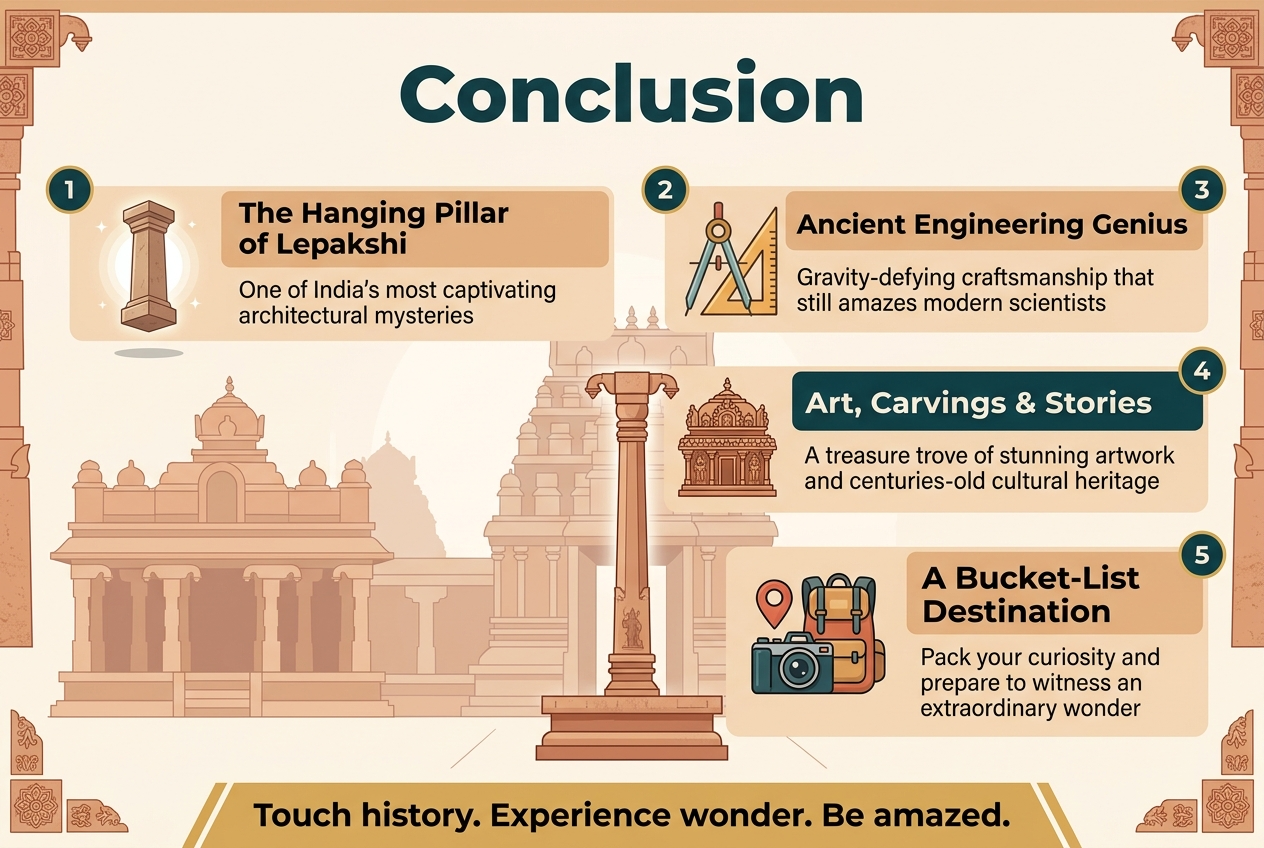
The hanging pillar of Lepakshi stands as one of India’s most captivating architectural mysteries. This gravity-defying wonder showcases the incredible engineering skills of ancient craftsmen while leaving modern scientists still searching for definitive explanations. The temple complex offers visitors far more than just this famous pillar – it’s a treasure trove of stunning artwork, intricate carvings, and centuries-old cultural stories waiting to be explored.
Ready to witness this architectural miracle for yourself? Lepakshi temple deserves a spot on every travel enthusiast’s bucket list. Pack your curiosity along with your camera, and prepare to be amazed by a place where ancient engineering meets timeless artistry. This isn’t just a tourist destination – it’s a chance to touch history and experience something truly extraordinary that continues to baffle experts and inspire wonder in every visitor who walks through its doors.
Leave a Reply