
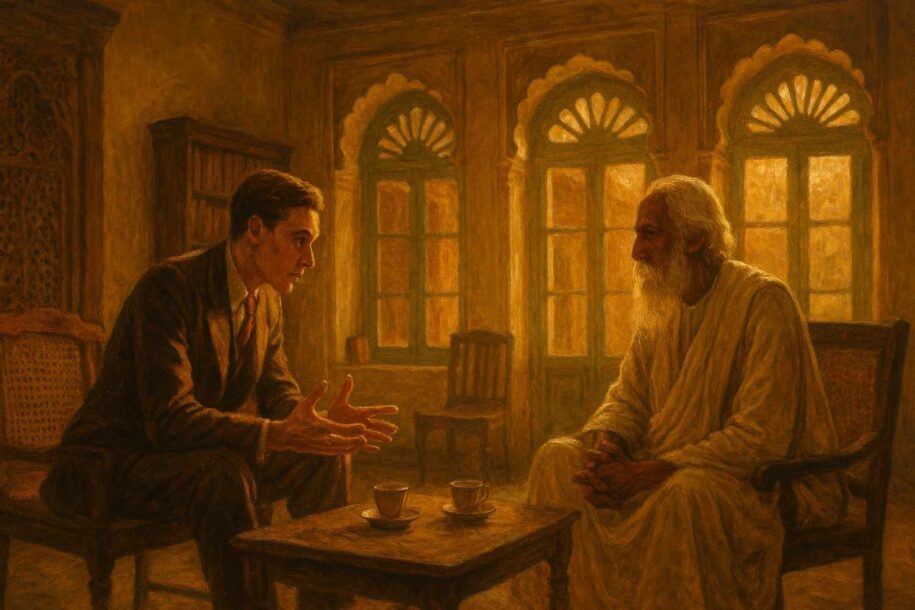
On the afternoon of October 4 1929, a 28-year-old German physicist arrived at the house of a 68-year-old Indian poet in Kolkata.
The physicist was Werner Heisenberg. Two years earlier he had published the uncertainty principle, one of the most philosophically disturbing discoveries in the history of science. It had shaken the foundations of physics so completely that Heisenberg himself, in his own words, had been left confused and troubled by what he had found.
The poet was Rabindranath Tagore. Nobel laureate. Composer of the national anthems of both India and Bangladesh. The first non-European to win the Nobel Prize in Literature. And a philosopher whose understanding of the relationship between the observer and the observed, between consciousness and reality, between the individual and the universe, was rooted in the Upanishadic tradition that the Indian subcontinent had been developing for three thousand years.
They talked for hours.
After these conversations with Tagore, Heisenberg said, some of the ideas that had seemed so crazy suddenly made much more sense. That was a great help for me.
The man who had discovered that the act of observation changes the thing being observed found comfort and clarity in a philosophical tradition that had been saying exactly this for three thousand years. The most disturbing finding of 20th-century physics had already been anticipated by ancient Indian thought. And it took a conversation in a house in Kolkata to make the connection visible.
This is the complete story of the Heisenberg Tagore Kolkata meeting. The science. The philosophy. The precise moment where they converge. And the house in Jorasanko where it happened, which is still standing in Kolkata today and is one of the most extraordinary intellectual heritage sites in Asia.
Heisenberg Tagore Kolkata: Understanding What Each Man Brought to the Conversation
Who Was Werner Heisenberg and Why the Uncertainty Principle Was So Philosophically Disturbing
Werner Heisenberg was born in Germany in 1901 and became one of the principal architects of quantum mechanics, the theory of physics that describes the behaviour of matter and energy at the subatomic scale. Werner Heisenberg who died forty years ago was one of the founders of quantum theory and will be remembered along with Albert Einstein and Niels Bohr as one of the giants of modern physics.
The uncertainty principle, which Heisenberg published in 1927, states that it is impossible to know simultaneously and with perfect precision both the position and the momentum of a subatomic particle. The more precisely you determine a particle’s position the less precisely you can know its momentum and vice versa. This is not a limitation of measurement instruments. It is a fundamental feature of physical reality at the quantum level.
The philosophical implications of this discovery were deeply disturbing to the physicists who had to absorb it. Classical physics, built on the foundations of Newton and Maxwell, assumed that physical reality is objective and independent, that particles have definite positions and velocities whether or not anyone is measuring them and that the role of the scientist is simply to observe what is already there.
Heisenberg recognised that the formalism of quantum theory cannot be interpreted in terms of our intuitive notions of space and time or of cause and effect but at the same time he realised that all our concepts are connected with these intuitive notions of space and time.
Quantum mechanics destroyed this picture completely. At the quantum level particles do not have definite positions until they are measured. The act of measurement itself disturbs the system being measured and changes the result. The observer and the observed are not separate. They are entangled in a way that makes the classical notion of objective independent reality untenable at the most fundamental level of physical description.
This was not merely a scientific finding. It was a philosophical earthquake. And it had left Heisenberg, in the period before his Kolkata visit, genuinely troubled about how to interpret what he had found.
Who Was Rabindranath Tagore and Why Indian Philosophy Had Already Addressed What Quantum Physics Was Discovering
Rabindranath Tagore was born in Kolkata in 1861 into the Tagore family of Jorasanko, one of the most intellectually distinguished families in the history of Bengal. He was a poet, novelist, playwright, composer, philosopher, educator and social reformer whose work across every one of these domains was informed by his deep engagement with the Upanishadic philosophical tradition of ancient India.
Tagore was the first non-European to win the Nobel Prize and proceeded to have one of the most stimulating intellectually riveting conversations in history exploring the age-old friction between science and religion.
The Upanishadic tradition, the philosophical corpus of ancient India developed between approximately 800 and 200 BCE, proposes a view of reality that is in extraordinary consonance with what quantum mechanics eventually discovered. The Upanishads describe a universe in which the distinction between subject and object, between observer and observed, between the individual consciousness and the universal, is ultimately not fundamental. At the deepest level of reality, the Upanishads propose, the distinction between the knower and the known dissolves. Consciousness is not an observer of physical reality. It is a participant in it.
Brahman, the universal consciousness of the Upanishadic tradition, is not a God who exists separately from the physical world and observes it from outside. It is the ground of all being, the substrate from which both consciousness and matter emerge, the unified field in which the separation between subject and object is an appearance rather than an ultimate truth.
This philosophical position, developed three thousand years before quantum mechanics, describes the same fundamental insight that the uncertainty principle had forced upon Heisenberg by mathematical necessity. The observer cannot be separated from the observed. The act of observation is itself part of the physical event. Reality at its deepest level is not independent of consciousness.
Tagore understood this. He had spent his entire intellectual life exploring the implications of the Upanishadic insight through poetry, philosophy and music. And when Heisenberg arrived at his house in Jorasanko on the afternoon of October 4 1929, Tagore was perhaps the one person in the world best placed to tell the confused young physicist that what he had discovered was not new. It was very, very old.
The Heisenberg Tagore Kolkata Meeting: What Was Said and Why It Mattered

How the Heisenberg Tagore Kolkata Meeting Came to Happen on October 4 1929
On October 4 1929, Heisenberg visited the University of Kolkata where he was received with great honours by the entire faculty and in the afternoon of that day he visited Rabindranath Tagore. On the following day Heisenberg wrote to his parents: In the afternoon I was the guest of the Indian poet Rabindranath Tagore.
Heisenberg was in Kolkata as part of an extraordinary 1929 world lecture tour that took him from Germany to the United States, to Japan, to India and back. He had specifically expressed an interest in meeting Tagore. He was taken to Tagore’s house at Jorasanko by the scientist Debendra Mohan Bose, a nephew of Jagadish Chandra Bose, and they had a number of conversations over the next few days.
The connection was made through Debendra Mohan Bose, the nephew of the extraordinary Jagadish Chandra Bose, the same scientist who had transmitted the world’s first wireless signal before Marconi and proved that plants have feelings. The Bose family of Kolkata was the intellectual bridge between the scientific tradition of Bengal and the visiting European physicist, facilitating a conversation whose significance would only become fully apparent decades later.
What the Heisenberg Tagore Kolkata Conversations Covered
The conversations between Heisenberg and Tagore at Jorasanko over those October days in 1929 covered ground that was simultaneously scientific, philosophical and deeply personal.
Heisenberg brought to the conversation his specific professional crisis. He had discovered, through the rigorous mathematics of quantum mechanics, that physical reality at the subatomic level is fundamentally different from what classical physics had assumed. Particles do not have definite properties independent of observation. The act of measurement is not neutral. The universe at its deepest level is not made of solid, separate, independently existing objects.
He had found this disturbing in a way that went beyond professional puzzlement. It was philosophically destabilising. It implied things about the nature of reality, about the relationship between the observer and the world, about the objectivity of science itself, that had no precedent in the Western philosophical tradition within which he had been educated.
Tagore brought to the conversation three thousand years of Indian philosophical tradition that had been grappling with precisely these questions since the composition of the Upanishads. The Upanishadic concept of maya, the apparent solidity and separateness of the physical world that consciousness overlays on the underlying unified reality, is a direct philosophical anticipation of the quantum mechanical insight that definite properties of physical systems are not independent of the process of observation. The Advaita Vedanta teaching that the individual self and the universal consciousness are not ultimately separate is a philosophical statement about the non-separability of observer and observed that quantum entanglement would later describe mathematically.
He began to see that the recognition of relativity interconnectedness and impermanence as fundamental aspects of physical reality which had been so difficult for himself and his fellow physicists was the very basis of the Indian spiritual traditions.
Relativity. Interconnectedness. Impermanence. The three philosophical concepts that quantum mechanics had forced upon Western physics as conclusions of mathematical necessity were the starting premises of the Indian philosophical tradition that Tagore embodied and articulated. They were not new discoveries. They were ancient recognitions. And knowing this, Heisenberg told Fritjof Capra decades later, had been a great help.
The Honest Account: What the Heisenberg Tagore Meeting Did and Did Not Mean
Intellectual honesty requires being precise about what the Heisenberg Tagore Kolkata meeting did and did not accomplish.
Heisenberg proposed the uncertainty principle in 1927 and met Tagore in 1929. These ideas of oneness between the observer and the observed helped Heisenberg and Bohr reconcile with the disturbing facets of the discovery of the uncertainty principle after it was made. They did not lead up to it.
This distinction is important. The Indian philosophical tradition did not cause the discovery of the uncertainty principle. Heisenberg derived his principle from the mathematics of quantum mechanics two years before he met Tagore. The Indian tradition gave him a philosophical framework within which to understand and accept what he had already found. It provided comfort and clarity for a discovery that had already been made rather than inspiration for a discovery yet to come.
This is still extraordinary. The fact that a three-thousand-year-old philosophical tradition had arrived independently at philosophical conclusions that 20th-century physics reached through rigorous mathematics is remarkable regardless of the direction of the causal arrow. The convergence is real. The comfort it provided was real. And the intellectual consequence, that Heisenberg came away from Kolkata with a more settled understanding of the philosophical implications of his own work, was real.
The kinship between the ancient Eastern teachings and the philosophical consequences of the modern quantum theory have fascinated me again and again said Heisenberg.
This is the quote that matters. Not a claim that Indian philosophy caused quantum mechanics. A statement of genuine, repeated, personal fascination with the convergence between ancient Indian thought and the most advanced physics of the 20th century, expressed by one of the greatest physicists who ever lived.
Heisenberg Tagore and Einstein: The Complete Story of Indian Philosophy Meeting Modern Physics in Kolkata
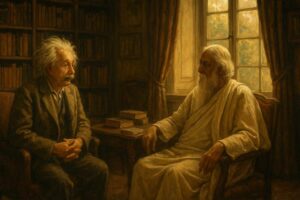
The Einstein Tagore Meeting: The Other Great Conversation That Indian Philosophy Inspired
The Heisenberg Tagore meeting in Kolkata was not the only extraordinary conversation between a 20th-century physics giant and the Indian philosopher.
On July 14 1930 Albert Einstein welcomed into his home on the outskirts of Berlin the Indian poet philosopher and musician Rabindranath Tagore. The two proceeded to have one of the most stimulating intellectually riveting conversations in history exploring the age-old friction between science and religion.
The Einstein-Tagore conversation of July 14 1930 was recorded and published in the January 1931 issue of the Modern Review. It covers the deepest possible questions about the nature of reality, the relationship between truth and human consciousness and the question of whether the universe has an existence independent of human observers.
Einstein argued for what he called mind-independent reality. The Apollo of Belvedere is beautiful whether or not any human being is there to perceive it. Mathematical truth exists whether or not any human mind has discovered it. The universe existed before humans arrived and will exist after they are gone.
Tagore stressed the human character of truth and beauty while Einstein defended an ideal of mind-independent reality.
Tagore argued from the Upanishadic tradition that truth and beauty are inseparable from the consciousness that perceives them. Not because they are subjective in the everyday sense of being merely matters of personal opinion, but because consciousness is itself the ground of reality rather than a late arrival to a pre-existing universe. The world is a human world, Tagore told Einstein. Not in the sense that it is limited or parochial. In the sense that consciousness is not a visitor to physical reality but a constituent of it.
Einstein was unconvinced. He could not accept a universe whose existence was contingent on human observation. The disagreement between Einstein and Tagore maps precisely onto the disagreement between Einstein and Bohr about the interpretation of quantum mechanics. Einstein’s resistance to the Copenhagen interpretation, his insistence that God does not play dice, his refusal to accept that quantum probability reflects genuine physical indeterminacy rather than human ignorance, is philosophically identical to his insistence to Tagore that reality is mind-independent.
Tagore and Bohr were on the same side. Einstein was on the other.
The Indian philosopher and the Danish physicist, working from completely different traditions and completely different methods, had arrived at the same position on the deepest question in the philosophy of physics. This convergence, visible in Kolkata in 1929 and in Berlin in 1930, is the most extraordinary intellectual story of the 20th century that nobody tells.
The Upanishads and Quantum Mechanics: The Philosophical Connections That Heisenberg and Tagore Saw
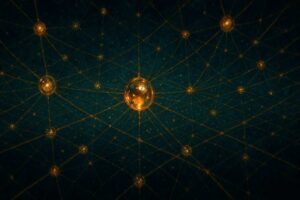
The specific parallels between the Upanishadic philosophical tradition and the findings of quantum mechanics that Heisenberg found so clarifying in his Kolkata conversations with Tagore can be stated precisely.
The uncertainty principle states that the observer cannot be separated from the observed at the quantum level. The act of measurement is part of the physical event. The Upanishadic tradition states that consciousness is not separate from the physical world it perceives. The knower and the known are not ultimately distinct.
Quantum entanglement demonstrates that particles that have interacted remain connected regardless of the distance between them, such that measuring one instantaneously affects the other. The Upanishadic concept of Indra’s Net describes a universe in which every node reflects every other node simultaneously, in which separation is appearance and connection is the underlying reality.
The Copenhagen interpretation of quantum mechanics, developed by Bohr and Heisenberg, holds that quantum systems do not have definite properties independent of measurement. Properties emerge through the interaction between the system and the measuring apparatus. The Advaita Vedanta teaching holds that definite, separate, independently existing objects are a superimposition of maya on the underlying unified reality of Brahman. The definite properties of things emerge through the interaction of consciousness with the undifferentiated ground of being.
These are not identical statements. The physics and the philosophy operate at different levels and use different methods. But the structural similarity is genuine and extraordinary. And it was precisely this structural similarity that Heisenberg found so clarifying in his conversations with Tagore on those October afternoons in Jorasanko in 1929.
Visit the Heisenberg Tagore Kolkata Heritage Site With 5 Senses Tours
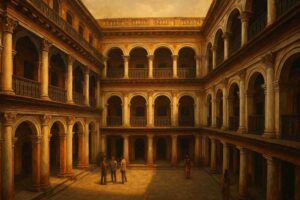
Jorasanko Thakur Bari: The House Where the Heisenberg Tagore Meeting Happened
Jorasanko Thakur Bari is the ancestral home of the Tagore family. It is the birthplace of poet Rabindranath Tagore and the host of the Rabindra Bharati University campus. Built in Traditional Bengali Architecture of Dalan genre it is considered to be a heritage historic icon and centre of socio-cultural evolution of Kolkata.
The Jorasanko Thakur Bari, the ancestral home of the Tagore family in North Kolkata, is one of the most extraordinary intellectual heritage sites in Asia. It was built in 1784 and expanded across the 19th century as the Tagore family grew in cultural influence and intellectual prominence. It was the birthplace of Rabindranath Tagore in 1861. It was the centre of the Bengal Renaissance, the extraordinary flowering of Bengali culture, science and philosophy in the 19th and early 20th centuries that produced not only Tagore but Jagadish Chandra Bose, Satyendra Nath Bose, Meghnad Saha and the scientific tradition of Presidency College.
And it was here, in the rooms of this house, that Werner Heisenberg came on the afternoon of October 4 1929 and had the conversations that he later said made some of the ideas that had seemed so crazy suddenly make much more sense.
A walk through this museum-house will show you how old Bengali households functioned. The museum is open from 10:30 am to 4:30 pm except Mondays. Choose a guided tour to learn more about this family of artists and reformers and understand why Rabindranath Tagore is still so revered.
The museum at Jorasanko houses an extensive collection of the Tagore family’s artworks, manuscripts and photographs. The evening Light and Sound Show is available in both Bengali and English. And the physical space of the house itself, its courtyards and rooms and the particular quality of light in the North Kolkata afternoon, creates an atmospheric connection to the conversations that happened here that no amount of reading about them can fully replicate.
5 Senses Tours takes international travellers to Jorasanko Thakur Bari in Kolkata where the Heisenberg Tagore conversations happened, with expert cultural guides who bring the complete story of those conversations and their extraordinary intellectual significance to life in the physical space where they occurred. If this story has moved you, the house is still there. The rooms are still there. Plan your Kolkata heritage experience with 5 Senses Tours.
The Complete Kolkata Intellectual Heritage Journey

The Heisenberg Tagore meeting at Jorasanko in 1929 was not an isolated event. It was one moment in the extraordinary intellectual tradition of Kolkata that the 5 Senses Tours Kolkata heritage experience brings to life in its complete depth.
Presidency College, where Jagadish Chandra Bose taught Satyendra Nath Bose and Meghnad Saha and where CV Raman conducted his Nobel Prize-winning experiments, is within walking distance of Jorasanko. The same intellectual ecosystem that produced the Bengali scientists who reshaped modern physics also produced the poet-philosopher whose Upanishadic understanding of reality gave Werner Heisenberg the philosophical comfort to accept what his own mathematics had forced upon him.
The Bose Institute founded by Jagadish Chandra Bose, whose nephew Debendra Mohan Bose brought Heisenberg to Tagore’s house in the first place, is the physical embodiment of the connection between the scientific and philosophical traditions of Bengal that the Heisenberg Tagore meeting made dramatically visible.
Our Kolkata tours cover the complete intellectual heritage of one of Asia’s most extraordinary cities, including Jorasanko Thakur Bari, Presidency College, the Bose Institute and the Indian Museum, with expert cultural guides who connect every site to the complete story of Bengal’s extraordinary intellectual tradition.
For travellers who want to extend the Indian philosophy and modern science story beyond Kolkata, our Varanasi tours cover the Kashi Vishwanath tradition of accumulated knowledge on the banks of the Ganges where the Upanishadic philosophy that Tagore articulated to Heisenberg was developed and maintained for three thousand years. Our Bodhgaya tours cover the Buddhist philosophical tradition that developed alongside the Upanishadic tradition and whose own insights about the nature of consciousness and reality are equally relevant to the questions that quantum mechanics eventually forced upon modern physics.
5 Senses Tours is recognised by India’s Ministry of Tourism, winner of the Tripadvisor Travellers Choice Award and the Outlook Responsible Tourism Award. Every tour is private, expert-guided and completely customised for your group.
Talk to a 5 Senses Tours expert about your Kolkata intellectual heritage experience today. Contact us and we will build the journey around your specific interests, travel dates and time available.
Contact 5 Senses Tours to begin planning your Kolkata heritage journey today
Frequently Asked Questions
Who were Heisenberg and Tagore and why did they meet in Kolkata?
Werner Heisenberg was a German physicist who published the uncertainty principle in 1927 and was one of the principal architects of quantum mechanics. Rabindranath Tagore was an Indian poet, philosopher and Nobel laureate whose philosophical outlook was rooted in the Upanishadic tradition of ancient India. They met on October 4 1929 at Tagore’s ancestral home at Jorasanko in Kolkata when Heisenberg was on a world lecture tour. Heisenberg had specifically expressed an interest in meeting Tagore and was brought to Jorasanko by Debendra Mohan Bose, nephew of the scientist Jagadish Chandra Bose.
What did Heisenberg say about his conversations with Tagore in Kolkata
Heisenberg told the physicist Fritjof Capra decades after the meeting that after these conversations with Tagore some of the ideas that had seemed so crazy suddenly made much more sense and that the introduction to Indian thought had brought him great comfort. He said he began to see that the recognition of relativity, interconnectedness and impermanence as fundamental aspects of physical reality, which had been so difficult for himself and his fellow physicists, was the very basis of the Indian spiritual traditions.
Did Indian philosophy influence the discovery of the uncertainty principle?
No. Heisenberg published the uncertainty principle in 1927, two years before he met Tagore in 1929. The Indian philosophical tradition did not cause the discovery of the uncertainty principle. What the conversations with Tagore provided was a philosophical framework within which Heisenberg could understand and accept the disturbing implications of his own discovery. The Indian tradition had independently arrived at philosophical conclusions about the non-separation of observer and observed that quantum mechanics had reached through rigorous mathematics, and knowing this gave Heisenberg comfort and clarity about the philosophical meaning of his work.
What is the connection between the Upanishads and quantum mechanics?
The structural parallels between the Upanishadic philosophical tradition and quantum mechanics that Heisenberg found clarifying are specific and genuine. The uncertainty principle shows that the observer cannot be separated from the observed at the quantum level. The Upanishadic tradition teaches that consciousness is not separate from the physical world it perceives. Quantum entanglement demonstrates that separated particles remain connected. The Upanishadic concept of Indra’s Net describes a universe of fundamental interconnection. The Copenhagen interpretation holds that definite properties emerge through interaction between system and measuring apparatus. Advaita Vedanta holds that definite separate objects emerge through the interaction of consciousness with the unified ground of being.
Where did the Heisenberg Tagore meeting happen and can you visit it today?
The Heisenberg Tagore meeting happened at Jorasanko Thakur Bari, the ancestral home of the Tagore family in North Kolkata, on October 4 1929 and over the following days. The house is now a museum open from 10:30 am to 4:30 pm except Mondays, housing the Rabindra Bharati University campus and an extensive collection of Tagore family artworks, manuscripts and photographs. 5 Senses Tours offers expert guided Kolkata heritage tours that include Jorasanko Thakur Bari with cultural guides who bring the complete story of the Heisenberg Tagore conversations and their intellectual significance to life.
Leave a Reply