
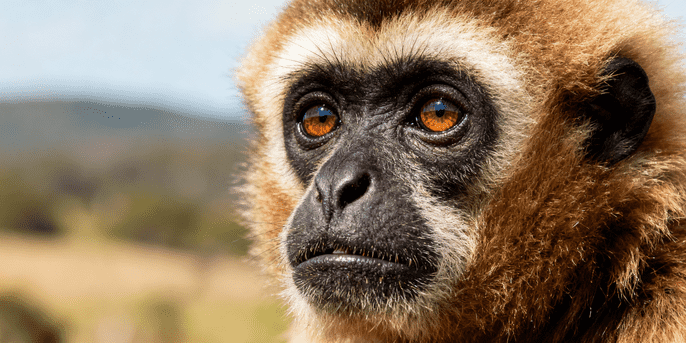
Just before dawn in a forest surrounded by tea gardens in Assam, something extraordinary happens.
A sound rises from the canopy that has no equivalent anywhere else in India. It begins as a series of low, tentative calls, a male finding his voice in the dark before the light arrives. Then a female answers from a neighbouring tree. And then the two voices weave together into a duet of such power and beauty that naturalists who have heard it for the first time have described the experience as one of the most moving encounters with wild nature available anywhere on earth.
The Hoolock Gibbon is singing.
It sings every morning from the upper canopy of the Hollongapar Gibbon Sanctuary near Jorhat in Assam. It has been singing in these forests since long before the tea gardens that now surround the sanctuary were planted. And it is India’s only ape, the only member of the great ape family found anywhere in the subcontinent, a fact that almost nobody in the international travel community knows.
People come to India for tigers. For rhinos. For elephants. Almost nobody comes for the ape that has been here all along, swinging through the canopy of Assam’s last evergreen forests, singing at dawn over the tea gardens and living its entire life without ever once touching the ground.
This is your complete guide to the Hoolock Gibbon tour in Assam. The science, the stories, the sanctuary and everything you need to know to plan your visit with 5 Senses Tours.
Hoolock Gibbon Tour Assam: Why India’s Only Ape Is the Most Overlooked Wildlife Experience in the Country
India has 75 percent of the world’s wild tiger population. It has the world’s largest population of Asian elephants. It has the only surviving Asiatic lions on earth. Its wildlife credentials are extraordinary and well documented.
And then there is the Hoolock Gibbon. India’s only ape. Living in the last fragments of evergreen forest in Assam and the northeast. Critically endangered. Completely unknown to most international travellers. And arguably the most fascinating, most behaviourally extraordinary and most visually spectacular primate in the entire subcontinent.

What Makes the Hoolock Gibbon Unlike Any Other Animal in India
The Hoolock Gibbon is not a monkey. This distinction matters enormously and most people who encounter one for the first time are surprised by it.
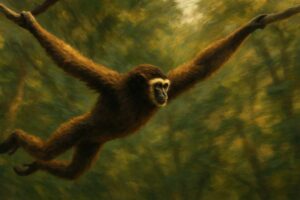
Monkeys have tails. Apes do not. The Hoolock Gibbon, like all apes, has no tail whatsoever. It is anatomically closer to a human being than it is to any monkey species. Its arms are dramatically longer than its legs, evolved specifically for brachiation, the extraordinary form of locomotion in which the animal swings through the forest canopy using only its hands, releasing and catching branches in a fluid continuous motion that looks less like movement and more like flying.
A Hoolock Gibbon moving at full speed through the upper canopy covers distances of up to fifteen metres in a single swing, reaching speeds of up to fifty-six kilometres per hour. It moves through the forest with an effortless grace that is unlike anything else in the Indian animal kingdom and which experienced wildlife photographers consistently describe as one of the most technically challenging and most rewarding subjects they have ever attempted to capture.
It never comes down from the trees. Its entire life, from birth to death, is conducted in the upper and middle canopy. It drinks water from the moisture of leaves rather than descending to ground-level water sources. It sleeps in the trees, forages in the trees, raises its young in the trees and dies in the trees. The forest floor is a world the Hoolock Gibbon has never needed to visit.
The Remarkable Social Life of India’s Only Ape
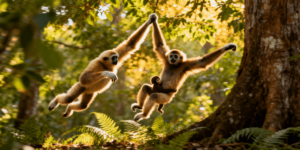
The Hoolock Gibbon is monogamous. In the animal kingdom this is extraordinarily rare. Fewer than five percent of mammal species form lifelong pair bonds and the Hoolock Gibbon is one of them.
A mated pair of Hoolock Gibbons will spend their entire adult lives together, defending a territory of approximately thirty acres of forest, raising their young as a cooperative unit and performing their extraordinary dawn duets as a combined territorial declaration and an affirmation of their bond. The male and female voices are distinctly different in tone and register. The male produces a series of rapid ascending calls. The female responds with a longer, more elaborate phrase. Together they create something that ornithologists and primatologists have spent decades trying to adequately describe because no purely scientific description captures the emotional impact of hearing it for the first time.
When one member of a bonded pair dies, the survivor does not seek a new partner. A Hoolock Gibbon will remain alone, sometimes for the rest of its life, rather than form a new bond. This behaviour has been documented consistently across multiple studies and it is one of the details that gives people who visit the Hollongapar sanctuary an encounter with the Hoolock Gibbon that goes far beyond simple wildlife observation into something that feels genuinely intimate and genuinely moving.

Why the Hoolock Gibbon Is Critically Endangered and Why Hollongapar Matters
The Hoolock Gibbon once ranged across a vast swathe of northeast India’s evergreen forests. Today it survives in fragments. Habitat destruction, tea garden expansion, illegal logging and the extraordinary pressure of one of the most densely populated regions in Asia have reduced its range to isolated pockets of forest, many of them too small to support viable long-term populations.
The Hollongapar Gibbon Sanctuary contains India’s only gibbons and Northeastern India’s only nocturnal primate, the Bengal slow loris. The sanctuary has been fragmented and surrounded by tea gardens and small villages. A railway line runs directly through the sanctuary, physically dividing the gibbon population into two groups that cannot interact. The tea gardens are used by elephants as a migration route to Nagaland, making them vulnerable to frequent poaching.
As of the most recent survey there are approximately 125 individual Hoolock Gibbons remaining in the Hollongapar sanctuary. One hundred and twenty-five individuals. In the world’s largest democracy. In a country that hosts 75 percent of the world’s wild tigers.
The Hollongapar sanctuary is not just a wildlife destination. It is one of the most important small protected areas in Asia for primate conservation. Every visitor who comes here with a responsible tour operator and spends money in the local economy contributes directly to the case that this forest has economic value that justifies its protection.
Our Hoolock Gibbon tour in Assam is operated with complete respect for the sanctuary’s conservation priorities. We work with local naturalists from the surrounding communities, we ensure all visitor fees go directly to the sanctuary management and we keep group sizes small to minimise disturbance to the gibbon families.
The Hollongapar Gibbon Sanctuary: What You Will See and Experience
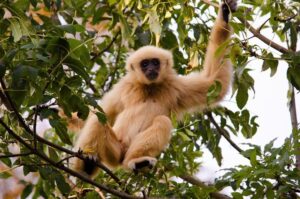
The Hollongapar Gibbon Sanctuary is home to primates like stump-tailed macaque, northern pig-tailed macaque, capped langur and the most famous being the hoolock gibbons. Gibbons are monogamous and live as family units till the offspring turn adults.
It is in fact the only sanctuary in India with seven species of primates in a single location. This remarkable diversity makes it extraordinary for anyone interested in primate behaviour regardless of whether they encounter the Hoolock Gibbon itself.
The Dawn Walk: The Most Important Two Hours of Your Hoolock Gibbon Tour
The Hoolock Gibbon tour in Assam is built around a single non-negotiable timing requirement. You must enter the sanctuary at dawn.
The sanctuary opens at 6am. Your naturalist guide will want you inside the forest before the light has fully established itself, in the window between first light and full sunrise when the gibbons are most active and their calls are at their most frequent and most audible. This is when the families begin their morning routines, when territorial boundaries are declared through song and when the young gibbons of each family begin their day of play and practice in the upper canopy.
The walk itself is conducted in complete silence. Your naturalist leads you along the forest trails with hand signals and whispered guidance, stopping when signs of gibbon activity are detected, positioning the group for the best possible sighting angles and providing a running commentary in the quietest possible voice about the behaviour you are observing.
The extraordinary thing about encountering Hoolock Gibbons in the wild is that you hear them long before you see them. The sound of the morning duet carries through the forest with remarkable clarity, and following the sound to its source, gradually narrowing the search through the canopy as the calls become louder and more distinct, is itself one of the most memorable parts of the entire experience.
When you finally locate a family in the canopy, the experience of watching them move is something that photographs and descriptions cannot adequately prepare you for. The brachiation is so fluid and so fast that the first reaction of most visitors is disbelief followed immediately by a kind of delighted astonishment that an animal can move this way.
The Seven Primates of Hollongapar: The Complete Wildlife of the Sanctuary
The Hoolock Gibbon is the most celebrated resident of Hollongapar but the sanctuary’s primate diversity is extraordinary in its own right and a significant part of what makes the wildlife experience here unlike any other in India.
The Bengal Slow Loris is the only nocturnal primate in northeast India, a small, wide-eyed creature of the night whose enormous eyes and slow, deliberate movements give it an otherworldly quality that has made it one of the most sought-after subjects for wildlife photographers in Assam. It is rarely seen during daytime walks but your naturalist guide will know the specific trees and hollow branches where they shelter during daylight hours.
The Capped Langur, with its distinctive pale-faced appearance and long sweeping tail, moves through the middle canopy in family troops that can number up to twenty individuals. Its calls are completely different from the gibbon’s, a series of sharp barking sounds that carry through the forest as alarm calls when predators are detected.
The Stump-tailed Macaque, the Pig-tailed Macaque, the Assamese Macaque and the Rhesus Macaque complete the seven-species primate roster. Each occupies a slightly different ecological niche within the sanctuary and each exhibits distinctly different social behaviour, making Hollongapar an extraordinary natural laboratory for anyone with an interest in primate social dynamics.
Beyond the primates the sanctuary is home to over 219 species of birds, making it equally rewarding for birdwatchers. The Red Jungle Fowl, the Kalij Pheasant, the Red-breasted Parakeet and the Drongo Cuckoo are among the most frequently observed species. Indian elephants pass through the sanctuary as part of their migration corridor to Nagaland, making elephant encounters a genuine possibility on any given morning walk.
The Tea Garden Landscape: What Surrounds the Sanctuary and Why It Matters
The Hollongapar Gibbon Sanctuary does not exist in isolation. It sits in the middle of one of the most extraordinary landscapes in India, completely surrounded by the ancient tea gardens of the Dissoi, Kothalguri and Hollonguri estates, with the Bhogdoi River creating a waterlogged border along one side and the distant hills of the Assam-Nagaland border visible on clear mornings.
This landscape context is one of the most distinctive features of the Hoolock Gibbon tour in Assam. You arrive at the sanctuary through tea garden roads, with the low, manicured bushes extending in every direction to the forest edge. The contrast between the ordered, cultivated tea landscape and the wild, dense evergreen forest that rises suddenly from its edge is visually arresting and completely unique to this corner of Assam.
The tea gardens themselves have an extraordinary history. The Assam tea industry was established by the British in the 19th century and the estates surrounding Hollongapar are among the oldest in the region, their colonial-era tea bungalows still standing in the gardens as architectural relics of a vanished world. Some of these bungalows can be visited as part of an extended Assam cultural experience, providing a connection between the natural heritage of the sanctuary and the human heritage of the landscape that surrounds it.
Our Hoolock Gibbon tour includes time in the tea garden landscape before and after the sanctuary walk, giving you the complete sensory experience of this extraordinary setting.

Combining Your Hoolock Gibbon Tour With Kaziranga: The Ultimate Assam Wildlife Experience
No visit to the Hoolock Gibbon sanctuary in Assam is complete without combining it with Kaziranga National Park, one of the most extraordinary wildlife destinations in the world and less than a two-hour drive from Hollongapar.
Kaziranga National Park: The UNESCO World Heritage Park Where Rhinos Outnumber Tigers
Kaziranga is one of the best places for wildlife safari in India with the unique opportunity of elephant safaris that put you right in the animals’ world, riding atop these gentle giants getting unbelievably close to rhinos, sometimes within 20 feet. Wild animals perceive elephants as non-threatening so they don’t flee like they might from vehicles.
Kaziranga National Park is a UNESCO World Heritage Site and one of the most successful conservation stories in Indian wildlife history. It is home to approximately 2600 Indian one-horned rhinoceroses, more than two-thirds of the world’s entire surviving population of this species. It is also home to the highest density of Royal Bengal Tigers of any national park in India, along with wild water buffalo, swamp deer, Asian elephants and over 478 species of birds.
The landscape of Kaziranga is completely unlike anywhere else in India. Vast grasslands stretch across the Brahmaputra floodplain, punctuated by stands of semi-evergreen forest and the extraordinary network of seasonal wetlands that form when the Brahmaputra floods each monsoon and retreats each dry season, depositing the extraordinary fertility that has made this one of the most biodiverse landscapes in Asia.

Why the Combined Hoolock Gibbon and Kaziranga Tour Is the Most Rewarding Wildlife Experience in Northeast India
The combination of the Hoolock Gibbon sanctuary and Kaziranga National Park in a single tour creates an experience that is available nowhere else in India.
In a single journey you encounter India’s only ape, singing its extraordinary duets in the canopy of an ancient evergreen forest surrounded by tea gardens, and the world’s largest surviving population of one-horned rhinos moving through the extraordinary grassland landscape of the Brahmaputra floodplain. Two completely different ecosystems. Two completely different wildlife experiences. Both within one hundred kilometres of each other in the extraordinary natural landscape of Assam.
Our combined Hoolock Gibbon and Kaziranga tour with 5 Senses Tours covers both destinations with expert naturalist guides throughout, private vehicle, all safari fees and accommodation included. This is the most comprehensive and most rewarding wildlife experience available in northeast India for international travellers from the USA, UK and Australia.

The Cultural Dimension of Assam: What 5 Senses Tours Adds That No Wildlife Operator Can Match
Assam is not just its wildlife. It is one of the most culturally rich and least explored states in India, with a heritage that stretches from the ancient Ahom kingdom that ruled for six centuries to the extraordinary Vaishnavite monasteries of Majuli, the world’s largest river island.
The Mising tribal communities who live in the buffer zones surrounding Kaziranga have a material culture and a way of life that has been shaped by centuries of coexistence with the extraordinary wildlife of the Brahmaputra valley. Their woven silk textiles, their stilt-house architecture and their rice beer traditions are a living cultural heritage that most wildlife tourists never encounter because dedicated wildlife operators do not know how to access it.
5 Senses Tours does. Our approach to wildlife tourism combines the extraordinary natural heritage of Assam with the cultural depth of the communities who live alongside it, creating an experience that is genuinely unlike anything offered by any dedicated wildlife operator in India.
Our Hoolock Gibbon tour and Kaziranga tour are available as standalone experiences or as a combined northeast India wildlife and culture journey. Contact us at www.5sensestours.com for a customised itinerary.

Plan Your Hoolock Gibbon Tour Assam With 5 Senses Tours: Complete Practical Guide
Best Time to Visit the Hoolock Gibbon Sanctuary
The Hoolock Gibbon sanctuary can be visited throughout the year but the ideal season is November to April when the weather is cool and dry, the forest trails are free from the leeches that emerge during the monsoon months and the morning light in the canopy is at its most beautiful for photography.
February and March are the single best months for Hoolock Gibbon sightings. The gibbons are most active in these months as the breeding season reaches its peak and territorial calling is at its most frequent and most sustained. The early mornings in February in the Assam forests are cool enough to be comfortable for walking and warm enough to be pleasant, and the light in the canopy at sunrise during these months has a quality that experienced wildlife photographers travel specifically to capture.
June and July are the most challenging months due to leeches on the forest trails but offer extraordinary rewards for birdwatchers as the monsoon brings migrant species to the sanctuary in significant numbers.
How to Reach the Hollongapar Gibbon Sanctuary
The Hollongapar Gibbon Sanctuary is located near Jorhat in Assam, approximately 25 kilometres from Jorhat town and 5 kilometres from Mariani railway junction.
The nearest airport is Jorhat Airport, which is connected to Guwahati, Kolkata and Delhi with onward connections to all major Indian cities. From Guwahati, the nearest major gateway city, the sanctuary is approximately four and a half hours by road through the extraordinary landscape of the Assam plains.
Our Hoolock Gibbon tour with 5 Senses Tours includes all transfers from Guwahati, accommodation in the Jorhat area, the guided sanctuary walk with an expert naturalist and all entry fees. Everything is arranged. You need only arrive.

Extend Your Assam Journey With 5 Senses Tours
The Hoolock Gibbon sanctuary is the beginning of an extraordinary journey through one of India’s most rewarding and least discovered wildlife and cultural landscapes.
Our Kaziranga tour combines the world’s greatest one-horned rhino population with elephant-back safaris, jeep safaris through the extraordinary grassland landscape and expert naturalist guides who bring the full story of this UNESCO World Heritage Site to life.
For travellers who want to experience the broader wildlife portfolio of India, 5 Senses Tours offers expert guided experiences across thirteen wildlife destinations nationwide, from the Royal Bengal tigers of the Sundarbans to the last Asiatic lions of Gir Forest in Gujarat, from the named celebrity tigers of Ranthambore to the Jungle Book forests of Kanha and Pench.
Every wildlife tour we offer is designed for travellers who want more than a sighting. We want you to understand the landscape, the culture, the conservation story and the extraordinary human communities who live alongside these animals.
Leave a Reply