
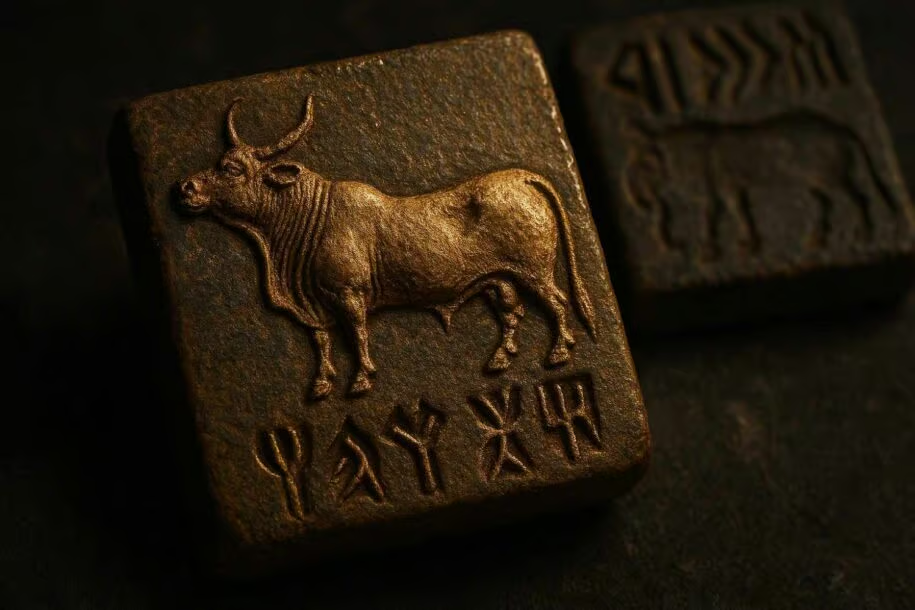
There is a seal in the collection of the National Museum in Delhi.
It is approximately four centimetres square. It is made of steatite, a soft grey stone. It was carved somewhere in the Indus Valley between 2600 and 1900 BCE. And on its surface, above the carved image of a humped bull, there are five symbols.
Nobody knows what they say.
Not for lack of trying. Since the Archaeological Survey of India announced its first findings on the Indus Valley Civilisation in 1924, over 5000 inscriptions have been excavated from sites across present-day India, Pakistan and Afghanistan. Linguists, archaeologists, cryptographers, computer scientists and now artificial intelligence researchers have spent over a century attempting to decode them. None has produced a result that the scholarly community has accepted as definitively correct.
The Indus Valley script remains the last major undeciphered writing system of an advanced ancient civilisation. It is older than Egyptian hieroglyphs. It is older than Mesopotamian cuneiform. It was used by a civilisation of extraordinary sophistication that built grid-pattern cities with indoor plumbing, standardised weights and measures and a trade network extending to Mesopotamia and the Persian Gulf at a time when most of the world was still living in scattered agricultural settlements.
And we still cannot read what its people wrote.
But 2025 has brought this hundred-year mystery to its most urgent and most publicly charged moment. The Tamil Nadu government has offered a one million dollar prize for successful decipherment. Artificial intelligence researchers are applying deep learning algorithms to the script’s structure with results that are generating genuine excitement in the field. And a researcher called Yajnadevam has published a cryptanalytic decipherment claiming to have read over 500 inscriptions in post-Vedic Sanskrit using methods borrowed from modern cryptography.
The race to crack history’s greatest code is at its most intense. And the physical evidence of the civilisation that created it, the extraordinary UNESCO World Heritage cities of Dholavira in Gujarat and Lothal near Ahmedabad, is waiting for the visitors who arrive with the complete story of what has been found and why it matters so profoundly.
Indus Valley Script Decipherment: The Civilisation That Created the World’s Most Mysterious Writing System 
Who Were the Indus Valley People and Why Their Script Matters So Much
The Indus Valley Civilisation, also called the Harappan civilisation, flourished between approximately 3300 and 1300 BCE across an area larger than ancient Egypt and Mesopotamia combined. At its peak it encompassed over 1000 known settlements across present-day India, Pakistan and Afghanistan, with major urban centres at Mohenjo-daro, Harappa, Dholavira, Rakhigarhi and Lothal.
Characterized by sophisticated urban planning and commercial networks, the civilisation left a script that for over a century has resisted all efforts at decipherment by scholars. The mysterious script, comprising about 4,000 inscriptions, occurs almost exclusively on seals, pottery and tablets.
What makes the Indus Valley Civilisation so extraordinary, and what makes the decipherment of its script so consequential, is the specific quality of its achievements. Grid-pattern city streets. Indoor plumbing and sophisticated drainage systems. Standardised weights and measures used across the entire civilisation from Dholavira in Gujarat to sites in present-day Afghanistan. A maritime trade network that reached Mesopotamia and the Persian Gulf. Evidence of cotton textile production, the earliest known in the world.
This was not a primitive or peripheral civilisation. At its height it was the largest of the three great Bronze Age civilisations alongside Egypt and Mesopotamia, almost certainly the most populous and possibly the most commercially sophisticated. And the language its people spoke, the script they carved into their seals and clay tablets, is still unknown.
If the Indus Valley script is ever fully deciphered it will not merely add a curiosity to our knowledge of ancient history. It will provide a direct window into the beliefs, the governance, the commerce and the daily life of the largest civilisation of the Bronze Age, a civilisation whose descendants are almost certainly among the billion people who live in the Indian subcontinent today.
Renowned Indologist Asko Parpola has characterised the script of the Indus as the most important system of writing that is undeciphered.
The most important undeciphered writing system in the world. And it is carved into stones that are sitting in museums and archaeological sites across India right now.
What Makes the Indus Valley Script So Difficult to Decipher
The Indus Valley script decipherment challenge is uniquely difficult for a combination of reasons that distinguish it from every other undeciphered ancient script.
The script appears on roughly 4,000 known inscriptions most of which are small and inscribed on seals. The average inscription contains only four to five signs. This extreme brevity is the single biggest obstacle to decipherment. There is simply not enough text to work with using conventional linguistic analysis.
The Egyptian hieroglyphs, which were undeciphered for centuries, were cracked by Champollion in 1822 using the Rosetta Stone, a single inscription containing the same text in three scripts including the already-known Greek. The Indus Valley script has no Rosetta Stone. No bilingual inscription has ever been found that connects it to any known language.
For more than a century researchers have proposed dozens of theories about the language behind the script. Initially some suggested connections to Sumerian, Hurrian, Elamite, even ancient Slavic or Egyptian writing. None of these theories managed to produce convincing results.
The root language of the script is itself unknown and this is the most fundamental problem of all. To decipher a script you need either a bilingual text or a reasonable hypothesis about what language the script represents. Without either you are working in complete darkness. The scholarly community is divided between those who believe the Indus script represents a Dravidian language ancestral to Tamil and other South Indian languages, those who believe it represents a proto-Sanskrit or Vedic language and those who believe it may not be a language at all but a system of non-linguistic symbols.
The debate about the language underlying the Indus Valley script is not merely academic. It is politically charged in the specific context of Indian historical identity, touching on questions about the relationship between the Indus Valley Civilisation and the Vedic tradition, about the origins of the Sanskrit language and about the historical relationship between North and South Indian linguistic and cultural traditions. These political dimensions have complicated the scholarly debate and made it harder to evaluate competing claims on purely linguistic and archaeological grounds.
Indus Valley Script Decipherment: The Three Recent Breakthroughs That Are Changing Everything

The AI Revolution in Indus Script Research
A new generation of scholars and researchers is leveraging AI and advanced techniques to unravel the mysteries of the Indus Valley script, sparking optimism that the ancient language may soon be deciphered through these cutting-edge technologies. Researchers are applying AI algorithms to examine the patterns and frequencies of symbols in the Indus Valley script aiming to uncover insights into its structure and meaning.
The application of artificial intelligence to the Indus Valley script decipherment challenge represents the most significant methodological advance in the field since the first computer analyses of the 1960s. The specific AI techniques being applied include deep learning models trained on the complete corpus of known Indus inscriptions to identify structural patterns, transformer models adapted from natural language processing to analyse the statistical distribution of signs and their sequential relationships and computer vision algorithms to digitise and standardise the representation of inscriptions from photographs and drawings.
Transformer models for phonetic decipherment of the Indus script have been published in the Transactions of the Association for Computational Linguistics in 2025. This represents the application of the same class of AI architecture that underlies tools like ChatGPT to the specific problem of ancient script analysis, using the statistical patterns in human language to identify whether the Indus sign sequences have the structural characteristics of a genuine writing system rather than a non-linguistic symbol system.
The results are not yet a decipherment. But they are producing genuine insights into the script’s structure, sign frequency distributions and sequential patterns that are narrowing the field of possible interpretations and making some theoretical positions more defensible than others.
In the late 1960s two independent research teams, one Soviet led by Yury Valentinovich Knorozov and one Finnish led by Asko Parpola, used computers for the first time to analyse symbol sequences. The AI tools available to researchers in 2025 are immeasurably more powerful than the computers of the 1960s. The optimism in the field that a decipherment is approaching is grounded in the specific capabilities of these new tools rather than in wishful thinking.
The Yajnadevam Cryptanalytic Decipherment: The Most Complete Claim Yet

The most complete and most technically ambitious recent claim for the Indus Valley script decipherment comes from a researcher who publishes under the name Yajnadevam.
Indus inscriptions hold the key to unlocking the history of pre-Iron Age India and all Indo-European peoples but remain undeciphered for over a century. All prior attempts have been partial, unsatisfactory and unfalsifiable. We decipher the Indus script by treating it as a large cryptogram as described by Claude Shannon. We decipher every sign sequentially using regular expressions and set-intersection. Indus script is discovered to be proto-abugida segmental with signs for consonants and vowels. Indus inscriptions are in grammatically correct post-Vedic Sanskrit.
The Yajnadevam approach treats the entire corpus of Indus inscriptions as a single large cryptogram, applying the mathematical framework developed by Claude Shannon for cryptanalysis to identify the underlying structure of the sign system. The claim is that this approach has produced readings of over 500 inscriptions in grammatically correct post-Vedic Sanskrit.
Yajnadevam’s work on the Indus script potentially marks a historic breakthrough in ancient language studies, providing valuable insights into early Indian culture, linguistics and regional history. This cryptanalytic approach not only stands out for its use of systematic mathematical methods but also for its ability to read inscriptions beyond standard limits, adding weight to the claim of decipherment. His findings highlight linguistic continuity from the Indus civilisation to later Indian traditions, noting the presence of Vedic deities, familiar symbols and early use of Sanskrit in the Indus civilisation. This challenges the long-held belief that Sanskrit and the Vedic religion entered India only after the decline of the Indus civilisation.
The scholarly response to Yajnadevam’s work has been mixed. Supporters point to the mathematical rigour of the approach and the specific falsifiability criteria drawn from Shannon’s information theory. Critics point to the contested assumption that the underlying language is Sanskrit and to the broader debate about the Aryan migration hypothesis that any Sanskrit reading of the Indus script necessarily engages.
What is beyond dispute is that the Yajnadevam decipherment is the most methodologically sophisticated and the most completely worked-out claim for Indus Valley script decipherment that has yet been published. Whether it is correct or not, it has advanced the field.
The One Million Dollar Prize: Why Tamil Nadu’s Announcement Changed Everything
In January 2025 the Government of Tamil Nadu announced a prize of one million US dollars for the decipherment of the Indus script. The prize is named after Iravatham Mahadevan.
Iravatham Mahadevan was the most significant Indian scholar in the history of Indus script research, whose comprehensive concordance of the complete known Indus inscription corpus created the standardised database that all subsequent computer and AI analysis has relied upon. Naming the prize after him is an act of scholarly respect and historical acknowledgement of the right kind.
The prize announcement renewed worldwide interest with computer scientists, engineers and linguists putting forward claims. Researchers such as Nisha Yadav at the Tata Institute of Fundamental Research have been applying machine learning to analyse script patterns.
The Tamil Nadu prize reflects the state’s specific cultural and political interest in the decipherment question. The Dravidian hypothesis, which holds that the Indus script represents a language ancestral to Tamil and the other South Indian Dravidian languages, would if confirmed place Tamil Nadu’s linguistic heritage at the heart of India’s oldest known civilisation. The prize is therefore simultaneously a scholarly incentive, a cultural statement and a political act, all three of which have together generated exactly the kind of worldwide attention that the Indus script decipherment challenge has needed for decades.
The challenge of deciphering the Indus script has taken on new urgency with a remarkable incentive. Tamil Nadu Chief Minister M.K. Stalin has announced a one million dollar reward for anyone who successfully deciphers the script. This substantial prize highlights the script’s historical importance and its potential links to Dravidian languages sparking renewed enthusiasm in the search for answers.
The prize has attracted computer scientists, engineers and linguists from outside the traditional Indus scholarship community, bringing new methods, new perspectives and new computational resources to a problem that has been worked on almost exclusively by a relatively small group of specialist scholars for the past hundred years. The diversity of approaches now being applied to the Indus Valley script decipherment challenge is greater than at any previous point in its history.
The Dholavira Signboard: The Most Extraordinary Single Inscription in the Indus Valley

What Is the Dholavira Signboard and Why It Is the Most Important Indus Inscription Ever Found
One of the most impressive finds comes from the ancient city of Dholavira, a signboard roughly 10 feet long with a 10-character inscription. It is the largest known inscription from the civilisation but even this remains silent about its meaning.
The Dholavira signboard is the single most dramatic and most consequential Indus Valley inscription ever discovered. It was found at the entrance to the northern gateway of the ancient city of Dholavira in the Rann of Kutch in Gujarat, mounted prominently above the gateway in a position that suggests it was intended to be read by everyone entering the city. Its ten large characters, each approximately 37 centimetres tall, are made of white gypsum set against a dark wooden background in a display format that has no parallel in any other known Indus inscription.
This is not a seal inscription. It is not a small clay tablet. It is a public sign, mounted at a city gate, designed to be read from a distance, in what appears to be the largest display text in the history of the Indus Valley Civilisation. If we could read it we would know what the people of Dholavira wanted every visitor to their city to see and understand as they entered.
We cannot read it. Yet.
The Dholavira signboard is the most frequently cited single piece of evidence in the AI-driven decipherment efforts because its ten large, clearly defined characters provide the cleanest and most unambiguous examples of Indus sign forms available in the entire corpus. If any single inscription is going to yield to AI analysis it is likely to be this one. And the city where it stands, Dholavira in Gujarat, was inscribed on the UNESCO World Heritage List in 2021, recognising it as one of the most significant archaeological sites in the world.
5 Senses Tours takes international travellers to Dholavira, where the signboard was found and where the extraordinary urban landscape of one of the ancient world’s greatest cities is directly visible and directly experiential. If this story has moved you, the gateway where that sign once stood is still there on the island of Khadir in the Rann of Kutch. Plan your Dholavira heritage visit with 5 Senses Tours.
What the Dholavira Excavations Tell Us About Indus Valley Civilisation Without Reading the Script
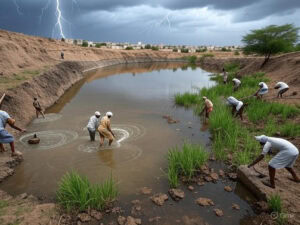
The extraordinary thing about Dholavira is that even without reading a single word of its inscriptions the archaeological evidence of the city itself tells a story of extraordinary sophistication.
Dholavira was a planned city of approximately 100 hectares divided into three distinct districts, a citadel, a middle town and a lower town, each separated by massive stone walls whose construction required an engineering capability of the highest order. Its water management system, a network of reservoirs, channels and drains that collected, stored and distributed rainwater across the city, is one of the most sophisticated hydraulic engineering achievements of the ancient world. The reservoirs of Dholavira could store enough water to sustain the city’s population through multiple years of drought.
The standardised weights and measures found at Dholavira, identical to those found at Harappa thousands of kilometres away, demonstrate the existence of a unified system of commercial regulation across the entire Indus Valley Civilisation, implying a level of political and administrative organisation that required some form of written communication to maintain.
The seals found at Dholavira, each bearing its distinctive animal image and its line of undeciphered script, were the instruments of that commercial regulation. They authenticated goods, identified traders and marked ownership or origin in a commercial system of extraordinary geographical reach. Reading them would not merely tell us what the people of Dholavira believed or how they governed themselves. It would tell us how the ancient world’s largest Bronze Age civilisation conducted its commerce across thousands of kilometres of land and sea trade routes.
Indus Valley Script Decipherment and the Three Competing Theories
The Dravidian Theory: Did the Indus People Speak an Ancestor of Tamil
The Dravidian hypothesis is the most widely supported theory among professional Indus script scholars and the position associated with the two most significant scholars in the field, Asko Parpola of Finland and the late Iravatham Mahadevan of India.
The Dravidian hypothesis proposes that the Indus script represents a language ancestral to the Dravidian language family, which today includes Tamil, Telugu, Kannada, Malayalam and several other South Indian languages. The evidence cited includes the geographical distribution of Dravidian languages in South India which suggests a historical displacement southward from a more northerly original range, specific sign sequences in the Indus corpus that can be given plausible readings as Dravidian words and the fish symbol in particular which appears to have both a phonetic value and a semantic connection to the Dravidian word for fish and star.
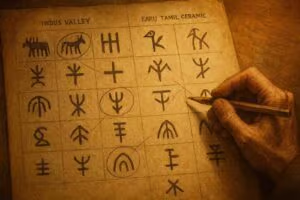
Recent studies have hinted at the script having a connection with Tamil Nadu’s early graffiti markings. Researchers K. Rajan and R. Sivananthan compared over 14,000 ceramic sherds of Tamil Nadu and discovered similarities with the Indus script. According to them 60 percent of the signs showed a match suggesting a potential cultural contact between southern India and the Indus Valley.
Sixty percent sign similarity between the Indus script and early Tamil Nadu graffiti markings. This is a significant piece of evidence that has not been widely reported outside specialist circles and that carries genuinely important implications for the relationship between the Indus Valley Civilisation and the South Indian cultural tradition.
The Sanskrit Theory and Why It Is Controversial
The Sanskrit or proto-Vedic hypothesis, which holds that the Indus script represents an early form of Sanskrit or a language ancestral to Sanskrit, is the position associated with the Yajnadevam decipherment and with a number of other scholars working in the Indian nationalist historiographical tradition.
The controversy around this hypothesis is not primarily linguistic but historical. If the Indus Valley script represents Sanskrit it would imply that the Vedic tradition was already present in the Indus Valley Civilisation rather than arriving later with a migration from Central Asia. This would resolve one of the most contested questions in South Asian historiography in a specific direction that is politically significant to Hindu nationalist interpretation of Indian history.
The scholarly mainstream, represented by Parpola, Mahadevan and the majority of professional Indus script researchers, considers the Sanskrit hypothesis unlikely on linguistic and archaeological grounds. The AI and machine learning research of recent years has tended to support the view that the script represents a language with structural characteristics consistent with Dravidian rather than Indo-Aryan phonology.
The honest position as of 2026 is that neither hypothesis has been definitively proved and the prize of one million dollars remains unclaimed, which is itself the clearest possible evidence that no decipherment has yet achieved the level of scholarly consensus necessary to be considered definitive.
The Non-Linguistic Theory: What If the Indus Script Is Not a Language at All
A third position, held by a minority of scholars including the computational linguist Steve Farmer, is that the Indus script may not be a linguistic writing system at all but a system of non-linguistic symbols used for religious, administrative or identification purposes without encoding the sounds of any spoken language.
The evidence for this position includes the extreme brevity of the inscriptions, the absence of the statistical characteristics of natural language that computational analysis has identified in every confirmed writing system and the apparent absence of long texts of the kind that would be expected from a civilisation sophisticated enough to have used writing for administrative purposes.
The counter-evidence is equally strong. The sign sequences show the conditional entropy and sequential dependency patterns that are characteristic of natural language. The distribution of signs follows Zipf’s law, the statistical pattern observed in all natural languages. And the sheer commercial sophistication of the Indus Valley trade network makes it extremely difficult to understand how its merchants maintained quality control, authenticated goods and conducted long-distance commerce without some form of written communication.
The debate continues. The prize awaits. And the seals in the museums are still not speaking.
Experience the Indus Valley Heritage With 5 Senses Tours
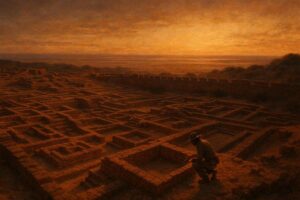
Dholavira: Standing in the City Where the Most Important Indus Inscription Was Found
The UNESCO World Heritage city of Dholavira on the island of Khadir in the Rann of Kutch in Gujarat is the most complete and the most dramatically preserved of the major Indus Valley Civilisation sites accessible to international tourists. Its urban layout, its water management system, its city walls and its remarkable collection of artefacts including the fragments of the famous signboard inscription create a heritage experience of extraordinary power for any visitor who arrives with the complete story of what was built here and what is still being decoded from its ruins.
The journey to Dholavira itself is part of the extraordinary quality of the experience. The Rann of Kutch, the vast seasonal salt flat that surrounds the island of Khadir, is one of the most visually dramatic landscapes in India. Arriving at the ruins of a city that was built four thousand years ago across a landscape of such otherworldly beauty creates a sense of temporal dislocation that no amount of museum-visiting can replicate.
Our Dholavira tour takes you to this extraordinary UNESCO World Heritage site with expert cultural guides who bring the complete story of the Indus Valley Civilisation, the decipherment challenge and the specific significance of the Dholavira signboard inscription to life at the exact place where it was found. The gateway where the sign once stood. The reservoirs that represent one of the most sophisticated hydraulic engineering systems of the ancient world. The streets of a planned city built when the ancestors of those who built it were already trading with Mesopotamia across the Arabian Sea.
Lothal: The Ancient Port That Connected the Indus Valley to the World
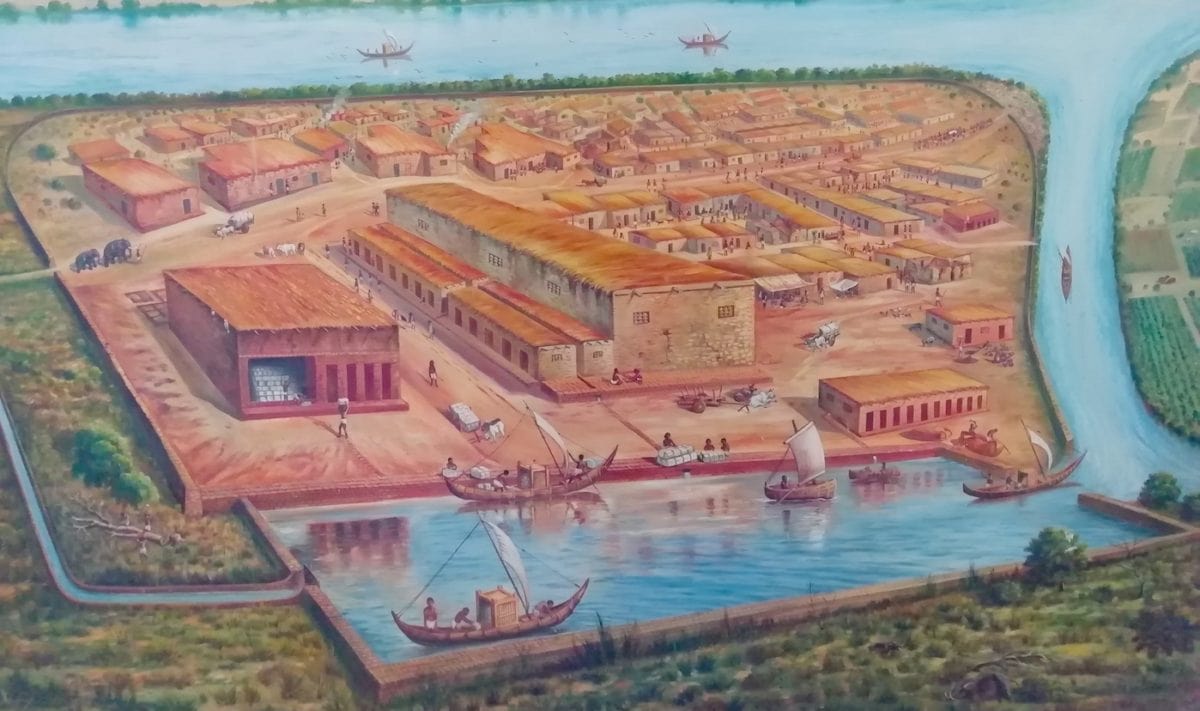
Our Lothal tour covers the ancient Indus Valley port city near Ahmedabad whose dry dock, the world’s earliest known, demonstrates the maritime engineering capability that made the Indus Valley Civilisation’s extraordinary long-distance trade network possible.
Lothal is where the Indus Valley script appears on trade seals that were used to authenticate goods moving between the Indus Valley and the ports of Mesopotamia and the Persian Gulf. The seals found at Lothal are among the most commercially significant in the entire Indus corpus because they were found in a port context, their function as commercial authentication devices is clear even without reading their text and the goods they were attached to have been identified through archaeological evidence.
Standing at the ancient dock at Lothal and holding in your imagination the image of a merchant pressing a carved steatite seal into a clay tablet to authenticate a cargo of cotton or carnelian beads being loaded onto a boat bound for the Persian Gulf four thousand years ago, you are standing at the origin point of the commercial tradition that the Indus Valley Civilisation invented and that the world is still practising today.
The text on that merchant’s seal is still unread. But the dock is still there.
Our Ahmedabad tours hub covers the complete Gujarat heritage circuit connecting Dholavira and Lothal to the UNESCO World Heritage pols of Ahmedabad, the extraordinary stepwell at Rani ki Vav in Patan and the complete heritage of one of India’s most historically layered states.
The Complete Indus Valley Heritage Journey With 5 Senses Tours
For travellers who want to experience the complete arc of the Indus Valley Civilisation heritage in India, 5 Senses Tours can create a customised private journey that covers both the Gujarat sites of Dholavira and Lothal and the broader archaeological heritage of the ancient civilisation across northern India.
The Gujarat section covers the UNESCO World Heritage city of Dholavira where the most important Indus inscription was found, the ancient port of Lothal where Indus trade seals have been found in their commercial context and the complete Ahmedabad heritage circuit. Our Ahmedabad tours hub provides the starting point for the complete Gujarat Indus Valley experience.
5 Senses Tours is recognised by India’s Ministry of Tourism, winner of the Tripadvisor Travellers Choice Award and the Outlook Responsible Tourism Award. Every tour is private, expert-guided and completely customised for your group.
Talk to a 5 Senses Tours expert about your Indus Valley heritage experience today. Contact us and we will build the journey around your specific interests, travel dates and time available.
Contact 5 Senses Tours to begin planning your Indus Valley heritage journey today