
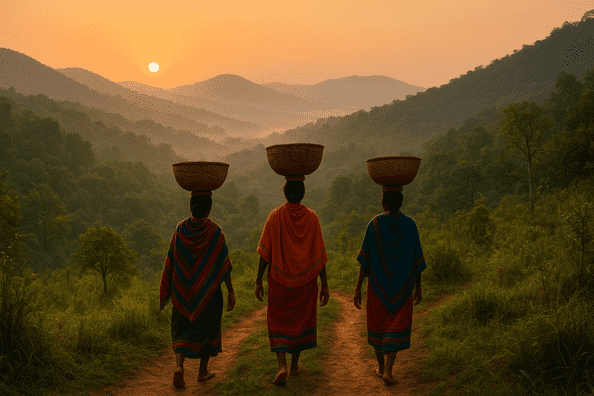
Long before cities rose and trains crossed the plains, people here lived by the rhythm of wind and drum. In Odisha, that rhythm endures. The state’s lush southern hills and northern forests are home to over 60 tribal communities, each carrying a language, faith, and art that reaches back thousands of years. Nearly a quarter of Odisha’s population belongs to these indigenous groups — making it one of India’s most culturally alive destinations.
This is not a museum of the past. It is a world still humming with ancestral music, a world that travellers can step into — gently, respectfully, and with wonder.
The Living Tribes of the Hills
The Dongria Kondh — Guardians of Niyamgiri
In the misty folds of the Niyamgiri Hills, the Dongria Kondh live in near-mystical communion with the land they call sacred. Their name means “people of the streams.” They believe the mountain is their ancestor, and to cut its forests would be to wound their lineage. Visitors can meet them at the Chatikona weekly market (Rayagada), where they come to trade forest produce and handmade goods. Access to their villages is restricted, but the haat offers a glimpse into their enduring traditions — bright shawls, intricate jewellery, and fierce pride in self-sufficiency.
The Bonda — The Matriarchs of Bondaghati
In Malkangiri district, high in the hills, live the Bonda people — one of India’s oldest and most independent tribes. Women here rule trade, wear bright orange beads, and shave their heads as a mark of freedom. Travellers can meet Bonda women at the Onukadelli Thursday market, a sensory whirl of barter and colour. Entry to their villages, however, is protected — these are Particularly Vulnerable Tribal Groups (PVTGs), and respectful distance is essential.
The Saora — Painters of the Invisible
Further east, in the Gajapati and Rayagada districts, live the Saora (Soura) people — artists who paint their prayers. Their Ittal murals, made with rice paste on mud walls, are both art and scripture — mapping births, harvests, and ancestors. Some Saora villages welcome visitors for workshops and homestays, where guests can learn mural-making directly from community artists.
The Gadaba — Dancers of the Earth
Near Koraput and Nandapur, the Gadaba people invite travellers into a world of music and movement. The Dhemsa dance, performed in circles under the moonlight, expresses harmony with nature — men and women moving together like rippling grain in wind. Visitors can join community stays through programs like Desia Ecoverse, which support local income while offering a cultural exchange few forget.
The Santhal and Juang — Voices of the Forest
In northern Odisha, around Mayurbhanj and Keonjhar, live the Santhal and Juang tribes — agriculturalists, singers, and storytellers. Travellers can visit villages near Similipal National Park, where community tourism blends with wildlife safaris. During the Karam festival, held after harvest, the forests echo with drumming, dance, and song that celebrate fertility and the forest spirit.
Festivals of Fire and Faith
Time your visit to coincide with Chaitra Parab (March–April), a festival of renewal when tribal villages across the south burst into celebration — drums, feasts, and ritual dances thanking the earth for her bounty. Another marvel is Danda Nata, an ancient dance-drama that merges devotion and discipline; its origins are pre-Hindu, yet it continues with full vigor today.
Art, Craft, and the Poetry of Hands
Odisha’s tribal art is not just ornamental — it’s philosophical. The Dhokra metalwork of the Kondh and Santal tribes uses the lost-wax casting method to create brass figurines of deities, animals, and dancers. The Saora murals have evolved from sacred walls to global galleries. Travellers can see and buy these crafts at tribal haats in Koraput, Nabarangpur, and Rayagada — each a marketplace of tradition, rhythm, and humanity.
Meeting the Tribes: Responsible Encounters
Odisha’s government and local NGOs have built sensitive routes that allow visitors to connect ethically with tribal communities. These tours are guided, small-scale, and community-led. Key options include:
- Rayagada – Koraput – Malkangiri circuit: Visit Dongria Kondh, Bonda, Saora, and Gadaba markets.
- Mayurbhanj – Keonjhar circuit: Visit Santhal and Juang villages, with Similipal forest excursions.
Visitors should begin at the Odisha State Tribal Museum in Bhubaneswar, an excellent primer on history, rituals, and art. From there, overnight trains or flights to Koraput and Rayagada open the gateway to the southern hills.
Photography is allowed only with consent. Gifts or charity are discouraged — buying local crafts, attending dances, and staying in homestays are far more meaningful ways to contribute.
Why the World Should Come
Odisha’s tribal belt is not just India’s heritage — it’s humanity’s mirror. In an age of climate anxiety and cultural amnesia, these communities remind us of something forgotten: how to live with nature, not against it.
Come here to walk ancient paths, to listen to stories older than empires, to witness a way of life that measures wealth not in gold, but in belonging.
In Odisha, the earth still sings — in the footsteps of the Dongria on the mountain, in the laughter of the Saora artists, and in the quiet wisdom of forest elders who have never needed to be taught sustainability.
Leave a Reply