

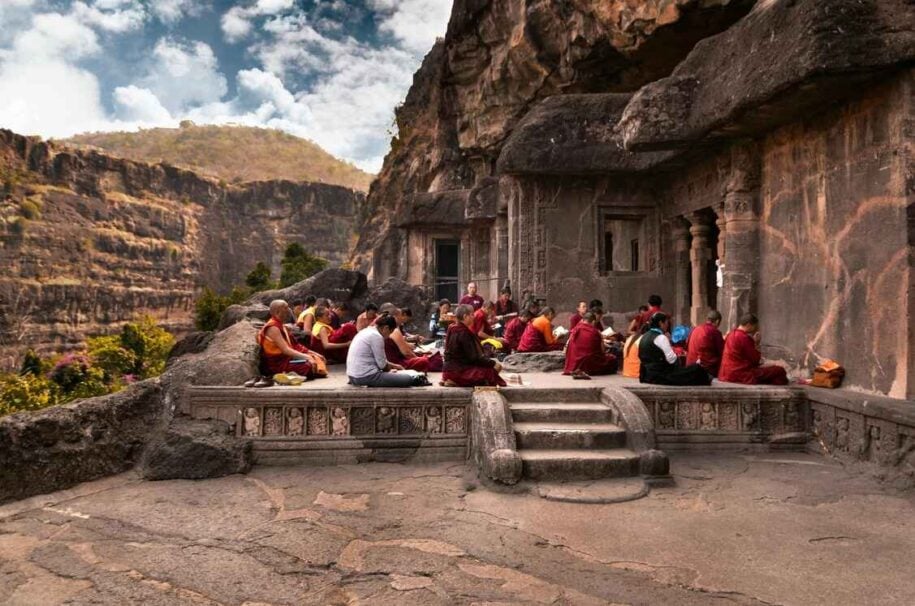
Kailasa Temple will Leave You Speechless
Imagine a monument so grand, so intricately detailed, and so utterly unique that it defies conventional understanding of human capability. A structure nearly as large as the Taj Mahal, yet built a thousand years earlier. But here’s the mind-blowing twist: it wasn’t built up from the ground, but carved downwards from a single, massive hill of solid rock. This isn’t a fantasy; it’s the Kailasa Temple (Cave 16) at Ellora, India, an undisputed crescendo in an epic symphony of stone.
Are you ready to dive into the mystery of how ancient hands sculpted a mountain into a masterpiece?
Vision from Solid Rock
Nestled in the Deccan Plateau, near Aurangabad, Maharashtra, the Ellora Caves are more than just caves; they are colossal temples, monasteries, and chapels meticulously carved out of the living rock face. The Kailasa Temple is the largest monolithic structure in the world, literally sculpted from one enormous basalt rock.
Unlike traditional construction where materials are brought to the site, rock-cut architecture demands the removal of material. This meant that master sculptors and architects, likely part of an organized guild, had to visualize the entire structure—its intricate interior chambers, pillars, sculptures, and even drainage systems—within the solid rock before a single chisel strike. This extraordinary ability to “see” the finished temple by imagining what to subtract is a testament to their genius.
A Top-Down Miracle
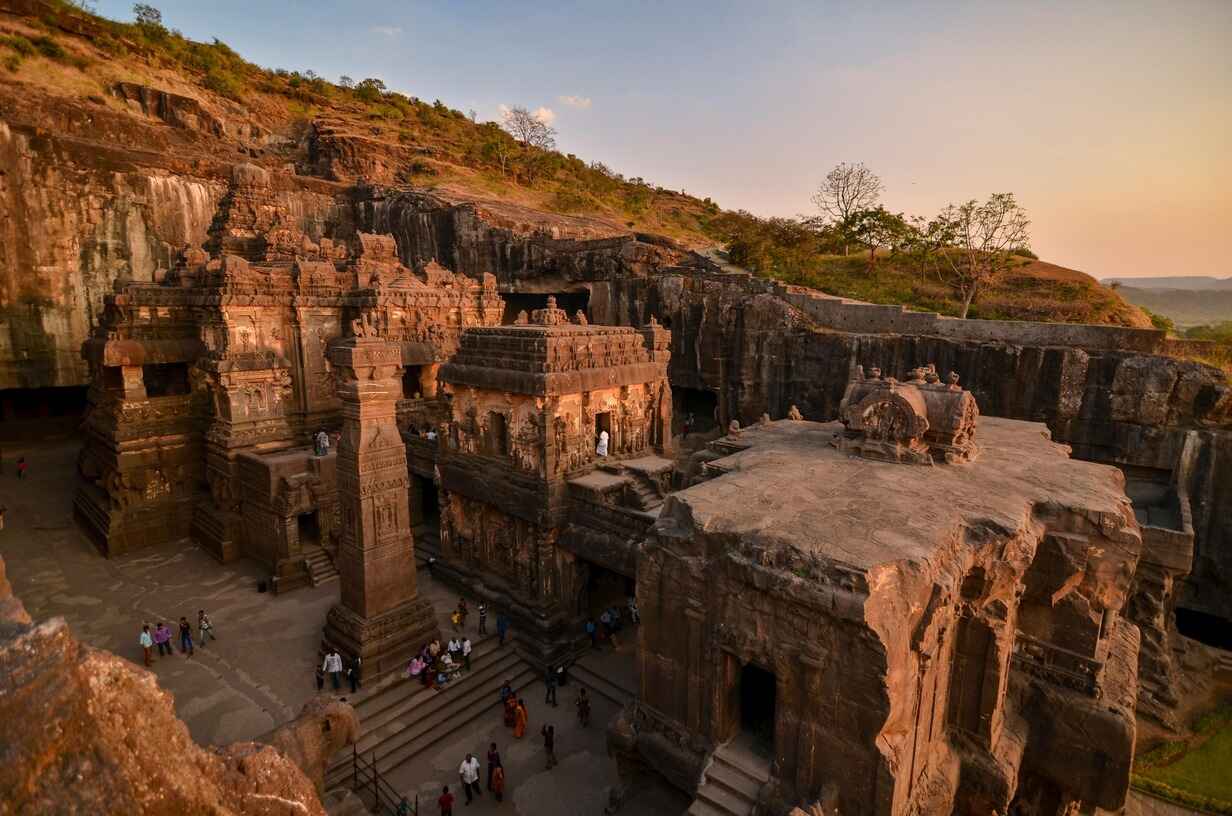
The construction of Ellora spanned roughly five centuries, from the 6th to the 10th century CE. This long duration allowed for the evolution of styles, techniques, and religious patronage, resulting in an eclectic mix of structures. The ambitious Hindu period, particularly under the Rashtrakuta dynasty, culminated in wonders like Kailasa. The chosen site at Ellora offered a long, gentle slope of horizontal basaltic rock, laid down by ancient volcanic eruptions, providing ample vertical and horizontal space perfect for extensive excavation.
But how did they carve a multi-storied temple out of a mountain? The answer lies in a revolutionary technique: the top-down (or outside-in) method. Instead of building upwards from a foundation, the artisans started at the summit of the rock and worked their way down, layer by painstaking layer.
This wasn’t just ingenious; it was strategic:
•Gravity was their ally: Excavated material naturally fell away, making debris removal more efficient. Loose debris would naturally fall away from the working face.
•Structural integrity: By carving from the top, the structural integrity of upper sections could be maintained throughout the process. There was no need to worry about supporting incomplete structures from below.
•Protection from elements: By creating the roof first, completed lower sections were shielded from rain and weathering during the centuries-long construction period. This was critical for preserving the intricate details as they were carved.
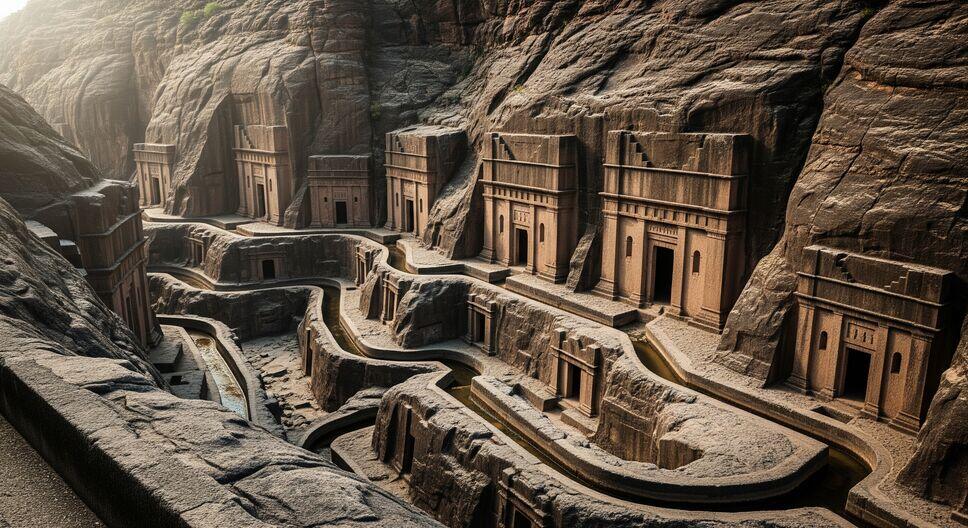
•Integrated drainage: Complex drainage systems were planned and carved from the outset, ensuring water runoff was managed away from the temple structure.
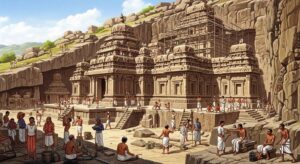
The process would have begun with the careful marking of the temple’s outline on the top surface of the basaltic hill. Then, deep trenches would be cut around this outline, isolating a massive, rectangular block of rock that would eventually become the Kailasa Temple. This initial “scooping out” created the outer courtyard and the space around the main temple.
From there, sculptors meticulously carved downwards, creating the roof, then working through the stories—the shikhara (spire), mandapas (halls), plinth, and elaborate base sculptures. Simultaneously, interior elements like pillars, walls, and the cella (sanctum sanctorum) would be excavated within the colossal block, always working from the top down.
The tools used were surprisingly rudimentary: hardened iron chisels, hammers/mallets, picks, levers, and wedges. Baskets and sledges were used for removing the enormous quantities of excavated debris. Yet, with these simple tools, they achieved incredible precision and artistic flair. It’s estimated that Kailasa Temple alone involved the removal of approximately 200,000 tons of basalt rock. This wasn’t just about hacking away; it was a methodical process of breaking, clearing, and shaping. And here’s one of the biggest mysteries: nobody knows where all that rock went; it’s as if it simply disappeared! Imagine the monumental task of breaking, clearing, and shaping, without the luxury of making even one mistake, as you can’t add rock back once it’s removed.
The Hands That Shaped Eternity
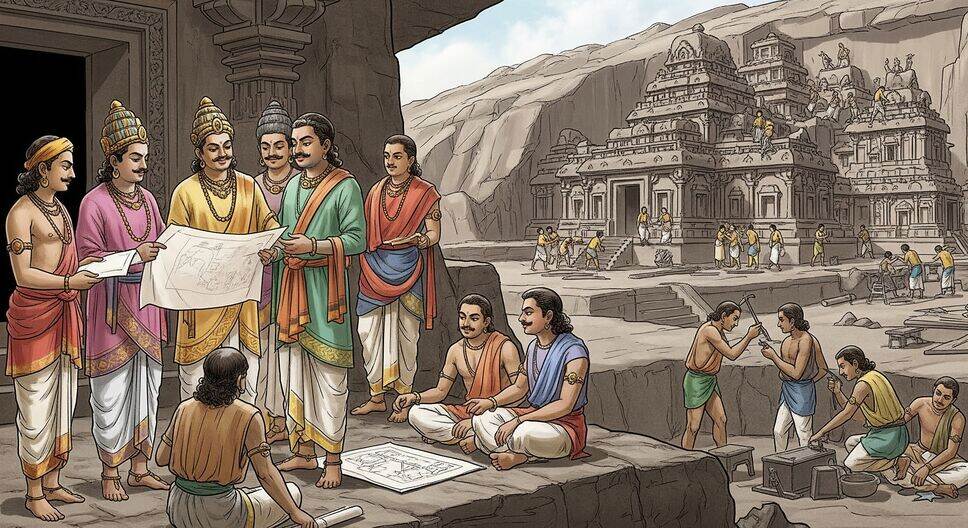
Such a colossal undertaking demanded a massive, diverse workforce. Visionary Master Architects/Sculptors (Sthapatis) planned the layout and oversaw the project, possessing profound knowledge of geology, engineering, and religious iconography. Skilled Stone Carvers (Shilpins) translated designs into stone, wielding chisels and hammers with incredible precision and artistic flair, specializing in everything from large-scale excavation to intricate sculptures and decorative motifs. A large labor force handled debris removal, transporting water and food, maintaining tools, and providing general support.
The Rashtrakuta kings, particularly Krishna I (c. 756–773 CE), are credited with commissioning and funding the Kailasa Temple, driven by deep religious devotion to Lord Shiva and a desire to showcase their power and piety. Inscriptions confirm his patronage, stating that it was built “by the king Krishna-raja… by a work of art so wonderful that the very gods… might be brought to declare themselves excelled.” While some historians believe its marvelous beauty suggests it might have been a multi-generational project starting under Raja Danti Durga’s reign, as such a masterpiece could not have been built under a single king’s reign, the common belief, at least according to some, is that it was completed in a mere 18 years.
For immersive culture walks in India, please visit 5 Senses Walks.
Artistic and Engineering Brilliance
The Ellora caves are more than just large; they are a showcase of incredible mastery:
•Precision and Symmetry: Despite the challenging medium of rock, the structures exhibit remarkable precision, symmetry, and alignment. The pillars are uniformly spaced, the halls are proportionate, and the sculptures are balanced within their architectural settings. This required constant measurement and careful planning.
•Iconographic Detail: The sculptures at Ellora are integral to religious narratives, depicting a rich pantheon of Hindu deities (Shiva, Vishnu, Durga), Buddhist iconography (Buddhas, Bodhisattvas), and Jain Tirthankaras. The level of detail, from the expressions on the faces to the folds of drapery and the intricate jewelry, is astonishing. It features carvings of epic tales like the Ramayana and Mahabharata, along with depictions of deities, celestial beings, and legendary creatures. The carved elephants at the base of Kailasa, appearing to carry the temple, beautifully symbolize how these majestic creatures hold the structure on their backs, an elegant and load-bearing illusion.
•Light Management: The architects understood the play of light and shadow within the rock-cut spaces, expertly using skylights and strategically placed openings to illuminate key shrines and sculptures, creating dramatic effects throughout the day.
•Water Management: Elaborate drainage channels were carved into the rock to divert rainwater away from the temple complex, protecting the structures from erosion and water damage. This foresight was crucial for the long-term preservation of the caves.
•Mimicry of Structural Architecture: What makes Ellora truly unique is its ability to mimic freestanding structural temples. The Kailasa Temple astonishingly replicates every element of a built temple—the plinth, the walls, the pillars, the multi-storied shikhara, the sculpted elephants at the base—all carved from a single piece of rock. This demonstrates a conceptual leap, where rock-cut architecture transcended its limitations to imitate masonry construction.
•Cosmic Alignment: The design and orientation of the temple were based on Vastu Shastra and astronomy principles, carefully planned for spiritual and cosmic energy balance. From the temple’s alignment to its carvings, everything was carefully planned.
An Enduring Legacy and Unanswered Questions
The immense effort behind Ellora was driven by deep religious piety, a display of royal power and wealth, and a canvas for unparalleled artistic expression. Building temples was seen as an act of great merit, ensuring spiritual rewards. The co-existence of three major religions at Ellora underscores India’s historical tradition of religious tolerance and syncretism. It also served as a center for worship, meditation, and pilgrimage, attracting pilgrims from far and wide.
But even today, the Kailasa Temple holds mysteries that continue to fascinate. How was such precision maintained over vast excavations without modern tools? What kind of scaffolding, if any, was used within the carved spaces? And that enduring question: where did the 200,000 tons of removed rock go? Some even theorized, especially in the colonial era when it was difficult for Westerners to believe ancient Indians could achieve such feats, that it was the work of aliens, a theory often considered nonsense.
The temple’s resilience is legendary. In 1682, the Mughal emperor Aurangzeb sent a thousand soldiers to destroy it. For three whole years, they tried, but could barely make a dent in the main structure, only managing to damage a few sculptures here and there. The temple, carved from the heart of the mountain, simply refused to yield. It’s almost as if the temple was built to survive everything: time, erosion, natural calamities, and even human aggression. It stands as a symbol of strength, determination, and the unparalleled brilliance of ancient Indian engineering, faith, devotion, and their belief in their gods. It’s a reminder of the genius, resilience, and creativity of our ancestors.
Experience Kailasa temple for yourself
The Ellora Caves, a UNESCO World Heritage Site, are not just historical relics; they are living testaments to an extraordinary period of human endeavor, where vision, skill, and unwavering determination transformed a barren hillside into an enduring masterpiece of rock-cut architecture. They are more than just structures; they are an epic poem carved in stone, a symphony frozen in time, continuing to inspire awe and wonder in all who witness their magnificent grandeur. They challenge us to consider what’s possible when determination meets imagination.
Imagine standing before this monumental creation, feeling the cool stone, tracing the intricate carvings, and pondering the sheer audacity of its makers. This is more than a visit; it’s an immersive journey into ancient India’s soul.

Don’t just read about it. Come and witness this epic symphony in stone! While you’re there, be sure to also visit the nearby Ajanta Caves, another stunning collection of rock-cut Buddhist cave monuments that will complete your journey through ancient Indian art and history. Your eyes will not believe what they behold!
For a guided tour of Kailasa temple, visit Ellora Tours
For planning tips to visit India, please visit India Travel Planning.
Kumbhalgarh Fort Travel Guide: History, the Great Wall of India & How to Visit
Kumbhalgarh Fort stands as one of Rajasthan’s most impressive UNESCO World Heritage Sites, famous for housing the second-longest wall in the world after China’s Great Wall. This Kumbhalgarh travel guide is perfect for history buffs, adventure seekers, and anyone planning … Read More

Sikkim Travel Guide: Villages, Monasteries & Hidden Himalayan Experiences
Explore the best of Sikkim — hidden villages, monastery heritage, organic farms, and Himalayan landscapes. A complete travel guide for meaningful journeys. … Read More

Lucknow Heritage Tour: Discover the Hidden Gem of India’s Nawabi Splendor
Explore the best Lucknow Heritage Tour covering Bara Imambara, Rumi Darwaza, Nawabi cuisine, Chikankari craft, and colonial landmarks. … Read More

Leave a Reply