
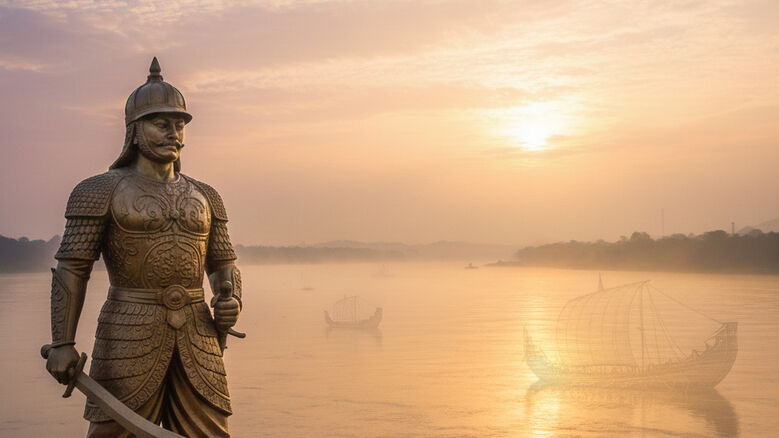
Some stories cling to a landscape the way mist clings to the Brahmaputra at sunrise. Lachit Borphukan’s story is one of them. When travellers step into Assam, they are not just entering its forests, temples, and wildlife sanctuaries—they are walking into the world of a commander whose courage shaped an entire region’s identity and still echoes through its culture.
Lachit Borphukan was the Ahom general who, in 1671, led the legendary defence of Assam at the Battle of Saraighat. But his story becomes far richer when you look beyond that final, dramatic clash. The Ahom chronicles—the Buranjis—show that Lachit’s leadership took shape long before he ever stepped onto a battlefield. He served early in his career as the Solal Gohain, responsible for the royal stables and palace security. It sounds mundane, but it reveals the Ahom philosophy: a leader must master discipline in detail before commanding men in war. Lachit’s eye for organisation, timing, logistics, and responsibility grew from these early roles.

His rise came during a restless moment in Assamese history, when Mughal pressure was tightening. What sets Lachit apart is not simply his eventual victory, but the steel of character he displayed along the way. The chronicles tell of a moment—retold for generations—when he punished his own uncle for delaying fortification work. Whether one views this as literal or symbolic, the story has survived because it captured the essence of the man: the land comes before personal ties, and duty comes before comfort.
As the Mughal forces advanced toward Assam, Lachit embarked on an extraordinary study of the Brahmaputra. Instead of brute strength, he relied on knowledge. He mapped the river’s curves, its shifting sandbars, its quiet backwaters. Modern historians often highlight this as an early example of theatre-specific military science—understanding not just an enemy, but the natural system in which a battle would unfold. The Brahmaputra became his ally. Narrow channels, sudden currents, morning fog—these became tools in his hands. He designed feints, ambushes, and sudden manoeuvres that confused a much larger force. At Saraighat, the river was not a battleground; it was a strategy.
Even during the final stage of the battle, when illness strained his body, Lachit insisted on being carried into the middle of the fighting. It wasn’t reckless bravado. It was a psychological strike. A feverish general fighting on the prow of a boat transforms soldiers into something more than a regiment; they become the fierce embodiment of their homeland. And that day, they did. The Mughal advance collapsed, and Assam remained unconquered.

Lachit didn’t merely win a war; he safeguarded a civilisation with a distinct script, its own scientific practices, its own chronicles, and a highly developed system of governance. Travellers following his story aren’t just learning about a warrior—they are stepping into the heart of Assamese identity.
Today, echoes of Lachit’s presence ripple through the landscape. At the Lachit Borphukan Maidam in Jorhat, the quiet earth holds the memory of the general who refused to surrender. In Guwahati, statues of Lachit stand watch near the river, while the Saraighat Bridge stretches across the very waters where his fleet once fought. The Assam State Museum adds depth, displaying manuscripts, weapons, metalwork, and other cultural artefacts that reveal the richness of the Ahom world he defended.

Exploring Lachit’s legacy is a journey into Assam itself. And that journey expands naturally into the living culture and natural splendour surrounding Guwahati.
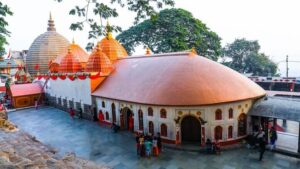
From the historic riverbanks, travellers rise toward Kamakhya Temple, perched on Nilachal Hill. This ancient shrine—rooted in centuries of tantric tradition, archaeological clues, and sacred texts—feels like entering a world where myth and meaning intertwine. The temple’s rituals, chants, and incense-filled chambers create a sensory immersion that travellers remember long after they leave. The view from the hill—boats dotting the Brahmaputra, the city spread along its bend—feels like a bridge between Lachit’s time and today.
The trail then leads to Mayong, a village whose folklore has long woven tales of mystics, healers, and arcane knowledge. Historical references to Mayong’s “magick” appear in colonial-era documentation and local manuscripts, but the village’s true charm lies in its living culture: oral storytelling, traditional healing practices, manuscripts of old charms, and a rural rhythm that invites slow, curious exploration.

And then the wild heart of Assam begins to beat. Pobitora Wildlife Sanctuary, famous for having one of the highest concentrations of the great one-horned rhinoceros, offers a close, almost tender introduction to a species that survived through science-driven conservation and community protection. The grasslands shimmer with birdlife, and the wetlands teem with creatures that turn every jeep ride into an ecological story.

Farther out, the legendary Kaziranga National Park, a UNESCO World Heritage Site, unfolds like a natural epic. Elephants move in solemn processions. Rhinos graze calmly. Wetlands echo with the honking of geese and the heavy wingbeats of hornbills. Decades of ecological studies—from early 20th century forest records to modern biodiversity surveys—affirm Kaziranga’s status as one of the world’s richest wildlife refuges.

To connect these worlds—Lachit’s battlefield, Kamakhya’s mystic hill, Mayong’s folklore, Pobitora’s grasslands, and Kaziranga’s sweeping wilderness—travellers need more than simple transport. They need storytelling, context, and someone to reveal the threads that bind Assam’s past and present. Through private guided experiences with 5 Senses Tours, visitors can journey through these landscapes as unfolding chapters of one interconnected narrative. Each stop becomes an experience of sensation: temple bells ringing across the hills, the thrum of wildlife in tall grass, river winds brushing past monuments of history.
Leave a Reply