
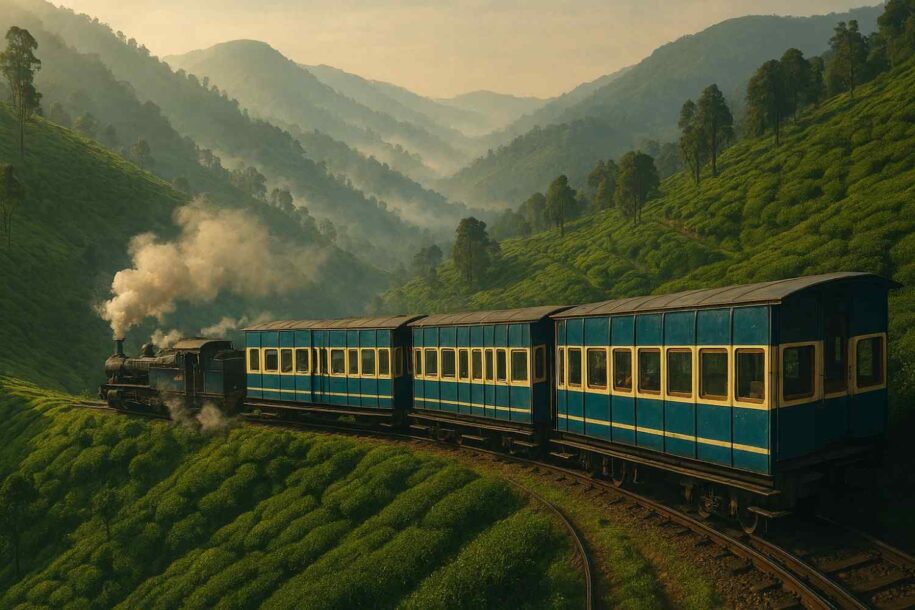
In 1854 a British engineer looked up at the Nilgiri Hills and proposed building a railway to the top.
His superiors said no.
He proposed it again. They said no again. He proposed it a third time. No. A fourth time. No. For forty-five years, through multiple proposals, multiple engineers, multiple surveys and multiple committees, the answer was always some version of no. The gradients were too steep. The terrain was too difficult. The engineering challenge was too great.
In 1899 the first train finally climbed from Mettupalayam at the base of the hills to Coonoor in the Blue Mountains above.
The engine that pulled it was Swiss. The mechanism that made it possible, a toothed rack between the rails that engages with a pinion gear on the locomotive to haul the train up gradients that would cause a conventional train to slide helplessly back down the hill, was a piece of Victorian engineering so elegant and so completely effective that it is still being used today. Unchanged. On the same tracks. Through the same sixteen tunnels and across the same 257 bridges.
One hundred and twenty-seven years later the Nilgiri Mountain Railway is a UNESCO World Heritage Site, the only rack-and-pinion railway in India, the steepest railway in Asia and one of the most extraordinary travel experiences available anywhere in the subcontinent.
And if you are travelling through South India without riding it, you are missing something genuinely irreplaceable.
Nilgiri Mountain Railway Tour: The Extraordinary Engineering Story Behind the World’s Most Scenic Hill Railway
Why the Nilgiri Mountain Railway Took 45 Years to Build
The story of the Nilgiri Mountain Railway begins not with an engineer but with a problem.
The British colonial administration of the Madras Presidency had established their summer capital at Ooty, or Udhagamandalam, in the Nilgiri Hills at 2203 metres above sea level. This was entirely sensible. The Nilgiri Hills in summer are cool, green and extraordinarily beautiful, everything that the baking plains of the Madras Presidency are not. The problem was getting there.
The road from the plains to the hills was a gruelling multi-day journey by bullock cart or palanquin through forests that were significantly more challenging and significantly more dangerous than they are today. The British administration needed a faster and more comfortable connection between their seasonal capital in the hills and their permanent administration on the plains.
In 1854 John Sullivan, who had first brought the hills to the attention of the British administration in 1819, proposed a railway. The engineering challenge was immediately apparent. The Nilgiri Hills rise from 326 metres at Mettupalayam to 2203 metres at Ooty over a distance of just 46 kilometres. That is an elevation gain of approximately 1877 metres in less than 50 kilometres. The gradients required to achieve this climb, reaching a maximum of 8.33 percent on the steepest section between Mettupalayam and Coonoor, are far beyond the capability of any conventional adhesion railway where the locomotive simply pushes its drive wheels against the rail surface.
The answer, when it finally came after four decades of proposals and rejections, was the rack-and-pinion system pioneered by the Swiss engineer Roman Abt. Between the conventional rails of the track a third rail, a toothed rack, was laid along the full length of the steepest section. The locomotive was fitted with a matching pinion gear that engages with the teeth of the rack, giving the engine a positive mechanical grip on the track that cannot slip regardless of the gradient.
The Abt system had been used successfully on mountain railways in Switzerland. Nobody had tried it on quite this scale, in quite this terrain, in quite this climate. The British engineers who finally began construction in the 1890s were doing something genuinely new.
The Nilgiri Mountain Railway line was constructed and opened in phases. The Mettupalayam to Coonoor section opened on June 15, 1899, and the Coonoor to Fernhill section opened on September 15, 1908.
The steam locomotives that were ordered to haul the trains up this extraordinary gradient were built in Switzerland, specifically designed for the Abt rack system and the specific conditions of the Nilgiri Hills. They arrived in India, were assembled at Mettupalayam and began climbing the hills that four decades of British engineers had insisted could not be climbed by rail.
They were wrong about the impossibility. They were right about the difficulty. And the result of that difficulty, the extraordinary engineering achievement of sixteen tunnels, 257 bridges, 209 curves and 46 kilometres of track that climbs nearly two kilometres in elevation while winding through some of the most beautiful landscape in South India, is what you experience when you ride the Nilgiri Mountain Railway today.
The Swiss Locomotives That Still Haul the Steepest Section Today

Here is the detail about the Nilgiri Mountain Railway that stops most visitors when they hear it.
The steam locomotives that haul the trains on the steepest section between Mettupalayam and Coonoor today are not replicas. They are not restored antiques displayed for tourist nostalgia. They are working machines of the same design as the original Swiss locomotives, still performing the same engineering task they were designed for in the 1890s, on the same track, through the same tunnels, across the same bridges.
The Nilgiri Mountain Railway has retained much of its original components including stations, semaphore signal systems, locomotives and rolling stock, making it a rare system of heritage value that is still operational.
When you board the Nilgiri Mountain Railway at Mettupalayam in the early morning and feel the distinctive lurching engagement of the rack-and-pinion mechanism as the train begins its climb, you are experiencing exactly what every passenger on this railway has experienced since 1899. The sound is the same. The sensation is the same. The view of the Nilgiri Hills opening up around you as the train climbs is the same.
This is not a museum exhibit. It is a living piece of Victorian engineering still doing exactly what it was built to do.
In 2005, UNESCO declared the railway as a World Heritage Site as an extension to the Darjeeling Himalayan Railway. It has since then been part of the greater heritage site of the Mountain Railways in India.
The UNESCO designation was not for sentimental reasons. It was because the Nilgiri Mountain Railway represents something genuinely rare in the modern world. An original piece of 19th century engineering infrastructure, still operational, still serving its original purpose, still using its original technology, in a landscape of extraordinary natural beauty. There are almost no other examples of this anywhere on earth.
Riding the Nilgiri Mountain Railway Tour: What You Will Actually Experience
The Journey From Mettupalayam to Coonoor: The Most Extraordinary 27 Kilometres of Track in India
The most dramatic and most celebrated section of the Nilgiri Mountain Railway tour is the 27 kilometres from Mettupalayam at the base of the hills to Coonoor in the Blue Mountains above. This is the rack-and-pinion section. This is where the Swiss steam locomotives are in operation. And this is where the landscape changes so dramatically, so completely and so continuously that stopping to photograph any single view means missing the next one before you have put your camera down.
The train departs Mettupalayam at 7:10 am. At this hour the Nilgiri Hills are draped in morning mist, the forest canopy visible above the lower slopes and the distant peaks of the Blue Mountains barely distinguishable from the clouds above them. The temperature at Mettupalayam at this hour is already warm. By the time you reach Coonoor it will be fifteen degrees cooler.
For the first few kilometres the train moves through the agricultural landscape of the Mettupalayam valley, the flatlands of the plains still visible on either side. And then the gradient begins.
The rack-and-pinion engagement, when it happens, is unmistakable. A mechanical clunk from beneath the carriage. A change in the sound of the locomotive ahead. And then the angle of the carriage shifts and you are climbing. The landscape outside the window transforms within minutes. The agricultural flatlands give way to dense forest. The forest gives way to rocky gorges with waterfalls visible in the distance. The gorges give way to the extraordinary view of the Bhavani River valley far below, dropping away from the railway line with a drama that makes the height you have gained in a few minutes of travel genuinely astonishing.
The train covers a distance of 46 km while scaling an elevation from 326 m to 2203 m. The toy train, as it is fondly called, features quaint wooden coaches and large windows designed to provide an unabated view of the breathtaking surroundings.
The tunnels are completely dark. Not dimly lit. Completely, absolutely dark, the darkness of a mountain carved open by Victorian engineering a hundred years ago with no interior lighting installed because there was no electricity available when the tunnel was built. For a few seconds at a time you are in the dark, the sound of the steam locomotive echoing off the tunnel walls, and then the light returns and outside the window is something different from what you were looking at before.
The bridges are extraordinary. There are 16 tunnels, 257 bridges and 209 curves between Mettupalayam and Udagamandalam. Some bridges are short, spanning small ravines at modest heights. Others are long, spanning deep valleys with the forest floor visible far below through the gaps between the sleepers. On every bridge the sound of the train changes, the echo of the wheels on the rails reflecting off the valley walls in a way that makes the mechanical soundtrack of the journey as remarkable as its visual one.
Coonoor to Ooty: Where the Tea Gardens Begin
After Coonoor the character of the Nilgiri Mountain Railway tour changes completely. The rack section ends. The Swiss steam locomotive is replaced by a diesel engine. The dramatic gorges and forest tunnels of the lower section give way to the rolling tea-covered hillsides of the upper Nilgiris. And the train slows to what feels like a walking pace as it winds through a landscape of such extraordinary pastoral beauty that most passengers stop talking and simply look.
The tea gardens of the upper Nilgiris are visible from the train windows as an endless rolling green carpet covering every hillside in every direction. The occasional flash of colour from a tea picker’s sari visible between the rows of tea bushes. The smell of the tea, warm and slightly grassy, drifting through the open windows of the wooden carriages.
The section from the starting point Mettupalayam to the stop point Coonoor is considered the best section for viewing. You will pass through deep canyons, winding mountain roads and dense forests. When you arrive at Coonoor, a famous tea-producing area in India, the fragrance of tea fills the air.
The stations between Coonoor and Ooty have names that carry their own specific nostalgia for anyone who knows anything about the history of British India. Wellington, named after the Duke of Wellington who served in the Deccan before his European campaigns. Aruvankadul. Ketti, with its spectacular valley views. Lovedale, where the Lawrence School, one of India’s most famous boarding schools, has educated the children of Indian officers and civil servants since 1858.
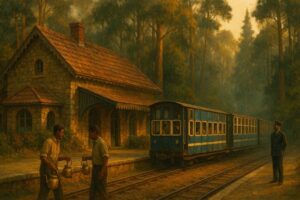
Each station is a small stone building in the British railway tradition, maintained in remarkably good condition for its age, with the station name painted in white on the platform wall. The train stops briefly at each one, a minute or two, long enough for passengers to buy tea from the platform vendors and exchange a few words with the stationmaster before the whistle blows and the journey continues.
The Chaiyya Chaiyya Connection: Why the Nilgiri Mountain Railway Is Famous Across Asia
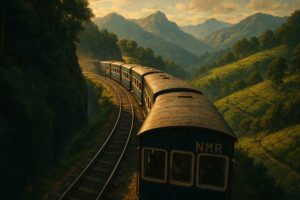
There is one more reason why the Nilgiri Mountain Railway is known to audiences who have never set foot in the Nilgiris and never consciously thought about visiting India.
In 1998 the Bollywood director Mani Ratnam filmed the opening sequence of his film Dil Se on the Nilgiri Mountain Railway. The sequence, in which the actor Shah Rukh Khan and the dancer Malaika Arora perform the song Chaiyya Chaiyya on the roof of a moving train through the Nilgiri Hills, became one of the most iconic images in Indian cinema history. The sequence was later recreated for the Hollywood film Inside Man, directed by Spike Lee.
Bollywood buffs may remember the iconic Chaiyya Chaiyya song from Dil Se, in which Shah Rukh Khan and Malaika Arora danced to the rhythm atop this heritage moving train.
The Nilgiri Hills visible through the carriage windows in that sequence are the same hills visible from the train today. The tea gardens, the tunnels, the dramatic gorges of the lower section, all of them are exactly as they appear in one of Bollywood’s most celebrated visual moments.
Nilgiri Mountain Railway Tour Practical Guide: Everything You Need to Know
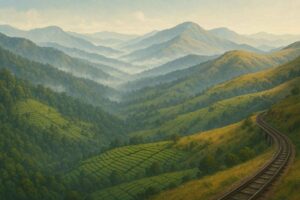
The Two Routes and Which One to Choose
The Nilgiri Mountain Railway operates on two distinct sections and the choice between them matters significantly for what kind of experience you are planning.
The full route from Mettupalayam to Ooty is 46 kilometres and takes approximately five hours. This is the complete Nilgiri Mountain Railway tour, covering both the dramatic rack-and-pinion steam section from Mettupalayam to Coonoor and the tea-garden diesel section from Coonoor to Ooty. The main train departs Mettupalayam at 7:10 am and reaches Ooty at approximately noon. The return train departs Ooty at 2:00 pm and reaches Mettupalayam by early evening.
The Coonoor to Ooty section is a shorter ride of approximately one hour covering the most scenically pastoral part of the journey through the tea gardens of the upper Nilgiris. Three pairs of trains operate between Coonoor and Ooty daily, making this section much easier to access without advance planning.
For travellers on our Nilgiris Blue Mountains tour from Bangalore, the Coonoor to Ooty section is included in the Day 3 itinerary. It is the most accessible and in many ways the most beautiful section of the complete journey, giving you the full tea garden experience in a manageable timeframe that fits within the day’s programme.
Booking Your Nilgiri Mountain Railway Ticket
Tickets for the Nilgiri Mountain Railway are in high demand. Book online months in advance, especially for the full Mettupalayam to Ooty route. For the best panoramic views of the Nilgiri hills, secure seats on the right side of the train when traveling uphill.
This is not a casual recommendation. The Nilgiri Mountain Railway carries a fixed number of passengers on each service and the full Mettupalayam to Ooty route regularly sells out weeks in advance during the October to March peak season and during school holidays. The Coonoor to Ooty section has more frequent services and is generally easier to book but still requires advance planning during peak periods.
Tickets are available through IRCTC, the Indian Railway Catering and Tourism Corporation website, which handles online booking for all Indian railway services. An account is required for online booking. Our Nilgiris Blue Mountains tour from Bangalore includes the railway experience as a subject to availability element of the Day 3 itinerary, with our guides making every effort to secure tickets in advance as part of the complete tour arrangement.
What to Bring and How to Maximise the Experience
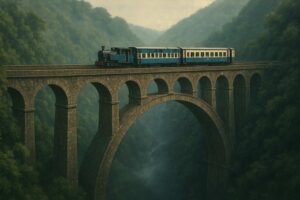
The Nilgiri Mountain Railway journey from Mettupalayam to Coonoor takes approximately three hours. Carry your own water and snacks as options on the train are limited to platform vendors at the intermediate stations.
The wooden carriages have large windows designed to provide unobstructed views but the windows can be difficult to open on some sections. Sitting on the right side of the train when travelling uphill from Mettupalayam toward Coonoor gives the best valley views on the most dramatic sections. A light jacket is essential as the temperature drops significantly as the train gains altitude, even on warm days.
Photography from the carriage windows is the default approach for most passengers. The tunnels, the bridges and the moments where the train rounds a curve and reveals a sudden panoramic view of the valley below are the highest-priority photographic moments. A camera with a fast shutter speed handles the movement of the train on the bridge sections most effectively.
The most extraordinary photographs are taken not from inside the carriages but from the platform of a small intermediate station, waiting as the train pulls in and captures the locomotive against the mountain backdrop. This requires getting off the train, which is only possible at stations where the stop is long enough, usually Hillgrove or Runnymede on the lower section.
Nilgiri Mountain Railway Tour and the 5 Senses Tours Blue Mountains Experience
 Why the Nilgiri Mountain Railway Is the Perfect Centrepiece of the Complete Blue Mountains Tour
 Why the Nilgiri Mountain Railway Is the Perfect Centrepiece of the Complete Blue Mountains Tour
The Nilgiri Mountain Railway does something that no other single experience on the Blue Mountains itinerary does. It connects the landscapes.
In four days of the Nilgiris Blue Mountains tour from Bangalore you move through four completely distinct environments. The dry deciduous forest of Bandipur at 800 metres. The transition forest of the lower Nilgiris. The mist-covered tea estates of Coonoor at 1800 metres. And the open montane grasslands of the upper Nilgiris above 2000 metres.
The Nilgiri Mountain Railway travels through all of these environments in a single journey, making the vertical and ecological geography of the Blue Mountains physically comprehensible in a way that driving the road never quite achieves. On the road the landscape change is gradual and the forest obscures the view. On the train the change is visible and the open carriages frame it continuously.
When you have spent the previous two days at Bandipur watching elephants in the forest at 800 metres and waking up at Coonoor in a tea estate at 1800 metres, the train journey between these two worlds makes the extraordinary ecological range of the Nilgiris Blue Mountains immediately and viscerally comprehensible. You are not simply riding a train. You are understanding a landscape.
Book Your Nilgiris Blue Mountains Tour
Our Nilgiris Blue Mountains tour from Bangalore includes the Nilgiri Mountain Railway experience on Day 3 as part of a four-day journey that covers Bandipur Tiger Reserve, Coonoor tea plantations, the Toda tribal village and the Mysore Palace.
Book your Nilgiris Blue Mountains tour including the Nilgiri Mountain Railway with 5 Senses Tours today
Our Mysore Silk Tour from Bangalore combines the royal heritage of Mysore with the living craft traditions of Karnataka and pairs naturally with the Blue Mountains experience for travellers wanting the complete South India cultural journey from Bangalore.
Explore our complete Bangalore tours portfolio for the full range of South India experiences available from the city.
Leave a Reply