
A Port That Sailors Wrote Down Two Thousand Years Ago
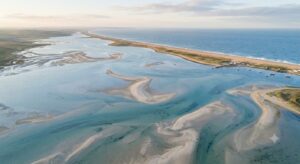
Pulicat has been on the maps of seafarers for a very long time. A Greek sailor’s guide of the first century CE, the Periplus of the Erythraean Sea, lists a port called Podouke on this coast, and the geographer Ptolemy lists it again in the second century. Pulicat has long been proposed as the site. The other leading candidate is Arikamedu, further south near Pondicherry, and scholars have not settled the question. Either way, the coast around Pulicat was part of the world that Roman merchants and Tamil traders were already crossing the ocean to reach.
By the 7th century the Pallavas, the dynasty that carved the shore temples of Mahabalipuram, knew the town as Mamalla Pattinam. Arab traders had settled here by the 9th century, and two mosques in the town, each nearly 300 years old, belong to the long story of those sea routes. Locals still use the Tamil name Pazhaverkadu.
When Pulicat Was the Dutch Headquarters on the Coromandel Coast
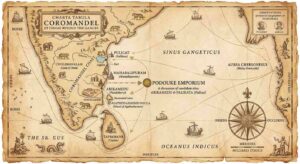
The Portuguese arrived in 1502. The Dutch followed in the early 1600s and did something the earlier arrivals had not: they made Pulicat the headquarters of their trade on the Coromandel coast. They built Fort Geldria. They struck coins in their own mint here. For a few decades, decisions that shaped the cloth trade between India and Southeast Asia were taken in a small lagoon town that most visitors to Chennai have never heard of.
Then the water and the world moved on. The lagoon that sheltered the ships is shallow, and shoals and silt made it hard for large vessels to use. Trade routes shifted after the fall of Vijayanagara. The Dutch moved their headquarters to Nagapattinam. The British took control in 1825, and Madras, a short way south, grew into the port that Pulicat had once been. A harbour that held the attention of the world became a quiet shore where fishing families still live and work.
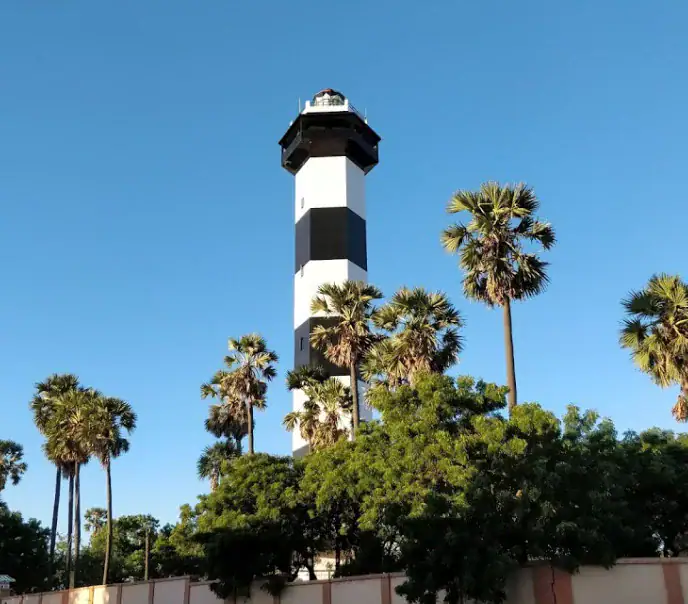
That is why the lighthouse points the way it does.
What Still Stands at Pulicat
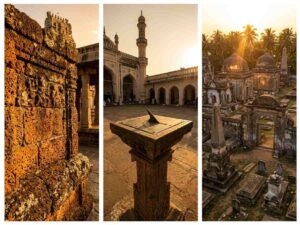
The traces of that old life are still on the ground, and each one rewards a closer look.
The Adinarayana temple, a Vishnu temple and one of the two largest in the town, is built entirely of laterite blocks. Most South Indian temples are granite. Laterite is a porous stone more common on the Malabar and Konkan coasts than in Tamil Nadu, which is a quiet clue that the people who built this temple had links by sea.
Chinna Pallivasal, one of the town’s two prominent mosques, keeps a sundial. Long before clocks, people here read the time from the sun, and in 1914 a sundial was installed at the mosque to show the hour and to call the community together for prayer. Stand beside it and watch the shadow fall across the marks, and the whole idea of a community running on solar time becomes physical.
The Dutch cemetery is a walled ground of about 77 graves, with carved tomb slabs, domed mausoleums, an obelisk and a skull motif carved above the arch. The burials run from the mid 1600s into the 1700s. These are the people who ran the trade, and they are buried in the sand of the place they came to govern.
The History Pulicat Asks You to Face
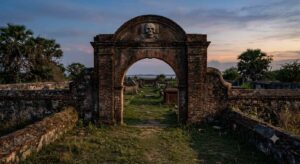
Pulicat is also a place that asks you to look honestly. Between 1621 and 1665, Dutch records count 131 ships carrying 38,441 enslaved Indians, many bought through brokers at Pulicat, most of them taken across the sea to Batavia, today’s Jakarta.
The same ground that holds the beauty of the lagoon holds this grief. It would be easy to tell Pulicat as a story of forts, coins and cloth. The fuller account includes the people who were sold from this shore, and any telling that leaves them out is not telling the history of the place.
The People Who Stayed
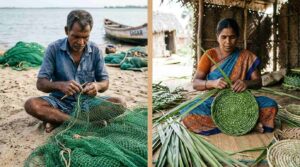
When the ships left, the families stayed. Today the lagoon’s economy is the one that was always underneath the trade: fishing.
On the sand beside the net yard, fishermen sit mending torn mesh by hand, a knot at a time, in the shadow of stacked green and blue nets. The work is skilled, repetitive and entirely unglamorous, and it is what keeps the lake’s fishing households going.
A short distance away, a women’s self help group splits palm leaf into strips, dyes them pink, green and orange, and weaves them into baskets, trays, lidded boxes and bags. The palm itself belongs to the story: it helps conserve groundwater, and its leaves, which are biodegradable, have long gone into household goods. A craft that looks small is part of how a coastal community manages its land and its income.
These are not heritage performances. They are the working lives of the people who inherited a harbour after the harbour left.
Why How You Visit Pulicat Matters
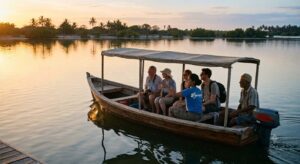
A place like this can be damaged by being visited carelessly. A bus stops, cameras come out, and a community that did not ask to be a stop on anyone’s itinerary becomes a backdrop.
The alternative is to visit on terms the community can accept. That means small groups, so a net yard is not overwhelmed. It means arriving during real working hours rather than asking anyone to perform. It means every host deciding what to share and how much to open. And it means paying people directly for their time, built into the price of the journey, rather than leaving it to tips or to a shop that a guide steers you into.
5 Senses Tours runs its Pulicat day on exactly these terms. It is the same approach we take elsewhere in India. In coastal Karnataka, the Coast to Canopy trail was co designed with five communities who each decided what to share and on what terms. In Varanasi, the Andaman Way enamelling workshop takes you into a working artist’s own studio. In the Nilgiris, the Toda village visit is arranged through community approved channels. And the Loom to Lac journey is built on the same principles. You can see all of them on our Responsible Tourism page.