
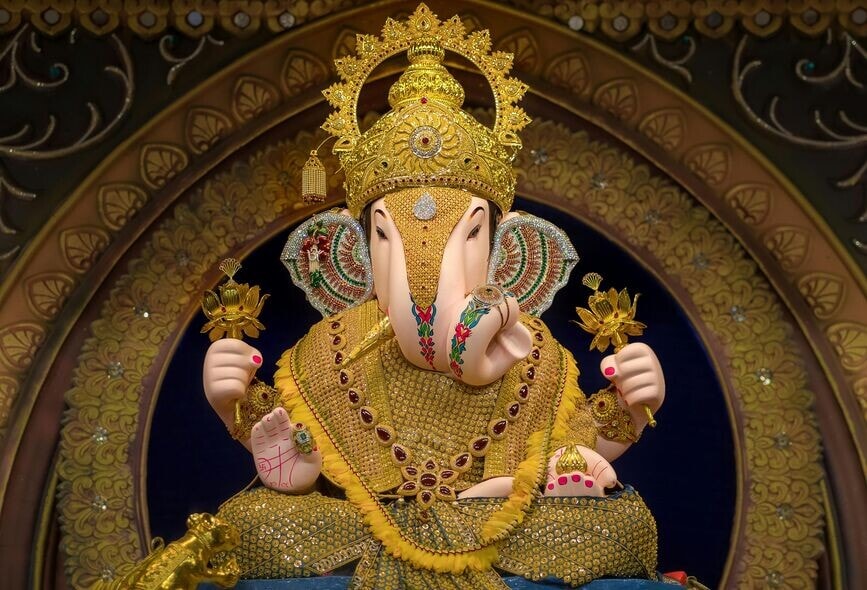
In 1893, the British colonial administration was watching Pune carefully.
Large public gatherings were viewed with suspicion. Political meetings were monitored. Any organised assembly that could give voice to the growing feeling of nationalism was a threat to the colonial order. The freedom movement was still finding its form, largely confined to educated drawing rooms and English language newspapers, unable to reach the vast majority of ordinary Indians who had no access to either.
Then Lokmanya Bal Gangadhar Tilak looked at something that had been happening quietly in Marathi homes for centuries, a private family celebration of Lord Ganesha lasting one to three days, and asked a question that would change the history of India.
What if we did this in the streets?
What the British could not ban was devotion. What they could not prevent was a religious celebration that every Hindu family in Pune already participated in. What they could not monitor without revealing their own suspicion of ordinary people’s faith was a festival of a beloved deity who removes obstacles and blesses new beginnings.
What had for centuries been a quiet, one-day household puja was suddenly reborn as a ten-day public celebration charged with the spirit of cultural pride and political awakening.
The Pune Ganesh festival, and specifically the tradition of the five Manache Ganpati pandals that stand at its historic heart, is one of the most extraordinary stories of cultural intelligence in the entire Indian freedom movement. This is their complete story, and this is how you experience them.
Book your Pune Ganesh festival walk with 5 Senses Tours today
Pune Ganesh Festival: The History Behind the Five Honoured Pandals
 How Lokmanya Tilak Turned a Religious Festival Into a Revolutionary Act

To understand what Tilak did in 1893, you need to understand the specific problem he was trying to solve.
The Indian freedom movement was still developing. Political participation was largely restricted to educated and elite sections of society. Public political gatherings were closely watched by the colonial administration, and the British government remained suspicious of large-scale mobilisation. Tilak recognised a fundamental challenge facing the nationalist movement: How could the idea of freedom reach ordinary people?
His answer was the Pune Ganesh festival. By transforming the private home worship of Lord Ganesha into a ten-day public celebration with community pandals, cultural performances, speeches, music and collective devotion, Tilak created the largest legally permitted public assembly in colonial India. Poets could recite patriotic verses from the pandal stage. Speakers could address thousands of people from all castes and communities simultaneously. Ideas that could not be voiced in a political meeting could be expressed through the cultural framework of a religious festival.
The colonial administration could not intervene without appearing to suppress religion itself. Tilak had found the one door the British could not close.
Tilak made the attainment of swaraj, by mobilising and channelising all the extant forces into one patriotic current, the sole mission of his life. The Pune Ganesh festival was the most powerful instrument he ever found for that mobilisation.
The word Manacha in Marathi means honoured or respected. The five Manache Ganpati are the five pandals that hold the highest ceremonial rank in the entire festival, receiving the greatest honour in the immersion procession that closes the ten days. No other pandal can begin the immersion until these five, in their precise order of precedence, have been acknowledged. They are not simply the oldest or the most elaborate. They are the five whose specific histories and specific community connections have earned them a permanent ceremonial authority that no newcomer can challenge.
Each one has a story that reaches deeper into Pune’s history than the festival itself.
The First: Kasba Ganpati and the Mother Who Founded a City

Shri Kasba Ganpati holds the first position among the five Manache Ganpati, not by seniority among the festival pandals but by a much older authority.
Kasba Ganpati is the Gramadevata, the presiding deity, of Pune itself. The story goes that the idol was first found near the home of Vinayak Thakar, close to where Jijabai lived. Around 1639, Shivaji Maharaj and Jijabai built a small temple for it. Even today, Kasba Ganpati leads the visarjan procession. No other mandal can begin until this Bappa has reached the river.
This is the specific texture of what the Kasba Ganpati represents. Before Lokmanya Tilak. Before the freedom movement. Before the British arrived in Pune. The mother of Shivaji, who was herself one of the most remarkable women in Maratha history, a strategist, a teacher and a political figure who shaped the character of the man who built the Maratha Empire, chose this idol as the presiding deity of the city she was helping build.
When you stand before Kasba Ganpati during the Pune Ganesh festival, you are standing before an object of devotion that was placed in its temple by Jijabai and Shivaji in 1639. The Maratha Empire that Shivaji would build, the resistance to Mughal dominance that would eventually produce the political culture from which the independence movement drew its identity, the tradition of Pune as a city of warriors and scholars and administrators, all of it has this modest neighbourhood temple at its historical root.
The Second: Tambdi Jogeshwari and the Annual Renewal

Tambdi Jogeshwari is the temple of Goddess Durga and is known as the Gramdevata of Pune. Lokmanya Tilak himself had given the status of Manacha Dusara Ganapati to Tambdi Jogeshwari Ganeshotsav Mandal because of its association with the Gramdevata from the very beginning of the festival, i.e., in 1893.
The temple itself dates to the 15th century, six centuries of continuous worship on the same sacred ground. What makes this Ganpati special is a quiet tradition. The idol is immersed every year and a new one is installed the next. This annual renewal, the deliberate choice not to preserve the same idol across years but to release it into the river and begin again, speaks to a philosophy of devotion that is beautifully distinct from the permanence-seeking instinct of most heritage traditions. The goddess is honoured precisely by the willingness to let the form go while the devotion continues unchanged.
Since 2000, a silver dome pandal has been erected before the ancient temple, creating one of the most visually extraordinary settings of the entire Pune Ganesh festival, the old stone temple of the 15th century visible behind the gleaming silver canopy of the modern pandal, fifteen generations of Pune’s devotional life in a single visual frame.
The Third: Guruji Talim and the Most Beautiful Story in the Festival

This one is the most beautiful chapter in Pune’s communal story. It was started in 1887, even before Tilak made Ganeshotsav a public celebration. Two families, one Hindu and one Muslim, came together to install this Ganpati.
Guruji Talim is the 3rd respected Ganapati in Pune. It was first established in 1887 by two Hindu and Muslim families of Bhiku Shinde and Ustaad Nalban. This is the reason why Guruji Talim symbolizes Hindu-Muslim unity in Pune.
Six years before Tilak launched his public festival. A Hindu family and a Muslim family in a Pune wrestling gymnasium, a talim, coming together to install a Ganesh idol because they shared a neighbourhood and a sense of community that was stronger than any religious boundary. This was not a political statement. It was a neighbourly one. And it predated by six years the festival that would make such communal solidarity a deliberate platform of the freedom movement.
When Tilak organised the Sarvajanik Ganeshotsav in 1893, Guruji Talim was already six years old and already embodying the ideal of Hindu-Muslim unity that Tilak’s political vision was trying to build. The grassroots reality had arrived before the political framework that would celebrate it.
The Fourth: Tulshibaug Ganpati and the Heart of the Market

Tulshibaug Ganapati is the fourth manacha Ganapati, established in 1901. This idol stands 13 feet tall and is decorated with ornaments weighing more than 80 kg.
Tulshibaug sits in the densest, most commercially active part of old Pune, the labyrinthine market of Tulshibaug where jewellers, cloth merchants and sweet shops have been doing business since the Peshwa period. During the Pune Ganesh festival the market transforms completely, its narrow lanes becoming a river of devotees moving between the stalls of flowers, modak and devotional offerings that spring up alongside the ordinary commerce.
This mandal holds the honor of establishing the first Glass Fiber statue since 1975. The combination of an idol dressed in 80 kilograms of ornaments, a 13-foot standing figure of extraordinary visual presence and a location in the city’s most energetic commercial district makes Tulshibaug one of the most viscerally exciting stops on the entire Pune Ganesh festival walk.
The Fifth: Kesariwada and the Pandal Where India’s Freedom Was Planned

The fifth position among the Manache Ganpati carries the weight of history in the most direct possible sense.
Installed by Lokmanya Bal Gangadhar Tilak in 1893 within the historic Kesari Wada, Tilak’s residence, this Ganpati is deeply tied to India’s freedom movement. The idol is placed alongside a permanent shrine inside the Wada, which also houses a museum and Marathi press. This temple played a pivotal role in transforming Ganesh Utsav into a nationalistic and social movement.
Kesari Wada, Pune, 1893, the first organised Sarvajanik Ganesh Pandal was started here by Tilak. This inspired the entire city and later the whole country.
Standing inside Kesariwada during the Pune Ganesh festival is standing at the precise origin point of the public festival itself. The printing press that produced the Kesari newspaper, through which Tilak spread the nationalist message to Marathi-speaking India, is still inside the Wada. The rooms where the strategies of the freedom movement were debated are still there. The pandal that Tilak established in this courtyard in 1893 is still established in the same courtyard every year, 133 years of continuous devotion in the place where the Pune Ganesh festival was born.
The Pune Ganesh Festival Experience: What You Will Actually Encounter

The Sounds, the Crowds and the Sensory Reality of Ganeshotsav
The Pune Ganesh festival is not a spectacle you observe from a comfortable distance. It is a complete sensory immersion that arrives before you can prepare for it.
The dhol-tasha, the paired percussion of the large barrel drum and the flat metal cymbal played by procession groups, produces a sound that is felt in the chest as much as heard by the ears. During the festival days the sound fills entire neighbourhoods from dawn to well past midnight, rhythmic, insistent and completely unlike any recorded music. Each mandal has its associated dhol-tasha pathak, their percussion group, and learning to recognise the different rhythmic patterns of different groups is part of the living knowledge of the festival that takes years to accumulate.
The smell of marigold and mogra jasmine is everywhere, in the garlands on the idols, in the offerings carried by devotees, in the flower stalls that appear on every corner. The smell of incense from hundreds of active pandals drifts through the streets. And at each pandal there will be modak, the steamed rice flour dumplings filled with coconut and jaggery that are Lord Ganesha’s favourite offering and the one food that every visitor to the festival should eat at least once in its authentic ukadiche form.
The crowds during the Pune Ganesh festival, particularly in the final days before immersion, are unlike anything in ordinary Pune life. The streets around the five Manache Ganpati pandals narrow with the movement of thousands of devotees moving in the same direction, carried by a collective current of devotion that is simultaneously overwhelming and deeply moving.
Dagdusheth Halwai: The Ganesh That Commands Year-Round Devotion


No visit to the Pune Ganesh festival is complete without Dagdusheth Halwai Ganpati, technically outside the five Manache but arguably the most famous Ganesh in all of Maharashtra.
Dagdu Sheth temple is dedicated to Lord Ganesh and arguably the most famous one in Pune. The idol is adorned with gold and precious jewellery worth crores, and the Dagdusheth Halwai trust is the wealthiest Ganesh mandal in Maharashtra. Celebrities, politicians and devotees from across the world visit throughout the year, but during the festival the temple and its elaborate decoration become one of the primary visual spectacles of the entire city.
The story of Dagdusheth Halwai himself is worth knowing. He was a successful sweet maker in 19th century Pune who lost his son to plague and, consumed by grief, was advised by his spiritual guide to install a Ganesh idol and serve the community. The idol he installed became one of the most beloved sacred figures in India. The transformation of private grief into public devotion is a story that runs through the entire history of the Pune Ganesh festival.
The Modak Trail and the Food of the Festival

The Pune Ganesh festival is also one of the most extraordinary food experiences available anywhere in India during the festival period.
Ukadiche modak, steamed rice flour dumplings with coconut and jaggery filling, are the primary prasad of Ganesh Chaturthi and the one food that every pandal, every home and every sweet shop in Pune is producing during the festival days. The genuine article, made with fresh coconut and unrefined jaggery steamed in a delicate rice flour shell, bears no resemblance to the mass-produced fried versions sold year-round. Finding the best ukadiche modak in Pune during Ganeshotsav is a genuine culinary quest.
Alongside the modak, the festival food landscape of old Pune includes puran poli, the sweet lentil-stuffed flatbread of Maharashtrian celebration cooking, shrikhand, the strained yoghurt dessert flavoured with saffron and cardamom, and the specific street food universe of the Tulshibaug and Laxmi Road markets that comes alive during the festival in ways it does not at any other time of year.
Experience the Pune Ganesh Festival With 5 Senses Tours
The five Manache Ganpati pandals are walkable from each other in the old city of Pune. But walking them during the festival without understanding what you are looking at, why the order of the five matters, what Kasba Ganpati has to do with Jijabai, what Guruji Talim has to do with a Hindu-Muslim friendship in a wrestling gymnasium in 1887, what Kesariwada has to do with the birth of the freedom movement, is to be present at an extraordinary story without the words to read it.
Our Pune Ganesh festival walk covers all five Manache Ganpati pandals, the historic lanes that connect them, the food of the festival and the complete story of how a ten-day religious celebration became the largest anti-colonial mobilisation in the history of the Indian freedom movement, concluding at the extraordinary Dagdusheth Halwai Ganpati with its gold-adorned idol and its story of grief transformed into devotion.
The walk is conducted by expert cultural guides who are themselves part of the Pune tradition, who know which dhol-tasha pathak belongs to which mandal, which sweet shop has been making the best modak in this neighbourhood for three generations and which lane takes you behind the crowds to a moment of stillness inside a 400-year-old temple courtyard.
5 Senses Tours is recognised by India’s Ministry of Tourism, winner of the Tripadvisor Travellers’ Choice Award and the Outlook Responsible Tourism Award. Every tour is private, expert-guided and completely customised for your group.
Book your Pune Ganesh festival walk with 5 Senses Tours today