
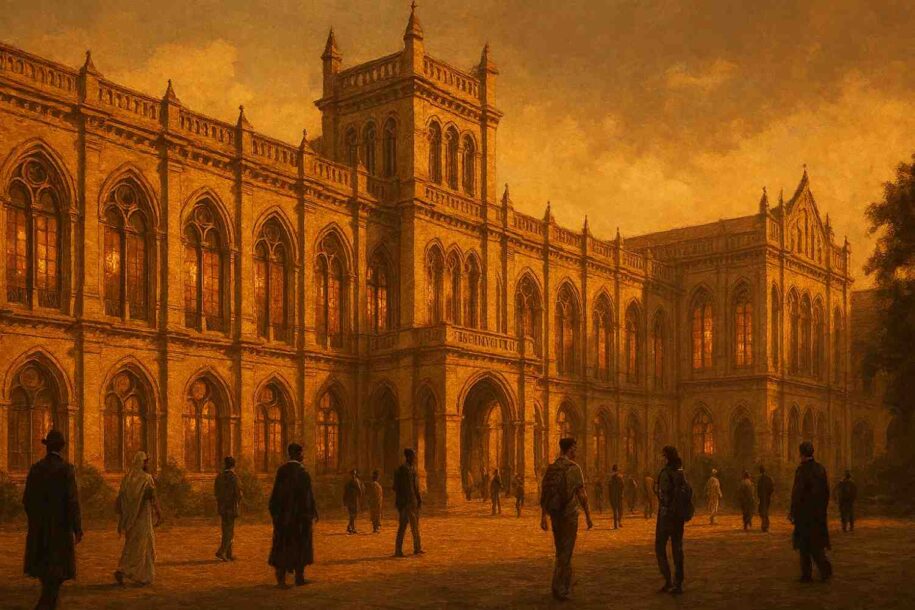
There is a building on College Street in Kolkata.
It was built in 1875. Its architecture is the confident Victorian Gothic of a colonial institution that expected to last. Tall windows. High ceilings. A sweeping central staircase. A Baker Laboratory that became one of the most productive scientific research spaces in Asia.
Its name is Presidency College. And the list of the people who studied and taught within its walls across a period of approximately seventy years is so extraordinary that if you compiled it without knowing it was true you would be accused of making it up.
Jagadish Chandra Bose. The man who proved that plants have feelings and who transmitted the world’s first wireless signal before Marconi, teaching in its laboratories.
Prafulla Chandra Ray. The chemist who founded the Indian pharmaceutical industry and whose students would reshape modern physics, teaching beside him.
Satyendra Nath Bose. The physicist whose paper Albert Einstein personally translated into German and whose name is now attached to the most fundamental class of particles in the universe, studying in its classrooms.
Meghnad Saha. The astrophysicist whose equation explaining the chemical composition of stars transformed our understanding of the cosmos and who was repeatedly nominated for the Nobel Prize, studying beside Bose in the same year.
CV Raman. The physicist who discovered the effect that bears his name and won India its first Nobel Prize in science, conducting his experiments in its Baker Laboratory.
Amartya Sen. The economist whose work on welfare, poverty and human development won the Nobel Prize in Economics and whose name was given to him by Rabindranath Tagore, studying in its economics department.
Six individuals. One building. Physics. Chemistry. Astrophysics. The God Particle. The Raman Effect. The Nobel Prize for Economics. The understanding of stellar composition. The Indian pharmaceutical industry.
And almost no international tourist who visits Kolkata knows this building exists.
This blog is the complete guide to the Bengali scientists heritage trail in Kolkata. And it is one of the most extraordinary intellectual heritage stories available anywhere in India.
Bengali Scientists Kolkata Heritage Trail: The One Building That Changed the World
Why Presidency College Kolkata Produced More World-Changing Science Than Almost Any Other Institution in Asia
The concentration of scientific genius at Presidency College Kolkata in the late 19th and early 20th centuries was not accidental. It was the product of a specific historical moment when a newly confident Bengali intellectual class, educated in both the Western scientific tradition and the deep philosophical tradition of their own culture, produced a generation of thinkers who approached the fundamental questions of science with a combination of rigour and imagination that their contemporaries in Europe and America found simultaneously impressive and unexpected.
CV Raman who won the Nobel Prize for Physics in 1930 performed many of his famous experiments in light spectrometry in Presidency’s Baker laboratory. The lab was established by one of the pioneers of Indian science Acharya Jagadish Chandra Bose who proved that plants have life and that they responded to external stimuli. Satyen Bose who theorised the God Particle named after him as the Boson learnt his chops there mentored by Meghnad Saha another pioneer of Indian science.
The research confirms an extraordinary genealogy. Jagadish Chandra Bose taught Satyendra Nath Bose and Meghnad Saha. Prafulla Chandra Ray taught both of them alongside Bose. CV Raman used the laboratory that Jagadish Chandra Bose established. Amartya Sen and Abhijit Banerjee both studied in its economics department decades later.
This is not a coincidence of geography. It is a living intellectual tradition, each generation of scientists inspiring and training the next, in the same building, on the same College Street in the same city, across seventy years of extraordinary continuous achievement.
Bengali Scientists Kolkata Heritage Tour: The Six Who Changed Everything
Jagadish Chandra Bose: The Man Who Proved Plants Have Feelings and Invented Radio Before Marconi
Sir Jagadish Chandra Bose was born on 30 November 1858 in Mymensingh Bengal Presidency. He studied at St Xavier’s College Calcutta and then at Christ’s College Cambridge and University College London before returning to India to teach at Presidency College.
The two claims associated with Jagadish Chandra Bose are so extraordinary that most people who hear them for the first time assume they are exaggerated.
The first is that he transmitted the world’s first wireless signal before Guglielmo Marconi, who is conventionally credited with the invention of radio. Bose demonstrated wireless transmission of electromagnetic waves in Calcutta in 1895, a year before Marconi’s celebrated demonstration in Britain. His apparatus included a coherer, a device for detecting radio waves, whose design Marconi later adapted without acknowledgement. The historical record of priority in the invention of radio is genuinely contested and Jagadish Chandra Bose’s claim to it is supported by documentation that Marconi’s defenders have never been able to definitively refute.
The second is that he proved plants have feelings. The crescograph, an instrument Bose invented for measuring plant growth and response with extraordinary precision, demonstrated that plants respond to stimuli including heat, cold, light, darkness and electrical impulses in ways that are functionally analogous to the responses of animal nervous systems. The implications of this work, published across multiple papers and books in the first two decades of the 20th century, are still being explored by plant neurobiologists today.
When not practicing science Bose also wrote science fiction publishing his first short story in 1896 establishing him as one of the forefathers of Bengali science fiction. Whilst his most pioneering work took place at the end and beginning of the 19th and 20th centuries his professorship at the University of Calcutta continued his legacy as Bose mentored some notable students including many Indian physicists such as Satyendra Nath Bose after whom Paul Dirac named the class of particles bosons and Meghnad Saha who was often nominated for the Nobel Prize in Physics.
The man who invented radio before Marconi, proved plants have feelings, wrote science fiction and then trained the students who gave their names to the God Particle and transformed astrophysics is one of the most completely extraordinary figures in the history of science. His house in Kolkata, the Bose Institute he founded and Presidency College where he taught are all part of the Bengali scientists Kolkata heritage trail.
Prafulla Chandra Ray: The Chemist Who Founded Indian Pharmaceutical Science and Lived Like a Saint
Prafulla Chandra Ray is the least internationally famous of the six Bengali scientists on the Kolkata heritage trail and arguably the one whose impact on Indian daily life has been the most direct and the most enduring.
Sir Prafulla Chandra Ray was born on 2 August 1861 in Paikgacha Bengal British India. He studied at the University of Edinburgh. His notable students include Satyendranath Bose and Meghnad Saha.
Ray returned from Edinburgh to Presidency College and began building what would become the foundation of the Indian chemical and pharmaceutical industry. He founded Bengal Chemical and Pharmaceutical Works in 1901, the first pharmaceutical manufacturing company in India, with the explicit objective of creating an Indian industrial capacity that would reduce dependence on imported British medicines and chemicals.
Ray was not only a scientist but a nationalist whose scientific work was inseparable from his political convictions. He lived with extraordinary simplicity, donating most of his income to educational and social causes, wearing simple Indian clothing at a time when professors of his standing typically wore western dress. He used his salary to fund scholarships for students who could not afford to study and his chemical company to fund the independence movement.
As a teacher he was one of the most inspirational figures in Presidency College’s history. Satyendra Nath Bose and Meghnad Saha both cited him as a transformative influence. The combination of scientific rigour, nationalist conviction and personal integrity that he embodied in his teaching created a generation of scientists who understood that doing world-class science in India was itself a political act.
Meghnad Saha: The Boy From a Village Shop Who Explained the Stars
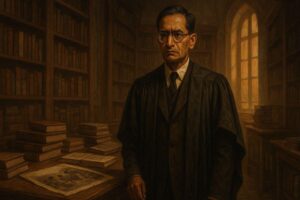
Meghnad Saha was born on 6 October 1893 in Seoratali Dhaka district Bengal Presidency. He is known for thermal ionisation and the Saha ionization equation. His academic advisors were Jagdish Chandra Bose and Prafulla Chandra Ray.
Meghnad Saha grew up in poverty in rural Bengal, the son of a small shopkeeper. His access to education was precarious at multiple points in his childhood. And he went on to develop an equation that transformed humanity’s understanding of the stars.
The Saha Ionization Equation, published in 1920, describes the degree to which atoms in a hot gas are ionized, meaning stripped of their electrons, as a function of temperature and pressure. Applied to the spectral analysis of starlight, this equation gave astronomers for the first time the ability to determine the chemical composition, temperature and physical conditions of stars from the light they emit. It transformed astrophysics from a descriptive science into a predictive one.
Meghnad Saha FRS was an Indian astrophysicist best known for his development of the Saha equation used to describe chemical and physical conditions in stars.
The Saha equation is used in every calculation of stellar composition today. It is the foundation on which our understanding of the sun, the stars and the physical conditions of the early universe is built. Every time an astronomer reads a stellar spectrum and tells you that a star is made of hydrogen and helium and traces of iron and calcium and oxygen, they are using Meghnad Saha’s equation to translate the light into chemistry.
Meghnad Saha a fellow student of Satyendra Nath Bose who would eventually work with him stood second in the exam. From 1916 to 1921 he and Saha became lecturers in the physics academic department of the University of Calcutta.
Saha and Bose were classmates at Presidency College. They stood first and second in their examinations. They became lecturers together. They published together. They were nominated together for the Nobel Prize. The intellectual partnership between these two men, formed in the classrooms of Presidency College under the teaching of Jagadish Chandra Bose and Prafulla Chandra Ray, produced some of the most significant physics of the 20th century.
Satyendra Nath Bose: The Man Whose Name Is on the God Particle
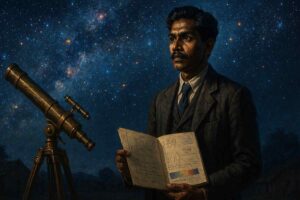
Satyendra Nath Bose was born on 1 January 1894 in Calcutta Bengal Presidency British India. He is known for the Bose-Einstein condensate, Bose-Einstein statistics, Bose-Einstein distribution and the boson. His academic advisors were Jagadish Chandra Bose and Prafulla Chandra Ray.
In 1924 Satyendra Nath Bose wrote a paper on quantum statistics that he could not get published. The European journals to which he submitted it rejected it. Frustrated, he did something audacious. He posted it directly to Albert Einstein.
Einstein read it. He recognised immediately that the paper described something genuinely new. He translated it into German himself. And he submitted it to the leading German physics journal with his own endorsement.
The paper described a new way of counting quantum particles that applied specifically to what are now called bosons, particles with integer spin that include the photon and the Higgs boson. The counting method Bose developed, extended by Einstein, became Bose-Einstein statistics, one of the foundational theoretical frameworks of quantum mechanics.
The Higgs boson, whose discovery at CERN in 2012 completed the Standard Model of particle physics and was immediately called the God Particle by the popular press, is named after Peter Higgs and Satyendra Nath Bose. Every boson, the entire class of fundamental particles that includes the photon, the gluon and the Higgs, carries Bose’s name.
Bose was a genius since the very beginning. He topped the entrance exam of Hindu School and ranked fifth in the order of merit. Following that Bose joined Presidency College in Kolkata where he studied with renowned scientists Jagadish Chandra Bose and Prafulla Chandra Ray. Bose graduated with a Bachelor of Science degree in combined Mathematics in 1913 and a Master of Science in the same subject from Calcutta University in 1915 acquiring such high marks that he not only ranked first but set a new record score which is yet to be surpassed.
The record that Satyendra Nath Bose set at Calcutta University in his Master of Science examination has never been surpassed. From the classrooms of Presidency College, where Jagadish Chandra Bose and Prafulla Chandra Ray inspired him, to the paper that Einstein translated, to the particle that carries his name in the God Particle discovered at CERN ninety years later, the arc of SN Bose’s intellectual life is one of the most extraordinary trajectories in the history of modern physics.
CV Raman: The Man Who Made Sunlight Speak and Won India’s First Nobel Prize in Science
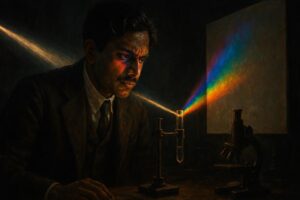
CV Raman was not Bengali by birth. He was born in Tiruchirapalli in Tamil Nadu in 1888. But his scientific career was built in Kolkata. He was the Palit Professor of Physics at Calcutta University from 1917 to 1934. He conducted the experiments that won him the Nobel Prize in the Baker Laboratory at Presidency College, the same laboratory established by Jagadish Chandra Bose.
Indian physicist CV Raman received the Nobel Prize for physics in 1930. He was born in the Madras Province and had gone on to become the greatest physics professor at the University of Calcutta. During his work he discovered the groundbreaking Raman Effect which earned him the Nobel Prize.
The Raman Effect, discovered in 1928, describes the phenomenon in which light scattered by a molecule changes its wavelength. When a photon collides with a molecule and gives some of its energy to the molecule’s vibrational modes, the scattered photon has a different, longer wavelength than the incoming photon. The specific change in wavelength is a fingerprint of the molecule’s composition.
The Raman Effect is now used in every chemistry laboratory in the world. Raman spectroscopy identifies unknown substances from their molecular fingerprints without touching or destroying the sample. It is used in pharmaceutical quality control, in the authentication of gemstones and works of art, in forensic science, in medical diagnosis and in the analysis of samples from other planets. The Mars rovers use Raman spectrometers to analyse the Martian surface.
When Raman made his discovery in 1928 he was reportedly so certain of its significance that he immediately booked a ticket to Stockholm, anticipating the Nobel Prize. He received it in 1930, the first Asian scientist to win a Nobel Prize in science.
Amartya Sen: The Economist Named by Tagore Who Proved Famines Are Not About Food Shortages
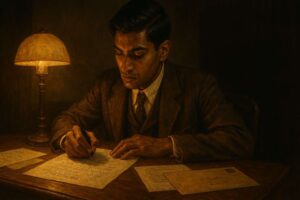
Amartya Kumar Sen was born on 3 November 1933 in Santiniketan Bengal British India. He studied at Presidency College Calcutta where he earned a BA in economics with First in the First Class. He won the Nobel Memorial Prize in Economic Sciences in 1998.
Amartya Sen was given his name by Rabindranath Tagore, who was a close associate of his maternal grandfather at Shantiniketan. The name Amartya means immortal in Sanskrit. It was a gift from one Nobel laureate to the man who would become another.
Sen’s most celebrated contribution to economics is his theory of famines. His book Poverty and Famines published in 1981 demonstrated with historical evidence from multiple famines including the Bengal Famine of 1943 that famines are almost never caused by a shortage of food. They are caused by a failure of entitlement, a situation in which specific groups of people lose the economic or political power to access food that exists in sufficient quantities somewhere in the economy.
The Bengal Famine of 1943, which killed between two and three million people, occurred while food was being exported from Bengal. The problem was not the absence of food. It was the absence of purchasing power among the rural poor whose wages had been destroyed by wartime inflation and whose political voice was insufficient to trigger government intervention.
Sen’s framework for understanding famines transformed development economics and influenced international humanitarian policy. The understanding that famines are political and economic events rather than natural disasters, and that they are therefore preventable through policy intervention, is now the foundation of global famine prevention strategy.
The Bengal Famine that shaped Sen’s most important intellectual work happened in the city where he later studied. Walking through Kolkata with the understanding that the city’s history is written into the most influential work of one of the world’s greatest economists gives the heritage experience a depth and a personal dimension that is completely specific to this city.
Bengali Scientists Kolkata Heritage Tour: What You Will Visit
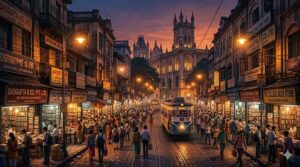
Presidency College and the Baker Laboratory
Presidency College will celebrate its 200th anniversary. It’s a bit of a stretch of the imagination: 1816 witnessed a meeting in the home of the then-British Chief Justice of the Supreme Court where a group of progressive Brits and Bengalis established what would become the most intellectually productive educational institution in the history of South Asia.
The main building of Presidency College, now Presidency University, on College Street in central Kolkata is the physical heart of the Bengali scientists Kolkata heritage trail. The Baker Laboratory, established by Jagadish Chandra Bose and the site of CV Raman’s Nobel Prize-winning experiments, is the single room most charged with scientific history in the entire Indian subcontinent.
The college is an active educational institution and visiting it requires coordination with the university administration. Our Kolkata heritage tour guides have established relationships with the institution that allow visitors to see the key spaces including the Baker Laboratory, the main hall and the extraordinary library with the guidance of someone who can bring the complete story of what happened in each room to life.
The Bose Institute and the Acharya Jagadish Chandra Bose Indian Botanic Garden
Jagadish Chandra Bose founded the Bose Institute in Kolkata in 1917, the first multidisciplinary research institute in India and one of the oldest in Asia. The institute is still an active research centre. Its heritage section preserves the original equipment used by Bose in his research and provides the most direct physical encounter with the scientific work that the Bengali scientists Kolkata heritage trail commemorates.
The Acharya Jagadish Chandra Bose Indian Botanic Garden, one of the largest botanical gardens in Asia, carries his name and contains the famous Great Banyan Tree, a single tree over 250 years old whose aerial roots cover more than 3.5 acres of ground.
The Indian Museum and the Complete Kolkata Heritage Experience
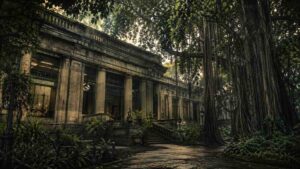
The Indian Museum in Kolkata, the oldest and largest museum in India established in 1814, provides the complete historical and cultural context for the Bengali scientists Kolkata heritage trail. Its natural history, geology and anthropology collections represent the intellectual landscape of the 19th century Bengal Renaissance that produced the scientific tradition these six men exemplify.
Our Kolkata tours cover the complete heritage of the City of Joy including the Bengali scientists heritage trail, the Indian Museum, the Victoria Memorial, the colonial heritage of the Maidan and the extraordinary living culture of Kolkata’s neighbourhoods with expert cultural guides who know the complete story of every site and every building on the route.
Plan Your Bengali Scientists Kolkata Heritage Tour With 5 Senses Tours
Why the Bengali Scientists Story Is the Most Compelling Heritage Narrative in Kolkata for International Visitors
The Bengali scientists Kolkata heritage trail offers something that most heritage tours in India cannot. It is a story that connects directly to the world the visitor came from.
The phone in your pocket uses technology whose foundations were laid by the wireless transmission experiments of Jagadish Chandra Bose. The light coming through the window has just demonstrated the Raman Effect in ways that Raman himself would recognise. The GPS that brought you to Kolkata uses calculations that depend on the understanding of stellar physics made possible by Meghnad Saha’s equation. The global development policy frameworks that determine how international aid is distributed are built on the intellectual foundations of Amartya Sen’s work on famines and entitlement.
These are not abstract historical contributions. They are the intellectual foundations of the world you live in today. And they were created in a single building on College Street in Kolkata by a group of scientists who were students and teachers of each other across seventy extraordinary years.
For a western tourist from the USA or UK who wants to understand India not as a collection of ancient monuments but as a living intellectual civilisation that has shaped the modern world, the Bengali scientists Kolkata heritage trail is the most direct and most personally relevant heritage experience available anywhere in the country.
Which Kolkata building produced six scientists who changed the world?
Presidency College on College Street in Kolkata, built in 1875, produced six scientists across approximately seventy years whose work transformed physics, chemistry, astrophysics and economics. Jagadish Chandra Bose and Prafulla Chandra Ray taught there. Satyendra Nath Bose and Meghnad Saha studied there as classmates. CV Raman conducted his Nobel Prize winning experiments in its Baker Laboratory. Amartya Sen studied economics there decades later. It is considered one of the most intellectually productive single institutions in the history of South Asia.
Who was Jagadish Chandra Bose and what did he discover?
Jagadish Chandra Bose was an Indian scientist born in 1858 who taught at Presidency College in Kolkata. He demonstrated wireless transmission of electromagnetic waves in Calcutta in 1895, a year before Guglielmo Marconi’s celebrated demonstration in Britain, giving him a strong claim to priority in the invention of radio. He also invented the crescograph, an instrument that proved plants respond to stimuli including heat, light and electrical impulses in ways functionally analogous to animal nervous systems. He went on to found the Bose Institute in 1917 and mentored Satyendra Nath Bose and Meghnad Saha.
Why is Satyendra Nath Bose’s name attached to the Higgs boson?
In 1924 Satyendra Nath Bose wrote a paper on quantum statistics that European physics journals rejected. He posted it directly to Albert Einstein, who recognised its significance, translated it into German himself and submitted it with his own endorsement. The counting method Bose developed became Bose-Einstein statistics, and the entire class of fundamental particles with integer spin, including the photon and the Higgs boson discovered at CERN in 2012, is now called the boson in his honour.
What is the Saha equation and why is it significant?
The Saha Ionization Equation, published by the astrophysicist Meghnad Saha in 1920, describes the degree to which atoms in a hot gas become ionized as a function of temperature and pressure. Applied to the spectral analysis of starlight, it gave astronomers for the first time the ability to determine the chemical composition, temperature and physical conditions of stars from the light they emit, transforming astrophysics from a descriptive science into a predictive one. It remains the foundation of every modern calculation of stellar composition.
What did CV Raman discover and where did he discover it?
CV Raman discovered the Raman Effect in 1928 in the Baker Laboratory at Presidency College in Kolkata, a laboratory originally established by Jagadish Chandra Bose. The Raman Effect describes how light scattered by a molecule changes wavelength according to the molecule’s vibrational structure, creating a unique spectral fingerprint for every substance. Raman won the Nobel Prize in Physics in 1930, becoming the first Asian scientist to win a Nobel Prize in science. Raman spectroscopy is now used in pharmaceutical quality control, gemstone authentication, forensic science and the Mars rovers.
How did Amartya Sen change the understanding of famines?
Amartya Sen, who studied economics at Presidency College in Kolkata and was given his name by Rabindranath Tagore, demonstrated in his 1981 book Poverty and Famines that famines are almost never caused by a shortage of food but by a failure of entitlement, in which specific groups lose the economic or political power to access food that exists elsewhere in the economy. He used the Bengal Famine of 1943, which killed between two and three million people while food was being exported from Bengal, as central evidence. He won the Nobel Memorial Prize in Economic Sciences in 1998 and his framework now underpins global famine prevention policy.
Book Your Bengali Scientists Kolkata Heritage Tour With 5 Senses Tours
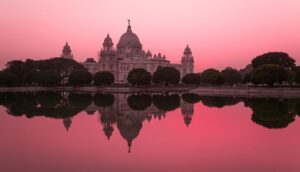
Our Kolkata tours include the complete Bengali scientists heritage trail with expert cultural guides who bring the full story of Jagadish Chandra Bose, Prafulla Chandra Ray, Satyendra Nath Bose, Meghnad Saha, CV Raman and Amartya Sen to life at the specific buildings and institutions where their work was done.
The tour includes Presidency College and the Baker Laboratory, the Bose Institute, the Indian Museum and the complete heritage landscape of central Kolkata that gave rise to one of the most extraordinary concentrations of intellectual genius in modern history.
For travellers extending their Bengal heritage experience, our Sundarbans wildlife tour covers the extraordinary mangrove ecosystem of the Bengal delta where Royal Bengal tigers swim between islands in one of the most biodiverse and most endangered habitats on earth. Our Bishnupur terracotta temples tour from Kolkata covers the extraordinary terracotta temple tradition of Bengal’s medieval Malla kingdom. And our complete India heritage tours portfolio creates customised itineraries across the full depth of Indian intellectual and cultural heritage.
Book your Bengali scientists Kolkata heritage tour with 5 Senses Tours today
Leave a Reply