
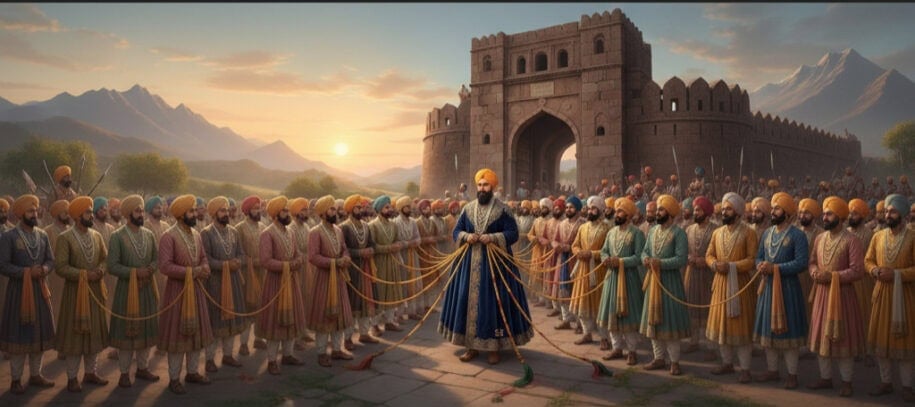
As the sun dips below the horizon in Amritsar, the Golden Temple awakens. Thousands of lamps shimmer upon the sacred waters of the Sarovar, their golden reflections dancing like stars brought down to earth. Fireworks bloom above the temple domes, and a gentle hum of prayers fills the night air.
It looks like Diwali—but the story behind these lights is not of gods or demons. It is the story of a man who turned captivity into compassion, and a festival that transformed from celebration to liberation.
For a private tour of Amritsar, please visit Golden Temple Experience.
A Prison, a Cloak, and 52 Kings
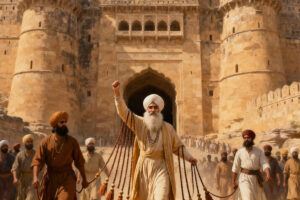
The year was 1619. The Mughal Empire was at its zenith, ruled by Emperor Jahangir. Among those who drew the emperor’s wary eye was Guru Hargobind, the sixth Sikh Guru—a spiritual leader who believed devotion should walk hand in hand with courage. His growing influence made Jahangir uneasy, and the Guru was imprisoned in the mighty Gwalior Fort, a citadel of stone and silence.
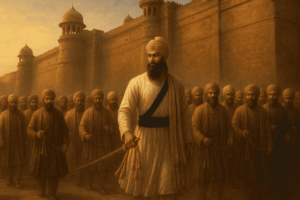
Inside its walls, Guru Hargobind discovered fifty-two Hindu princes, each unjustly detained for resisting imperial power. When the emperor later relented and offered to free him, the Guru refused to leave without them.
Jahangir hesitated. Releasing one man was an act of mercy; releasing fifty-two could be seen as weakness. The Guru smiled and proposed a compromise. He had a cloak stitched with fifty-two tassels, each to be held by a king as they walked out together. Jahangir agreed—and watched as the Guru emerged with all fifty-two rulers, each clutching a thread of freedom.
That day became known as Bandi Chhor Divas, “The Day of Liberation.”
When Diwali Became a Festival of Freedom
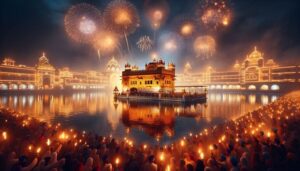
The day of the Guru’s release happened to coincide with Diwali—India’s festival of lights. In Amritsar, news of his freedom spread like wildfire. The Golden Temple, or Harmandir Sahib, was illuminated with thousands of oil lamps to welcome him home.
From that year onward, Sikhs have celebrated Diwali not merely as a victory of light over darkness, but as a victory of justice over oppression, compassion over power.
Today, Amritsar glows brighter than ever on Bandi Chhor Divas. The marble causeways glisten under the light of countless diyas, fireworks fill the northern sky, and devotees offer prayers of gratitude beside the water’s edge. Each lamp honors not only the Guru but every soul who stood for freedom.
Walking Through the Story

For travellers, this is one of the most moving experiences in India.
- Amritsar becomes a living poem—its narrow lanes fragrant with sweets and incense, its people dressed in festive colors, its temple reflecting like liquid gold under a dark sky.
- A short flight away, in Gwalior, stands the ancient fort where the story began. Within its walls lies the Gurudwara Data Bandi Chhor Sahib, marking the site of the Guru’s imprisonment. Standing there, one can almost hear the echo of chains falling away and the whisper of the tassels that carried kings to freedom.
The two cities—Gwalior and Amritsar—mirror each other like the two halves of the same story: captivity and release, darkness and light.
The Meaning Beyond the Festival
Historically, this tale is remarkable because it turns Diwali’s symbolism from myth into moral philosophy.
- The Ramayana’s Diwali celebrates the return of a god.
- The Sikh Diwali celebrates the liberation of men.
In both, light wins—but for different reasons. Guru Hargobind’s story invites travelers to see Diwali not only as a spectacle but as an ethical statement: that the truest light is the one we kindle in others.
Modern historians like J.S. Grewal and Khushwant Singh note that this event helped shape Sikh identity as one of moral defiance and compassion—a faith that wields both the sword and the lamp.
A Journey Through Light
If you visit India during Diwali, step beyond the firecrackers and the sweets. Visit Amritsar on Bandi Chhor Divas. Stand by the shimmering waters of the Golden Temple, where faith and freedom share the same reflection.
Then travel to Gwalior, where the story began. The walls of the fort may no longer hold prisoners, but they still hold memory—the kind that turns history into light.
Because sometimes, Diwali is not about returning home.
Sometimes, it is about setting others free.
For a private tour of Amritsar, please visit Golden Temple Experience.
Leave a Reply