
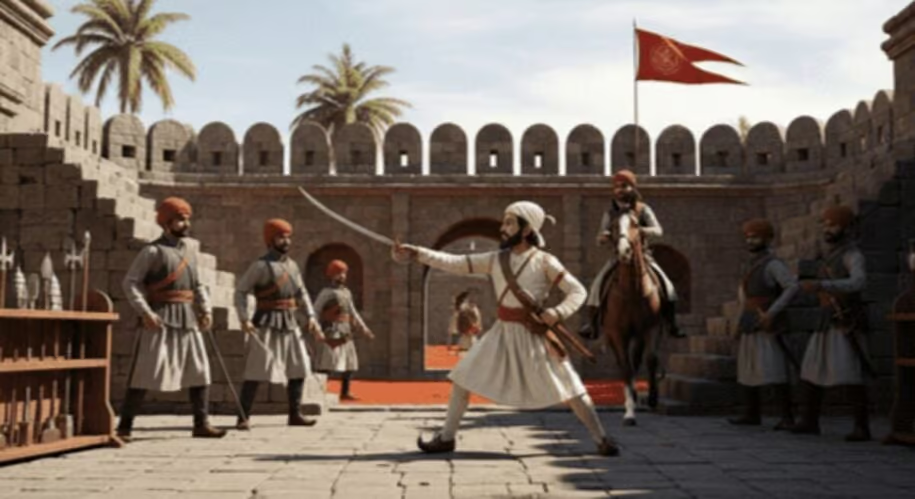
Long before the roar of traffic and the glow of tech parks, Bangalore was a frontier town of stone walls, moats, and tamarind trees. In the mid-1600s, its skyline was dominated not by glass towers but by the bastions of the Bangalore Fort, then under the control of the Bijapur Sultanate. Into this city rode a young Maratha prince — Shivaji Bhonsle, son of the valiant general Shahaji Raje Bhonsle.
Shivaji’s arrival in Bangalore was not as a conqueror, but as a learner. His father, Shahaji, had been granted the jagir of Bangalore for his service to the Adil Shahi rulers of Bijapur. This was around 1638–1648, when Shahaji made Bangalore his base, turning it into both a military outpost and a center of administration. The young Shivaji, barely out of his teens, joined his father here, absorbing lessons that would later define his empire.
The Fort and the Palace
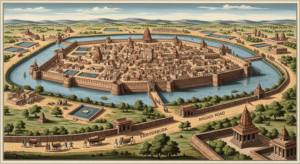
At the heart of Shivaji’s Bangalore stood the Old Bangalore Fort, near today’s KR Market. Though the original mud fort built by Kempegowda I in the 16th century had been rebuilt in stone by the Bijapuris, its core still retained the essence of an older, local Karnataka aesthetic. Within those walls, Shahaji established his residential palace and military headquarters, where he received emissaries, planned campaigns, and trained his son.
Historians believe the palace stood near Kempapura Agrahara, a settlement just outside the fort where Brahmins and administrators lived. It was here, amidst the hum of local markets and the watchful eyes of guards, that young Shivaji studied the fine threads of administration — how to collect revenue, maintain cavalry, and manage alliances with the local Kannadiga chiefs.
Today, though the palace has vanished, remnants of the old fort near Tipu Sultan’s Summer Palace still whisper of that time. Visitors can stand by its massive granite walls, look toward the remnants of the moat, and imagine a teenage Shivaji sparring in the courtyards or riding his horse through the gates.
The Wedding of a Warrior
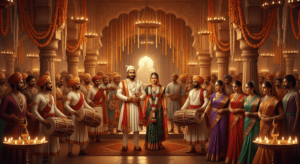
In 1640, Bangalore saw one of its most regal celebrations. The city’s lanes filled with festivity as Shivaji married Sai Bai Nimbalkar, the daughter of Lakhuji Jadhav’s family of Phaltan nobility. The wedding, arranged by Shahaji, was held at his Bangalore palace. Chronicles describe an event marked by grandeur — Marathi and Kannada musicians, Adil Shahi courtiers, and local chieftains attended, symbolizing a bridge between cultures.
Even today, residents of Chickpet and Balepet, areas that formed the commercial heart of Shahaji’s Bangalore, speak of old houses and temples where Maratha guests once stayed during the royal wedding.
Training Grounds and Alliances

Beyond the fort, Shivaji spent time exploring the rolling lands south of Bangalore — what we now know as Basavanagudi, Banashankari, and the Ramanagara region. These rocky hills and forested outcrops were perfect for cavalry practice and stealth maneuvers. Here he first experimented with the tactics that would later evolve into his famous guerrilla warfare strategy, or ganimi kava.
He also interacted with local Nayakas (feudal chiefs) in nearby towns like Magadi and Savanadurga, observing how smaller rulers managed to assert independence under the shadow of larger empires. This understanding of local politics would later guide his campaign for Swarajya — self-rule.
The Departure and Legacy
By 1648, political winds changed in the Deccan. Shahaji was arrested briefly by the Bijapur Sultan, and Shivaji was recalled to Pune to manage family estates. But the lessons of Bangalore traveled with him. Here he had learned the importance of fortifications, the power of disciplined cavalry, and the value of ruling through both strength and compassion.
Centuries later, Tipu Sultan would strengthen the very same fort that Shahaji once governed, layering history upon history. The modern KR Market, Tipu’s Palace, and the Gavi Gangadhareshwara Temple area still stand as mute witnesses to the time when young Shivaji roamed these lands, a prince unaware that destiny would crown him one of India’s greatest kings.
Even today, if you stand by the crumbling walls of the old fort and listen closely amid the noise of the city, it’s easy to imagine the clang of swords, the neighing of horses, and the fiery dreams of a young man destined to rewrite Indian history.
Leave a Reply