
Kannauj: India’s Grasse
In the heartland of Uttar Pradesh, on the ancient Gangetic plains, lies Kannauj, a city whose very soul is intertwined with fragrance. Known as “India’s Grasse,” this city is not merely a geographic location but a living, breathing museum of perfumery, where a tradition spanning over a thousand years continues to thrive. This blog post invites you on an olfactory pilgrimage, a journey to a place where time slows down, and the air itself is a rich tapestry of history and aroma.
The story of Kannauj’s perfumes is the story of India’s civilization itself, a fragrant legacy that has been meticulously preserved against the tides of modernity. Unlike the modern, alcohol-based perfumes found on store shelves, Kannauj specializes in attars—pure, botanical, and alcohol-free fragrances made through a unique and ancient hydro-distillation method. To understand Kannauj is to understand this art form, an alchemy that transforms ephemeral blossoms into eternal scents.
For a guided tour of Kannauj Perfumeries, please visit Kannauj Tour from Agra.
A Walk Through History: Kannauj’s Fragrant Past
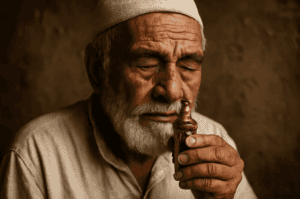
The roots of Kannauj’s perfumery can be traced back to the 7th century, during the reign of Emperor Harshavardhana. Historical accounts, such as Harsha Charita by his court poet Banabhatta, mention the use of fragrant oils and perfumes, indicating that a sophisticated culture of scent was already flourishing. The city’s strategic location along ancient trade routes and its fertile alluvial soil, perfect for cultivating fragrant flora like roses, jasmine, and vetiver, solidified its destiny as a perfumery hub.
The industry truly reached its zenith under the patronage of the Mughal emperors, who, with their refined tastes and love for luxury, elevated attar-making to a high art. The Ain-i-Akbari a 16th-century administrative document of Emperor Akbar’s court, details the establishment of a dedicated attar-making center in Kannauj. Emperor Akbar was so fond of these scents that he established a special department, the Khusbhu-Khana, to oversee the production and supply of attar for the royal court. The story of Mughal Empress Nur Jahan is legendary; she is credited with discovering the process of extracting rose oil (ruh gulab) when she noticed an oily film floating on the surface of her rose-petal bath. This discovery is a testament to the city’s role in pioneering perfumery techniques that would become central to Indian and, eventually, global fragrance traditions.
Throughout the centuries, despite the rise and fall of empires and the challenges of a changing world, the perfumers of Kannauj, known as attar-makers, have been the silent custodians of this tradition. Their knowledge is a cherished family secret, passed down from father to son, a living oral history that is not written in books but in the deftness of their hands and the sharpness of their noses.
The Alchemy of Scent: Unveiling the Deg-Bhapka Method

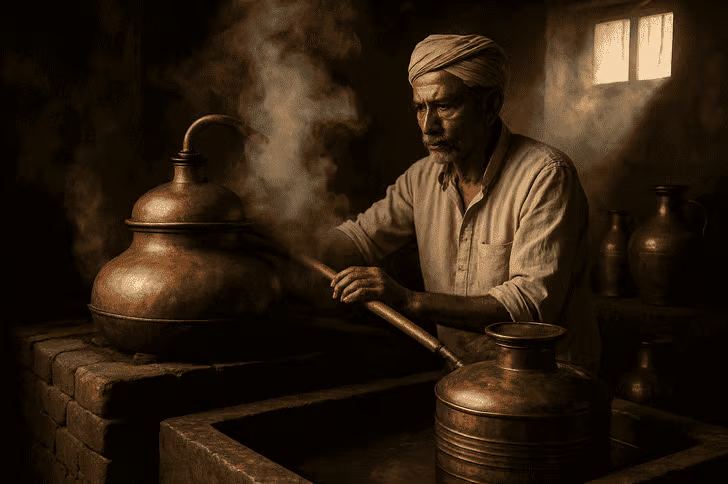
At the heart of Kannauj’s enduring perfumery tradition is the deg-bhapka method, a slow, labor-intensive, and entirely organic process of hydro-distillation. This technique, which predates the famed perfumeries of Grasse, France, is a beautiful dance between fire, water, and flora.
The process begins at dawn when fresh, fragrant flowers like the Damask rose or Bela jasmine are plucked from the fields. It is a race against time, as the flowers must be processed immediately to capture their most potent fragrance. The flowers, along with water, are placed in a large copper still called a deg This copper vessel, often weighing up to 160 kilograms, is a crucial component, as the metal is believed to be non-reactive and helps to preserve the integrity of the delicate essential oils.
The deg is then sealed with a unique mixture of clay and cotton, ensuring no fragrant vapor escapes. This sealed vessel is placed on a traditional furnace, a bhatti, where a slow fire, often fueled by wood or cow-dung cakes, is lit underneath. The temperature is regulated with astonishing precision, not by a digital thermostat, but by the watchful eye and experienced hand of the dighoo, the master distiller. The heat gently warms the flowers and water, causing the fragrant compounds to vaporize.
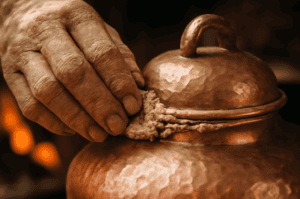
This fragrant steam travels through a long bamboo pipe, known as a chonga, which acts as a condenser. The chonga is wrapped in twine and connected to a second copper vessel, the bhapka or receiver. This bhapka sits submerged in a large cooling tank, a gachchi, which is continuously replenished with fresh water to maintain a cool temperature. As the hot, fragrant steam enters the cool bhapka, it condenses back into a liquid form, a mixture of aromatic water and essential oil.
But the journey is not over. The liquid from the bhapka is then poured into a separate container, where the water is separated from the oil. The aromatic water is often used as a base for rose water, while the precious oil is reintroduced into a fresh batch of flowers and the distillation process is repeated. This is a multi-stage process, and the final attar can be the result of a single distillation or multiple redistillations over several days, each adding layers of complexity and concentration.
The final, highly concentrated oil is then stored in special leather bottles made from camel hide, called kuppis. This step is a hallmark of Kannauj’s tradition. The porous leather allows any remaining moisture to evaporate slowly over time, leaving behind only the pure, rich, and intensely fragrant attar. This natural aging process is what gives Kannauj attars their deep, mature character and incredible longevity.
A Symphony of Scents: The Unique Attars of Kannauj
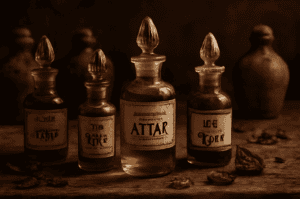
Kannauj’s perfumers have mastered the art of capturing an astonishing variety of scents, far beyond the typical floral notes.
- Mitti Attar: Perhaps the most famous and unique attar of Kannauj, Mitti Attar is a fragrance that captures the petrichor—the earthy scent of the first rain on dry soil. This is achieved by hydro-distilling baked clay, a process that is a marvel of human ingenuity and a true reflection of the cultural and spiritual connection to the land.
- Ruh Gulab: The soul of the rose. This is the pure, unadulterated oil extracted from the Damask rose. Known for its rich, sweet, and deep floral notes, it is a timeless classic.
- Ruh Khus: Extracted from the roots of the vetiver grass, Ruh Khus attar is a cooling, earthy, and woody scent that is particularly popular in the summer months.
- Shamama Attar: A complex and intoxicating blend of numerous herbs, spices, and flowers. The creation of a Shamana is a highly guarded secret and a showcase of a perfumer’s skill, often involving dozens of ingredients and multiple distillations.
- Jasmine (Bela and Mogra): Kannauj is home to some of the finest jasmine attars, including Bela and Mogra. These are intensely floral and rich, capturing the heady scent of the night-blooming flowers.
- Genda (Marigold) and Hina: Even marigolds, with their distinctively sharp and spicy aroma, are transformed into beautiful attars. Hina attar is another complex scent, created from henna flowers, often with warm, spicy, and woody undertones.
Visit Kannauj
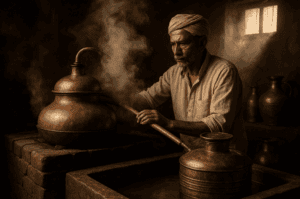
For the discerning traveler seeking an authentic and unforgettable experience, Kannauj offers a window into a world that few have seen. It’s a place where you can not only witness the ancient deg-bhapka process firsthand but also engage with the master craftsmen who have dedicated their lives to this art. The city’s narrow, fragrant streets, bustling markets, and historical sites provide a backdrop for a journey that is as much about cultural immersion as it is about scent.
You can visit the local distilleries, watch the artisans meticulously tend to their copper stills, and feel the warm, humid air thick with the scent of a thousand flowers. You can walk through the rose fields at dawn, a sight and smell that is nothing short of magical. And, of course, you can sample and purchase a wide range of attars, each bottle a liquid memory of your journey.
In a world increasingly dominated by mass production and synthetic fragrances, Kannauj stands as a beacon of tradition, sustainability, and authenticity. A visit here is more than just a trip; it’s a sensory and cultural experience that leaves a lasting impression, a fragrant souvenir that you will cherish long after you have returned home.
For a guided tour of Kannauj Perfumeries, please visit Kannauj Tour from Agra.
Leave a Reply