
Chennai Tour
Chennai is the gateway to South India and is a cultural melting pot. Join us for an immersive experience.
From Kanchipuram to Mahabalipuram: Meet Silk Weavers, Doll Makers, Stone Scultors & Irula Tribals
Silk to Stone experience is two days spent with the people who still weave Kanchipuram silk, carve Pallava granite and read the forest as their ancestors did, each of them paid directly for the time they give you.
Silk to Stone is a private two day responsible tourism journey from Chennai through Kanchipuram and Mahabalipuram, where you meet the people who make silk and carve stone. On Day 1 you visit Ekambareswarar Temple in Kanchipuram, then meet silk dyers, a weaving family and doll makers, and spend the night in Mahabalipuram. On Day 2 you walk the Mahabalipuram monuments, watch students carve at a sculpting college, and spend time with the Irula community before returning to Chennai by 530 PM. Every host is paid directly by 5 Senses Tours, built into the price
Tour | Silk to Stone, a private 2 day, 1 night responsible tourism tour from Chennai |
Route | Chennai – Kanchipuram – Mahabalipuram- Chennai |
Community Hosts: | A silk dyeing unit, a handloom weaving family, a sculpting college and the Irula community, |
Transport: | Air conditioned privare car |
Heritage: | UNESCO World Heritage monuments at Mahabalipuram, inscribed in 1984, and Kanchipuram silk, a Geographical Indication product since 2005 |
Group size: | Private |
Price: | From Rs 6500-10750 per person |
| Guide language: | English |
Operator: | 5 Senses Tours, Ministry of Tourism approved, running tours across India since 2015 |
On the first morning of this journey you stand beneath Ekambareswarar, a Kanchipuram temple that Pallava, Chola and Vijayanagara builders each shaped. On the second you stand at the Shore Temple, raised on the Mahabalipuram coast in the early eighth century by the Pallava king Rajasimha, also known as Narasimhavarman II, from granite blocks. About seventy kilometres apart, the families around these monuments have kept working for centuries: weaving silk in one town, carving stone in the other.
On these two days you will do something no monument can offer. You will sit in a weaver’s home while a saree that takes ten days to make comes alive on the loom, watch a dyer set the colour that will become a bride’s border, see a family turn waste paper into painted dolls, stand beside a master carver as a granite block begins to show a deity, and spend time with the Irula, an indigenous community whose knowledge of plants and snakes has helped save lives across India. Every one of these hosts is paid directly by 5 Senses Tours for their time, built into the cost of your journey.
🧵 Silk Weaving
🌿 Irula Community
🏛️ Pallava Temples
🗿 Stone Sculpting
The tour runs two days by private air conditioned car from your Chennai hotel, covers seven stops, includes one night in Mahabalipuram, lunch on both days and breakfast on Day 2, and returns you to Chennai by about 7 PM on the second evening. It is run by 5 Senses Tours, a Ministry of Tourism approved operator and winner of the Outlook Responsible Tourism Award, with every host paid directly.

Silk to Stone is a private two day journey that leaves your Chennai hotel in the morning and travels through six stops. On Day 1 you visit Ekambareswarar and Kailasanathar temples in Kanchipuram, a silk dyeing unit and a handloom weaving family’s home, before driving to Mahabalipuram for the night. On Day 2 you walk the UNESCO World Heritage monuments at Mahabalipuram, visit a sculpting college where granite is carved by hand, spend time with the Irula community, and return to Chennai by evening.
This is built as responsible tourism, not marketed as it. The dyeing unit, the weaving family, the sculpting college and the Irula community are each paid directly by 5 Senses Tours for their time, built into the cost of your journey and never left to tips. Visits happen during real working hours, nothing is staged for you, and each host decides what to open to you and how much.
Named bodies stand behind this model. 5 Senses Tours has won the Outlook Responsible Tourism Award, is approved by the Ministry of Tourism, is a member of the Indian Association of Tour Operators, and was a Tripadvisor Travellers Choice 2025 winner. The company is ranked number one of 226 tours and activities in Chennai on Tripadvisor, with a 4.9 rating across more than 1,350 reviews, and has run private tours across more than fifteen Indian cities since 2015.
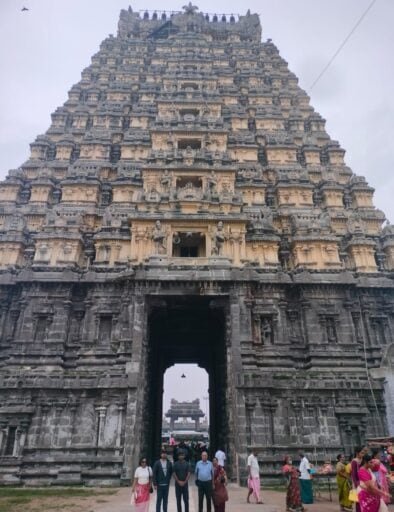
Ekambareswarar is one of the five Pancha Bhuta Sthalas, the Shiva temples that tradition ties to the five elements, and this one holds earth. You arrive early, before the crowds, and walk under a gateway tower that ranks among the tallest in South India. Your guide takes you through the sacred mango tree, the story of the sand lingam, and the Pallava, Chola and Vijayanagara builders who each left their mark. Footwear comes off at the entrance, and shoulders and knees should be covered.
You will walk through the society, meet the people who work the design and coding sections, and see how a centuries old craft runs on a modern system without losing the hand at the loom. The silk itself travels here from Karnataka, arriving at the society before it passes on to the dyers and then to the weavers. This is the part of the saree’s story that almost no visitor to Kanchipuram ever sees.
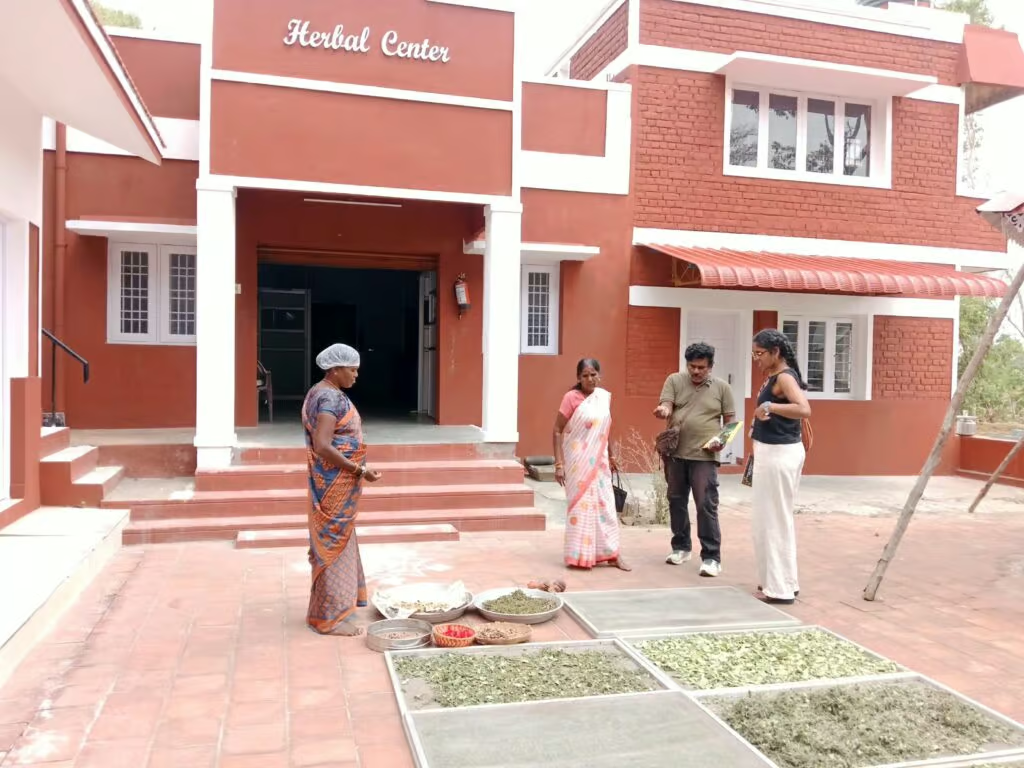
Kanchipuram silk is dyed in specialist units before it reaches the weaver, and most visitors are never allowed inside one. Raw mulberry silk arrives here from the society and leaves it coloured, ready to be handed to the weaver. You will watch the dyeing process from a respectful distance, in a working unit where the people you see are at work and not performing.
Access is by agreement, and two rules apply. Please do not film, and please do not photograph the faces of the workers. Your guide will also speak plainly about what dyeing costs the area, the water it uses and the pressure that places on the surroundings. It is an honest part of the story, and the families who depend on this trade, around seven and a half thousand of them, think about it every day.
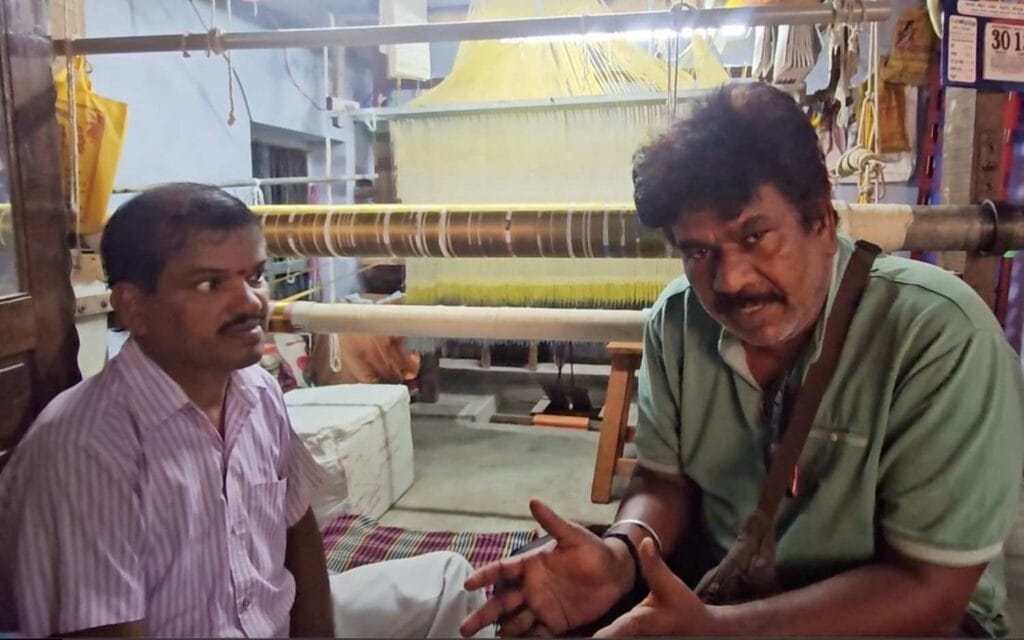
A traditional Kanchipuram saree takes about ten days to weave at eight hours a day, and a weaver is typically paid around ₹5,000 for it. That figure sits against a retail price that starts at ₹15,000 for an original silk saree, and it is the most honest number you will hear on the whole trip. You will hear it from the weaver, in the weaver’s own home.
The home you visit is a simple village house, not a luxury stay. The loom occupies most of the main hall, and the family lives around it. A standard saree runs eighteen feet, and a traditional one twenty four, woven in pure mulberry silk with zari, the silver thread plated in gold that gives the border its light. The family you meet includes a weaver who has won a national award for the craft. Their craft is also protected by a Geographical Indication tag granted in 2005, one that recognises the interlocking korvai technique in which border and body are woven separately and joined by hand. The Silk Mark Organisation of India certifies pure silk, and a zari testing unit in Kanchipuram checks the gold and silver content of the thread.
Ask about the rains. A week of continuous rain can cost a weaving family heavily, as raw material and the wooden loom both suffer. Ask about the next generation as well, since many young people in weaving families are choosing other work. These are not complaints. They are the reason your visit matters.
Kanchipuram’s papier mâché dolls are made from paper that would otherwise be thrown away. After lunch you will spend about forty five minutes with the doll makers and learn the full traditional process, from soaking and shaping waste paper to moulding, drying and painting the finished figure. It is a lighter, more colourful hour that follows the quieter weight of the weaving village.
The craft also carries an unexpected thread that leads to your final stop. In Japan, Bodhidharma is remembered as Daruma, and the round, legless Daruma doll that carries his name is traditionally made of papier mâché. The dolls you watch being made here are not Daruma dolls, but you will be standing in the town that tradition names as his home when you see how paper becomes a figure.
Mahabalipuram’s Group of Monuments has been a UNESCO World Heritage Site since 1984, and you have three unhurried hours here.
The Pancha Rathas are the first stop: five monolithic temple chariots carved from single granite boulders in the 7th century, in the reign of the Pallava king Narasimhavarman I. They carry the names of the Pandava brothers and their wife Draupadi, though those names came later and have no real link to the Mahabharata. What makes them remarkable is that each shows a different architectural style, as if the boulder field were a laboratory for temple design. A lion, an elephant and a Nandi stand among them. Your guide explains the carving and what the Pallava craftsmen were testing in each one.
Arjuna’s Penance is among the most remarkable reliefs in the world, a giant open air panel about 29 metres long and 13 metres high, carved across two huge boulders. Tradition reads it two ways: Arjuna performing penance to win a divine weapon from Shiva, or Bhagiratha bringing the river Ganga down to earth. A natural cleft between the boulders carries the river, with nagas and celestial beings flowing down it, among gods, hunters, animals and birds. In the lower left a cat stands on one leg in imitation of the holy man while mice gather around it, a detail most visitors walk past. Your guide points it out and explains the humour the Pallava sculptors tucked into their most ambitious panel.
Krishna’s Butterball is next, a giant granite boulder balanced on a gentle slope that has resisted every attempt to move it. It has stood in the same place for more than twelve centuries.
The Varaha Cave and the Mahishasuramardini Cave follow, two of the finest examples of Pallava cave temple carving. The Varaha Cave shows Vishnu as the boar lifting the earth goddess from the cosmic ocean, and the goddess Lakshmi being anointed by elephants. The Mahishasuramardini Cave holds two celebrated panels: Vishnu reclining on the serpent Ananta in absolute serenity, and Durga riding her lion into battle against the buffalo demon Mahishasura with extraordinary force. The two panels face each other on opposite walls, one of the great compositional contrasts in early Indian sculpture.
On the rock above stands the Olakkanesvara Temple, known as the Old Lighthouse, a reminder of how busy this port was in the Pallava period.
The Shore Temple is the final and most iconic stop. Built around 700 CE by the Pallava king Rajasimha, also known as Narasimhavarman II, from dressed granite blocks, it is one of the oldest structural temples in South India. It stands at the edge of the Bay of Bengal with two towers dedicated to Shiva and, between them, a shrine of Vishnu reclining, a dual dedication that shows the theological range of the Pallava age. Sea air has softened its carvings over thirteen centuries, yet it keeps an extraordinary presence, and because it faces east, the first light of the day falls on its main deity.
A sculpting college in Mahabalipuram still trains young artisans in the ancient art of stone carving, under master craftsmen who learned from masters before them. The Pallava carvers left no signatures, but their craft did not die. You watch chisels meet granite exactly as they have for centuries, and see a shapeless block slowly reveal a deity, a dancer or a myth.
Talk to the students about why they chose a trade that takes years to learn, and to the masters about what they are passing on. This hour closes the loop on everything you saw in the morning. The monuments are the finished work, and this is the workshop.
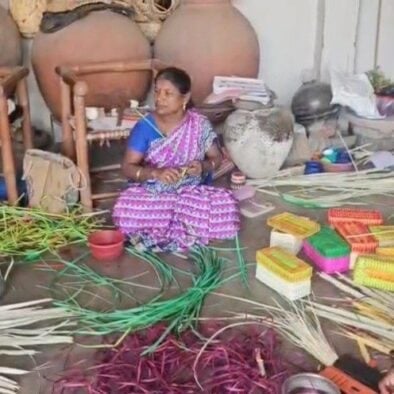
The Irula are one of India’s oldest indigenous communities, renowned for their ecological wisdom, their knowledge of medicinal plants and their snake handling skills, which have helped supply the venom used to make life saving antivenom. You meet community members, and see how Irula women craft natural herbal products as a sustainable livelihood.
This is a side of Tamil Nadu few travellers ever meet. It is also an unhurried, respectful conversation and not a performance, and the community decides what to share. When you leave, you will have spent two days with the people who work with silk, stone and forest, and you will see the whole state differently.
Every host on this journey is paid directly by 5 Senses Tours at the time of your visit. The dyeing unit, the weaving family, the sculpting college and the Irula community are each paid for the time they give you, built into the cost of the tour and never left to tips. No host waits on a guest’s generosity, and each decides what to open to you.
Both halves of this journey are crafts under pressure. Silk weaving faces rain, water use and a younger generation looking elsewhere for work. The Irula lost much of their traditional living when snake hunting was banned in 1972, and have rebuilt livelihoods around venom collection and herbal products. A guest who understands those pressures supports the craft better than one who has only seen the finished product.
The silk you see is protected by a Geographical Indication registration dating to 2005. The monuments you walk are protected as a UNESCO World Heritage Site. Travelling this route with 5 Senses Tours puts money directly into the households and institutions that keep both kinds of heritage alive.
5 Senses Tours is a member of the Indian Association of Tour Operators.
🏆 Outlook Responsible Tourism Award
🏛️ Ministry of Tourism Recognised
⭐ Ranked #1 on Tripadvisor
🤝 IATO Member
Your guide has spent years walking Kanchipuram’s temple lanes and Mahabalipuram’s rocky shore, and speaks Tamil and English fluently enough to translate not just a weaver’s words but a carver’s pride. Expect Pallava history delivered as a story you are standing inside, and a pace that adjusts to how long your group wants to linger at a loom or a rock face.
Over two days your guide reads the group quickly. Guests who want more time with the Irula get it, and guests who want to stay longer at the monuments in the morning light get that too. The same standard applies to every host, and your guide’s relationships with each family and institution, built over repeated visits, are the reason these doors open.
✅ Private air conditioned vehicle from your Chennai hotel and back
✅ Pickup and drop at your Chennai hotel
✅ Visit to a weavers cooperative society and a silk dyeing unit
✅ Time in a weaving village and a weaving family’s home
✅ Guided tour of Mahabalipuram world heritage site
✅ Meeting students of Sculpture College
✅ Interaction with Irula Tribe working on herbal medicine
✅ Direct payment to every host, included in the tour cost
✅ English speaking expert guide throughout
✅ Bottled water in the vehicle
✅ 1 night stay in Mahabalipuram with breakfast




Yes, with adjustments. The day involves about four and a half hours of driving in total and one visit to a simple village home with basic seating, so it is best suited to guests who are comfortable sitting for longer stretches. Tell us about any mobility concerns when you book and we will shape the pace around them.
Your private air conditioned vehicle for both days, one night in Mahabalipuram, Day 2 breakfast, entry to the temples and monuments, visits to the dyeing unit, weaving family, sculpting college and Irula community centre, an English speaking expert guide, direct payment to every host, and all taxes.
Every 5 Senses Tours journey is private and built around your group. If you would like more time at the Mahabalipuram monuments, an extra night by the sea, or a different pace through the weaving village, tell us before you travel and we will arrange it.
You will meet community members and see how Irula women craft natural herbal products as a sustainable livelihood, and learn about the community’s knowledge of medicinal plants and snake handling, which has helped supply the venom used in antivenom production
Choose from our comprehensive list of guided tour from Chennai.
Join our immersive culture walks to discover authentic India. Led by a guide, experience culture, heritage & food across India.
Listen to Incredible India Travel, a podcast about the best places to visit and experiences in India.
Join our ride on Royal Enfield Motorcycles s we experience authentic India, led by an escort rider.