
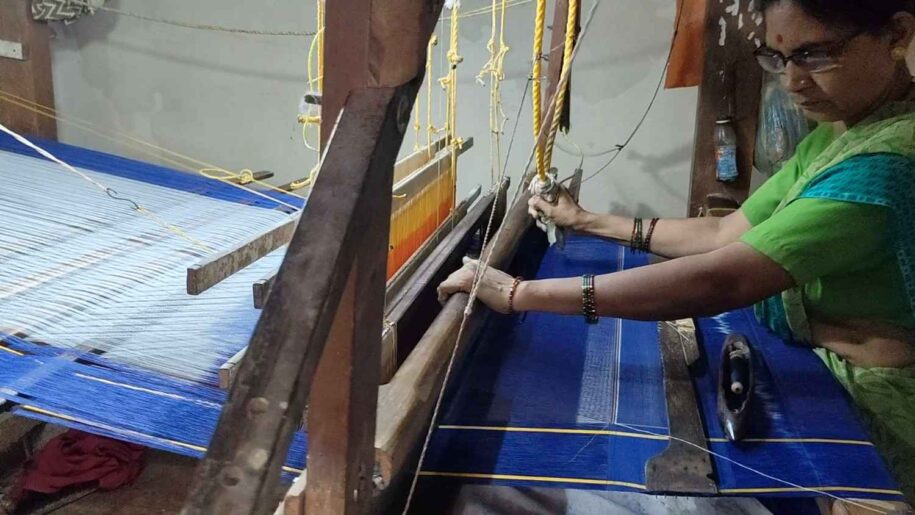
The cotton arrives as a simple cone of white thread.
By the time it leaves the workshop at Talipady as a finished Udupi saree, it has passed through hands that know exactly how much tension a warp thread can bear before it snaps, how to apply sizing directly onto the loom while the weave is in motion, and how to read the rhythm of a shuttle moving through thousands of individual threads without losing count of a single one.
It has also passed through a tradition that is, at this moment, genuinely close to disappearing from the earth.
A 2017 survey by the Kadike Trust revealed that only forty-two weavers continued to make Udupi sarees across the two districts of Udupi and Dakshina Kannada. Forty-two. For a craft that had once supported over five thousand weaving families across the same region, that number tells a story of collapse so quiet and so gradual that most people living nearby have barely noticed it happening.
This is the story of the Udupi cotton weavers of Talipady, what they make, how they make it, what has brought them to this moment of precarity, and why the answer to whether this craft survives lies partly in whether the world beyond this small workshop is paying attention.
Contact 5 Senses Tours to join the Coast to Canopy trail and meet the weavers of Talipady
The Udupi Cotton Weavers: What Makes This Cloth Different From Everything Else
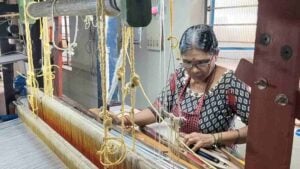
What the Udupi Saree Actually Is and Why It Cannot Be Faked
The Udupi cotton saree is not simply a cotton saree made in Udupi. It is a specific textile with a specific construction method, specific raw materials and a specific finish that cannot be reproduced on a power loom, however sophisticated, without losing the qualities that make it worth having in the first place.
The Udupi saree is woven using the best quality single ply combed cotton yarns for both warp and weft. A unique method of sizing known as loom sizing is practiced by Udupi saree weavers. The sizing material is applied directly to the yarn while the weaving is in progress. A special brush with bristles made from parts of the fish tail palm tree is used to brush the yarn during this process. The sizing reduces yarn breakage and improves the quality and efficiency of weaving. The on-loom sizing provides good stiffness and a shine finish to the woven saree.
The loom sizing is the technical detail that separates an authentic Udupi cotton saree from every imitation. Sizing, the process of coating yarn with a stiffening agent to reduce breakage and improve weave density, is normally done before weaving in industrial textile production. Doing it during the weave itself, on the loom, while the shuttle is still moving, requires a level of manual skill and spatial awareness that takes years to develop and cannot be automated. The fish tail palm brush used in this process is itself under threat, adding a layer of ecological fragility to an already endangered craft.
The finished cloth has a distinctive hand feel that wearers describe as crisp without being stiff, light without being flimsy. It breathes in the coastal Karnataka heat in a way that synthetic and power loom fabrics simply do not. It lasts decades with proper care. And it improves with washing rather than degrading, because the cotton fibres soften while retaining their structure.
Why This Craft Has Survived for Two Hundred Years and Why It Is Now at Risk
As part of the freedom movement headed by Mahatma Gandhi, eight cooperative handloom societies were formed in undivided Dakshina Kannada. More than five thousand families from different communities were engaged in weaving at the time. There was great demand for Udupi sarees from all over Karnataka.
The cooperative model that Gandhi’s movement created gave Udupi cotton weavers an institutional structure that held through independence, through the early decades of the republic and through the first waves of industrial competition. What it could not hold against was the specific combination of forces that arrived together after liberalisation in the 1990s.
There are multiple reasons for the fall of Udupi saree weaving. The onslaught of power loom clothes and their cheap products, and fake handloom products flooded the market. Power loom sarees, produced in hours rather than days, sold at prices that no handloom weaver producing a genuinely labour-intensive cloth could match. Worse, they were often sold as handloom, labelled and marketed in ways that made it impossible for a buyer without specific expertise to tell the difference between an authentic Udupi cotton saree and a machine-produced imitation.
The society has been running under a loss of about two crore rupees since the last twenty years. In the past, over one hundred sarees and bed sheets were being made. Now only sixty sarees are being made.
And then there is the question of the next generation.
Not many youngsters are taking up this profession. If I continued to be a weaver I would not have got married, said one weaver who left handloom work to become a roadside food vendor.
That sentence contains the entire crisis in one human statement. Handloom weaving in India has historically been both a livelihood and an identity, the craft, the community and the income all bound together in the same daily practice. When the income becomes insufficient, the identity follows. And when the parents stop weaving, the children never learn. The knowledge, accumulated across generations of practice, does not go anywhere to be retrieved. It simply ceases to exist.
What the Families at Talipady Are Still Doing and Why It Matters
The Talipady Weavers Society is one of the five cooperative societies where Udupi saree production continues today. The families here have stayed with the craft through decades of declining income and dwindling recognition, for reasons that are as much about identity and community as they are about economics.
What they produce at Talipady is genuinely irreplaceable. The loom sizing technique, the fish tail palm brush, the specific cotton counts and the on-loom rhythm that produces the distinctive Udupi saree hand feel, these are not things that can be reconstructed from a manual or a video. They are embodied knowledge, living in the hands and eyes and spatial memory of the weavers who practice them. When the last weaver who holds this knowledge stops working, it is gone.
The focus of the NGOs working on revival is the youth, who they believe can learn the craft and take it forward. Manjunath is learning to weave Udupi sarees along with his daughter and daughter-in-law. He hopes to take the legacy forward.
The Geographical Indication tag that the Udupi saree has received in recent years is an important protection, legally distinguishing the authentic handloom product from machine-made imitations. But legal protection alone cannot keep a craft alive. What keeps a craft alive is demand, direct, informed demand from buyers who understand what they are buying and are willing to pay the price that makes it worth the weaver’s time to keep weaving.
Experience the Udupi Cotton Weavers With 5 Senses Tours
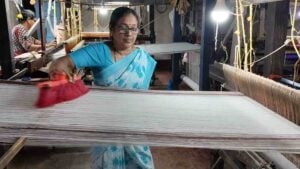
The weaving families of Talipady decide how much of their process to open up to outside visitors. They are not a demonstration organised for tourists. They are a working cooperative that has chosen to allow a small number of guests into their production process because the direct connection with an international audience, and the direct income that comes with it, gives them a genuine reason to keep doing what they do.
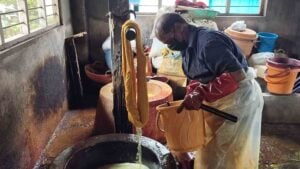
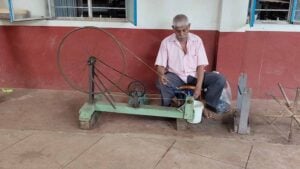
What visitors see at Talipady is the complete production chain, from yarn lifted out of a hand-dyeing vat, wound onto a traditional hand-cranked charkha wheel, and set as warp thread on a working loom. This is not a curated experience. It is a working morning in a working workshop, and what happens during it is determined by what the weavers are actually doing that day.
This visit is part of our seven-day Coast to Canopy: A Regenerative Trail Across the Western Ghats and Coastal Karnataka. Groups are small, always private, never exceeding eight people, and 5 Senses Tours pays the community directly after every visit.
Every saree purchased here goes directly to the weaving family. Not to a middleman. Not to a cooperative surplus fund. To the family whose hands made it.
Contact 5 Senses Tours to join the Coast to Canopy trail and meet the weavers of Talipady