
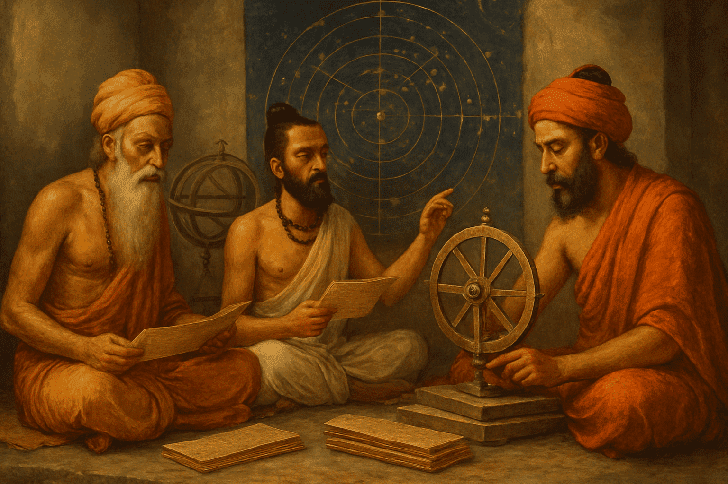
Ujjain: Where Time Began
Imagine a city where time itself was not just measured, but profoundly understood and integrated into the very fabric of existence. A place where ancient sages gazed at the stars, charting the cosmos and laying the very foundations of global timekeeping. Welcome to Ujjain, India’s timeless heart. This renowned and ancient city, often celebrated for its spiritual aura, holds an equally profound scientific legacy. It is literally the “crossroad of Space and Time” in India, a designation that speaks to its deep connection with both the terrestrial and celestial realms. Its history spans thousands of years, with archaeological evidence pointing to early urbanization around 700 BCE and a rich cultural heritage dating back to 2000 BCE.
For a guided tour of Ujjain, please visit Ujjain the ancient time keeper.
For millennia, Ujjain stood as the world’s zero longitude, its original Prime Meridian, a pivotal designation that shaped not just Indian calendars but influenced global geographical calculations. This historical role positions Ujjain as a true “ancient time keeper.” The city’s unique position, where scientific inquiry and spiritual practice were deeply integrated, offers a compelling narrative. For ancient Indian civilization, the pursuit of astronomical and timekeeping knowledge was not a secular endeavor isolated from spiritual beliefs. Instead, it was a path to understanding the divine order of the cosmos, where the precise measurement of time and celestial movements was a form of reverence, aligning human life with cosmic rhythms. This perspective challenges the modern separation of science and religion, presenting a unique cultural experience for those seeking to explore a civilization that viewed knowledge holistically.
Ujjain – The World’s Original Timekeeper
The Meridian of Mahakal: India’s Ancient Zero Longitude
To truly appreciate Ujjain’s historical significance, one must first understand the concept of a Prime Meridian. It is an imaginary line drawn between the North and South Poles, where longitude is defined as 0°. This line serves as a fundamental “zero point” for both time and geographical calculations. While today the internationally accepted Prime Meridian runs through Greenwich, England, the concept of a zero longitude is far older, with Ujjain holding this esteemed position for thousands of years.
For millennia, this crucial line in India was drawn through Ujjain, then known by its ancient name, Avanti. From about the 4th century BCE, Ujjain enjoyed the reputation of being “India’s Greenwich”. Its precise ancient geographical coordinates are noted as 23°10’58”N & 75°46’38”E. This centrality made Ujjain a sacred city, “dedicated especially to Sacred Time”.
This isn’t merely local lore; Ujjain’s status as the zero longitude is unequivocally stated in “all ancient texts on astronomy” , including revered epics like the Mahabharata and Ramayana.
The Surya Siddhanta, one of the earliest and most influential texts on Indian astronomy (dated 4th-5th century CE, though its methods are described as thousands of years old), explicitly explains how to determine place and time with respect to India’s ancient Prime Meridian. It even pinpoints specific cities like Rohitaka (modern Rohtak, near Kurukshetra) and Avanti (Ujjain) as lying on this meridian.
Ujjain’s astronomical importance resonated beyond India’s borders. Even Greek geographers, notably Ptolemy, acknowledged “Ozine” (Ujjain) and its zero meridian in their maps. This global acknowledgment underscores Ujjain’s historical significance as a pivotal point in early world geography and timekeeping. The city’s prime meridian status was not just a theoretical concept; it had profound practical implications. It served as the “basis for all geographical calculations,” and from this line, “All Indian traditional calendars & All sacred time is calculated”. Furthermore, even today, when a Hindu almanac (Panchang) or horoscope is drawn up, it is “always based on Ujjain time”.
The Surya Siddhanta even described a method for converting local time to Ujjain’s standard time. This demonstrates a continuous, unbroken chain of influence from ancient astronomical principles to contemporary cultural and religious practices. This enduring relevance highlights the remarkable resilience and continuity of ancient Indian scientific and cultural systems. Unlike many historical scientific advancements that have been superseded, Ujjain’s role as a timekeeping anchor continues to subtly shape the daily lives and spiritual practices of millions in India, making the city a unique nexus of past and present.
Echoes of Ancient Wisdom: The Cradle of Indian Astronomy
Ujjain was not merely a geographical marker; it was the “principal seat of astronomical knowledge during its early history” and the very “cradle of the Hindu science of astronomy and Timekeeping”. It fostered a vibrant intellectual environment, attracting and nurturing some of the most brilliant scientific minds of ancient India, building a “strong school of mathematical astronomy”.
Among the pioneering scholars who graced Ujjain were:
- Aryabhatt (born 476 CE): In his seminal work, Aryabhattya (written in 499 CE), he clearly articulated the concept of four cardinal cities along the equator (Lanka, Siddhapura, Yavakoti, Roaka) and their relative positions of day and night. This demonstrated an understanding of time zones and global geographical relationships 1500 years ago. His work reveals a sophisticated, global perspective on time and geography, anchored by the Indian meridian.
- Varahamihira (6th century CE): An “outstanding astrologer and astronomer” , he made significant contributions to Indian astronomy and astrology while working in Ujjain.
- Brahmagupta (7th century CE): Another luminary who built upon the strong foundation of mathematical astronomy established in Ujjain , further advancing the field.
- Bhaskara II (1114-1185 CE): As the head of Ujjain’s astronomical observatory, he represented the “peak of mathematical knowledge in the 12th century”. His monumental treatise, Siddhanta Shiromani (written in 1150 CE), covered advanced topics such as planetary mean and true longitudes, eclipses (lunar and solar), spherical trigonometry, and even discussed the concept of Earth’s gravity. The text explicitly references the prime meridian passing through Lanka and Ujjaini, using it as a baseline for calculations.
The Surya Siddhanta, a foundational text of Indian astronomy, not only asserted the Earth is spherical but also calculated its diameter (8,000 miles, remarkably close to modern figures of 7,928 miles) and the distances and diameters of the Moon with impressive accuracy. It provided detailed orbital parameters for planets and was so influential that it was translated into Arabic in the 8th century, significantly impacting medieval Islamic geography and astronomy. The
Surya Siddhanta is described not as a static, immutable text, but as a “living document” that was “revised through about the 10th century” and “updated several times”. The mention of medieval scholar Utpala citing verses from a version of
Surya Siddhanta that are not found in surviving manuscripts further reinforces this. This indicates a continuous process of observation, refinement, and adaptation of astronomical knowledge over centuries. This reveals a scientific tradition that was empirical and responsive to new findings or improved calculations, rather than being rigid or dogmatic. This fundamentally reshapes the perception of ancient Indian science, demonstrating a sophisticated and dynamic intellectual environment where knowledge was continually scrutinized and improved upon, a hallmark of true scientific inquiry. For visitors, this adds a layer of intellectual fascination, showcasing Ujjain as a place where scientific progress was an ongoing, collaborative endeavor.
The Cosmic Crossroads: Where Science Meets Spirituality
Mahakaleshwar: Lord of Time Incarnate
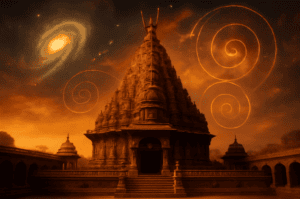
At the very heart of Ujjain’s spiritual landscape lies the Mahakaleshwar Jyotirlinga, one of the twelve most sacred manifestations of Lord Shiva. What makes this shrine profoundly unique is Shiva’s depiction as “Dakshinamurti” (south-facing), which explicitly signifies his role as “Mahakal,” the Lord of Time and Death. This makes the temple a literal, spiritual embodiment of the city’s timekeeping legacy, where the abstract concept of time is deified and worshipped.
The Mahakaleshwar lingam is a “Swayambhu” – meaning it is self-manifested and radiates divine energy without human intervention. This unique characteristic enhances its spiritual potency and reinforces its connection to the primordial, timeless forces of the cosmos. Ujjain, also known as Avantika, is revered as one of the “Sapta Puri” (seven sacred cities of Hinduism), believed to grant salvation (moksha). Its deep spiritual fervor is inextricably linked to its status as the center of time calculation, creating a powerful synergy between the sacred and the scientific. The explicit link between the deity Mahakal and the concept of “Great Time,” coupled with Ujjain’s role as the prime meridian, suggests a cultural tendency to personify fundamental scientific or philosophical concepts into divine forms. This is not just a religious belief; it is a profound cultural expression of how ancient Indians understood and revered the very fabric of existence, including time and space. The act of worship becomes a way to engage with these universal principles. This offers a unique lens for understanding the depth of Indian philosophical and scientific thought, highlighting a worldview where the sacred and the empirical were not in conflict but rather two facets of a unified reality. Visiting Mahakaleshwar, therefore, becomes an experience of connecting with the very essence of time, both scientifically and spiritually.
The Vedh Shala: A Window to the Stars
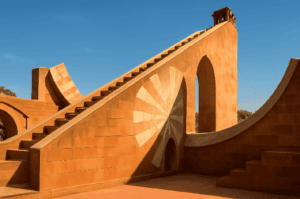
In the 18th century, Maharaja Sawai Raja Jaisingh of Jaipur, a formidable ruler, a brave fighter, and an exceptionally learned scholar, embarked on a remarkable project. Driven by a keen interest in astro-mathematics and a desire for greater accuracy in astronomical measurements, he constructed the Vedh Shala (Observatory), popularly known as Jantar Mantar, in Ujjain in 1719/1725 CE. This was one of five such observatories he built across India (others in Delhi, Jaipur, Mathura, and Varanasi), a testament to his commitment to advancing scientific knowledge. He even sent delegations abroad to collect books and learn from foreign astronomers, assembling a team knowledgeable in Hindu, Islamic, and European astronomical texts.
The Vedh Shala is an architectural marvel, housing large masonry instruments that are themselves astronomical tools. These instruments were designed to measure various celestial phenomena with astonishing accuracy, operating ingeniously on the principle of casting shadows. The large scale of these structures was specifically to gain accuracy, with some providing local time measurements accurate to within 2 seconds.
The observatory features several ingenious instruments:
| Instrument Name | Primary Function | Unique Feature/Significance |
| Samrat Yantra (Giant Sundial) | Measures accurate local time | Upper planes aligned parallel to Earth’s axis, accuracy of ~2 seconds |
| Nadi Valaya Yantra (Nari Valaya Yantra) | Determines exact time and celestial hemisphere | Constructed in the plane of the celestial equator, uses shadow of nails |
| Digansha Yantra | Finds direction, altitude, and azimuth of celestial bodies | Helps gauge planetary transits between celestial houses |
| Shanku (Gnomon) Yantra | Determines sun’s altitude and local latitude | Simple vertical rod utilizing shadow casting |
| Transit Instruments (Bhitti Yantra) | Measures zenith distance of celestial bodies | Unique to Ujjain’s Vedh Shala |
Remarkably, the Ujjain observatory has been continuously functioning since its renovation in the 1920s. It continues to publish an Ephemeris (Panchang) annually since 1942, a journal detailing the daily speed and position of the planets. The observatory also conducts daily weather activities, including rainfall, temperature, and air pressure measurements , and features a modern automatic telescope for visitors to observe planets.
The Tropic of Cancer Connection: A Celestial Alignment
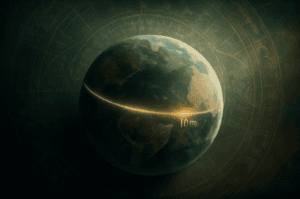
Ujjain has long been traditionally associated with the Tropic of Cancer, with ancient Indian astronomers supposing this significant celestial line to pass through the city. Specifically, tradition holds it crossed the Karkoteshwar temple, located within the Harsiddhi Temple compound , and the Mangalnath Temple, considered the birthplace of Mars (Mangala). This belief cemented Ujjain’s cosmic significance as a point of celestial intersection, further reinforcing its role as a “navel of the earth”.
It is a fascinating aspect of Ujjain’s astronomical heritage that, in actual physical reality, the Tropic of Cancer does not precisely cross the Karkoteshvara temple in Ujjain in our current time. This phenomenon is due to the Earth’s axial obliquity, which oscillates between 22.1 and 24.5 degrees over a vast 41,000-year cycle. The Tropic of Cancer last crossed the site of Ujjain approximately 20,000 years ago and is projected to do so again around 4250 AD. This apparent difference between traditional belief and modern measurement is not a simple error but a reflection of the limitations of ancient instruments and the long-term astronomical cycles they were trying to track. The fact that the
Surya Siddhanta and other texts believed it crossed Ujjain indicates a profound understanding and observation of celestial mechanics, even if the precise latitude shifted over millennia. The continued traditional belief, despite modern measurements, underscores the deep cultural embedding of this astronomical knowledge. This demonstrates that ancient Indian astronomy was a sophisticated, evolving science, grappling with complex phenomena like axial precession. It invites visitors to appreciate the ingenuity of ancient observation methods and the challenges of long-term astronomical prediction without the aid of modern technology. Moreover, it highlights how scientific understanding, once established, can become deeply ingrained in cultural and spiritual narratives, persisting even as scientific precision evolves. This makes Ujjain a fascinating case study in the interplay of science, belief, and enduring tradition.
Experience Ujjain: Walk Through Timelessness
The Sacred Shipra and the Cosmic Kumbh Mela
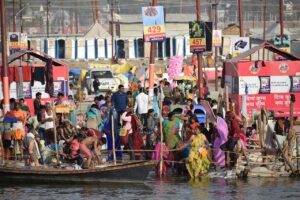
The Shipra River is not merely a geographical feature; it is a sacred entity, revered as much as the holy Ganga by Hindus. Legends abound about its divine origins, with some saying it sprang from the heart of Varaha, Lord Vishnu’s boar incarnation. Its banks hold immense spiritual significance, particularly Ram Ghat, where Lord Rama is believed to have performed his father’s last rites here. The river also witnessed Lord Krishna’s education at Sage Sandipani’s ashram on its banks.
Every twelve years, Ujjain transforms into the vibrant host of the Simhastha Kumbh Mela, one of India’s largest and most revered religious festivals. This grand event is deeply rooted in Hindu mythology, commemorating the legendary “Samudra Manthan” (Churning of the Cosmic Ocean) when drops of the elixir of immortality (Amrita) are believed to have fallen into the Shipra River.
Crucially, the timing of the Kumbh Mela is not arbitrary but dictated by precise astronomical alignments. The festival occurs when Jupiter enters the zodiac sign Leo (Simha Rashi) and aligns with the Sun in Aries. These specific celestial combinations determine the highly auspicious bathing dates for the “Shahi Snan” (Royal Bath) in the Shipra River, where millions of pilgrims take a holy dip to cleanse sins and seek liberation. The next Simhastha Kumbh Mela is an eagerly anticipated event, scheduled for March 27 to May 27, 2028. The Simhastha Kumbh Mela’s astronomical timing and its profound spiritual significance reveal a deep cultural understanding of time not merely as a linear progression but as a cyclical, cosmic rhythm that directly impacts human spiritual well-being. The precise alignment of celestial bodies dictates the most auspicious moments for a collective spiritual endeavor of immense scale, demonstrating how ancient astronomical knowledge directly informed and organized major societal and religious events. This highlights how ancient astronomical observations were not confined to academic circles but were intrinsically woven into the social, religious, and spiritual fabric of life. It offers a unique opportunity to witness a living tradition where the cosmos and human destiny are seen as intimately connected, making the experience of Ujjain truly profound and unlike any other. It underscores the idea that time, in Ujjain, is not just measured but lived and celebrated in harmony with the universe.
Beyond the Meridian: Other Ancient Wonders
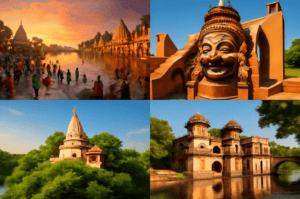
Ujjain’s rich heritage extends far beyond its astronomical prowess, offering a diverse array of historical and spiritual sites that promise a truly immersive and enriching experience for every traveler.
- Ram Ghat: This is the most ancient bathing ghat on the sacred Shipra River, steeped in legends including Lord Rama’s performance of his father’s last rites here. It remains a serene spot for spiritual dips and witnessing the mesmerizing evening aartis.
- Kal Bhairav Temple: Dedicated to Lord Kal Bhairav, a fierce incarnation of Shiva and the city’s guardian deity. This temple is renowned for its unique tantric traditions and the intriguing belief that the deity accepts alcohol offerings from devotees.
- Mangalnath Temple: Perched on a hill overlooking the Shipra, this temple is believed to be the birthplace of Mars (Mangala), according to the Matsya Purana. Its location is considered significant for astronomical studies and for seeking astrological remedies related to the planet Mars.
- Sandipani Ashram: A legendary site where Lord Krishna, his brother Balarama, and his bosom friend Sudama are said to have received their education from Guru Sandipani. The ashram houses ancient scriptures and artifacts, offering a glimpse into India’s profound educational heritage.
- Kaliadeh Palace: This magnificent Persian-style palace, built in 1458 AD by the Sultan of Mandu, is uniquely situated on an island in the Shipra River. Though damaged in wars, it was beautifully restored in the 20th century and offers stunning views of the river flowing on both sides.
- Bhartrihari Caves: These ancient caves, located near the Gadkalika Temple on the banks of the Shipra, are associated with King Bhartrihari, a renowned scholar and poet who is believed to have renounced his kingdom and taken “Vairaagya Diksha” (initiation into asceticism) here.
- Harsiddhi Temple: One of the revered 51 Shakti Peeths, this temple is believed to be the spot where Sati Maa’s lip fell. It was particularly revered by the legendary King Vikramaditya.
- Surya Mandir: Dedicated to Surya, the Sun God, this temple on the Shipra banks reinforces the city’s deep connection to celestial bodies and their worship. It is especially significant during Rath Saptami.
While the core focus of Ujjain’s historical narrative is its prime meridian status, the extensive array of other significant historical and spiritual sites demonstrates that the city’s appeal is far broader than a single theme. These sites represent diverse aspects of Indian culture, including mythology, unique spiritual practices, ancient education, architectural heritage, and traditional arts. This breadth of attractions ensures that Ujjain is positioned as a comprehensive travel destination, capable of offering a rich, multi-day experience rather than just a brief visit for a niche interest. By showcasing its diverse offerings, the city can attract a larger international audience and encourage longer stays, contributing more significantly to local tourism and allowing visitors to delve deeper into the layers of Indian heritage.
Your Invitation to Ujjain
Ujjain is far more than just a city; it is a living museum of time, a place where ancient science, profound spirituality, and vibrant culture converge in a truly unique confluence. From its ancient designation as the world’s Prime Meridian to its role as a cradle of astronomy and a spiritual powerhouse, Ujjain truly is a city that has shaped the very concept of time and continues to resonate with its timeless wisdom.
Do not just read about history – experience it. Come and walk the sacred grounds where ancient astronomers mapped the cosmos, feel the spiritual energy of Mahakal, the Lord of Time, and witness traditions that have endured for millennia. Ujjain invites visitors to step into a timeless journey and appreciate the city as an ancient time keeper firsthand. It promises a transformative journey that will leave an indelible impression on the soul.
For a guided tour of Ujjain, please visit Ujjain the ancient time keeper.
For immersive culture walks in India visit 5 Senses Walks.
Leave a Reply