
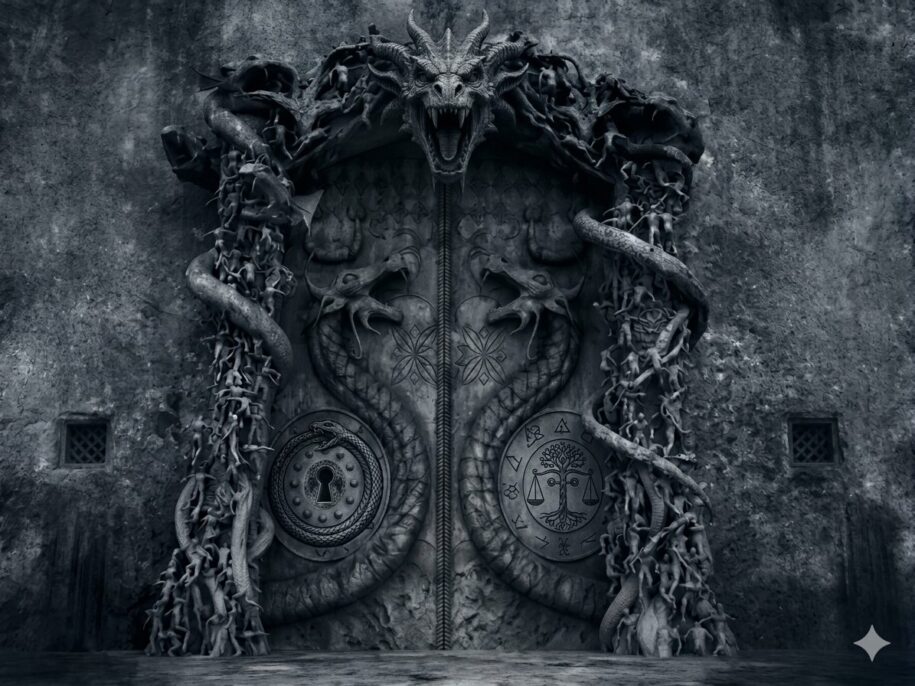
Deep inside Kerala’s ancient Padmanabhaswamy Temple lies Vault B, a sealed chamber that holds secrets so profound that India’s highest court refuses to order its opening. This mysterious door has captivated treasure hunters, historians, and spiritual seekers who want to understand why one of the world’s richest temples keeps this particular vault locked away from human eyes.
For anyone fascinated by unsolved mysteries, ancient treasures, or the intersection of law and spirituality, the story of Vault B offers a compelling blend of history, controversy, and unexplained phenomena. The temple’s other vaults revealed billions of dollars in gold and jewels, making it richer than many countries, yet this one chamber remains untouched.
We’ll explore the shocking discovery that transformed our understanding of the temple’s wealth and examine the legal battles that led the Supreme Court to take an unprecedented hands-off approach. You’ll also discover the competing theories about what lies behind that sealed door – from scientific explanations to supernatural beliefs that have kept local communities convinced the vault should never be opened.
Padmanabhaswamy Temple Kerala: The Ancient Sacred Site That Became the World’s Richest Temple
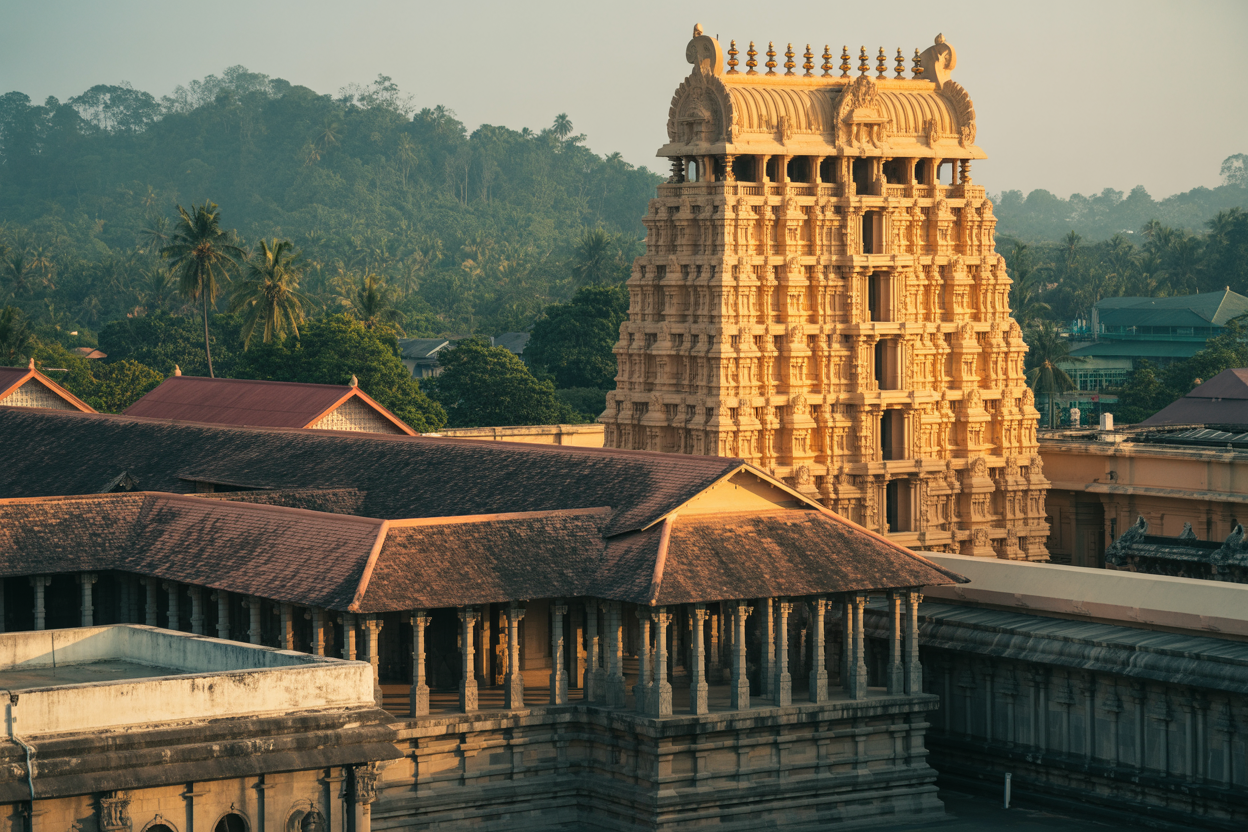
The Ancient Origins and Extraordinary Architecture of Padmanabhaswamy Temple Thiruvananthapuram
The Padmanabhaswamy Temple stands as one of India’s most ancient religious monuments, with its origins stretching back over 5,000 years according to historical records and local traditions. Built in the distinctive Dravidian style of architecture, the temple showcases Kerala’s unique approach to temple construction, featuring intricate stone carvings, towering gopurams, and elaborate corridors that speak to the craftsmanship of bygone eras.
The temple’s main deity, Lord Padmanabha (a form of Vishnu), reclines on the cosmic serpent Anantha in a pose known as “Anantha Shayana.” This massive idol, carved from over 12,000 sacred stones called “Kadu-Sharkara-Yogam,” stretches approximately 18 feet in length and represents one of the finest examples of ancient Indian sculptural artistry.
What sets this temple apart from others across India is its architectural precision and astronomical alignment. The structure was designed to capture specific celestial movements, with the main sanctum positioned to align with solar and lunar cycles that hold deep significance in Hindu cosmology.
The architectural splendour and spiritual depth of Padmanabhaswamy Temple Kerala is best experienced in person with expert guidance. Our Kochi tours include Kerala’s extraordinary temple heritage, bringing the living traditions of this ancient sacred landscape to life for international travellers.
The Travancore Royal Dynasty: 250 Years of Serving as Servants of Lord Padmanabha
The relationship between the Padmanabhaswamy Temple and the Travancore royal family creates one of the most fascinating chapters in Indian royal history. For over 250 years, the rulers of Travancore served not as kings in the traditional sense, but as “Padmanabha Dasa” – servants of Lord Padmanabha.
This unique arrangement began in 1750 when Maharaja Marthanda Varma dedicated his entire kingdom to Lord Padmanabha, establishing a theocratic state where the deity was considered the true ruler. The royal family became custodians rather than owners, managing the temple’s affairs and vast wealth on behalf of the god.
The Travancore rulers contributed immensely to the temple’s prosperity through generous donations of gold, precious stones, and artifacts. Royal patronage brought skilled craftsmen from across South India to enhance the temple’s beauty and expand its treasures. Each successive ruler added to the temple’s wealth, viewing it as their sacred duty to serve their divine master.
Even after India’s independence in 1947, the royal family maintained their traditional role as temple custodians, a responsibility they continue to honor today despite legal challenges and changing political landscapes.
Why Padmanabhaswamy Temple Is One of India’s 108 Most Sacred Vishnu Temples
The Padmanabhaswamy Temple holds immense spiritual significance as one of the 108 Divya Desams – sacred Vishnu temples mentioned in ancient Tamil literature. Devotees from across India and beyond visit this holy site, believing that prayers offered here carry special power due to the temple’s divine energy and historical sanctity.
Daily worship rituals follow ancient Vedic traditions that have remained unchanged for centuries. The temple opens before dawn for “Nirmalya Darshan,” when devotees can witness the deity adorned with flowers from the previous day’s offerings. Throughout the day, elaborate pujas involve chanting of Sanskrit mantras, offering of traditional foods, and presentation of gold ornaments that temporarily adorn the deity.
The temple’s religious calendar includes numerous festivals, with the bi-annual “Laksha Deepam” being the most spectacular. During this celebration, over 100,000 oil lamps illuminate the temple complex, creating a breathtaking spectacle that draws thousands of pilgrims.
Unique to this temple is the practice where devotees can offer gold and precious items directly to the deity, believing such offerings bring divine blessings and spiritual merit. This tradition has continued for generations, contributing significantly to the temple’s legendary wealth.
Kerala’s living tradition of Vishnu worship, royal patronage and ancient ritual is one of the most profound heritage travel experiences available anywhere in India. Our Kochi tours include expert guided access to Kerala’s most extraordinary sacred sites, designed for travellers who want to truly understand what they are standing in front of rather than simply passing through.
The 2011 Archaeological Discovery That Revealed the World’s Greatest Temple Treasure
The temple’s transformation from a place of worship to global headlines began in 2011 when a Supreme Court-appointed committee opened five of six underground vaults. What they discovered defied imagination and challenged understanding of historical wealth accumulation in India.
Vault A revealed an astounding collection of gold coins, some dating back over 2,000 years, alongside precious stones, golden idols, and artifacts crafted by master artisans of different eras. Archaeological experts identified items from various dynasties, including Chola, Pandya, and Vijayanagara kingdoms, suggesting the temple served as a repository for royal offerings across centuries.
The discoveries included a pure gold throne meant for the deity, studded with hundreds of diamonds and precious gems. Archaeologists found golden coconuts, mangoes, and other fruits crafted with incredible detail, along with necklaces weighing several kilograms each.
Carbon dating of various artifacts revealed the temple’s role as a continuous center of wealth accumulation, with some items tracing back to ancient trade relationships between South India and other civilizations. The sheer volume and variety of treasures suggested systematic collection over millennia rather than random accumulation.
These findings elevated the Padmanabhaswamy Temple to the status of the world’s richest religious institution, with conservative estimates placing the discovered wealth at over $20 billion, though the true value remains impossible to calculate given the historical and artistic significance of many pieces.
The story of how this discovery transformed global understanding of India’s ancient heritage is one that our expert guides bring vividly to life. Our Kochi tours and Madurai tours take you deep into South India’s most extraordinary temple heritage, connecting you with the living traditions and extraordinary history that make this region unlike anywhere else on earth.
The Discovery That Shocked the World: Inside Padmanabhaswamy Temple’s Treasure Vaults
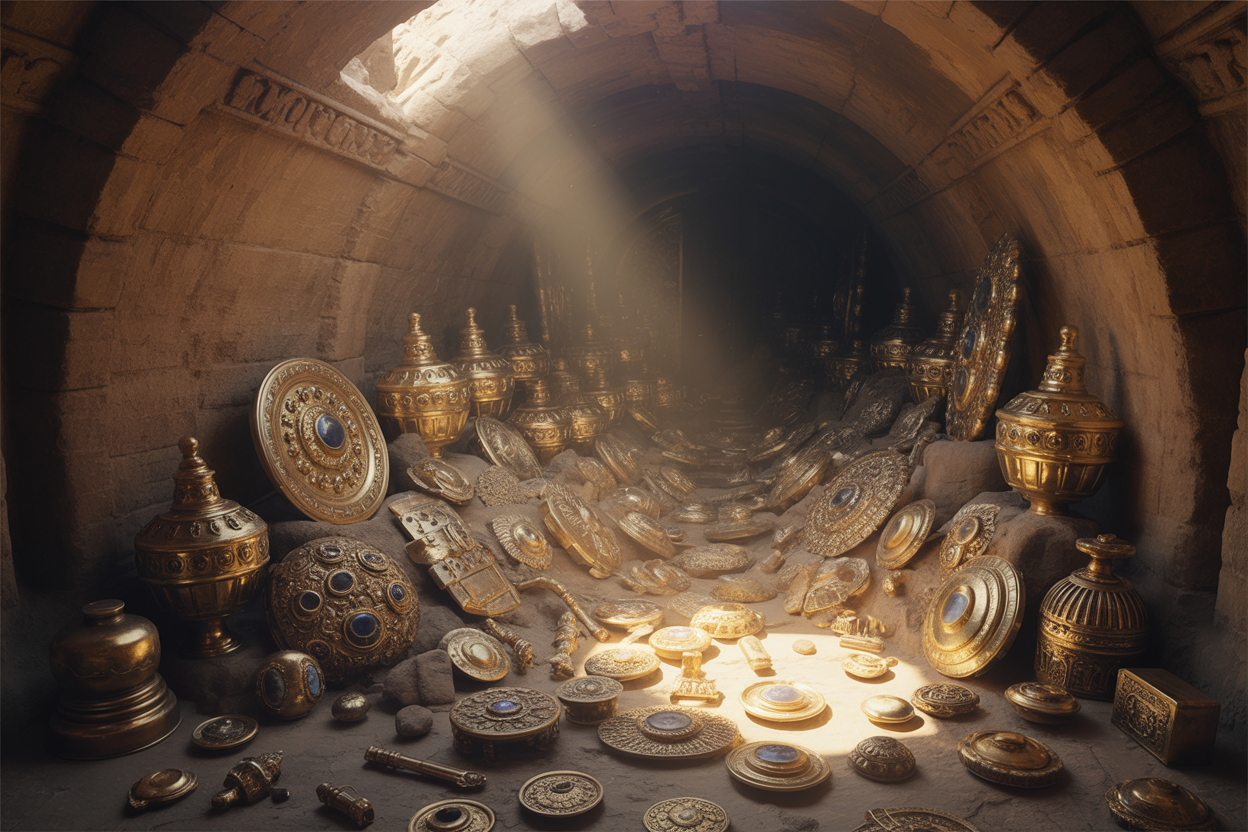
The Supreme Court Order That Led to Opening Five of Padmanabhaswamy Temple’s Hidden Vaults
The story begins with a petitioner named Sundarajan, a former Indian Police Service officer who filed a case in Kerala High Court in 2009. He expressed concerns about the security and management of the temple’s treasures. The case eventually reached the Supreme Court of India, which delivered a landmark judgment on July 4, 2011. The court appointed a seven-member committee to conduct a comprehensive inventory of all the temple’s vaults, marking the first official attempt to catalog the treasures that had remained hidden for centuries.
This decision wasn’t taken lightly. The court had to balance religious sentiments with the need for transparency and security. The royal family of Travancore, who had been the traditional custodians of the temple, initially opposed the opening but eventually cooperated with the court’s orders. The Supreme Court’s intervention transformed what was essentially a family-managed temple into a matter of national importance.
Unprecedented Wealth Found in the Accessible Chambers of the World’s Richest Temple
Between June and July 2011, the court-appointed committee opened five of the six underground vaults labeled A, C, D, E, and F. What they discovered defied all expectations and rewrote India’s understanding of temple wealth. Each vault revealed layers of treasure that had been accumulating for over 500 years, with some artifacts dating back to the medieval period.
Vault A alone contained treasures that took days to catalog. The committee members worked in shifts, carefully documenting each item while maintaining strict security protocols. The sheer volume of wealth was so overwhelming that the initial estimates kept increasing as more chambers were explored. The treasures weren’t just randomly stored – they were organized in a way that suggested systematic collection over generations of devotees and royal patronage.
Gold Thrones, Emeralds the Size of Eggs and Ancient Coins Worth Billions
The inventory revealed an astonishing collection that reads like something from a fairy tale. Solid gold crowns studded with diamonds and emeralds, golden elephant figurines weighing several kilograms, and ceremonial weapons crafted from precious metals filled the chambers. Among the most spectacular finds were:
- A pure gold throne meant for the 18-foot tall deity
- Thousands of gold coins from different historical periods
- Diamond necklaces and ruby-encrusted ornaments
- Ancient Roman and Venetian gold coins
- Ceremonial umbrellas made of solid gold
- Precious stone-studded golden vessels and urns
The committee also discovered rare artifacts that provided insights into Kerala’s rich trading history. Some items bore inscriptions in ancient scripts, while others showed influences from various cultures that had traded with the Malabar Coast. The craftsmanship displayed in these pieces represents centuries of artistic excellence that would be impossible to replicate today.
The treasure of Padmanabhaswamy Temple is a testament to the extraordinary wealth, artistic genius and spiritual devotion of South India’s ancient kingdoms. To experience the living legacy of these civilisations in person, our Madurai tours take you to the Meenakshi Temple, a living centre of Dravidian worship in continuous operation for over two thousand years, and our Chennai tours include the Brihadeeswara Temple, a UNESCO masterpiece whose mathematical genius continues to astonish the world.
How International Media Transformed Padmanabhaswamy Temple Into a Global Sensation
News of the discovery spread globally within hours, with international media dubbing it “the greatest treasure find in modern history.” CNN, BBC, and other major networks sent teams to cover the story, comparing it to the discovery of King Tutankhamun’s tomb. The temple suddenly found itself at the center of worldwide attention, with treasure hunters, historians, and curious tourists flocking to Kerala.
Valuing the treasure presented enormous challenges. The committee initially estimated the worth at around $15 billion, but experts argued this figure was conservative. Many pieces were historically priceless, making monetary valuation nearly impossible. The antique value, artistic significance, and religious importance of these artifacts created a complex puzzle for appraisers. Some individual pieces, like the ceremonial golden chains that stretched several feet, were estimated to be worth millions of dollars each.
The media frenzy also brought unwanted attention to security concerns. The Kerala government had to deploy additional forces around the temple, and the state’s tourism industry experienced both a boom and the challenge of managing increased visitor numbers while maintaining the sanctity of the religious site.
Vault B Padmanabhaswamy Temple: The Mystery Behind India’s Most Famous Sealed Door
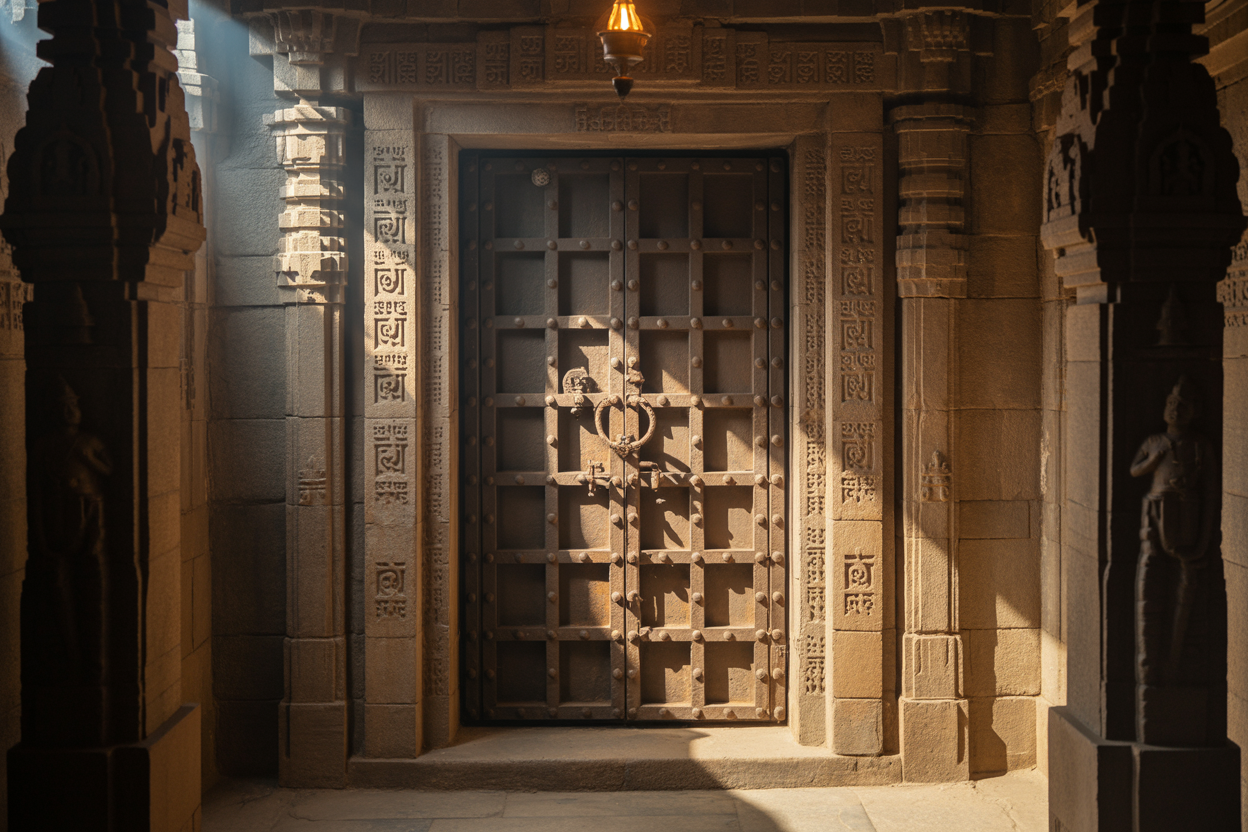
The Physical Description of Vault B: A Door That Has Defied Modern Technology
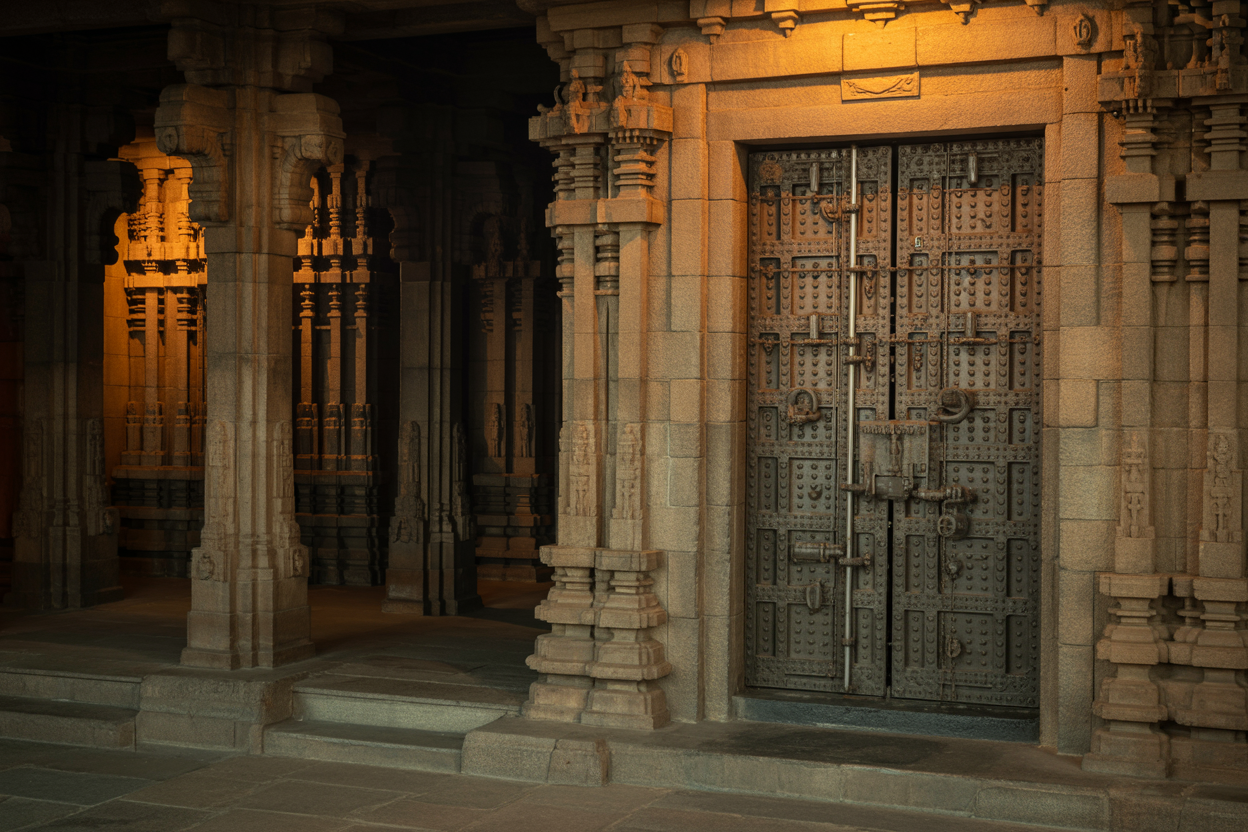
Vault B stands apart from the other vaults in the Padmanabhaswamy Temple through its extraordinary construction. Unlike the other chambers that were opened using conventional keys, this vault presents an entirely different challenge. The entrance consists of a massive iron door that appears to have been forged using ancient metallurgical techniques unknown to modern science.
What makes this door particularly fascinating is its apparent lack of conventional locking mechanisms. No visible hinges, keyholes, or latches can be found on its surface. The door seems to be seamlessly integrated into the stone framework of the temple wall, as if it were carved from a single piece of material. The iron surface shows intricate patterns and designs that experts believe were created during the forging process rather than added afterward.
The most puzzling aspect remains the door’s apparent fusion with the surrounding granite walls. Archaeological surveys have revealed that the metal and stone interface shows no signs of later modification or installation, suggesting the door was incorporated during the temple’s original construction over 1,000 years ago.
Temperature readings around the vault consistently show the door remains cooler than the surrounding stone, even during Kerala’s hottest months. This unusual thermal property has baffled engineers who have studied the structure, as conventional iron would typically conduct heat and match ambient temperatures.
Ancient Warning Inscriptions and Serpent Symbols Protecting Vault B’s Entrance
The area surrounding Vault B contains some of the most ominous inscriptional warnings found in any Indian temple. Sanskrit verses carved deep into the stone warn against disturbing the chamber’s contents, invoking the protection of serpent deities and other powerful guardian spirits.
The most prominent inscription translates roughly to “Those who dare to open this sacred chamber shall face the wrath of the guardians and bring calamity upon the land.” These aren’t mere decorative elements but form part of a complex spiritual protection system that temple priests believe remains active.
Intricate carvings of cobras surround the entrance, with their hoods spread in threatening positions. Hindu theology associates these serpent symbols with Ananta Shesha, the cosmic serpent upon which Lord Vishnu rests. The positioning and design of these carvings follow ancient Vastu Shastra principles, creating what believers consider an impenetrable spiritual barrier.
Additional protective symbols include the Sudarshana Chakra, Lord Vishnu’s divine discus, carved at precise geometric intervals around the door frame. Palm leaf manuscripts found in the temple archives describe elaborate rituals that were supposedly performed to “seal” the chamber, involving specific mantras and offerings that created supernatural locks.
Local priests maintain that these spiritual protections remain as powerful today as when they were first installed, warning that any attempt to breach the vault would activate curses that could affect not just individuals but entire regions.
Every Technological Attempt to Breach Vault B and Why Each One Failed
Multiple attempts using modern technology have failed to penetrate Vault B’s mysteries. Ground-penetrating radar surveys conducted in the early 2010s produced inconsistent and puzzling results, with some readings suggesting a vast empty space while others indicated solid rock.
Metal detectors behave erratically near the door, producing conflicting signals that prevent accurate assessment of what lies beyond. Electronic equipment frequently malfunctions when brought too close to the entrance, with digital cameras producing distorted images and audio recording devices capturing unexplained sounds.
Structural engineers brought in sophisticated drilling equipment to create small exploratory holes, but their diamond-tipped bits couldn’t penetrate more than a few millimeters into the door’s surface. The metal proved harder than anything in their experience, dulling equipment designed to cut through the strongest modern alloys.
Thermal imaging cameras have detected unusual heat patterns behind the door, suggesting either large empty spaces or materials with unique thermal properties. However, these readings change unpredictably, making it impossible to create reliable maps of the interior structure.
X-ray technology has proven completely ineffective, with the door’s composition somehow blocking electromagnetic radiation in ways that contradict known metallurgy. Even military-grade scanning equipment borrowed from defense research facilities has failed to produce usable data.
The most sophisticated attempt involved ultrasonic testing, but sound waves either absorbed completely or reflected in patterns that suggest the interior space defies conventional physics. Engineers admitted they’ve never encountered a structure that resists technological investigation so completely.
What Historical Records and Expert Speculation Suggest Lies Inside Vault B
Historical accounts from the 18th century describe Vault B as containing the temple’s most precious treasures, potentially worth hundreds of billions of dollars in today’s currency. Palace records from the Travancore kingdom mention “divine weapons” and “celestial ornaments” stored in the sealed chamber.
Ancient inventory lists reference items that sound almost mythological: golden vessels capable of multiplying food, gems that glow in darkness, and weapons blessed by the gods themselves. While these descriptions might seem fantastical, the incredible wealth already discovered in the other vaults lends credibility to claims of extraordinary treasures.
Archaeological experts believe the vault could contain artifacts predating the temple’s official construction, possibly including relics from earlier Hindu kingdoms that ruled the region. Some theorize it holds the original consecration materials used to establish the temple, items considered so sacred they could never be disturbed.
Gemologists speculate about legendary stones mentioned in Sanskrit texts, including the fabled Syamantaka gem that supposedly granted its owner unlimited wealth. The Travancore royal family’s close association with Lord Vishnu suggests they might have collected such mythical artifacts over centuries.
Financial experts attempting to estimate the vault’s value point to the exponential increase in precious metal prices since the other vaults were catalogued. If Vault B contains even a fraction of the wealth found elsewhere in the temple, its contents could represent one of the largest treasure hoards in human history.
Religious scholars argue the vault’s true value lies not in monetary worth but in spiritual significance, containing items whose cultural and religious importance far exceeds their material value. They suggest opening it could reveal artifacts that would reshape understanding of ancient Indian civilization and Hindu religious practices.
The mystery of what lies behind Vault B Padmanabhaswamy Temple is one of the most captivating ancient India mysteries a traveller can encounter. Standing before this sealed door in person, feeling the weight of centuries of faith, royal legacy and unanswered questions, is an experience that stays with you for the rest of your life. Our Kochi tours include Kerala’s most extraordinary heritage experiences with expert guides who transform what you see into something you truly understand.
The Legal Battle Over Vault B: Kings, Courts and the Constitution of India

The Ongoing Legal Battle Between the Travancore Royal Family and Government Authorities
The Padmanabhaswamy Temple has become the center of one of India’s most complex legal battles, pitting the erstwhile Travancore royal family against state authorities and various interest groups. The Travancore family, who have been the traditional custodians of the temple for centuries, found themselves locked in court proceedings after the Kerala High Court transferred management control to a government-appointed committee in 2011.
The royal family, led by the current titular head, has consistently argued that the temple’s administration should remain under their ancestral trusteeship. They claim that their family has protected the temple’s treasures and traditions for over 250 years without any scandal or mismanagement. The family’s lawyers have presented historical documents, including British-era agreements, that recognize their hereditary rights as temple administrators.
On the opposing side, various petitioners have argued that such immense wealth should be managed transparently by government authorities rather than private individuals. They’ve raised questions about accountability and proper utilization of the temple’s resources for public benefit. The Kerala government has taken varying positions throughout the litigation, sometimes supporting direct control and other times advocating for a balanced approach that respects both tradition and transparency.
The case has involved multiple stakeholders, including devotees’ associations, archaeological experts, and security agencies, each presenting different perspectives on how this sacred site should be managed while preserving its religious sanctity.
Why India’s Supreme Court Refuses to Order the Opening of Vault B
The Supreme Court of India has maintained an unwavering position regarding Vault B, refusing multiple petitions to open the mysterious chamber. In 2020, the apex court delivered a decisive judgment that effectively closed the door on any future attempts to breach the vault’s seal, at least through legal channels.
The court’s reasoning centers on respecting the religious beliefs and traditions associated with the vault. Chief Justice Ranjan Gogoi, leading the bench, emphasized that the court would not interfere with matters that could disturb the spiritual sanctity of the temple. The judges acknowledged that while Vaults A through F were opened for inventory purposes, Vault B holds special religious significance that warrants different treatment.
The Supreme Court specifically noted that the vault’s sealed status has been maintained for centuries according to temple traditions, and disrupting this could have unforeseeable consequences for the faith of millions of devotees. The court also referenced expert testimony about potential structural risks and the vault’s unique sealing mechanism, which some believe could be damaged beyond repair if tampered with.
Several attempts by treasure hunters, historians, and even some government officials to petition for the vault’s opening have been summarily rejected. The court has made it clear that no compelling legal or scientific argument has been presented that would justify overriding centuries of religious tradition and the expressed wishes of the temple’s spiritual community.
The Supreme Court’s extraordinary decision to leave Vault B sealed reflects a depth of respect for India’s ancient traditions that makes this story unlike any other legal case in the world. To understand the living spiritual context behind this decision, our Kochi tours connect you with Kerala’s extraordinary temple traditions and the expert guides who can explain the cultural, religious and historical significance of what you are experiencing with genuine authority and passion.
Constitutional Questions at the Heart of the Padmanabhaswamy Temple Case
The Padmanabhaswamy Temple case has raised fundamental questions about the balance between Article 25 (freedom of religion) and Article 26 (freedom to manage religious affairs) against the state’s duty to ensure transparency and proper management of public resources. Legal scholars have debated whether the immense wealth discovered in the temple transforms it from a purely religious institution into a matter of national importance requiring state oversight.
The tension becomes particularly acute when considering that the temple’s treasures, now valued at over $20 billion, represent one of the largest concentrations of wealth in India. Critics argue that keeping such resources under religious management without proper accountability violates principles of good governance and social justice. They point to Article 39(b) and (c) of the Constitution, which direct the state to ensure that community resources are not concentrated in few hands.
Supporters of traditional management counter that forcing government control over religious institutions violates the constitutional guarantee that religious denominations have the right to manage their own affairs. They argue that the temple has functioned successfully under royal patronage for centuries without any evidence of misappropriation or neglect.
The case has also highlighted questions about whether constitutional provisions protecting religious freedom can shield practices that might otherwise be subject to transparency laws and public accountability standards. Legal experts continue to debate whether the Right to Information Act should apply to religious institutions managing significant public wealth.
International Legal Precedents That Support Keeping Sacred Sites Sealed
The Padmanabhaswamy Temple situation has drawn comparisons to various international cases where courts have grappled with protecting sacred sites while balancing competing interests. The most frequently cited precedent comes from the Vatican’s Secret Archives, where the Catholic Church has maintained restricted access to historical documents despite international pressure for transparency.
In Tibet, the sealed chambers of Potala Palace have remained untouched despite Chinese control, partly due to international recognition that disturbing these sites could constitute cultural destruction. Similarly, many Buddhist monasteries across Asia maintain sealed chambers that are never opened, even for academic or archaeological purposes, and these restrictions have been legally upheld in various jurisdictions.
The Aboriginal sacred sites protection laws in Australia provide another relevant framework, where courts have consistently ruled that spiritual significance can override archaeological or commercial interests. The Uluru case established important precedents for respecting indigenous beliefs about certain locations being too sacred to disturb, even when significant scientific or economic benefits might result from access.
Egyptian authorities have also faced similar dilemmas with certain tombs and chambers that remain sealed due to religious or cultural considerations, despite immense archaeological interest. The European Court of Human Rights has generally supported the principle that states have obligations to protect religious sites and practices, even when they conflict with other interests like historical research or public transparency.
These international precedents have strengthened the legal foundation for the Supreme Court’s position on Vault B, providing examples of how other legal systems have prioritized religious and cultural protection over access and transparency concerns.
Scientific Theories and Ancient Curses: Why Vault B Padmanabhaswamy Temple Remains Sealed
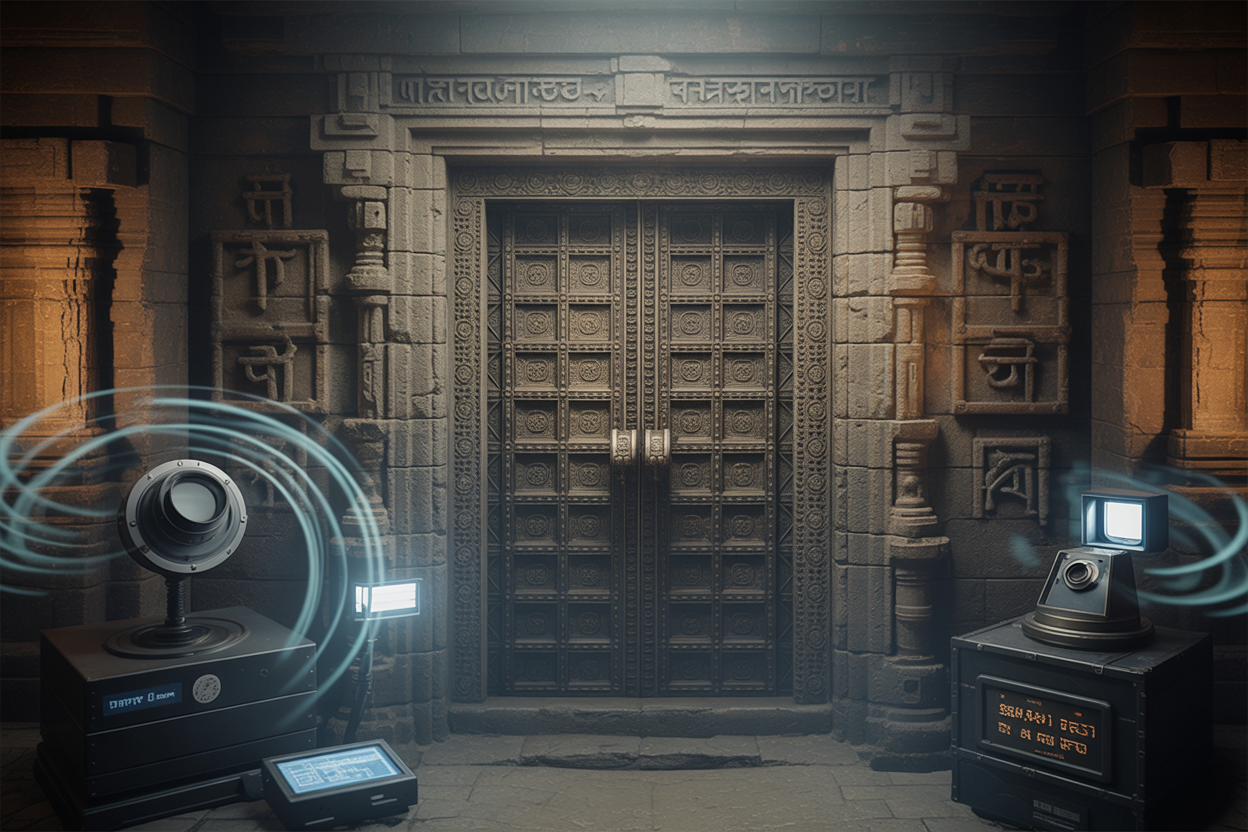
Engineering Analysis of Vault B’s Ancient Construction and Mysterious Locking Mechanism
The door to Vault B presents a fascinating puzzle that has captured the attention of structural engineers and archaeologists alike. Unlike conventional doors with visible hinges or handles, this chamber appears to be sealed using an ancient technique that completely integrates the closure with the surrounding stone structure. Expert analysis reveals that the door was likely constructed using interlocking stone blocks that create an almost seamless barrier.
What makes this engineering marvel particularly intriguing is the absence of any conventional locking mechanism. Traditional keys, bolts, or external hardware are nowhere to be found. Instead, the entire sealing system appears to rely on precisely cut stones that fit together with mathematical precision. Some engineers believe the door operates on a counterweight system hidden within the temple’s architecture, while others suggest it might require a specific sequence of movements or pressure points to open.
The craftsmanship demonstrates knowledge of load distribution and structural integrity that rivals modern construction techniques. Stone analysis indicates that the blocks were cut with extraordinary precision, leaving gaps of less than a millimeter between joints. This level of accuracy would be challenging to achieve even with contemporary tools and machinery.
The Curse of Vault B: Local Legends About Divine Serpents and Supernatural Consequences
Generations of local families have passed down spine-chilling stories about Vault B that go far beyond simple folklore. According to temple priests and longtime residents of Thiruvananthapuram, the chamber is protected by powerful serpent deities called Nagas, who guard the treasures within. These aren’t just symbolic protections – locals believe these are actual divine beings that will unleash devastating consequences on anyone who dares to breach the sacred seal.
The most persistent legend speaks of a curse that will befall not just the individual who opens the vault, but their entire family line for seven generations. Stories tell of mysterious deaths, unexplained illnesses, and financial ruin that have befallen those who even attempted to investigate the chamber too closely in the past.
Temple elders recount tales of strange sounds emanating from behind the sealed door during certain lunar phases – low humming, distant chanting, and what some describe as the rustling of massive serpents. Devotees claim that the temperature around Vault B remains consistently cooler than the rest of the temple, regardless of external weather conditions.
These beliefs aren’t dismissed as mere superstition by the local community. Many educated professionals, including doctors, lawyers, and government officials, treat these warnings with genuine respect and caution.
Kerala’s sacred landscape is filled with stories of this extraordinary depth and power, stories that are alive and actively believed by the communities who live alongside these ancient traditions today. Our Kochi tours bring international travellers into genuine contact with this living heritage, guided by experts who understand both the spiritual and historical dimensions of everything you encounter.
What Archaeologists and Engineers Say About the Real Dangers of Opening Vault B
Archaeological experts have raised legitimate concerns about the physical dangers that might await inside Vault B. Dr. Rajesh Kumar, a renowned archaeologist who has studied the temple extensively, warns that centuries of sealed conditions could have created a toxic environment inside the chamber. Without proper air circulation, dangerous gases might have accumulated, posing serious health risks to anyone who enters.
Structural engineers worry about the stability of the chamber itself. The precise engineering that keeps the door sealed might be part of a delicate balance that, once disturbed, could cause structural damage to the entire temple complex. The weight of centuries-old treasures stacked inside could have shifted over time, creating an unstable environment that might collapse if the seal is broken.
Conservation specialists point out that sudden exposure to air, light, and humidity changes could cause irreversible damage to priceless artifacts inside. Ancient metals, textiles, and organic materials that have been preserved in stable conditions for hundreds of years might deteriorate rapidly once exposed to the outside environment.
Some experts also raise concerns about potential booby traps or defensive mechanisms that ancient builders might have incorporated into the chamber’s design. Historical records suggest that valuable temple treasures were often protected by ingenious security systems designed to deter thieves.
Modern Security and the Debate Between Ancient Tradition and Transparency
The temple’s current security protocols reflect a careful balance between protecting invaluable treasures and respecting centuries-old religious practices. Modern surveillance systems monitor the vault area around the clock, but temple authorities maintain that technological intrusion should never override spiritual sanctity. This creates a unique challenge in contemporary heritage management.
Security experts have identified several vulnerabilities that opening Vault B might create. The publicity surrounding the temple’s wealth has already attracted unwanted attention from criminal organizations. Breaking the seal would require extensive documentation, photography, and cataloging processes that could expose security details and create new risks for the temple complex.
Insurance companies have expressed concerns about providing coverage for the contents of Vault B, given the unknown nature and potential value of items inside. The legal complications of insuring artifacts of unknown origin and cultural significance add another layer of complexity to any opening procedures.
Temple administration faces pressure from multiple directions – archaeological societies pushing for scientific exploration, government officials seeking complete inventory of national treasures, and religious communities demanding respect for sacred traditions. The Supreme Court’s decision to leave the vault sealed reflects recognition of these competing interests and the wisdom of preserving certain mysteries in our increasingly documented world.
The ongoing debate reflects larger questions about how modern society should handle ancient sacred sites and whether some doors are meant to remain closed, regardless of what treasures they might contain.
The Padmanabhaswamy Temple stands as one of India’s most fascinating mysteries, where ancient traditions clash with modern legal systems. The discovery of billions of dollars worth of treasures in multiple vaults transformed this Kerala temple into the world’s richest religious site overnight. Yet Vault B remains untouched, protected by both legal decisions and centuries-old beliefs that warn against opening what should stay closed.
The Supreme Court’s refusal to force open Vault B speaks to something deeper than legal precedent – it acknowledges the weight of tradition and the unknown. Whether you believe in the supernatural warnings or simply respect the historical sanctity of the space, this sealed door represents a rare moment where mystery is allowed to exist in our modern world. Sometimes the most powerful treasures are the ones we choose not to claim, and Vault B reminds us that some secrets are worth keeping sealed.
The ongoing debate around Vault B Padmanabhaswamy Temple reflects the larger question that ancient India poses to every traveller who encounters it. How do you preserve the sacred in a world that increasingly demands transparency and access? The best way to engage with that question is to experience it in person. Our Kochi tours and Hyderabad tours take you to the heart of this living conversation, guided by experts who have spent years understanding the extraordinary heritage of South India. Explore our full portfolio of India heritage tours and begin planning your journey today.
Plan Your Visit to Padmanabhaswamy Temple Kerala With 5 Senses Tours
The mystery of Vault B Padmanabhaswamy Temple is not just a story to read about. It is a living, breathing experience waiting for you in the heart of Thiruvananthapuram, Kerala. Standing before the sealed door of the world’s richest temple, feeling the weight of two thousand years of faith, royal legacy and unanswered questions, is one of the most extraordinary things any traveller can do in India. Here is everything you need to plan your visit.
Padmanabhaswamy Temple Darshan Timings, Dress Code and Visitor Information
Darshan Timings
Padmanabhaswamy Temple follows a strict daily schedule of multiple darshan slots. Planning your visit around these timings is essential as the temple closes between sessions for rituals and maintenance.
Early morning Nirmalya Darshan from 3.30am to 4.45am is the most peaceful and spiritually powerful time to visit, when the temple is at its most serene and the crowds are minimal.
Morning Special Darshan runs from 6.30am to 7.00am, followed by General Darshan from 8.30am to 10.00am. A brief Midday Darshan slot is available from 11.45am to 12.00pm.
The temple reopens in the evening with Darshan from 5.00pm to 6.15pm and a final slot from 6.45pm to 7.20pm. A VIP Darshan option is available from 8.30pm to 9.00pm for those who book in advance.
The temple remains closed from 12.00pm to 5.00pm each day for rituals and maintenance.
Entry Fee and Special Darshan Tickets
General darshan at Padmanabhaswamy Temple is completely free for all Hindu devotees. A Special Darshan ticket costs Rs 150 without prasadam and Rs 180 with prasadam. VIP Darshan passes can be booked online in advance through the temple’s official booking portal at booking.sreepadmanabhaswamytemple.org. During festival periods and weekends tickets sell out quickly so advance booking is strongly recommended.
Dress Code
Padmanabhaswamy Temple enforces a strict traditional dress code that must be respected without exception. Entry is permitted only to Hindu devotees.
Men must wear a traditional Kerala dhoti or mundu. Western trousers, shorts and shirts are not permitted inside the temple premises.
Women must wear a traditional saree, half saree or Kerala style churidar with dupatta. Jeans, trousers and sleeveless garments are not permitted.
Visitors who arrive without appropriate traditional attire can typically hire or purchase a dhoti or mundu from shops in the streets immediately surrounding the temple.
Best Time to Visit
October to March is the ideal season to visit Padmanabhaswamy Temple Kerala, when the weather is cool, dry and comfortable for exploring the temple precinct and the surrounding heritage areas of Thiruvananthapuram. The two major annual festivals, Alpashi Utsavam in October and November and Painkuni Utsavam in March and April, each lasting ten days, offer an extraordinary opportunity to witness the temple at its most vibrant and spiritually alive, though crowds during these periods are very significant.
Early weekday mornings between Monday and Thursday offer the quietest and most contemplative experience for international travellers who want to absorb the atmosphere of one of India’s most extraordinary sacred sites without the pressure of large crowds.
How to Reach Padmanabhaswamy Temple
The temple is located in the East Fort area of Thiruvananthapuram city centre, making it easily accessible from all parts of the city. Thiruvananthapuram Central Railway Station is just 600 metres away, a ten-minute walk. Trivandrum International Airport is approximately 6 kilometres from the temple, reachable by taxi in around 20 minutes. From Kochi, Thiruvananthapuram is accessible by train in approximately four hours or by road in approximately five hours.
Important Notes for International Visitors
Entry to Padmanabhaswamy Temple is restricted to Hindu devotees only. This rule is strictly enforced at the entrance gates. Non-Hindu visitors are not permitted inside the temple premises but can admire the extraordinary exterior gopuram, one of the most magnificent examples of Dravidian temple architecture in Kerala, from the surrounding streets.
Photography inside the temple premises is not permitted. Mobile phones must be switched off or kept on silent throughout the visit.
How to Experience Kerala’s Most Extraordinary Heritage With 5 Senses Tours

The Vault B Padmanabhaswamy Temple mystery is one chapter in a story of extraordinary depth that stretches across the entire cultural landscape of Kerala and South India. For international travellers from the USA, UK and Australia who want to go beyond the surface and truly understand what they are experiencing, 5 Senses Tours offers expert guided heritage experiences designed to transform a visit into something you carry for the rest of your life.
Explore Kerala’s Temple Heritage with Expert Guides
Our Kochi tours connect you with Kerala’s extraordinary living traditions of temple worship, royal heritage and ancient craftsmanship. Expert guides who have spent years understanding the culture, history and spiritual significance of Kerala’s most sacred sites bring each experience to life with a depth and authenticity that independent travel simply cannot match.
Fort Kochi, the backwaters, the spice markets, the Kathakali dance tradition and the extraordinary Dravidian temple architecture of Kerala together form one of the most culturally rich and visually stunning travel experiences available anywhere in India. Our Kochi tours are designed for travellers who want all of this with the confidence of knowing that every detail has been curated by specialists who truly love what they do.
Extend Your Journey Across South India’s Greatest Heritage Trail
The story that begins at Padmanabhaswamy Temple Kerala does not end in Thiruvananthapuram. South India contains some of the most extraordinary heritage destinations on earth, many of them unknown to international tourists and all of them accessible through 5 Senses Tours.
The Meenakshi Temple in Madurai, one of the largest temple complexes in the world, is a living centre of Dravidian worship that has been in continuous operation for over two thousand years. Our Madurai tours include expert guided access to this extraordinary site, bringing the architectural genius, spiritual significance and living ritual traditions to life in ways that transform a visit into a profound experience.
The Brihadeeswara Temple in Thanjavur, a UNESCO World Heritage Site whose tower never casts a shadow on the ground around it at midday throughout the entire year, is accessible on our Chennai tours. The mathematical genius embedded in its design continues to astonish engineers and astronomers worldwide.
Further north, the extraordinary Ramappa Temple in Telangana, another UNESCO World Heritage Site built on a floating sand foundation that has survived 800 years of earthquakes, is the centrepiece of our Hyderabad tours and one of the most remarkable ancient engineering achievements in the world.
Why Travel with 5 Senses Tours
5 Senses Tours is a specialist cultural tour operator recognised by India’s Ministry of Tourism, operating across more than 40 destinations nationwide. We take international travellers from the USA, UK and Australia deep into the India that most tourists never find, guided by experts who believe that travel at its finest does not just show you new places. It changes the way you see the world.
Every one of our tours is built around authentic encounters, expert knowledge and a genuine passion for the extraordinary heritage that India offers in greater abundance than almost anywhere else on earth.
The sealed door of Vault B Padmanabhaswamy Temple is waiting. And so is the rest of this astonishing country.
Explore All India Heritage Tours with 5 Senses Tours
Leave a Reply