
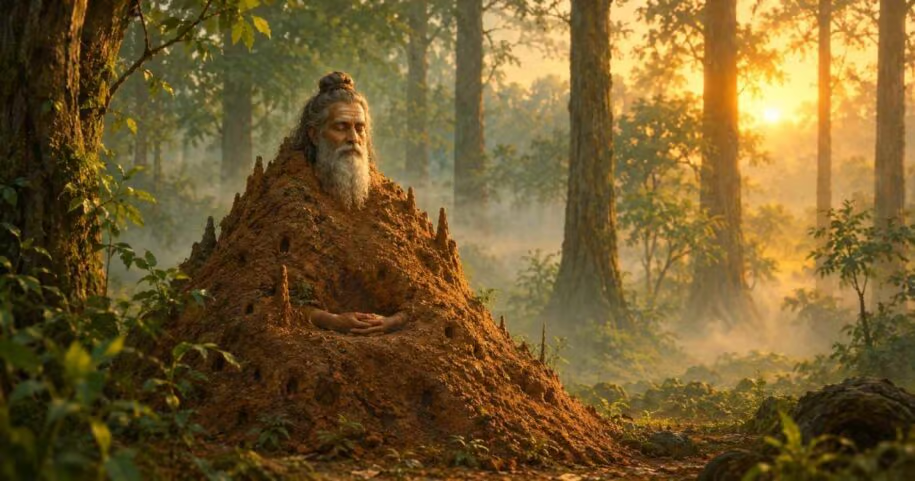
Who was Valmiki? Valmiki is the sage traditionally credited with composing the Ramayana, and is honoured as Adi Kavi, the first poet. A famous legend says he began life as a robber named Ratnakara who was transformed after meeting the sage Narada, and that an anthill grew around him as he meditated, giving him the name Valmiki. That story belongs to later tradition, and in the Ramayana itself Valmiki calls himself the tenth son of Pracetas. The epic says his first verse was born from grief at the death of a bird. You can visit places tradition links to Valmiki, including his ashram at Bithoor and Chitrakoot, on our 14 day Ramayana tour of India.
A robber waits beside a forest road.
He is patient and he is practised, and travellers who use this road have learned to fear it. On the day our story begins, a traveller comes along who is not afraid of him. He has nothing worth stealing, and he asks the robber a single question.
That, say the legends, is how the greatest poet in Indian history first met the world. Who was Valmiki? The answer is a mystery with at least three versions, and the real surprise is in the third.
Who was Valmiki? The poet behind the Ramayana
Valmiki is credited as the author of the Ramayana, the epic of about 24,000 verses in seven books that tells the life of Rama. India honours him as Adi Kavi, the first poet. His birthday, Valmiki Jayanti, is celebrated on the full moon of the month of Ashvin.
Yet history gives us almost nothing about the man. His own epic tells us a little. Every other detail comes from stories told long after, and those stories do not agree. So let us walk through them, as a detective would, one version at a time.

Version 1: The robber and the sage
This is the story that most Indian children hear, and it is wonderful.
A boy named Ratnakara was lost or abandoned in his youth, and grew up to be a robber. Some tellings say he turned to the road because his family was hungry, after a drought. One day he stopped the sage Narada and demanded his belongings.
Narada was calm. He asked a single question. You rob to feed your family, he said, but will your family share the burden of your sins?
Ratnakara did not know. He went home and asked his wife, his parents and his children. Each of them refused. They were glad to eat what he brought, but no one would carry the weight of how he got it. He walked back to Narada, shaken, and fell at his feet.

Narada taught him to repeat the name of Rama. In one telling, he could manage only the syllables in reverse, Mara, Mara, and over long penance they turned into Rama. It did not matter. He repeated it for years, so still and so long that an anthill rose around his body until only his eyes showed. When the sages returned, they pulled him out and gave him a new name. He had come from an anthill. He was Valmiki.
Version 2: The robber named in the Skanda Purana
A second telling gives the robber a different name and a different cause.
In the Skanda Purana, in a section called the Nagara Khanda, a Brahmin named Lohajangha turns to robbery during a drought in the land of Anarta that lasts twelve years. He meets the Seven Sages. One of them, Pulaha, gives him a mantra. He sits to meditate, and anthills grow around him. The sages call him Valmiki.
Notice what the two tellings share. A robber. A meeting with sages. A long stillness. An anthill. A new name. The names change, but the shape of the story holds, and that is how legends survive. They keep what matters and let the details travel.
Version 3: What the Ramayana itself says
Now comes the twist.
In the Ramayana, Valmiki introduces himself in a very different way. He calls himself the tenth son of Pracetas, a name sometimes identified with the god Varuna. There is no robber on the forest road. There is a sage living in a hermitage, with a disciple named Bharadvaja, and a visitor who is none other than Narada.
Narada appears in both stories. In the epic, he arrives at Valmiki’s hermitage and tells him of a man of perfect virtue. Valmiki listens in wonder and asks who this man could be. Narada answers by telling him the story of Rama, and then departs for the heavens.
So the sage who turned a robber into a poet in the later legend is, in the epic itself, the sage who hands the poet his subject. It is a curious echo. Some traditions also say that Valmiki was born when the seed of Varuna fell into a termite hill, which gives another account for the name.
The legends of the robber are beloved, and they carry a deep idea, that no life is beyond change. But a careful guide should be honest. They come from later tradition, and the epic does not tell them.

The day grief became poetry
What does the epic say happened next? This is the part that gives India its first poem.
After Narada leaves, Valmiki goes to bathe in the clear waters of the river Tamasa, near the Ganges. As he walks through the forest, he sees a pair of krauncha birds, playing together in affection. A hunter shoots the male. The female cries out over him.
Valmiki is overwhelmed by pity and anger. He speaks, and he curses the hunter. Then he stops. He reflects on what has just happened. He turns to Bharadvaja and says that his grief has taken a shape. His words have come out in a measured verse, with an even number of syllables in each line, a rhythm that could be sung. Bharadvaja memorises the lines on the spot, delighted.

Back at the hermitage, Valmiki is still disturbed. Brahma, the Creator, appears. He tells the sage that this spontaneous verse is the sign of a poetic gift, and he gives him a task. Tell the story of Rama, he says, in this same measure. Every event of it, Sita, Lakshmana, the court of Dasharatha, will be revealed to you and will be true. And the tale, Brahma promises, will endure as long as mountains stand and rivers flow.
Valmiki began to compose.
Think about that for a moment. The first shloka, tradition says, was not a hymn to a god. It was a cry of sorrow over a bird, and it grew into one of the greatest stories ever told.
The poet who steps into his own story
Valmiki does not stay outside his epic. According to tradition, he becomes a character in it.
When Sita is sent from Ayodhya, it is Valmiki’s ashram that shelters her. Her twin sons, Luv and Kush, are born there, and Valmiki raises them and teaches them the Ramayana. In the telling preserved at Bithoor, the boys grow up so brave and so radiant that they stop Rama’s sacrificial horse, and the meeting that follows brings the family back together.

It is a beautiful loop. The poet who sang the story ends up holding its most fragile people, and the children he teaches carry his words back into the world. Some scholars think this final book, the Uttara Kanda, may be a later addition and not Valmiki’s own, a point we return to below. But the story of the poet as protector has never let go of the Indian imagination.
Why the name Valmiki means anthill
The word Valmiki is usually understood to mean one who comes from an anthill. Whether you follow the story of Ratnakara or Lohajangha, the image is the same. A man so still for so long that the earth itself grew around him.
It is a perfect image for a poet. Poetry, like an anthill, is built grain by grain, in silence, over years. And what emerges is something much larger than the one who made it.

Where Valmiki lived: ashrams of the poet
If Valmiki was real, where did he live? Tradition offers more than one answer.
At Bithoor, near Kanpur in Uttar Pradesh, a hilltop ashram is said to be where Sita took refuge after she was sent from Ayodhya. Locals say this is the place where Valmiki composed the Ramayana, where Sita’s twin sons, Luv and Kush, were born, and where he taught them the epic. Pilgrims visit a spot called the Sita Rasoi, her kitchen, and a tree where tradition says Valmiki taught the boys. All of this rests on belief and local tradition, and the ashram’s own sources say as much.

A Valmiki ashram is also listed at Chitrakoot, the hill of the early exile. In Nepal, an ashram in the Chitwan district is considered by some to be his original home. In Chennai, a Valmiki temple at Tiruvanmiyur is said to be around 1,300 years old, and in Nagapattinam, a temple holds what is called his Jeeva Samadhi.
Many places claim him. That is a sign of how deeply he is loved.
The poet and the community that reveres him
Valmiki is more than a name in a book. The Balmiki community reveres him as a patron saint, with many temples dedicated to him. For them, Valmiki Jayanti is a major festival, known as Pargat Diwas, the day of manifestation. A poet who is also a saint is a rare thing, and it shows that he is still a living presence, not only a name on a manuscript.
How old is the Ramayana, and who wrote it?
Two questions hide inside this one. When was the poem composed? And when did the events it describes take place? Scholars answer the first. Others, using very different methods, try to answer the second. The two sets of dates are thousands of years apart, and that gap is the whole story.
When the text took shape: the scholarly view
Scholars estimate that the earliest stage of the Ramayana took shape between the eighth and fourth centuries BCE, with later stages stretching to about the third century CE. No one knows the original date, and over the centuries the text was expanded and revised.
Within that range, the experts offer sharper figures. The Sanskritist Robert Goldman argued in 1984 that the oldest parts date to the early seventh century BCE, and that the core was not composed later than the sixth or fifth century BCE. In 2022, he and Sally Sutherland Goldman placed the oldest surviving version at around 500 BCE. John Brockington, judging from the language, style and content of the verses, has settled on roughly the fifth century BCE.

Scholars also broadly agree on the order in which the books arrived. Since Hermann Jacobi, many have held that Books 2 to 6 form the oldest portion, while Book 1, the Bala Kanda, and Book 7, the Uttara Kanda, were added later. That is why some scholars, including the Goldmans, doubt that the last book was originally Valmiki’s own.
Before the page: a poem sung aloud
The epic itself tells us how it first travelled. According to tradition, Valmiki taught it to Luv and Kush, who sang it aloud. Scholars note that the oral original may be older than any written version. So a date of about 500 BCE may mark when the poem was fixed in a form we can trace, not when its first verses were sung.
When the events happened: far older dates
Tradition places Rama in the Treta Yuga, the second age in the Puranic cycle of four, which in Puranic reckoning lies hundreds of thousands of years in the past.
Modern researchers have tried to narrow that down by reading the epic’s sky descriptions as real observations and checking them against astronomy software. Pushkar Bhatnagar proposed that Rama was born around midday on 10 January 5114 BCE.
The author Nilesh Oak goes much further back. His book, The Historic Rama, argues that the war between Rama and Ravana took place in 12,209 BCE, and its foreword gives Rama’s birth as 29 November 12,240 BCE. He counts more than 500 astronomical references in the epic, and argues that the events cannot be later than about 10,000 BCE.
Why the dates differ so much
The estimates differ because they use different evidence and answer different questions. Language and manuscripts can date a text. Sky descriptions, if they are read as observations, might date the events behind it. Tradition reckons in ages of the world. None of these methods can be tested against the others.
What everyone agrees on is that the Ramayana has been told for at least two and a half thousand years, and that it still holds a living place in the lives of millions. The question of its age is still open, and a good guide will tell you so.
Follow Valmiki on the Ramayana tour of India
You cannot walk into a poem. But you can walk into the places that made it.
Our 14 day Ramayana tour of India takes you through the landscapes of the epic, from Ayodhya, where the story begins, along the road of exile through Shringverpur and Prayagraj to Chitrakoot, where tradition places a Valmiki ashram and where Rama and Bharata met. Your guide will tell the legend of the robber and the sage at the place where it feels most alive, and you will decide for yourself which version you believe.
Frequently Asked Questions
Valmiki is the sage traditionally credited with composing the Ramayana, and is honoured as Adi Kavi, the first poet. In the epic, he calls himself the tenth son of Pracetas.
According to a famous legend, he began life as a robber named Ratnakara and was transformed after meeting the sage Narada. This story comes from later tradition, and the Ramayana itself does not tell it. The Skanda Purana gives a similar tale about a Brahmin named Lohajangha.
It is usually understood to mean one who comes from an anthill. Legend says an anthill grew around him while he meditated.
Adi Kavi means the first poet. According to tradition, his grief at the death of a bird gave rise to the first verse in the measure of the Ramayana.
Tradition credits him with all seven books, but some scholars, including Robert and Sally Goldman, think the final book, the Uttara Kanda, may not originally have been his. The text grew and was revised over many centuries.
Valmiki Jayanti falls on the full moon of the month of Ashvin, and is also called Pargat Diwas.
Several places claim it. Bithoor near Kanpur is the best known in tradition, and others include Chitrakoot, Chitwan in Nepal and Tiruvanmiyur in Chennai.Accordion Content
To walk the road of the epic, join our 14 day Ramayana tour of India. Follow the search for the golden city in our blog on where Ravana’s Lanka may have been. Every 5 Senses tour is built to benefit the people who live along the route, and you can read how in our responsible tourism approach. To plan a longer journey, talk to us about a custom itinerary.
A robber, a sage, an anthill, a grieving bird. Whichever version you believe, Valmiki turned sorrow into the oldest story India still tells. Come and walk the road he sang about, and find out which Valmiki you meet.