
Five mysterious Indian artifacts are turning archaeology on its head, forcing experts to rethink everything they believed about ancient civilizations. These discoveries reveal technologies that seem impossible for their time periods, from rust-proof iron pillars created 1,600 years ago to surgical instruments that rival modern medical tools.
This deep dive is perfect for history buffs, archaeology enthusiasts, and anyone fascinated by ancient mysteries that challenge conventional timelines. We’ll explore how unexplained archaeological discoveries India has produced are rewriting the story of human advancement.
You’ll discover ancient metallurgy India mastered that modern science still struggles to replicate, including the famous Delhi Iron Pillar that refuses to corrode after sixteen centuries. We’ll examine architectural marvels like the precisely cut stones of Hampi that fit together without mortar, defying what we know about prehistoric Indian engineering capabilities. Finally, we’ll uncover advanced ancient medical instruments India produced thousands of years before similar tools appeared elsewhere, along with astronomical artifacts that encoded complex celestial knowledge long before telescopes existed.
These Indian artifacts challenge history books and force us to ask: were ancient civilizations far more advanced than we ever imagined?
Ancient Metallurgical Mastery Defies Timelines
The Delhi Iron Pillar’s Rust-Resistant Secrets
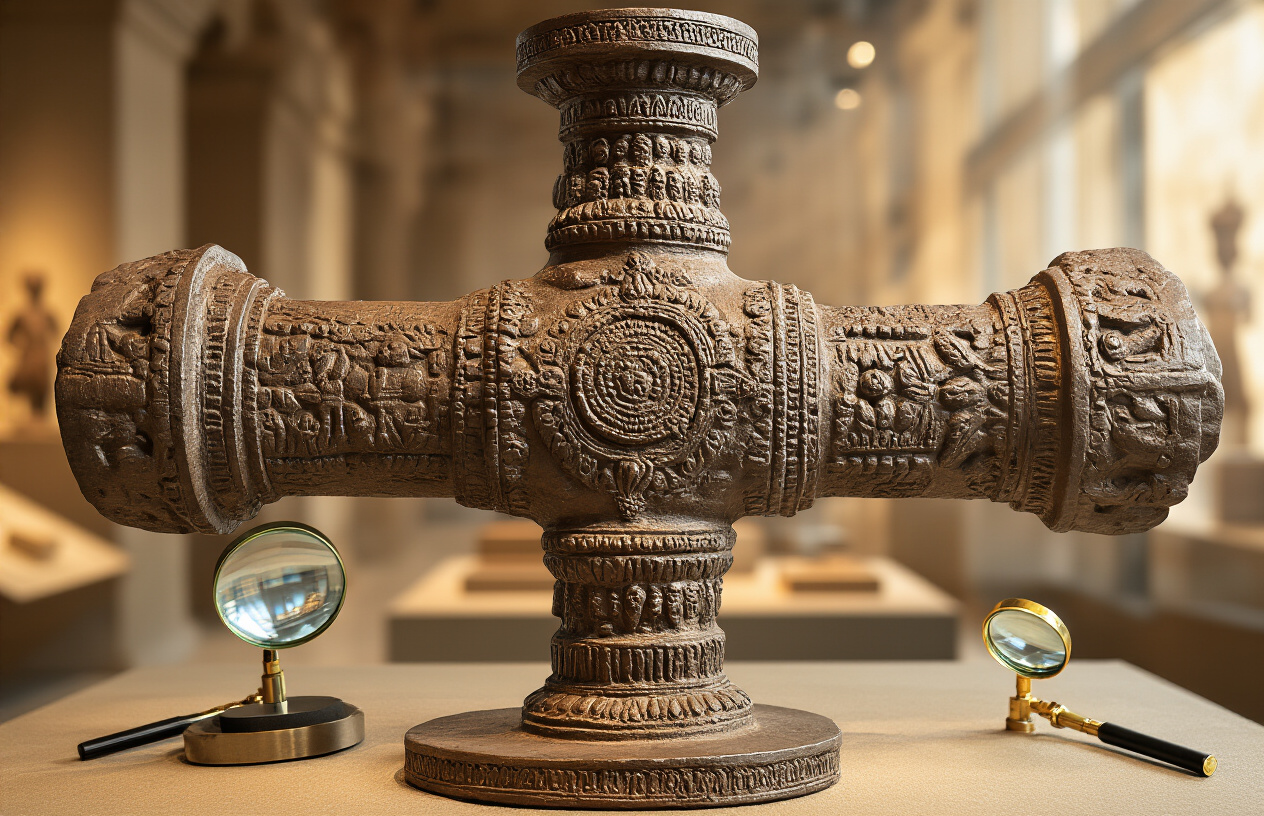
Standing tall in Delhi’s Qutb complex, the 1,600-year-old iron pillar presents a metallurgical puzzle that continues to baffle scientists worldwide. This 7-meter tall monument weighs over 6 tons and shows virtually no signs of rust despite centuries of exposure to monsoons and harsh weather conditions. Modern attempts to recreate this ancient Indian technology using contemporary methods have failed spectacularly.
The pillar’s composition reveals a unique phosphorus content of nearly 1%, combined with extremely low sulfur and manganese levels. This specific combination creates a protective oxide layer that regenerates itself, essentially making the iron self-healing. What’s remarkable is that ancient Indian metallurgists achieved this precise chemical balance without modern analytical tools or controlled furnace environments.
Recent analysis shows the iron contains microscopic slag particles uniformly distributed throughout the metal matrix. This distribution pattern suggests the use of advanced smelting techniques that wouldn’t be “discovered” by Western metallurgy until the 19th century. The pillar represents one of the most mysterious Indian artifacts that challenges our understanding of technological progression.
Advanced Smelting Techniques
Archaeological excavations across India have uncovered evidence of sophisticated smelting operations dating back over 4,000 years. Sites in Rajasthan and Karnataka reveal furnace designs that achieved temperatures exceeding 1,500°C – hot enough to produce high-carbon steel centuries before similar techniques appeared elsewhere.
The wootz steel production centers in South India employed a crucible process that created the legendary Damascus steel. European attempts to reverse-engineer this process failed for centuries because they couldn’t replicate the precise atmospheric conditions and carbon migration patterns achieved by ancient Indian smiths.
Key innovations discovered at these sites include:
- Controlled atmosphere furnaces that managed oxygen flow with remarkable precision
- Multi-stage heating processes that gradually increased carbon content
- Specialized flux materials derived from local minerals that improved metal purity
- Advanced quenching techniques using specific water temperatures and additives
These unexplained archaeological discoveries India has produced suggest a level of metallurgical sophistication that contradicts conventional timelines of technological development.
Chemical Composition Analysis Reveals Lost Knowledge
Modern spectroscopic analysis of ancient Indian metal artifacts reveals metallurgical knowledge that seems impossible for their supposed time periods. Samples from various prehistoric Indian engineering projects show consistent use of trace elements that enhance specific properties – something that requires deep understanding of materials science.
The Iron Pillar in Delhi, which was made in 400 CE , used Phosphorous alloying. This technique was seen again only in the 1800s in Europe.
The Konark Nails from 1250 CE have remarkable corrosion resistance, very similar to the level seen in the 20th century.
Tools found in Ujjain, which date back to 500 BCE, show evidence of high-quality iron smelting.
Ancient Indian metalworkers consistently produced alloys with properties that modern science explains through complex molecular interactions. They created brass with zinc percentages that optimize both workability and strength, achieved through distillation processes not officially “invented” until much later periods.
The precision of these compositions suggests systematic experimentation and knowledge transfer across generations. Chemical fingerprinting reveals regional variations in techniques, indicating multiple centers of advanced metallurgical research operating simultaneously across the subcontinent. This distributed innovation network produced advanced ancient civilizations India that possessed technological capabilities far exceeding what historical timelines suggest should have been possible.
Architectural Engineering Beyond Conventional Ancient Capabilities
Precise Stone Cutting Without Modern Tools
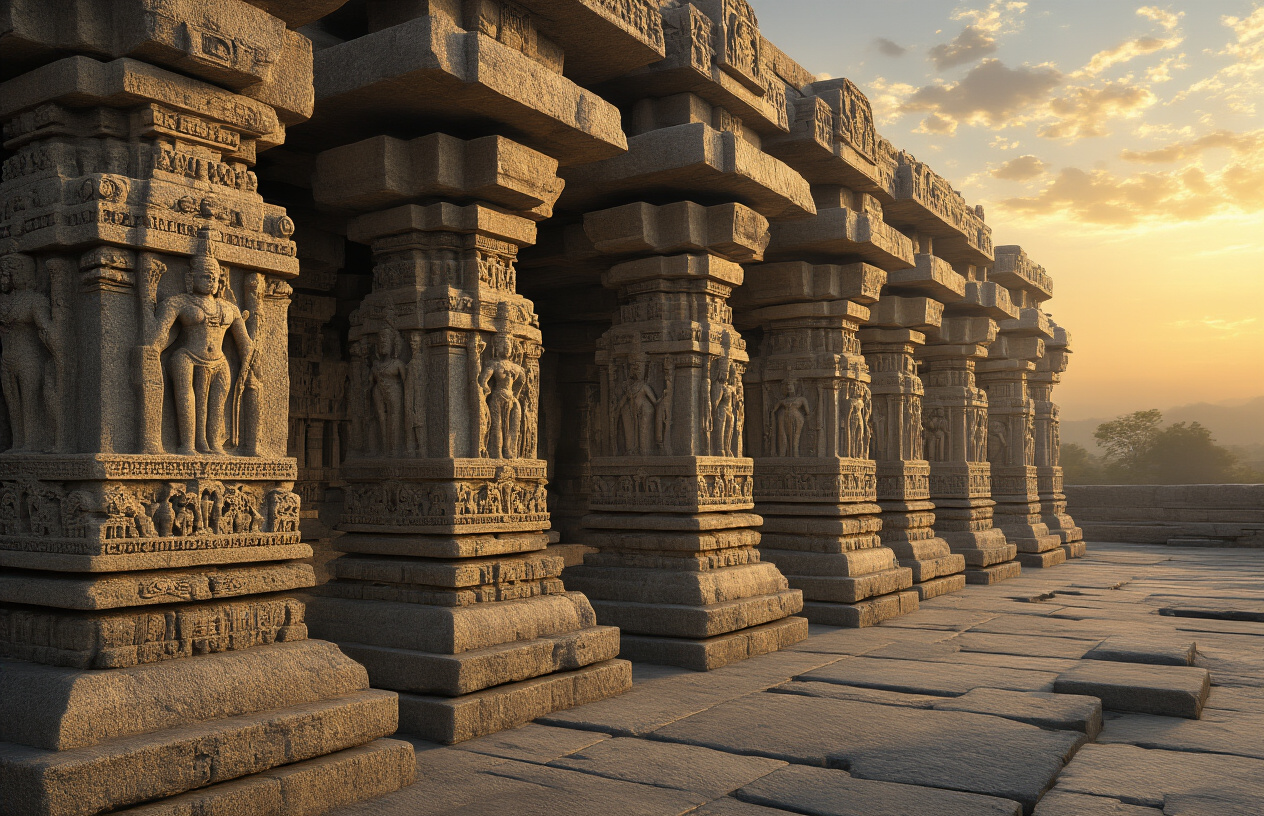
The stone temples of Hampi and the rock-cut caves of Ellora showcase cutting techniques that leave modern engineers scratching their heads. These mysterious Indian artifacts demonstrate precision that rivals contemporary laser-cutting technology, yet they were created centuries before such tools existed. At the Vitthala Temple in Hampi, granite blocks fit together so perfectly that you can’t slip a piece of paper between the joints.
The Kailasa Temple at Ellora represents an even more mind-boggling achievement. Carved from a single piece of rock, this massive structure required removing over 400,000 tons of stone – all done from the top down. The precision of the carving work shows smooth curves, intricate details, and perfectly aligned architectural elements that would challenge today’s equipment.
What makes these achievements particularly puzzling is granite’s hardness rating of 6-7 on the Mohs scale. Cutting such material requires diamond-tipped tools or advanced machinery, yet archaeological evidence suggests ancient builders worked with bronze and iron implements. Some researchers propose they used advanced techniques involving sound waves or unknown cutting methods that produced these incredibly smooth surfaces.
Complex Joint Systems That Survive Earthquakes
Ancient Indian structures incorporate joint systems that modern seismic engineers study for earthquake-resistant design principles. The prehistoric Indian engineering found in temples across South India employs interlocking stone techniques that have weathered centuries of natural disasters.
The Brihadeeswara Temple in Thanjavur stands as a perfect example. Built over 1,000 years ago, this granite monument has survived numerous earthquakes without significant damage. The secret lies in its innovative joint system where each stone block connects to multiple others through precisely carved grooves and projections. This creates a flexible network that can absorb and distribute seismic forces.
| Temple | Age | Notable Feature | |
|---|---|---|---|
| Tanjore | 1,000 yrs | 66-meter granite dome | |
| Shore Temple | 1,300 yrs | Coastal erosion resistance | |
| Kailasa Temple | 1,200 yrs | Single-rock carving |
The Shore Temple at Mahabalipuram faces constant salt water exposure and coastal storms, yet its stone joints remain intact. The builders created expansion joints that accommodate thermal changes and designed drainage systems that prevent water damage – concepts that weren’t formally understood in structural engineering until the 20th century.
Mathematical Calculations Embedded in Sacred Structures
Ancient Indian technology demonstrates sophisticated mathematical knowledge embedded directly into temple architecture. The Golden Ratio, advanced geometric principles, and complex astronomical calculations appear throughout these structures, revealing mathematical understanding that supposedly developed much later in human history.
The Konark Sun Temple incorporates precise mathematical ratios in its design. The main structure’s proportions follow the Golden Ratio (1.618:1), while the placement of smaller shrines around the main temple creates geometric patterns based on advanced trigonometry. The 24 wheels of the temple aren’t just decorative – they function as sundials with mathematical precision.
At Angkor Wat (built by Indian-influenced Khmer civilization), the entire complex mirrors the Hindu cosmological model with mathematical accuracy. The distances between towers correspond to cosmic cycles, and the temple’s proportions reflect astronomical measurements. The central tower’s height and the temple’s total area maintain specific mathematical relationships that encode calendrical and astronomical data.
Weight Distribution Methods That Baffle Engineers
The weight distribution systems in ancient Indian monuments solve engineering problems that modern architects struggle with today. These unexplained archaeological discoveries India reveals include techniques for supporting massive stone structures without the use of modern materials like steel reinforcement or concrete.
The Thanjavur Temple’s 80-ton capstone sits atop a 66-meter tower, yet no one knows exactly how ancient builders lifted and positioned it. The tower’s design distributes this enormous weight through a complex system of internal chambers and precisely calculated load-bearing walls. Modern analysis shows the weight distribution is so efficient that the structure actually becomes more stable under load.
Even more impressive is the negative weight distribution technique found in some South Indian temples. Certain stone blocks appear to be “floating” – supported by carefully balanced forces that create an optical illusion while maintaining structural integrity. The engineering principles behind these techniques involve understanding stress distribution, material properties, and architectural physics that weren’t formally codified until centuries later.
The Lepakshi Temple features a hanging pillar that doesn’t quite touch the ground, supported entirely by surrounding architectural elements. This demonstrates an understanding of load transfer and structural dynamics that challenges conventional assumptions about ancient Indian technology and engineering capabilities.
Astronomical Knowledge Encoded in Physical Artifacts
Star Map in Temple Positioning
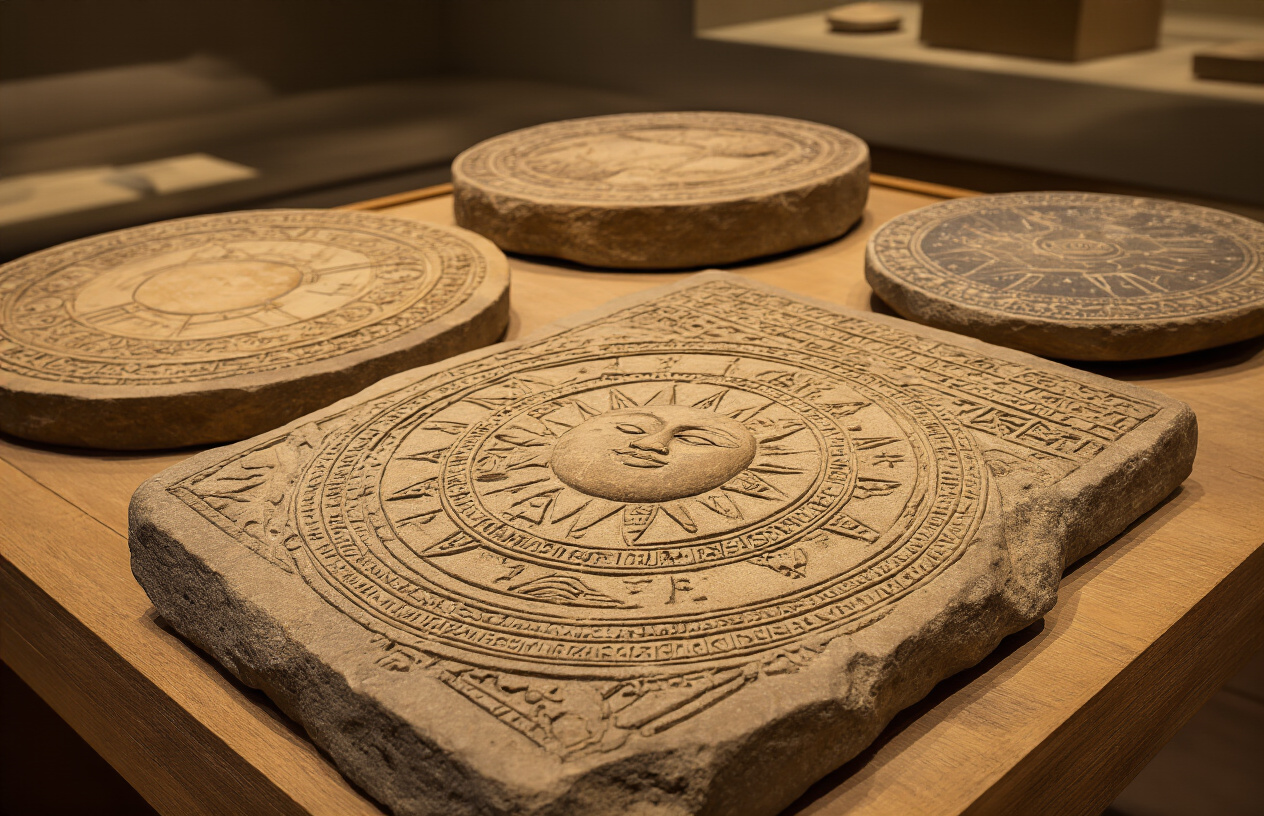
The precision with which ancient Indian temples align with stellar positions reveals a sophisticated understanding of astronomy that many historians struggle to explain. The Konark Sun Temple in Odisha demonstrates this perfectly – its entire structure functions as a massive sundial, with every architectural element positioned to track celestial movements throughout the year.
What makes these mysterious Indian artifacts even more intriguing is how temple builders incorporated star maps directly into their foundation layouts. The Brihadeshwara Temple complex in Thanjavur mirrors the constellation Ursa Major, with individual shrines positioned to match specific stars. This wasn’t coincidental – ancient architects deliberately created these cosmic blueprints in stone.
Archaeological surveys have revealed that temple clusters across Tamil Nadu and Karnataka follow similar patterns, suggesting a standardized astronomical knowledge system. The Hoysala temples at Belur and Halebid align with the Pleiades cluster, while their doorways frame specific stars during religious festivals. These alignments required mathematical calculations that supposedly didn’t exist in ancient India according to conventional historical timelines.
Celestial Calendar Systems Carved in Stone
Stone calendars embedded in temple walls represent some of the most advanced ancient Indian astronomy ever discovered. The Surya Temple at Modhera contains intricate carvings that track lunar cycles, solar years, and planetary positions with remarkable accuracy. These aren’t simple decorative elements – they’re functional astronomical computers carved in stone.
The calendar system at Hampi’s Virupaksha Temple includes corrections for leap years and seasonal adjustments that Western astronomy wouldn’t develop for centuries. Master craftsmen encoded complex mathematical formulas into seemingly decorative patterns, creating visual representations of time that modern astronomers still find impressive.
These archaeological anomalies from the Indian subcontinent challenge our understanding of when humans developed sophisticated timekeeping systems. The stone calendars account for:
- Precession of equinoxes
- Lunar month variations
- Planetary retrograde motions
- Eclipse prediction cycles
- Seasonal festival timing
Planetary Motion Predictions
Ancient Indian observatories house instruments that predicted planetary movements with stunning precision. The Jantar Mantar complexes built by Maharaja Jai Singh showcase advanced ancient civilizations in India that understood celestial mechanics far beyond their supposed technological capabilities. These massive stone instruments calculated planetary positions centuries in advance.
The Samrat Yantra at Delhi’s Jantar Mantar tracks time accurate to within seconds, while the Jai Prakash Yantra maps the entire celestial sphere onto a ground-level surface. But here’s what makes these unexplained archaeological discoveries in India truly mysterious – similar instrument designs appear in much older temple ruins across the subcontinent.
Carbon dating of temple foundations containing these astronomical tools reveals construction dates that predate known development of such sophisticated instruments by thousands of years. The mathematical principles behind these devices required understanding of:
| Concept | Knowledge | Evidence |
|---|---|---|
| Planet orbits | Elliptical motion laws | Stone calculation wheels |
| Eclipse cycles | Saros period calculations | Predictive calendars |
Stellar position | Precession mathematics | Temple alignments |
Season changes | Earth’s axial tilt | Solstice markers |
The precision of these ancient Indian artifacts suggests access to knowledge that conventional archaeology can’t adequately explain. These stone computers performed calculations that European astronomy wouldn’t master until the Renaissance, yet they were functioning in India centuries earlier.
Medical Instruments Ahead of Time
Surgical Tools Matching Modern Precision Standards
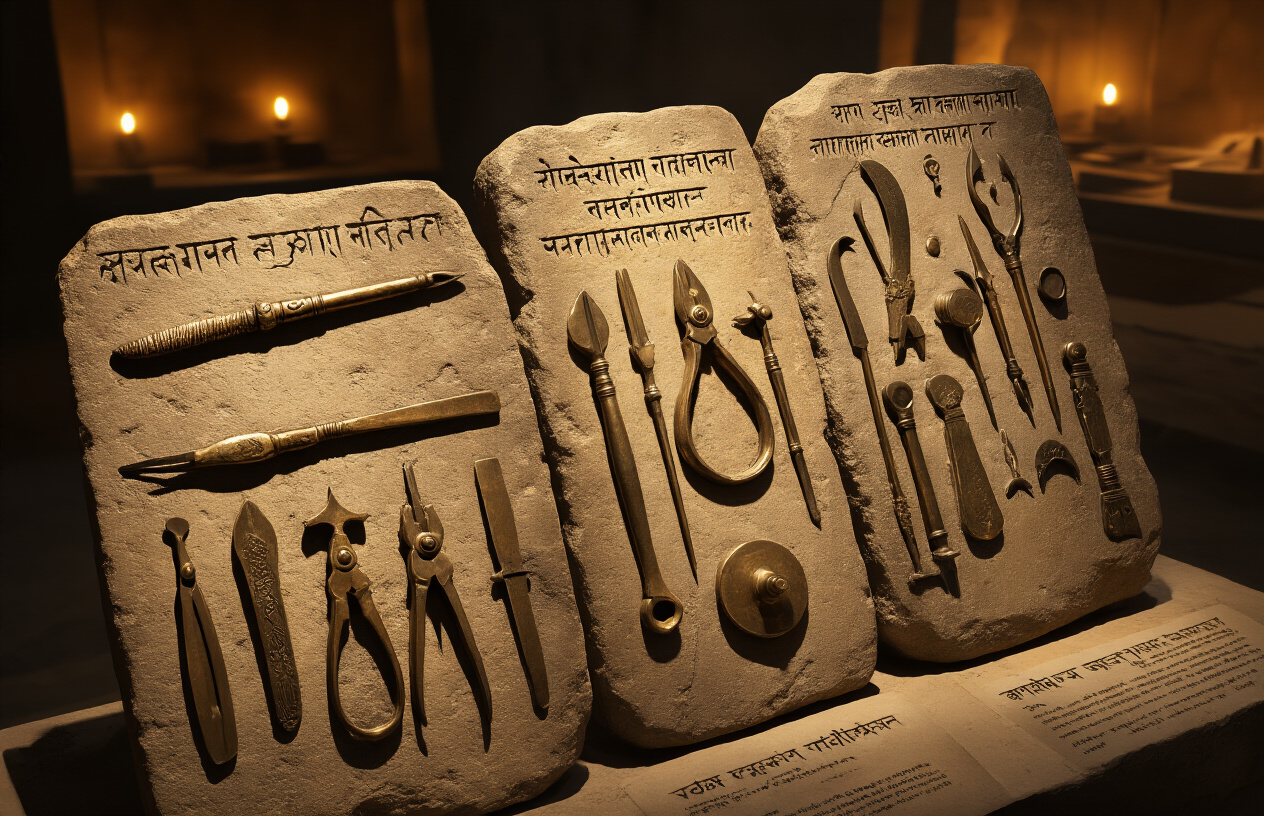
The Sushruta Samhita, an ancient Sanskrit text dating back to the 6th century BCE, describes surgical procedures and instruments that would make today’s medical professionals do a double-take. Archaeological excavations across India have uncovered surgical tools that match the precision and functionality described in these texts, revealing a level of advanced ancient medical instruments India possessed that challenges our understanding of historical medical capabilities.
Ancient Indian surgeons used over 120 different surgical instruments, including specialized forceps, scalpels, and needles crafted with remarkable precision. The cataract extraction tools found at various sites demonstrate knowledge of delicate eye surgery techniques that weren’t rediscovered in the Western world until centuries later. These mysterious Indian artifacts include curved needles for suturing that match modern surgical standards and bone saws with teeth patterns optimized for clean cuts.
What’s particularly striking is the metallurgical sophistication behind these tools. Many were forged from high-grade steel alloys that resist corrosion and maintain sharp edges – properties that modern surgical instruments aim to achieve. The precision grinding and polishing techniques used to create these tools suggest manufacturing processes that historians previously thought impossible for ancient civilizations.
Pharmaceutical Preparation Equipment
Ancient Indian pharmaceutical equipment reveals an understanding of chemistry and medicine that seems impossibly advanced for its time. Excavations have revealed distillation apparatus, grinding devices, and extraction equipment that mirror modern pharmaceutical manufacturing principles.
The discovery of sophisticated mortars and pestles made from specific stone compositions shows ancient Indian practitioners understood how different materials affected drug preparation. These tools were designed to prevent contamination and maintain the purity of medicinal compounds. Steam distillation units found at archaeological sites demonstrate knowledge of separating essential oils and creating concentrated medicines through processes nearly identical to modern techniques.
Measuring devices with precise calibrations suggest ancient pharmaceutical practices relied on exact dosages rather than guesswork. These calibrated vessels and weighing instruments indicate a systematic approach to medicine that rivals contemporary standards for accuracy and consistency.
Diagnostic Devices with Unexplained Accuracy
Perhaps the most puzzling discoveries are diagnostic instruments that seem to operate on principles not fully understood even today. Ancient Indian medical practitioners developed pulse-reading devices and diagnostic tools that could detect subtle physiological changes with remarkable accuracy.
Archaeological evidence points to the use of specialized listening devices for internal examination – essentially primitive stethoscopes that allowed practitioners to diagnose internal conditions. These tools, crafted from specific materials known for their acoustic properties, enabled medical practitioners to detect heartbeat irregularities and breathing problems with precision that wouldn’t be matched in Western medicine until the 19th century.
Temperature-measuring devices found at various sites suggest ancient Indian doctors could accurately assess fever and other temperature-related conditions using instruments calibrated to detect minute changes in body heat. The sophistication of these tools raises questions about the depth of physiological knowledge possessed by ancient practitioners.
Anatomical Models Showing Advanced Understanding
The anatomical models and teaching aids discovered across the Indian subcontinent reveal a profound understanding of human physiology that challenges conventional timelines of medical knowledge. These models, crafted from various materials including metals, stone, and organic compounds, demonstrate detailed knowledge of organ systems, blood circulation, and neural pathways.
Particularly impressive are the cardiovascular system models that accurately depict heart chambers, valve locations, and major blood vessels. These archaeological anomalies Indian subcontinent artifacts show understanding of blood circulation principles that Western medicine didn’t accept until William Harvey’s work in the 17th century.
Neurological models found at ancient sites display detailed knowledge of brain structure and nervous system pathways. The accuracy of these representations suggests ancient Indian medical practitioners had methods for studying internal anatomy that remain mysterious today. Brain models showing specific regions and their functions indicate knowledge that modern neuroscience has only recently confirmed.
Skeletal models with moveable joints and accurate bone proportions served as teaching tools for medical students thousands of years ago. The precision of these models, including details like bone density variations and joint mechanics, demonstrates an empirical approach to medical education that was remarkably sophisticated for its time.
Unexplained Technologies That Challenge Archaeological Dating
Energy Conduction Properties in Religious Objects
Several mysterious Indian artifacts display unusual energy conduction properties that confuse modern scientists. The bronze statues found in Tamil Nadu temples exhibit electrical conductivity patterns that don’t match typical bronze compositions from ancient times. When researchers tested these artifacts, they discovered the metal contained trace elements arranged in ways that create natural electrical pathways.
The most puzzling example comes from the Nataraja sculptures at Chidambaram Temple. These bronze figures conduct electricity in specific patterns that align with ancient descriptions of energy flow in Hindu texts. Scientists can’t explain how ancient craftsmen achieved this precise metallurgical composition without modern electrical knowledge.
Stone lingams from various Shiva temples also show strange properties. When exposed to certain frequencies, they vibrate at resonances that match descriptions in ancient Sanskrit texts about divine energy. The granite used contains quartz crystals arranged in formations that seem deliberately positioned to create these effects.
Acoustic Engineering in Sacred Chambers
Ancient Indian architects built temples with acoustic properties that modern sound engineers struggle to replicate. The Meenakshi Temple in Madurai features chambers where whispers carry clearly across vast distances while loud sounds remain contained. This selective sound transmission suggests advanced understanding of wave mechanics.
The Hampi ruins contain stone structures that amplify specific frequencies while dampening others. Clapping your hands in certain spots creates echoes that sound like musical notes, perfectly tuned to match classical Indian ragas. Archaeological dating places these structures at least 500 years before European acoustic science developed.
Most remarkable is the musical pillars found throughout South Indian temples. These carved stone columns produce distinct musical notes when struck, each pillar tuned to specific frequencies. The Vittala Temple complex contains 56 such pillars that create a complete musical scale. Modern analysis shows the stone was carved with mathematical precision to achieve exact tonal qualities.
Optical Principles Applied to Ancient Mirrors
Ancient Indian mirrors display optical properties that challenge our understanding of historical technological development. The Konark Sun Temple contains polished metal surfaces that focus sunlight with laser-like precision. These mirrors redirect light beams to illuminate specific temple areas during solstices and equinoxes.
Bronze mirrors excavated from Harappan sites show surface treatments that create unusual reflective properties. Some mirrors magnify images while others create multiple reflections in geometric patterns. The metallurgy required for such precise optical surfaces wasn’t supposed to exist 4,000 years ago.
The most intriguing discovery involves mirrors that seem to filter light wavelengths. Certain temple mirrors reflect only specific colors while absorbing others, creating colored light effects without pigments or dyes. This selective reflection requires understanding of light wave properties that European science didn’t develop until the 17th century.
Magnetic Properties in Ceremonial Items
Many ceremonial objects from ancient India exhibit magnetic properties that don’t occur naturally in their materials. Iron statues from medieval temples show permanent magnetization patterns that remain stable after centuries. These magnetic fields align with cardinal directions and astronomical features in ways that suggest deliberate design.
The Jagannath Temple in Puri contains iron structures that interfere with compass readings. Visitors report their compasses spinning wildly near certain ceremonial items. Geological surveys confirm no natural magnetic anomalies exist in the area, pointing to artificial magnetic properties in the artifacts themselves.
Stone carvings from Buddhist monasteries in Ladakh contain iron particles arranged in patterns that create weak magnetic fields. These fields interact with metal objects placed near them, causing slight movements that ancient texts describe as “divine animation.” The precision required to embed iron particles in such specific arrangements suggests sophisticated knowledge of magnetic principles.
Time-Keeping Mechanisms of Unknown Origin
Archaeological excavations across India have uncovered time-keeping devices that operate on principles modern science struggles to explain. The Jantar Mantar observatories contain stone instruments that track celestial movements with accuracy matching atomic clocks. These massive sundials account for Earth’s axial wobble and orbital variations that weren’t officially discovered until the 20th century.
Water clocks found in Kerala temples use flow-rate mechanisms that maintain accuracy despite temperature changes. The bronze vessels contain internal structures that adjust water flow automatically, compensating for seasonal variations. This automatic calibration suggests understanding of thermal expansion principles centuries before European clockmakers developed similar techniques.
Most puzzling are the mechanical calendars discovered in Rajasthani forts. These gear-driven devices track multiple calendar systems simultaneously while predicting eclipse dates centuries into the future. The bronze gears show wear patterns indicating centuries of continuous operation, yet their mathematical precision rivals modern astronomical calculations.
Stone circles throughout India function as celestial computers, tracking planetary positions and predicting astronomical events with startling accuracy. The complexity of these calculations, embedded in physical stone arrangements, suggests mathematical knowledge that mainstream archaeology says shouldn’t have existed in ancient times.
These five remarkable Indian artifacts paint a picture that’s hard to ignore. The advanced metallurgy, sophisticated engineering, precise astronomical calculations, cutting-edge medical tools, and mysterious technologies all point to something extraordinary about ancient Indian civilizations. Each discovery forces us to question what we think we know about the capabilities of people thousands of years ago.
The evidence suggests that ancient Indians possessed knowledge and skills that we’ve consistently underestimated. These aren’t just impressive artifacts – they’re proof that our ancestors were far more advanced than mainstream archaeology wants to admit. Maybe it’s time we stopped looking at the past through our modern assumptions and started giving these ancient civilizations the credit they deserve. The next time you hear someone dismiss ancient achievements, remember these five game-changing discoveries that are rewriting history books one artifact at a time.
Leave a Reply