
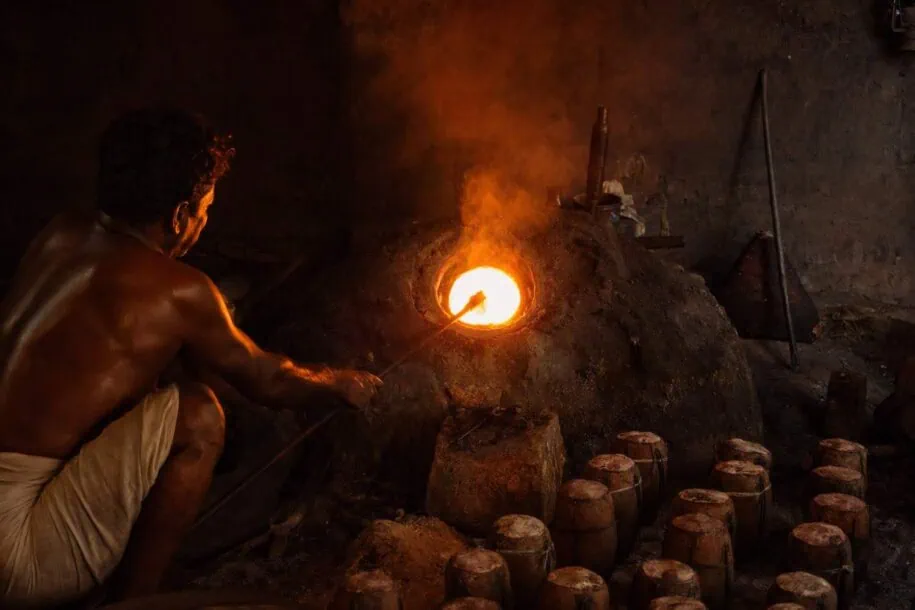
What Wootz Steel Actually Is and Why It Was Extraordinary
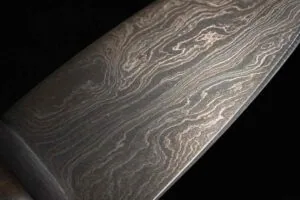
Wootz steel is a high-carbon crucible steel produced through a specific smelting process in which iron ore and carbon-rich organic material are sealed together in a clay crucible and heated to temperatures above 1,400 degrees Celsius, causing the carbon to dissolve into the molten iron at levels between 1 and 2 percent. When this material cools slowly under controlled conditions, the carbon precipitates out as iron carbide particles called cementite, which arrange themselves in a distinctive banded pattern visible on the surface of the finished metal as flowing wavy lines. This surface patterning, which looks like flowing water or a wood grain, is the visual signature of genuine Wootz steel and is called a Damascus pattern.
The material properties produced by this process are extraordinary by any standard of ancient or medieval metallurgy. Wootz steel is simultaneously harder and more flexible than any iron or steel that could be produced by conventional forging methods. It holds a sharper edge than any other blade material available before modern industrial processes. And the cementite particles distributed through the matrix act as a natural self-sharpening mechanism: as the blade wears in use, the softer iron matrix around each cementite particle wears away slightly faster, leaving the harder particles slightly proud of the surface and continuously renewing the cutting edge.
No European smithing tradition produced anything approaching this material before the industrial revolution. No Chinese, Persian or Arab metallurgical tradition independently replicated it. For approximately two thousand years, from 300 BCE to roughly 1750 CE, Wootz steel produced in South India was the most technically sophisticated blade material on earth.
Where Wootz Steel Was Made: The Furnaces of South India
The production of Wootz steel was concentrated in two broad regions of South India. The first was the area around Konasamudram in what is now Telangana, where the specific combination of local iron ore, charcoal from particular tree species and the mineral composition of the local clay used for crucible production created conditions uniquely suited to Wootz production. The second was the region around Salem and Trichinopoly in Tamil Nadu, where similar geological and botanical conditions supported an independent but related tradition.
The iron ore used in Wootz production was not generic. South Indian Wootz smiths selected specific ore deposits whose mineral composition, particularly the presence of trace elements including vanadium, molybdenum and manganese, contributed to the particular properties of the finished material. The charcoal came from specific tree species, particularly Cassia auriculata and Convolvulus laurifolius, whose combustion characteristics produced the precise carbon content and temperature profile required. The leaves of certain plants were added to the crucible mixture as additional carbon sources, with specific species selected for their chemical properties.
This level of botanical and geological specificity is one of the reasons Wootz production was so difficult to replicate outside South India. European metallurgists who obtained samples of the finished material and tried to work backward to its production process were missing not just the technical knowledge but the specific raw materials, the iron ore, the charcoal species and the crucible clay, that made the South Indian process possible.
The 18th century traveller and metallurgist Benjamin Heyne documented the Wootz production process in Telangana in 1795 and noted that the product was considered throughout the known world to be the finest steel produced anywhere. By the time he was writing, the tradition was already in decline, disrupted by British colonial trade policies that flooded India with cheap imported iron and destroyed the economic basis of the artisanal steel production tradition.
How Wootz Became Damascus: The Persian Connection
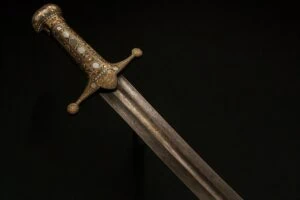
The journey from Wootz to Damascus steel follows the same trade routes that carried Indian pepper, cotton and ivory to the ancient and medieval world.
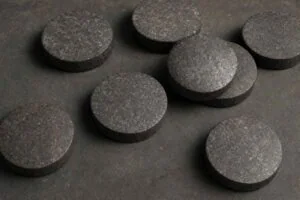
Indian Wootz steel was exported in the form of small circular cakes, approximately 12 centimetres in diameter and 2 centimetres thick, each weighing roughly one kilogram. These cakes were the raw material from which Persian, Arab and later European smiths forged blades, applying the specific forging techniques required to develop the Damascus pattern on the surface without destroying the material properties that made it extraordinary. The forging of Wootz into a blade was itself a highly skilled process: the temperature range within which the metal could be worked without losing its characteristic properties was narrow, and smiths who did not understand the material’s behaviour could produce a blade that looked correct but had none of the mechanical properties that made Wootz steel legendary.
The name Damascus comes from the city of Damascus in Syria, which was one of the primary trading and forging centres through which Indian Wootz was processed and distributed to the wider medieval world. Damascus smiths did not produce the raw material. They were the intermediaries who forged it into finished blades and from whose city it took the name by which the world came to know it. This is one of the most consequential misattributions in the history of technology: a material invented in India, refined over a millennium of South Indian metallurgical practice, named after a Syrian trading city, and credited by the entire Western world to an origin it never had.
The armies of Saladin, who recaptured Jerusalem from the Crusaders in 1187 CE, carried blades made from this material. The Islamic world’s military advantage over the Crusader forces was partly tactical and partly metallurgical. When the Crusaders eventually brought Damascus blades back to Europe, European smiths recognised immediately that they were looking at something they could not replicate. The attempts began and continued for six hundred years without success.
Napoleon’s Metallurgists and the Quest to Crack the Formula
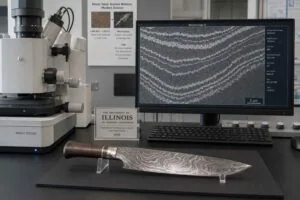
The story of the attempts to replicate Wootz steel reads like a chronicle of brilliant failure.
Michael Faraday, who would later discover electromagnetic induction and whose work underpins all modern electrical technology, spent years in the 1820s trying to analyse and replicate Damascus steel. He produced alloys with various combinations of metals but could not reproduce the characteristic surface pattern or the mechanical properties. He eventually concluded that the Damascus pattern was produced by an alloy of steel and a material he called siliceum, a hypothesis that was elegant but wrong.
Napoleon Bonaparte, whose campaigns in Egypt brought him into contact with Damascus blades, commissioned French metallurgists to crack the formula as a military priority. If France could produce Damascus steel at scale, the argument went, French armies would have a decisive advantage in blade-to-blade combat. The commission failed.
The Swedish chemist Jöns Jacob Berzelius, who discovered several elements and developed the modern system of chemical symbols, analysed samples of Damascus steel and produced detailed chemical reports but could not replicate the material. The German chemist Friedrich Wöhler, who synthesised urea and effectively founded organic chemistry, worked on the problem. The Russian metallurgist Pavel Anosov spent years at the Zlatoust arms factory in the Ural mountains trying to reconstruct the formula and published a monograph in 1841 claiming partial success, but his material did not fully replicate the original.
What all of these attempts missed, and what John Verhoeven at the University of California San Diego identified in 1998, was the critical role of trace elements in the original South Indian ore. The vanadium, molybdenum and manganese present in the specific ore deposits used by South Indian Wootz smiths were not just incidental impurities. They were essential to the formation of the carbide banding pattern and the mechanical properties it produced. European metallurgists working with European ores were missing these trace elements and therefore could not reproduce the result no matter how precisely they replicated every other aspect of the process.
The formula was not lost because the South Indian smiths kept it secret, though the tradition was certainly transmitted within specific communities and families rather than published. It was lost because the specific combination of raw materials, knowledge and technique that produced it existed only in a particular place, in the hands of particular people, and was destroyed by the economic disruption of colonial trade policy before anyone understood what was being lost.
The Science Behind the Legend: What John Verhoeven Found in 1998
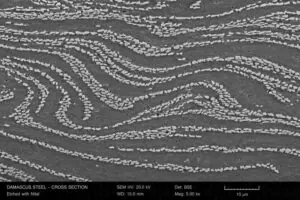
John Verhoeven is a materials scientist at Iowa State University who spent decades studying the microstructure of historical Damascus steel samples held in museum collections. What he found when he examined these samples under electron microscopy was not what previous researchers had expected.
The Damascus pattern is not produced by folding or twisting the metal, as many European smiths had assumed from looking at the surface. It is produced by the arrangement of iron carbide particles within the steel matrix, particles that form spontaneously when high-carbon steel is cooled slowly from above its liquidus temperature under specific conditions. The flowing pattern visible on the surface is a map of the internal microstructure, the way the carbide particles have organised themselves during controlled cooling.
What Verhoeven identified in 1998 was that the specific carbide banding pattern characteristic of genuine Damascus steel, as opposed to the many imitations produced by pattern welding and other techniques, requires the presence of specific carbide-forming trace elements in the steel. Vanadium is the most critical. At concentrations of approximately 0.01 percent by weight, vanadium promotes the formation of vanadium carbide particles that act as nucleation sites for the iron carbide banding pattern. Without vanadium at this specific concentration, the banding pattern does not form regardless of how precisely every other aspect of the process is controlled.
The South Indian ore deposits used for Wootz production happen to contain vanadium at almost exactly this critical concentration. This was not known to the South Indian smiths in any explicit chemical sense. They did not know about vanadium. They knew which ore deposits produced Wootz and which did not, which charcoal species produced the right carbon content and which did not, which crucible clay held the right temperature and which did not. This is the difference between explicit scientific knowledge and embodied craft knowledge: the South Indian smiths had solved a materials science problem that it took the world’s best metallurgists six hundred years to understand, not because they understood the chemistry but because they had developed, through centuries of practice and observation, a precise understanding of which materials in their specific landscape produced the result they wanted.
The Wootz Tradition and South India’s Metallurgical Continuum
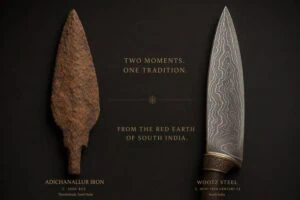
The story of Wootz steel cannot be separated from the broader story of South Indian metallurgy that begins at Adichanallur and Sivagalai.
The carbon dating at Sivagalai confirming iron smelting at 3,345 BCE establishes that the Tamirabarani valley was working with iron over five thousand years ago. The Wootz tradition, which begins to appear in the archaeological and textual record around 300 BCE, is not a separate story. It is the continuation of a metallurgical tradition that had been developing for over three thousand years in the specific landscape of South India, shaped by the particular iron ore deposits, the particular botanical resources and the accumulated practical knowledge of communities who had been working with iron longer than any other confirmed culture on earth.
The 1st century CE Tamil Sangam poetry, written when Wootz production was already established, references the quality of South Indian steel in terms that make clear it was already understood as extraordinary. The Periplus of the Erythraean Sea, the same 1st century CE Greek maritime text that references the Tamirabarani River as a source of iron, also mentions the export of South Indian steel to the Arabian Peninsula and beyond. Roman writers describe receiving steel from India that was superior to anything their own smiths could produce.
The tradition of producing extraordinary metal from the specific resources of South India, from the red laterite earth and the particular tree species and the craft knowledge passed down within families and communities, is a single continuum that runs from the burial urns of Adichanallur to the crucible furnaces of Konasamudram to the Damascus blades that armed Saladin’s armies to the laboratory in Iowa where John Verhoeven finally understood what it meant.
Where the Wootz Tradition Lives Today
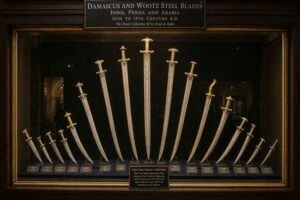
The industrial production of Wootz steel ended in the 19th century under the economic pressure of British colonial trade policy that made imported iron cheaper than locally produced steel and destroyed the economic basis of the artisanal tradition.
But the knowledge did not entirely disappear.
In the villages around Konasamudram in Telangana, families who descend from the Wootz-producing communities still carry the oral history of the tradition even if the furnaces no longer operate at scale. In the museum collections of Hyderabad, Chennai and the National Museum in Delhi, historical Wootz blades and crucible fragments survive as physical evidence of the tradition. In Salem in Tamil Nadu, the iron ore deposits that supplied the South Indian Wootz tradition are still present in the landscape.
And in the broader South Indian craft ecology, the relationship between specific communities, specific raw materials and specific embodied knowledge of metal production continues in the blacksmithing traditions of Tamil Nadu, Karnataka and Telangana, connecting the working craftspeople of today to a tradition that armed the medieval world and defeated the best European metallurgists of the Enlightenment.
What This Story Tells Us About India and the World
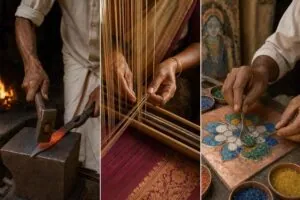
The story of Wootz steel is the story of how knowledge travels, gets renamed, gets credited to the wrong place and eventually gets reconstructed by someone patient enough to look at the evidence carefully.
Damascus steel was not from Damascus. The Iron Age did not begin in Turkey. The zero did not come from Arabia. Indian pepper did not become valuable because Rome discovered it: Rome was already dependent on it before most Romans had heard of India. The repeated pattern in the history of ancient and medieval trade and technology is that South and Southeast Asia were not recipients of knowledge from the Mediterranean and the Middle East. They were, in many of the most consequential cases, the sources.
The Wootz story is particularly instructive because it shows how a material produced in a specific place by people with specific knowledge of their specific landscape was extracted from that context through trade, renamed, credited to the trading intermediary rather than the producer, and then lost when the colonial disruption of trade policy destroyed the economic conditions that had sustained it.
This is not ancient history. It is the template for a recurring pattern in the relationship between the global economy and localised traditional knowledge that continues to play out in craft communities across India today. The jasmine farmers of Shankarapura whose knowledge of banana fibre tying techniques is endangered. The Udupi cotton saree weavers of Talipady whose craft faces pressure from cheaper machine-made substitutes. The Varanasi enamellists whose numbers have fallen sharply over three decades. The specific embodied knowledge of specific communities in specific places is always at risk when the economic conditions that sustain it are disrupted.
Visiting these communities, spending time with them, paying directly for their knowledge and their craft, is not simply tourism. It is a recognition that the tradition of South Indian knowledge production, from the iron furnaces of the Tamirabarani valley to the crucible smiths of Konasamudram to the working studios of Varanasi, deserves to be held rather than merely preserved.