
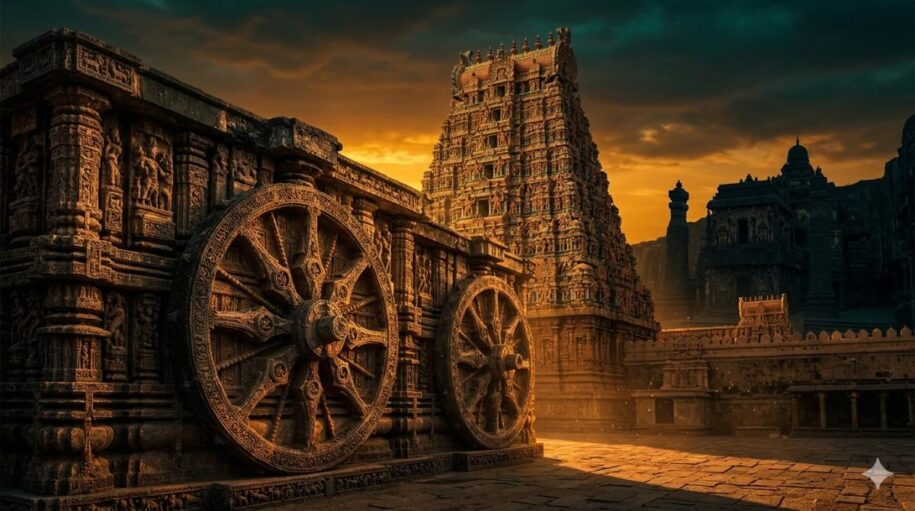
Ancient India holds engineering secrets that continue to baffle today’s scientists and researchers. These 10 ancient Indian engineering mysteries showcase technological achievements that modern experts struggle to replicate or fully understand.
This deep dive is perfect for history enthusiasts, engineering students, and anyone curious about how our ancestors accomplished seemingly impossible feats without modern tools or technology.
You’ll discover the mind-bending precision of ancient stone cutting techniques that created joints so tight you can’t slip a piece of paper between them. We’ll explore metallurgical marvels like the rust-resistant Iron Pillar of Delhi, which has stood for over 1,600 years without showing signs of corrosion despite having no protective coating. Plus, you’ll learn about the acoustic engineering wonders found in temples across India, where architects designed spaces that amplify whispers and create perfect sound resonance without any modern audio equipment.
Each mystery reveals how ancient Indian engineers pushed the boundaries of what seemed possible, leaving behind clues that modern science is still trying to decode.
Ancient Indian Engineering Mystery 1: Stone Cutting Precision That Defies Modern Science

Kailasa Temple Ellora: The Rock-Cut Wonder Every India Traveller Must See
Imagine carving an entire temple from a single rock, working from top to bottom, with absolutely no room for error. That’s exactly what ancient builders achieved at the Kailasa Temple in Ellora. This massive structure required removing 400,000 tons of solid rock with surgical precision that would challenge even today’s laser-cutting technology.
The mystery deepens when you consider the mathematical complexity involved. Every pillar, sculpture, and architectural element had to be perfectly calculated before the first chisel struck stone. Modern archaeologists estimate this would require advanced 3D modeling software today, yet these builders accomplished it over 1,000 years ago using unknown methods.
If witnessing one of ancient India’s greatest engineering mysteries in person is on your travel list, our Aurangabad tours include expert-guided visits to the Ellora Caves complex, where the story of the Kailasa Temple comes alive in the most extraordinary way.
Konark Sun Temple Odisha: The UNESCO Chariot Built With Zero Tolerance Stone Joints
The Konark Sun Temple showcases stone-cutting precision that baffles modern engineers. Massive granite blocks weighing several tons fit together so perfectly that not even a thin blade can slip between the joints. These connections were achieved without any binding agents or modern tools.
Recent studies using laser measurement devices reveal tolerances of less than 0.1 millimeters between stone surfaces. This level of accuracy typically requires computer-controlled machinery and diamond-tipped cutting tools. The builders somehow achieved this precision using techniques that remain completely unknown to modern science.
Stand before this UNESCO masterpiece yourself on our Bhubaneswar tours, which include expert guided access to the Konark Sun Temple and Odisha’s extraordinary ancient heritage.
Ajanta Caves Maharashtra: 2000 Year Old Geometry Carved Into Living Rock
The Ajanta Caves demonstrate mathematical precision that rivals modern architectural software. Each cave follows complex geometric principles with perfectly calculated proportions, yet these structures were carved directly into solid rock faces without the ability to make corrections.
The acoustic properties of these caves reveal advanced understanding of sound engineering. Every curve and angle was precisely calculated to create specific resonance patterns. Modern sound engineers struggle to replicate these acoustic effects even with sophisticated computer modelling.
Our Aurangabad tours combine both Ajanta and Ellora in one immersive journey, giving you two of ancient India’s greatest engineering and artistic mysteries in a single unforgettable experience.
Ancient Indian Stone Cutting Tools: The Technology That Left No Trace
Archaeological evidence suggests ancient builders possessed cutting tools that surpassed modern capabilities. Granite surfaces show cut marks that could only be produced by diamond-edged implements or ultrasonic cutting technology. Yet no such tools have ever been discovered from these time periods.
Stone samples reveal microscopic evidence of cutting techniques that modern industry cannot replicate without advanced machinery. The precision and smoothness of these cuts suggest technologies that either disappeared completely or were never properly documented in historical records.
Ancient Indian Engineering Mystery 2: Metallurgical Marvels No Modern Scientist Can Replicate
Iron Pillar of Delhi: 1600 Years of Rust-Free Ancient Indian Metallurgy
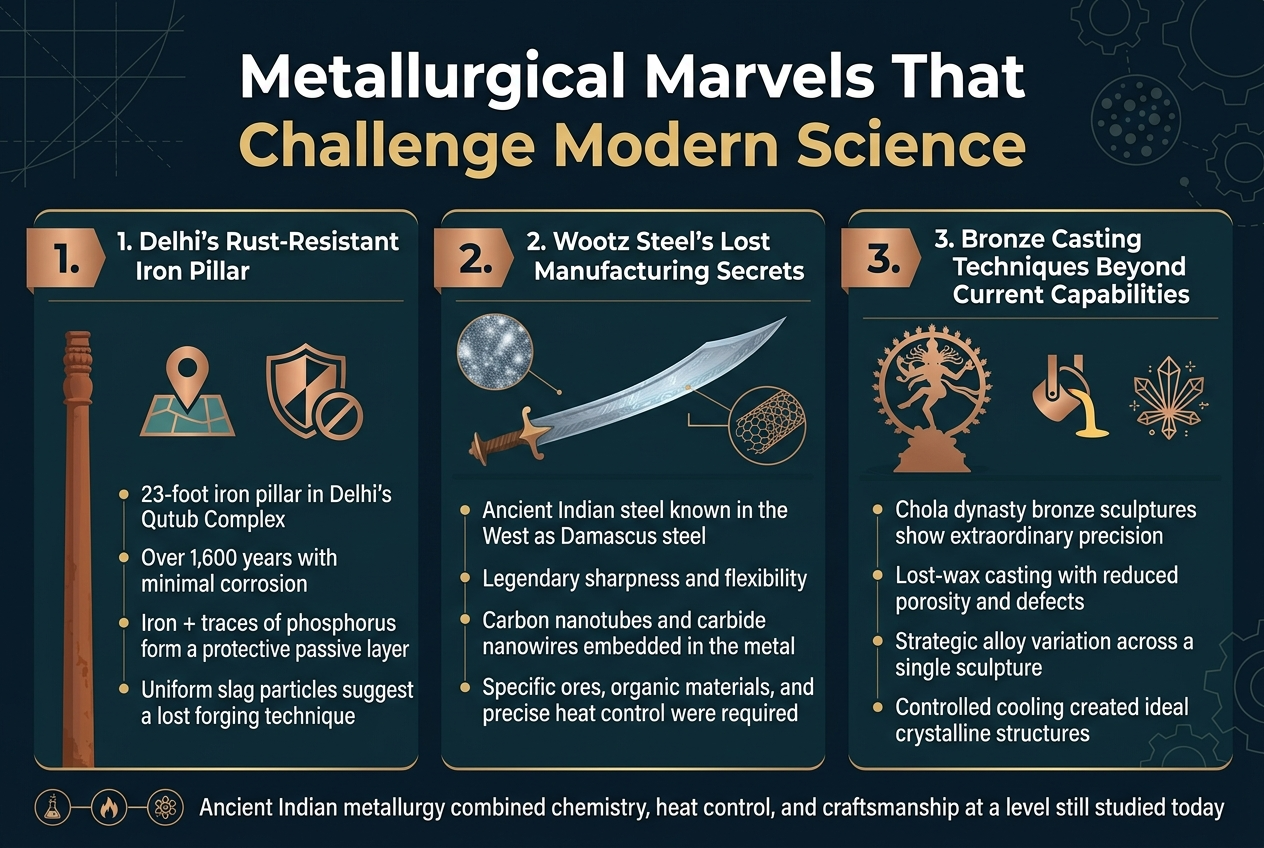
Standing tall in Delhi’s Qutub Complex, a 23-foot iron pillar has defied corrosion for over 1,600 years. While most iron structures would have crumbled to rust centuries ago, this pillar remains remarkably intact, puzzling metallurgists worldwide.
The pillar contains an unusual composition of iron with traces of phosphorus, creating a protective passive layer that prevents oxidation. What baffles experts is how ancient Indian metallurgists achieved this precise chemical balance without modern analytical tools. The manufacturing process required maintaining exact temperatures and atmospheric conditions that today’s engineers struggle to replicate consistently.
Recent studies reveal the iron’s microstructure contains microscopic slag particles distributed uniformly throughout the metal. This distribution pattern suggests a forging technique that modern science hasn’t fully decoded. The ancient smiths somehow managed to create a self-healing metal surface that forms protective compounds when exposed to moisture.
Archaeological evidence suggests similar rust-resistant iron artifacts existed across ancient India, indicating this wasn’t a one-time accident but a well-understood technology that has since vanished from human knowledge.
You can stand before this extraordinary ancient India travel mystery yourself on our Delhi tours, which include the Qutub Complex where the Iron Pillar has silently baffled the world’s metallurgists for over sixteen centuries.
Wootz Damascus Steel: The Ancient Indian Alloy That Modern Science Rediscovered Too Late
Ancient Indian Wootz steel, known in the West as Damascus steel, produced blades of legendary sharpness and flexibility. These weapons could slice through European armor while maintaining their edge through countless battles.
The steel’s distinctive watered pattern resulted from carbon nanotubes and carbide nanowires embedded within the metal matrix – structures that modern science only discovered in the 20th century. Ancient Indian craftsmen achieved this nanotechnology through a mysterious smelting process that remains incompletely understood.
The manufacturing required specific iron ores from particular Indian mines, combined with organic materials and precise temperature control over days-long forging cycles. European attempts to recreate Wootz steel using documented techniques consistently failed, leading to the technology’s complete loss by the 18th century.
Modern attempts using electron microscopy and computer modeling have partially recreated the steel’s properties, but the original methods that produced superior results remain elusive. The ancient masters somehow understood metallurgy at a molecular level without microscopic equipment.
Chola Bronze Casting: Ancient Indian Precision That Modern Foundries Cannot Match
The Chola dynasty’s bronze sculptures demonstrate casting precision that challenges contemporary foundries. The famous Nataraja statues exhibit perfectly balanced proportions and flawless surface finishing achieved through techniques modern bronze workers struggle to match.
These massive bronzes were cast using the lost-wax process, but with innovations that eliminated common defects like porosity and uneven metal distribution. The alloy composition varies strategically throughout single pieces – harder bronze for structural elements and softer alloys for detailed features.
Most remarkably, some Chola bronzes show evidence of controlled cooling rates that created specific crystalline structures for optimal strength and appearance. This level of thermal management requires understanding of metallurgical principles that weren’t formally documented until modern times.
The tools and furnaces capable of achieving such results have never been conclusively identified at archaeological sites, suggesting the ancient bronze workers possessed knowledge and equipment that left no trace for modern investigation.
The living legacy of Chola bronze mastery and Tamil Nadu’s temple heritage can be explored in depth on our Madurai tours and Chola tours, guided by experts who bring this extraordinary tradition to life.
Ancient Indian Engineering Mystery 3: Acoustic Wonders of Sacred Spaces You Can Hear Today
Chidambaram Nataraja Temple: Ancient Indian Acoustic Engineering 1000 Years Ahead of Its Time
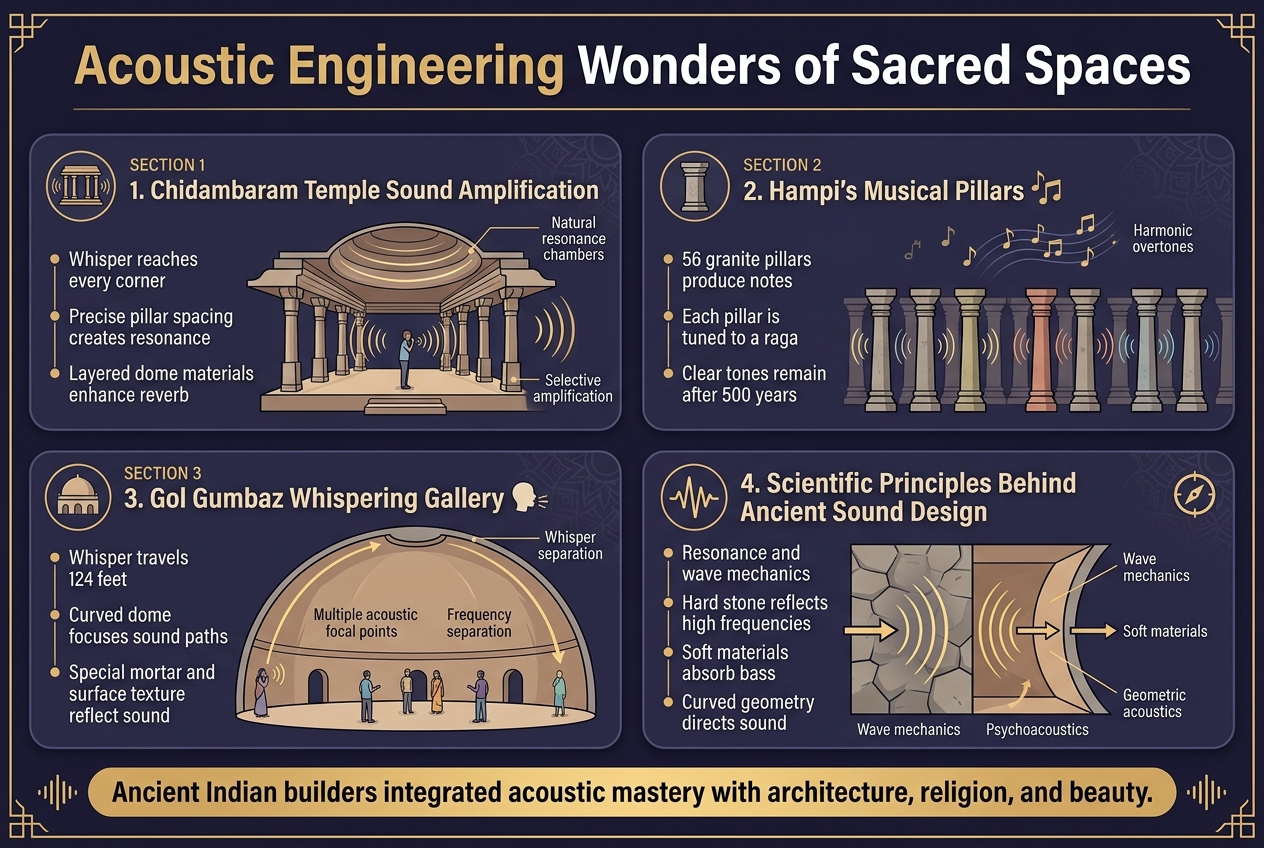
The Nataraja Temple at Chidambaram houses one of the most sophisticated acoustic systems ever discovered in ancient architecture. Built over a thousand years ago, this temple’s main hall can amplify a whisper from the center to reach every corner with perfect clarity. Engineers studying the structure found that the builders positioned the pillars at precise mathematical intervals, creating natural resonance chambers that enhance vocal frequencies without any mechanical amplification.
What makes this system truly remarkable is its selective amplification capability. The acoustic design specifically enhances frequencies of Sanskrit chants and traditional musical instruments while filtering out background noise. Modern sound engineers attempting to replicate this effect using contemporary materials have struggled to achieve the same level of precision and clarity.
The temple’s dome features a unique construction technique where multiple layers of different materials create a natural reverb chamber. Stone slabs of varying thicknesses were arranged in specific patterns, with air gaps calculated to create optimal sound reflection. This design ensures that prayers and chants maintain their spiritual resonance while reaching the maximum number of devotees.
The acoustic wonders of Tamil Nadu’s extraordinary temple tradition are best experienced in person with expert guidance. Our Chennai tours and Madurai tours take you deep into this living heritage.
Hampi Musical Pillars: The Granite Instruments of Vittala Temple That Science Cannot Explain
Hampi’s Vittala Temple contains 56 musical pillars that produce distinct musical notes when struck gently. Each pillar generates a different tone, and together they can create complex melodies spanning multiple octaves. What baffles modern engineers is how medieval craftsmen managed to carve solid granite pillars that function as precision musical instruments.
These pillars aren’t hollow like modern musical instruments. They’re carved from single blocks of granite, yet each produces pure, sustained tones without any internal mechanisms. The secret lies in the precise proportions and internal stress patterns created during the carving process. The artisans somehow understood how to manipulate granite’s crystalline structure to create resonant frequencies.
Recent acoustic analysis revealed that these pillars produce sounds that match traditional Indian musical scales perfectly. The frequency response of each pillar was deliberately tuned to specific ragas, suggesting the builders possessed advanced knowledge of both metallurgy and music theory. Some pillars even produce harmonic overtones that create complex chord progressions when multiple pillars are struck simultaneously.
The most intriguing aspect is the durability of this acoustic system. After 500 years of weathering, these pillars still produce clear, accurate tones. Modern attempts to recreate similar effects in granite have failed to achieve the same tonal quality or longevity.
Hearing these pillars for yourself is one of the most memorable sensory experiences available anywhere in India. Our Hampi tours include expert guided visits to the Vittala Temple where our guides bring the acoustic mystery of these extraordinary stone instruments to life.
Gol Gumbaz Bijapur: The Ancient Indian Whispering Gallery That Rivals Any in the World
The Gol Gumbaz in Bijapur demonstrates acoustic engineering that rivals the famous whispering galleries of European cathedrals, yet it was built using entirely different principles. This 17th-century mausoleum features a dome where a whisper at one end can be heard clearly at the opposite side, 124 feet away, while remaining inaudible to people standing in between.
The dome’s interior surface was designed with specific curvature calculations that focus sound waves along predetermined paths. Unlike European examples that use circular or elliptical geometry, Gol Gumbaz employs a complex mathematical curve that creates multiple acoustic focal points. This allows for various whispering effects depending on where speakers position themselves.
Engineers discovered that the builders used a unique mortar mixture containing specific mineral additives that enhanced sound reflection. The surface texture was also carefully controlled – smooth enough to reflect sound waves cleanly, yet with microscopic variations that prevent unwanted echoes and distortions.
The acoustic properties extend beyond simple sound transmission. The dome can separate and amplify different frequency ranges, allowing multiple conversations to occur simultaneously without interference. This suggests the designers understood principles of acoustic frequency separation that weren’t formally documented in European science until centuries later.
Gol Gumbaz is part of Karnataka’s extraordinary heritage circuit. Our Hubli tours include this remarkable ancient Indian acoustic wonder as part of a wider exploration of the Deccan’s remarkable built heritage.
Scientific Principles Behind Ancient Sound Design
Ancient Indian architects demonstrated mastery of acoustic principles that modern science is only beginning to fully understand. They manipulated natural materials to create spaces that enhanced specific types of sound while suppressing others, showing deep knowledge of wave mechanics, resonance theory, and psychoacoustics.
The builders understood that different materials and geometries affect various frequency ranges differently. They combined hard stones for high-frequency reflection with softer materials for bass absorption, creating balanced acoustic environments tailored to specific purposes. Temple spaces were designed to enhance the frequency ranges of human voices during prayer and chanting, while minimizing external noise interference.
These ancient engineers also grasped the relationship between space geometry and sound behavior. They created curved surfaces and angled walls that directed sound waves along specific paths, concentrated acoustic energy at particular points, and eliminated problematic echoes. The mathematical precision required for these calculations suggests they possessed sophisticated understanding of geometric acoustics.
The most remarkable aspect is how these acoustic systems were integrated seamlessly into structures that also met complex architectural, religious, and aesthetic requirements. Modern acoustic engineers typically design spaces primarily for sound quality, but ancient Indian builders achieved superior acoustic performance while simultaneously creating architecturally stunning and spiritually meaningful spaces.
Ancient Indian Engineering Mystery 4: Water Management Systems That Put Modern Cities to Shame
Indus Valley Civilisation Drainage: Urban Planning That Predates the Modern World by 4000 Years
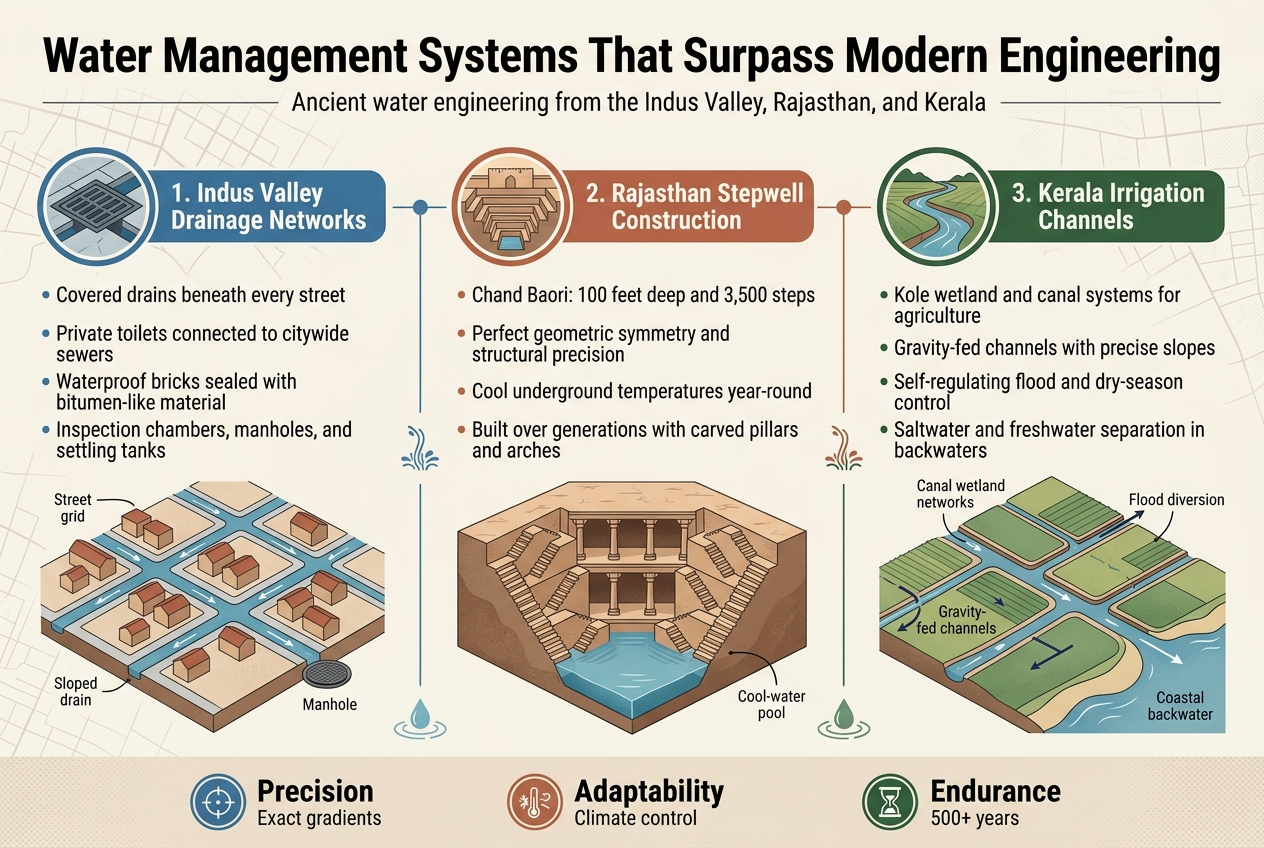
The Harappan civilization built cities with drainage systems that put many modern urban planners to shame. Walking through the ruins of Harappa and Mohenjo-daro today, archaeologists find covered drains running beneath every street, connecting houses to a sophisticated citywide network that would make contemporary engineers jealous.
What really blows minds is the precision. These ancient engineers created perfectly sloped channels that carried wastewater away from residential areas without any pumps or mechanical assistance. Every house had private toilets connected to the main drainage system – a luxury many parts of the world still lack today. The bricks were waterproof, made with a bitumen-like substance that kept sewage from contaminating groundwater.
The technical mastery gets even more impressive when you realize they built inspection chambers and manholes at regular intervals. Modern cities struggle with drainage maintenance, but the Harappans designed their system for easy cleaning and repairs. They even included settling tanks where solid waste could separate before flowing into larger channels.
What stumps modern engineers is how they calculated the exact gradients needed across entire cities without modern surveying equipment. These networks operated flawlessly for over 600 years, handling monsoon floods and daily waste management with an efficiency that many contemporary cities can’t match.
Two of the most extraordinary Indus Valley sites in the world are now accessible through 5 Senses Tours. Walk through the ancient streets of Dholavira, one of the largest and best preserved Harappan cities ever excavated, and Lothal, home to the world’s earliest known dock, where 4500-year-old drainage systems and urban planning will leave you genuinely speechless. These are among the most profound ancient India travel mysteries you can experience anywhere on earth.
Chand Baori Stepwell Rajasthan: The Underground Palace That Defies Medieval Engineering Logic
Rajasthan’s stepwells represent engineering achievements that seem almost impossible given the tools available 1,000 years ago. These aren’t just wells – they’re architectural marvels that descend deep into the earth through precisely carved stone steps, creating underground palaces that access groundwater with scientific precision.
The Chand Baori in Abhaneri drops 100 feet below ground level through 3,500 narrow steps arranged in perfect geometric patterns. The mathematical precision required to create these symmetrical designs while digging downward through solid rock challenges everything we know about medieval construction capabilities. Each step had to be calculated to maintain structural integrity as the well descended deeper.
Even more puzzling is the temperature control these structures achieve. While surface temperatures in Rajasthan can hit 120°F, the bottom levels of stepwells remain consistently cool year-round. The architects somehow understood thermal dynamics and air circulation principles that weren’t formally documented until centuries later.
The construction process itself remains a mystery. How did medieval workers remove millions of tons of stone and debris from increasingly narrow spaces hundreds of feet underground? They managed to carve intricate decorative pillars and arches while working in cramped, poorly lit conditions. Some stepwells took over 100 years to complete, requiring multiple generations to maintain exact architectural standards.
Most baffling is their water-sensing ability. These wells were positioned with uncanny accuracy over underground aquifers, suggesting knowledge of geological surveying techniques that modern hydrogeologists use sophisticated equipment to achieve.
The stepwells of Rajasthan are among ancient India’s most photographed and least understood engineering achievements. Our Jaipur tours include expert guided access to these extraordinary structures, one of the most distinctive heritage travel experiences available in India.
Kerala Ancient Irrigation Systems: Hydraulic Engineering That Modern Water Management Studies
Kerala’s ancient irrigation networks showcase hydraulic engineering that modern water management experts study but struggle to replicate. The traditional “Kole” wetland systems and canal networks demonstrate an understanding of water flow dynamics that rivals contemporary computer modeling.
The spice-growing regions developed intricate canal systems that could precisely control water levels across vast agricultural areas. These channels moved water uphill using nothing but gravity and carefully calculated slopes – a feat that seems to defy physics until you examine the mathematical precision behind every curve and elevation change.
What makes these systems extraordinary is their self-regulating capability. During monsoon seasons, the channels automatically redirect excess water to prevent flooding, while in dry periods, they maintain optimal moisture levels for crop growth. This automated water management was achieved entirely through mechanical design, without any electronic sensors or controls.
The most impressive examples are found in the backwater regions, where ancient engineers created networks that separate salt water from fresh water using nothing but strategic positioning and flow control. These systems have operated continuously for over 500 years, maintaining agricultural productivity in coastal areas where salt intrusion typically destroys farmland.
Modern attempts to recreate these irrigation methods using contemporary technology have largely failed. The original designers understood local microclimates, soil conditions, and seasonal water patterns with a sophistication that our current engineering approaches can’t match. Their knowledge of hydraulic principles was encoded directly into the physical structures, creating maintenance-free systems that continue operating long after the knowledge of how to build them has been lost.
Ancient Indian Engineering Mystery 5: Astronomical Precision Built Into Temple Architecture

Brihadeeswara Temple Thanjavur: The UNESCO Masterpiece Built on Mathematical Perfection
The Brihadeeswara Temple in Thanjavur stands as a testament to ancient India’s mathematical genius. Built around 1010 CE, this UNESCO World Heritage site showcases calculations that would challenge even modern engineers. The main tower reaches exactly 216 feet, a number that isn’t random—it’s 6 cubed, representing perfect mathematical harmony.
What really blows your mind is how the builders achieved perfect proportions without calculators or computers. The temple follows the golden ratio throughout its structure, from the base measurements to the height of each level. Every dimension relates to others through complex mathematical relationships that create both structural stability and aesthetic perfection.
The shadow cast by the main tower never falls on the ground around the temple during midday hours throughout the year. This required precise calculations considering the Earth’s tilt, seasonal variations, and the sun’s path across different months. Ancient architects somehow factored in all these variables to create this shadow effect.
Even more impressive is the temple’s foundation mathematics. The entire structure sits on a base that distributes its massive weight using principles that modern engineering has only recently begun to fully understand. The load distribution follows mathematical models that prevent settling or structural failure across centuries.
This UNESCO World Heritage masterpiece is accessible through our Chola tours, where expert guides illuminate the extraordinary mathematical genius embedded in every dimension of this thousand-year-old structure.
Khajuraho Temples: Ancient Indian Astronomical Alignments Hidden in Plain Sight
Khajuraho’s temples reveal ancient India’s deep understanding of celestial mechanics. These 10th-century monuments aren’t just randomly placed—they’re positioned according to a master plan that mirrors major star configurations visible from the Northern Hemisphere.
The temple complex aligns with cardinal directions so precisely that archaeologists use them as reference points for their surveys. During specific times of the year, certain temples frame the rising and setting positions of important stars and planets. The Kandariya Mahadev Temple, the largest in the complex, aligns perfectly with the constellation Orion during winter solstice.
What’s really fascinating is how the temples track Venus cycles. Ancient builders knew Venus returns to the same position relative to Earth every eight years, and several temples mark this cycle through their positioning and architectural features. Doorways and windows frame Venus at specific points in its cycle, creating natural astronomical observatories.
The spacing between temples follows mathematical patterns that correspond to planetary distances. When you map the temple positions, they recreate a scaled model of our solar system’s outer planets. This suggests ancient architects possessed knowledge about planetary relationships that Western astronomy didn’t confirm until much later.
The astronomical genius of Khajuraho is revealed in extraordinary depth on our Khajuraho tours, one of the most rewarding heritage travel experiences in all of India for visitors who want to understand what they are truly looking at.
Konark Sun Temple Solar Calendar: How Ancient India Built a Clock in Stone
Ancient Indian temples function as massive stone calendars, tracking solar movements with incredible accuracy. The Konark Sun Temple in Odisha serves as perhaps the most sophisticated example, where every architectural element serves a timekeeping function.
The temple’s main structure casts shadows that move across marked stones, indicating time of day down to minutes. Twelve pairs of ornately carved wheels around the temple’s base aren’t just decorative—they’re functional sundials that track hours, with each spoke representing a specific time interval.
Different temple sections illuminate during specific seasons, creating a year-long light show that marks important agricultural and religious dates. During equinoxes, sunlight penetrates the inner sanctum through carefully calculated openings, illuminating specific deities or symbols.
The builders integrated leap year corrections into their stone calendar system. They understood that Earth’s orbit takes approximately 365.25 days, not exactly 365, and built adjustment mechanisms into their architectural design. Some temples include additional shadow markers that activate only during leap years, maintaining calendar accuracy across centuries.
Ancient Indian Star Mapping: Celestial Accuracy That Rivals Modern Telescopes
Ancient Indian astronomers mapped star positions with accuracy that rivals modern telescopes, using nothing but naked-eye observations and mathematical calculations. Temple ceilings often reproduce exact star maps, showing constellations as they appeared thousands of years ago.
The Surya Temple at Modhera includes a ceiling that maps the entire northern hemisphere’s visible stars. Each carved star sits in its precise relative position, creating an accurate celestial map in stone. When you compare these ancient star maps with computer-generated models of historical sky positions, the accuracy is startling.
Temple builders tracked stellar precession—the slow wobble of Earth’s axis that changes star positions over thousands of years. They understood that star positions shift slightly each year and incorporated these changes into their architectural plans. Some temples include features that will align with specific stars only centuries in the future, showing they calculated stellar movement across vast time periods.
The most impressive achievement might be their tracking of subtle stellar brightness variations. Ancient astronomers somehow detected and recorded brightness changes in specific stars that modern instruments barely register. They incorporated these observations into temple designs, using varying depths of stone carving to represent different stellar magnitudes.
Ancient Indian Engineering Mystery 6: Vimana Flying Vehicles and Anti-Gravity in Sanskrit Texts

Vimana Aircraft in Sanskrit Literature: Ancient India’s Most Controversial Engineering Mystery
Ancient Sanskrit texts contain detailed descriptions of flying vehicles called Vimanas that sound remarkably similar to modern aircraft. The Vaimanika Shastra, attributed to sage Bharadvaja, provides technical specifications for constructing these aerial machines, including materials, propulsion systems, and navigation methods.
The text describes Vimanas capable of becoming invisible, moving silently, and changing direction instantly. Some accounts mention mercury-based propulsion systems that could generate anti-gravitational effects. The Samarangana Sutradhara contains blueprints for different types of Vimanas, categorizing them by their operational capabilities and flight patterns.
What puzzles researchers is the level of technical detail in these ancient manuscripts. They describe:
- Complex metallurgical processes for creating lightweight, durable materials
- Sophisticated control mechanisms operated by trained pilots
- Energy sources that remain unidentified by modern science
- Navigation systems using solar and magnetic principles
The Ramayana and Mahabharata contain numerous references to aerial battles fought using these vehicles. Characters travel vast distances in Vimanas, cross oceans, and engage in combat while airborne. These descriptions include specific details about speed, maneuverability, and weapons systems that wouldn’t seem out of place in modern military aviation manuals.
Lepakshi Temple Floating Pillar: Magnetic Levitation in Ancient Indian Architecture
Several ancient Indian temples display construction techniques that suggest knowledge of magnetic principles. The famous floating pillar at Lepakshi Temple in Andhra Pradesh remains partially suspended, defying conventional engineering explanation. Visitors can pass thin objects underneath the pillar, proving it doesn’t rest entirely on the ground.
Scientists have discovered that certain temple stones contain high iron content and exhibit unusual magnetic properties. The positioning of these stones creates magnetic fields that could theoretically reduce gravitational effects on specific structural elements. Some researchers believe ancient architects understood magnetic levitation principles long before their modern rediscovery.
The Konark Sun Temple contains iron beams arranged in patterns that generate complex magnetic fields. Historical accounts describe how the temple’s magnetic properties affected ship navigation in nearby waters. The main idol allegedly floated in mid-air due to carefully calculated magnetic forces created by the surrounding iron framework.
Archaeological studies reveal that temple builders selected specific types of magnetite-rich stones and arranged them in precise geometric patterns. These arrangements create localized magnetic anomalies that modern instruments can detect but struggle to explain fully.
The floating pillar of Lepakshi is one of ancient India’s most visually astonishing engineering mysteries and can be experienced as a day tour from Bangalore. Our Lepakshi Tours can include this extraordinary site for travellers who want to witness it firsthand.
Ancient Indian Temples: Weight-Defying Architectural Elements That Challenge Engineering Physics
Ancient Indian monuments contain massive stone blocks positioned in ways that challenge our understanding of construction physics. The Brihadeeswarar Temple features a 80-ton granite capstone placed 200 feet above ground level without any visible crane marks or ramp evidence.
The positioning accuracy of these enormous stones suggests either advanced lifting technology or knowledge of gravitational manipulation. Many blocks fit together with sub-millimeter precision despite weighing several tons each. The joints between stones remain so tight that even paper cannot slide between them.
Archaeological investigations have found no evidence of the massive earthen ramps typically required for such construction projects. The absence of construction debris around these sites raises questions about the methods used. Some stones appear to have been lifted and positioned as single units rather than assembled from smaller components.
The Hoysala temples feature intricate carvings on stones suspended in architecturally impossible positions. These decorative elements add significant weight to already massive structures yet show no signs of stress or settling over centuries. The engineering principles required to support such configurations remain unclear even with modern structural analysis techniques.
Ancient Indian Engineering Mystery 7: Chemistry and Materials Science Ahead of Their Time

Ajanta Cave Paintings: Ancient Indian Pigments That Have Survived 2000 Years of Monsoons
The vibrant paintings adorning ancient Indian temples and caves continue to baffle modern chemists with their extraordinary color retention. At Ajanta and Ellora caves, murals painted over 2,000 years ago maintain their original brilliance despite centuries of exposure to monsoons, temperature fluctuations, and time itself. The pigments display an almost supernatural resistance to UV degradation, moisture damage, and chemical breakdown.
Scientists have discovered that ancient Indian artisans created these pigments using sophisticated mineral processing techniques that modern laboratories struggle to replicate. The red ochres contain iron oxide particles engineered at the nanoscale level, creating exceptionally stable molecular structures. Blue pigments derived from lapis lazuli were mixed with organic binders that formed protective crystalline matrices around color molecules.
Recent spectroscopic analysis reveals that these ancient pigments possess self-healing properties – microscopic cracks in the paint layer actually repair themselves through chemical reactions triggered by atmospheric moisture. The binding agents used appear to be derived from specific plant resins that were chemically modified through heating processes that remain mysterious to contemporary researchers.
Standing before these 2000-year-old paintings in person is one of the most profound heritage travel experiences available anywhere in India. Our Aurangabad tours take you directly into the painted caves of Ajanta with expert guided context that transforms what you see into something you will never forget.
Ancient Indian Earthquake-Resistant Construction: Engineering Secrets Modern Science Is Still Learning
Ancient Indian builders developed construction materials with remarkable seismic resistance properties that modern earthquake engineering is only beginning to understand. The mortar used in structures like the Brihadeeswarar Temple contains organic additives that create flexible joints capable of absorbing and dissipating seismic energy without structural failure.
Archaeological analysis shows that ancient Indian mortars incorporated rice starch, jaggery, and egg whites in precise ratios that created polymer-like networks within the cement matrix. These bio-polymers allow the mortar to flex during ground movement while maintaining structural integrity. The resulting material exhibits viscoelastic behavior similar to modern shock-absorbing compounds.
Stone blocks in ancient Indian architecture were often joined using iron clamps embedded in lead, but the metallurgy involved specialized alloys that expand and contract at rates perfectly matched to the surrounding stone. This prevents stress fractures that typically occur at metal-stone interfaces during temperature changes or seismic activity.
Ancient Indian Mortars and Binding Agents: Why These Structures Outlast Modern Buildings
The mortars and binding agents used in ancient Indian construction demonstrate remarkable resistance to weathering that surpasses many modern materials. Structures built over a millennium ago show minimal degradation despite exposure to extreme monsoon conditions, desert heat, and coastal salt spray.
These ancient mortars contain carefully selected aggregates and organic additives that create hydrophobic surfaces while maintaining breathability. The secret lies in bio-active compounds extracted from specific plants that form molecular barriers against water penetration. When exposed to moisture, these compounds undergo chemical changes that actually strengthen the mortar rather than weakening it.
The lime mortars used in ancient Indian architecture incorporated crushed seashells, brick powder, and plant-based additives in formulations that created self-cementing properties. Over time, these materials continue to harden and strengthen through ongoing chemical reactions with atmospheric carbon dioxide and moisture.
Ancient Indian Bio-Compatible Building Materials: The Original Green Architecture
Ancient Indian builders pioneered the use of naturally antimicrobial and air-purifying building materials centuries before modern green building concepts emerged. Temple walls constructed with specific clay compositions naturally regulate humidity and inhibit the growth of harmful microorganisms.
The plasters used in ancient Indian architecture contain mineral compositions that release negative ions, creating indoor environments that promote human health and well-being. These materials actively filter airborne pollutants and neutralize harmful bacteria through photocatalytic processes triggered by natural light.
Stone compositions selected for ancient Indian structures often contain trace minerals that provide natural radiation shielding and electromagnetic field moderation. Archaeological studies suggest these materials were chosen not just for durability, but for their positive effects on human physiology and mental clarity during extended exposure.
Ancient Indian Engineering Mystery 8: Precision Timekeeping Mechanisms Built Entirely in Stone
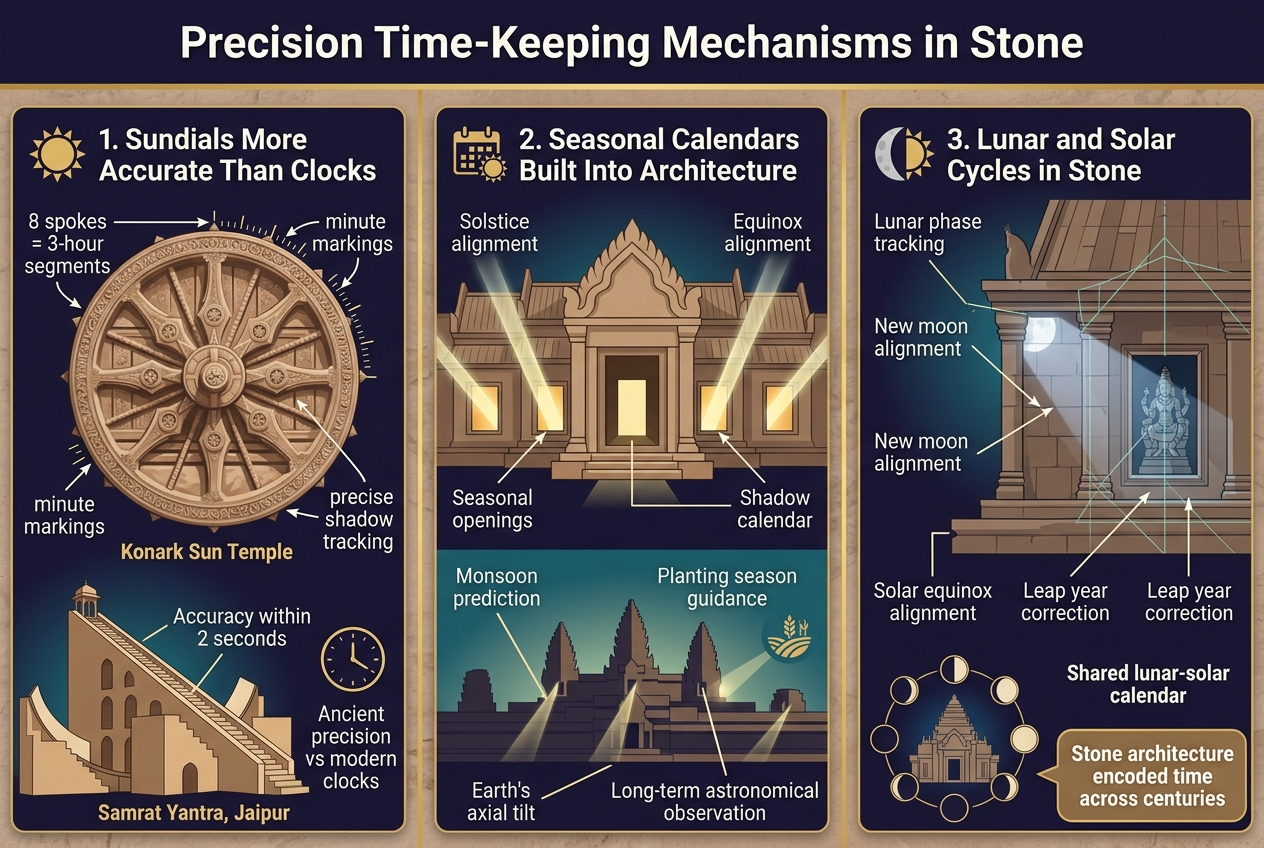
Jantar Mantar Jaipur: The Ancient Indian Stone Observatory That Measures Time to Two Seconds
The Konark Sun Temple in Odisha showcases time-keeping precision that leaves modern scientists scratching their heads. The massive chariot wheels carved into the temple’s walls aren’t just decorative—they function as incredibly accurate sundials. Each wheel contains eight spokes dividing the day into precise three-hour segments, while smaller divisions mark individual minutes with startling accuracy.
What baffles researchers is how ancient architects achieved precision rivaling atomic clocks without modern instruments. The Samrat Yantra at Jaipur’s Jantar Mantar can measure time to within two seconds of accuracy. This massive sundial, built in 1734 but based on much older designs, demonstrates mathematical calculations that would challenge today’s chronometer manufacturers.
The positioning calculations required for such accuracy demand understanding of Earth’s rotation, axial tilt, and geographical coordinates to decimal precision. Ancient builders somehow accounted for seasonal variations in the sun’s path, creating time-keeping devices that automatically adjust for changing daylight hours throughout the year.
Our Jaipur tours include Jantar Mantar, where expert guides explain the extraordinary astronomical and mathematical precision behind each instrument in this UNESCO World Heritage Site, one of the most intellectually rewarding heritage travel destinations in all of India.
Ancient Indian Temple Architecture: Seasonal Calendars Built Into Stone Structures
Temple architects embedded sophisticated seasonal calendars directly into stone structures. The Brihadeeswarar Temple in Tamil Nadu features strategically placed openings that illuminate specific chambers during solstices and equinoxes. These architectural elements predict seasonal changes months in advance with mathematical precision that modern meteorology still struggles to match.
The Angkor Wat complex, though located in Cambodia, reflects Indian architectural knowledge where temple alignments predict monsoon patterns, agricultural cycles, and optimal planting seasons. Stone carvings change their shadow patterns throughout the year, creating a three-dimensional calendar system that guided agricultural communities for centuries.
Building designers incorporated knowledge of Earth’s axial precession—a phenomenon modern astronomy only confirmed in recent centuries. The precision required suggests access to astronomical data spanning thousands of years of observations, compiled and encoded into permanent stone structures.
Khajuraho and Belur Temples: Lunar Calendar Precision in Ancient Indian Architecture
Ancient Indian temples seamlessly integrate lunar and solar calendar systems in ways that modern architects find nearly impossible to replicate. The Khajuraho temples feature window placements that track lunar phases, with moonbeams illuminating specific deity sculptures during particular lunar months.
The mathematical complexity of synchronizing solar and lunar cycles requires understanding of fractional day calculations and leap year adjustments. Temple builders created structures where lunar shadows follow predictable patterns, enabling priests to determine auspicious dates for ceremonies without consulting external calendars.
Most remarkably, these temples account for the gradual drift between lunar and solar years, incorporating correction mechanisms that maintain accuracy across centuries. The Chennakeshava Temple at Belur demonstrates this integration, where architectural elements align with both new moon positions and solar equinoxes simultaneously, creating a unified time-keeping system that modern calendar makers still struggle to perfect.
Ancient Indian Engineering Mystery 9: Natural Climate Control Without Electricity or Modern Technology
Ancient Indian Natural Air Conditioning: How Stepwells and Wind Towers Cooled Entire Cities
Ancient Indian architects mastered climate control without electricity or modern HVAC systems. The stepwells of Gujarat showcase this genius perfectly. These massive underground structures stay naturally cool even when surface temperatures soar above 45°C. The secret lies in their ingenious design that creates air circulation patterns using thermal dynamics.
The Chand Baori in Rajasthan demonstrates this principle beautifully. Its 3,500 narrow steps create a natural cooling system where hot air rises while cool air from the depths circulates upward. The geometric precision ensures optimal airflow throughout the structure.
Many ancient palaces and temples feature wind towers called “hawa mahal” that capture prevailing winds and channel cool air through buildings. These towers work on the principle of pressure differentials, drawing hot air up and out while pulling cooler air from shaded areas into living spaces.
The Mughal architecture in places like Fatehpur Sikri incorporated water features that enhanced natural cooling. Courtyards with fountains and water channels created microclimates that reduced ambient temperatures by several degrees through evaporation.
The climate engineering genius of ancient India is best experienced at the stepwells of Rajasthan and the ruins of Hampi. Our Jaipur tours and Hampi tours bring these remarkable achievements to life with expert guided context.
Ancient Indian Solar Architecture: How Temples Were Built to Harness the Sun
Temple architects positioned structures to harness solar energy with mathematical precision that rivals modern solar installations. The Konark Sun Temple in Odisha exemplifies this mastery. Its wheels aren’t just decorative – they function as sundials that track solar movement throughout the year.
The temple’s main structure aligns perfectly with sunrise during equinoxes, maximizing solar energy capture during specific seasons. Stone surfaces heat up during the day and release warmth gradually, creating comfortable temperatures for evening prayers.
Many South Indian temples feature corridors and chambers that capture and distribute solar heat efficiently. The massive stone construction acts as thermal mass, absorbing solar energy during the day and releasing it slowly at night. This natural heating system maintains comfortable temperatures without any external energy source.
The Brihadeeswara Temple in Thanjavur demonstrates advanced solar orientation. Its gopurams (towers) cast shadows that help regulate internal temperatures while maximizing beneficial solar exposure. The architects calculated sun angles with precision that modern solar engineers would appreciate.
Hampi and Dholavira: Ancient Indian Underground Cooling Networks That Spanned Entire Cities
Ancient Indian engineers created sophisticated underground systems that provided cooling and ventilation across entire cities. The most impressive examples exist in places like Hampi and Dholavira, where underground channels carried cool air through residential areas.
These systems worked like natural air conditioning networks. Underground passages connected to wells and water bodies created pressure differentials that pushed cool, moist air through buildings. The channels often featured strategic bends and chambers that filtered and cooled the air further.
The stepwell systems of western India showcase another brilliant cooling network. These structures didn’t just store water – they created vast underground cooling zones. The water’s evaporation combined with the thermal mass of stone steps generated consistently cool air that could be channeled into adjacent buildings.
Archaeological evidence suggests some cities had interconnected underground cooling systems spanning several kilometers. These networks included air shafts, cooling chambers, and distribution channels that maintained comfortable temperatures across large urban areas without any mechanical systems.
The precision of these cooling networks shows deep understanding of thermodynamics, air pressure, and fluid dynamics that modern engineers are still studying and trying to replicate in sustainable building designs.
Dholavira is now accessible through 5 Senses Tours. Visit Ancient Harapan site of Dholavira for a memorable experience.
Ancient Indian Engineering Mystery 10: Structural Feats That Modern Engineers Cannot Fully Explain
Ancient Indian Stone Transportation: Moving 80-Ton Blocks Without Modern Machinery
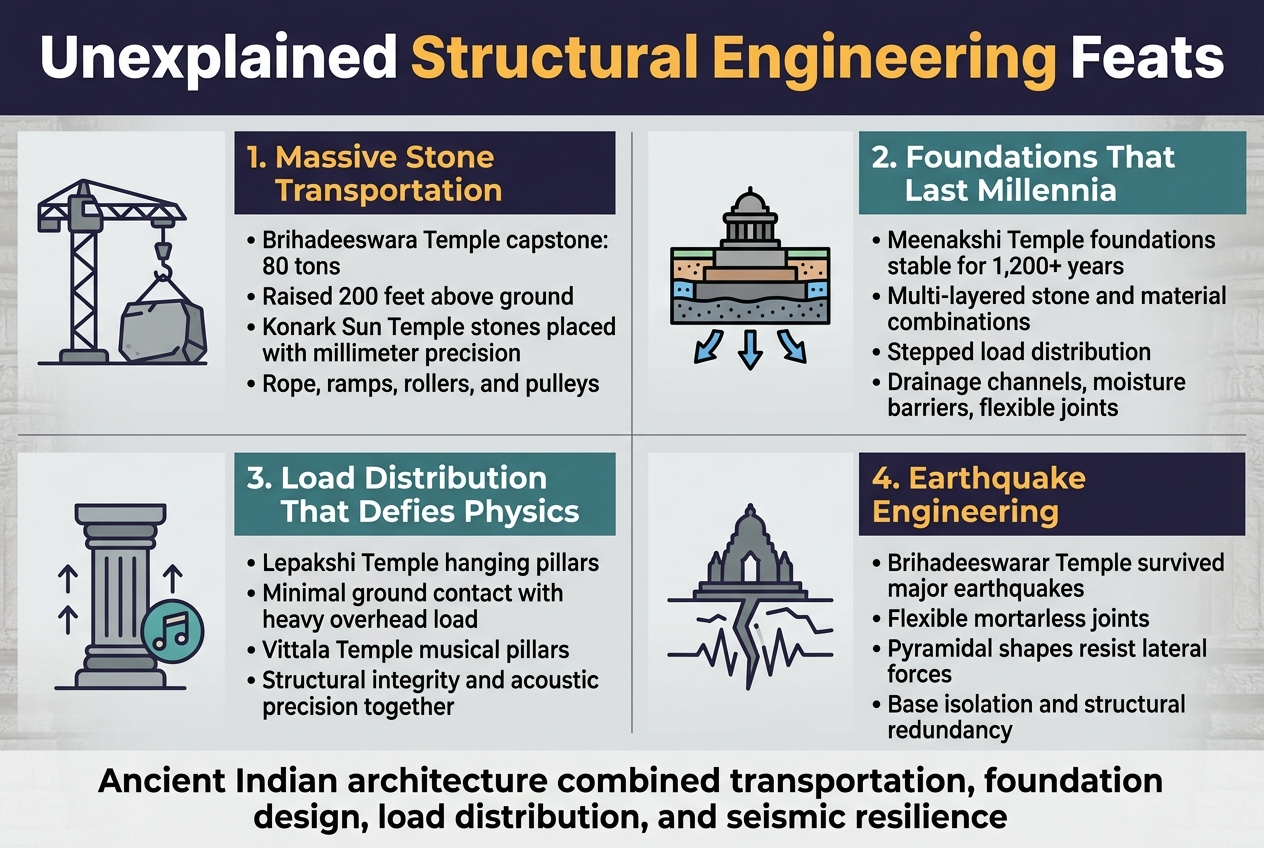
Ancient Indian civilizations accomplished feats of stone transportation that leave engineers scratching their heads today. The Brihadeeswara Temple in Tamil Nadu showcases this mystery perfectly – its capstone weighs approximately 80 tons and sits 200 feet above ground level. Moving such massive blocks without cranes, trucks, or modern lifting equipment seems impossible, yet there it stands after a thousand years.
The Konark Sun Temple presents another puzzle with its intricate carvings on stones weighing several tons each. These weren’t just moved; they were positioned with millimeter precision. Archaeological evidence suggests ramps, rollers, and pulleys played a role, but the logistics of coordinating such operations across hundreds of workers defies easy explanation.
Transportation methods that puzzle experts:
- Rope and pulley systems capable of handling multi-ton loads
- Elaborate ramp constructions that somehow disappeared without a trace
- Coordination systems for moving stones across hundreds of miles
- Timing mechanisms that allowed precise placement of architectural elements
Ancient Indian Foundation Engineering: Why These Structures Outlast Modern Buildings by Centuries
The foundation systems beneath India’s ancient monuments reveal engineering wisdom that modern construction often struggles to match. The Meenakshi Temple in Madurai rests on foundations that have remained stable for over 1,200 years despite being built on relatively soft soil. The secret lies in their multi-layered approach using specific combinations of materials and techniques.
These foundations employ interlocking stone systems that distribute weight evenly while allowing for natural ground movement. The builders incorporated drainage channels, moisture barriers, and even seismic shock absorbers – concepts that didn’t appear in Western engineering until centuries later.
Foundation innovations that endure:
- Stepped foundation systems that spread loads across larger areas
- Natural drainage systems preventing water damage
- Flexible joint systems accommodating ground settlement
- Material combinations creating stronger composite foundations
Ancient Indian Load Distribution: The Hanging Pillars and Impossible Arches of Heritage India
Ancient Indian architects mastered load distribution in ways that challenge our understanding of structural mechanics. The hanging pillars of Lepakshi Temple appear to violate basic engineering principles – these massive stone columns hang suspended with minimal ground contact, yet support significant overhead weight.
The Vittala Temple’s musical pillars demonstrate another impossible feat. These slender stone columns carry enormous loads while producing distinct musical notes when struck. The precise calculations required to achieve both structural integrity and acoustic properties simultaneously represent engineering mastery that modern architects struggle to replicate.
Load distribution mysteries:
- Columns that appear to float while bearing massive loads
- Corbelled arches extending far beyond theoretical limits
- Interlocking stone systems creating self-supporting structures
- Weight transfer mechanisms that bypass conventional load paths
Brihadeeswara Temple Seismic Engineering: 1000 Years of Earthquake Survival Explained
India’s ancient temples demonstrate sophisticated earthquake engineering in regions where seismic activity regularly destroys modern buildings. The Brihadeeswarar Temple has survived numerous major earthquakes over its thousand-year history, while newer structures in the same region have crumbled.
These monuments incorporate flexible joint systems, shock-absorbing materials, and structural designs that allow controlled movement during seismic events. The stone blocks fit together with such precision that they can shift slightly during earthquakes without losing structural integrity – a principle modern seismic engineering has only recently adopted.
Earthquake-resistant features:
- Flexible mortarless joints allowing controlled movement
- Pyramidal shapes that naturally resist lateral forces
- Base isolation techniques predating modern seismic design
- Structural redundancy ensuring multiple load paths during ground movement
Every one of the ancient India travel mysteries on this list is a real, visitable, experienceable destination. At 5 Senses Tours we have built expert guided experiences around all of them, designed for international travellers from the USA, UK and Australia who want more than sightseeing. We want you to truly understand what you are standing in front of. Explore our full portfolio of India heritage tours and start planning the most extraordinary journey of your life.
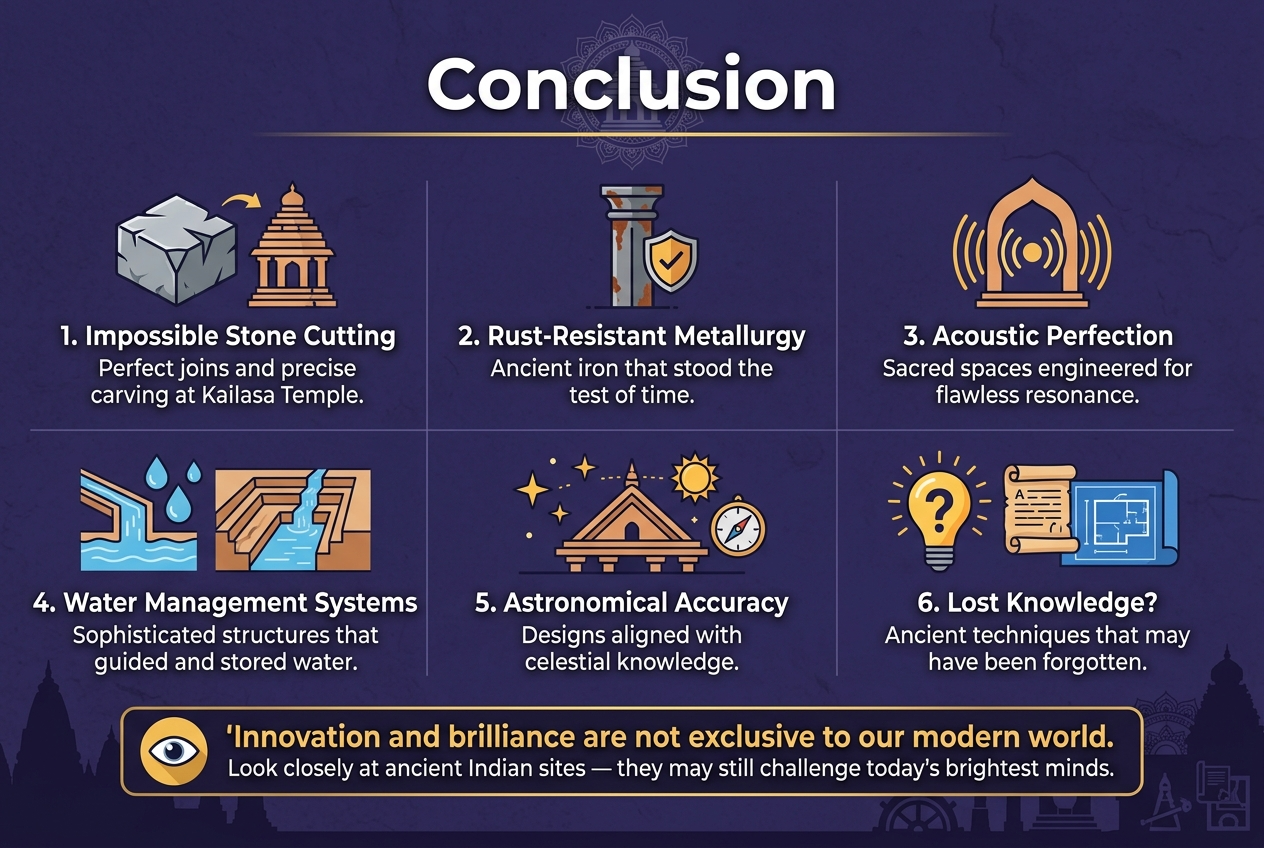
These ten engineering mysteries from ancient India show us just how much we still don’t understand about our ancestors’ capabilities. From the impossible precision of stone cutting at temples like Kailasa to the advanced metallurgy that created rust-resistant iron pillars, these achievements challenge everything we think we know about ancient technology. The acoustic perfection of sacred spaces, sophisticated water management systems, and astronomical accuracy built into temple designs reveal a level of scientific understanding that seems almost impossible for their time.
What makes these mysteries even more fascinating is how they push us to question our assumptions about human progress. Maybe ancient civilizations had access to knowledge and techniques that we’ve somehow lost along the way. While we may never fully crack these ancient codes, they serve as a powerful reminder that innovation and brilliance aren’t exclusive to our modern world. Next time you visit an ancient Indian site, take a moment to really look at the details – you might just find yourself staring at engineering solutions that would stump today’s brightest minds.
Leave a Reply