
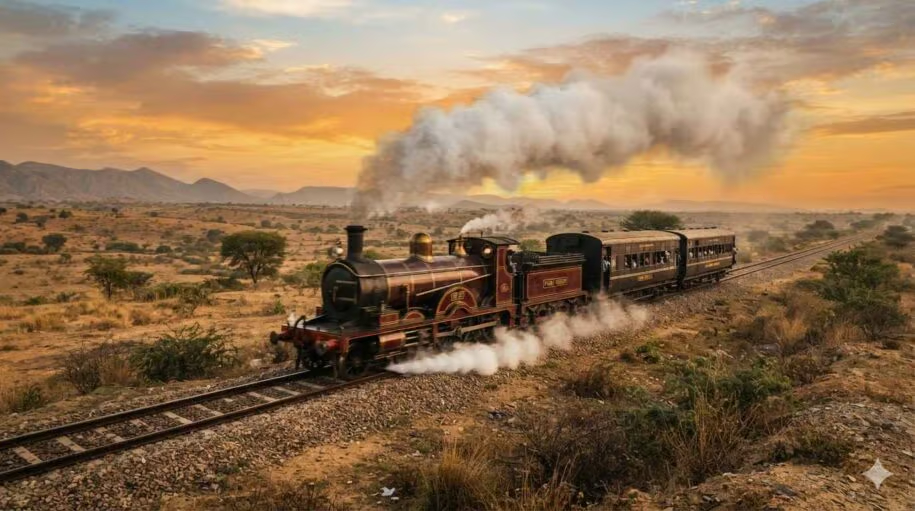
The Fairy Queen was built in 1855 by Kitson, Thompson and Hewitson.
That sentence, read carefully, requires a moment to absorb.
Not restored to look like 1855. Not rebuilt using modern parts inside a Victorian shell. Built in 1855. The boiler, the cylinders, the driving wheels, the coal tender. All of it assembled in Leeds, England, put on a ship to Calcutta and pressed into service for the East Indian Railway.
In 1998 it was certified by the Guinness Book of Records as the world’s oldest steam locomotive in regular service, a certification that marked it as the most historically significant working railway engine anywhere on earth at that moment. It was awarded the National Tourism Award in 1999. And it still runs from Delhi to Alwar in Rajasthan on seasonal heritage journeys that are among the most extraordinary railway experiences available anywhere in India.
East Indian Railways EIR-22, also known affectionately as the Fairy Queen, is today more than 170 years old.
One hundred and seventy one years old. Still running. Still producing steam. Still hauling passengers through the Rajasthan landscape at the 40 kilometres per hour that is precisely the speed this locomotive was designed to travel at in the workshops of Victorian England.
Since 2011 a companion locomotive from the same East Indian Railway era, EIR-21 Express, has also been restored to operational service and runs on weekends in South India, making two mid-19th century Indian locomotives among the oldest working steam engines anywhere on earth. The Fairy Queen, Guinness-certified and National Tourism Award winning, remains the one you can ride from Delhi through the Rajasthan landscape to Alwar and Sariska, and it remains one of the most extraordinary railway experiences available anywhere in the world.
This is the complete guide to the Fairy Queen train, and the heritage railway journey that takes it from Delhi to the royal city of Alwar and the wildlife of Sariska Tiger Reserve.
The Fairy Queen Train: A Complete History of 171 Years in Service
How the Fairy Queen Train Came to India and What It Did When It Got Here
The Fairy Queen locomotive was built by Kitson, Thompson and Hewitson of England and worked on passenger and freight services for more than 55 years.
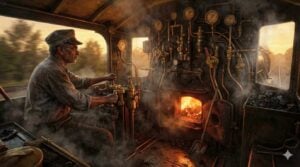
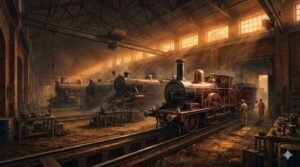
The journey from Leeds to Calcutta in 1855 was itself an extraordinary undertaking. The locomotive was dismantled, packed into crates and shipped around the Cape of Good Hope, a voyage of several months, before being reassembled at the East Indian Railway workshops at Howrah on the banks of the Ganges. Initially the Fairy Queen locomotive was used to haul light mail trains in West Bengal that operated between Howrah and Raniganj.
Perhaps the most famous period of the Fairy Queen train’s service is the Indian Rebellion of 1857, during which it was used to haul troop trains. The railways, which the colonial administration had built primarily for commercial purposes, became immediately and critically important as a military logistics system. Locomotive Number 22, the engine that Kitson Thompson and Hewitson had built in Leeds for hauling mail trains between Howrah and Raniganj, found itself hauling soldiers toward one of the most consequential military and political events in the history of the subcontinent.

Later it was consigned to line construction duties in Bihar, where it stayed till 1909. It was displayed outside Howrah Station for 34 years. In the year 1943 the locomotive was moved to the Railway Zonal Training School at Chandausi in Uttar Pradesh. In 1972 the Fairy Queen was bestowed with heritage status and declared a national treasure by the Indian Government.
How the Fairy Queen Train Was Restored and Returned to Service
Owing to the success of luxury trains in India the decision to run the Fairy Queen as a luxury train for commercial purpose after eighty odd years was taken. In 1997 the train set out for a two day trip from Delhi to Alwar with a night’s rest in the Sariska Palace followed by a trip to the Wildlife Sanctuary.
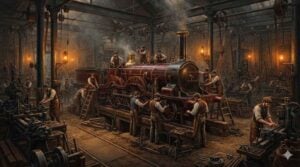
The overhaul was carried out at the Loco Works Perambur in Chennai. The engineers who restored the Fairy Queen train to working order in 1996 and 1997 were not merely repairing a machine. They were reviving a piece of industrial heritage that had not moved under its own steam for nearly ninety years. The Fairy Queen was completely overhauled in 1996 and resumed commercial operations in 1997 for a two day one night tourist circuit from Delhi to Alwar with overnight stay in Sariska Tiger Reserve.
In 1998 it was certified by the Guinness Book of Records as the world’s oldest steam locomotive in regular service. The National Tourism Award followed in 1999 for the most innovative and unique tourism project in India.
The Fairy Queen train is not a replica. It is not a restored reproduction. The locomotive built by Kitson Thompson and Hewitson in Leeds in 1855 is the locomotive that you board at Delhi Cantonment Station. That is what makes it genuinely irreplaceable.
The Fairy Queen Train Today: What Has Changed and What Has Not
The Fairy Queen train journey has had some changes in its modern incarnation worth knowing honestly before you plan your visit.
In 2011 the train was extensively damaged and parts were stolen at a railway shed in Delhi. The rare parts were custom made at Perambur Loco Works in Chennai, ensuring that the Fairy Queen train returned to service. The locomotive is housed at the Rewari Railway Heritage Museum when not on its seasonal runs.
The Rewari Railway Heritage Museum was built in 1893 and is the only surviving steam locomotive shed in India, housing some of India’s last surviving steam locomotives alongside the Fairy Queen train.
The current heritage service connects Delhi to Alwar and runs seasonally from October to March, making advance planning essential for international travellers who want to include this once in a lifetime railway experience in their India itinerary.
Riding the Fairy Queen Train: What the Experience Is Actually Like
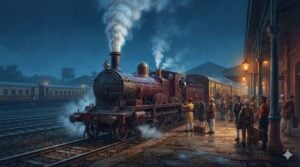
What You See, Hear and Feel on the Fairy Queen Train Journey
There are forms of travel that are primarily about the destination. The Fairy Queen train journey is entirely about the experience of the journey itself.
EIR-22 is a broad gauge locomotive. It weighed just 26 tons, had a power output of 130 horsepower and produced a maximum speed of 40 kilometres per hour.
Forty kilometres per hour. This is not a limitation to be frustrated by. It is the precise pace at which the journey becomes something other than transportation. At 40 kilometres per hour the landscape outside the window is not a blur. It is a series of specific images, fields and villages and road crossings and the occasional glimpse of the Aravalli Hills in the distance, each one visible long enough to actually register in the consciousness of a passenger who is looking out of the window at the India the train is passing through.
The sensory experience of the Fairy Queen train journey is unlike anything available on any modern train. The sound of a coal-fired steam locomotive under load is a rhythmic, mechanical, deeply satisfying sound. The chuffing of the exhaust through the stack, the hiss of steam from the pressure valves, the metallic percussion of the driving gear working against the rails. It is louder and more physical than the sound of a diesel or electric locomotive and it fills the carriages in a way that makes the source of the train’s motion constantly present to the passenger’s awareness.
The smell of coal smoke is equally distinctive. It is the smell of Victorian industrial power harnessed to the specific purpose of carrying you through the Rajasthan landscape at the same pace travellers would have moved in the mid-19th century.
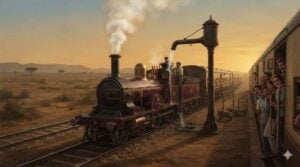
The water stops are one of the most memorable details of the Fairy Queen train experience. The locomotive carries 3000 litres of water in its tank. The locomotive consumes this continuously as it generates the steam that drives its pistons. At specific points along the route the train stops at water towers and the locomotive is replenished before the journey continues. These stops, which on a modern train would be an interruption, are on the Fairy Queen among the most photographable moments of the entire journey.
The Fairy Queen Train Route: Delhi to Alwar and the Rajasthan Landscape
The Fairy Queen was put into service hauling a twin coach train between Delhi Cantonment, Delhi, and Alwar, Rajasthan, India, a journey of 143 kilometres.
The train departs from Delhi Cantonment railway station in the morning. By the time passengers board the locomotive is already alive, steam rising from its pressure valves and the smell of coal smoke hanging in the cool morning air of the station.
The journey south from Delhi takes the train through Gurgaon and Rewari, where the extraordinary Rewari Railway Heritage Museum houses some of India’s last surviving steam locomotives alongside the Fairy Queen itself when it is not on its seasonal runs. The Rewari Railway Heritage Museum is located 50 kilometres from Gurgaon and 79 kilometres from the National Rail Museum at Chanakyapuri in New Delhi.
Beyond Rewari the landscape changes character. The flat agricultural plains of Haryana give way to the more varied topography of the Alwar district in Rajasthan, the ancient Aravalli Hills becoming visible on the horizon and the vegetation shifting from the wheat and sugarcane of the plains to the dry deciduous scrub and rocky outcrops of the Rajasthan transition zone.
The arrival at Alwar after the journey at 40 kilometres per hour brings you to one of the most historically significant cities in Rajasthan, its magnificent fort rising above the city, its palaces and cenotaphs and step wells representing a royal tradition of extraordinary architectural ambition.
5 Senses Tours creates complete heritage experiences that combine the Fairy Queen train journey with the complete cultural and natural heritage of Alwar and Sariska.
Plan your Fairy Queen heritage experience with 5 Senses Tours.
Fairy Queen Train and the Alwar Heritage: What Waits at the Journey’s End

Alwar: The Most Overlooked Royal City in Rajasthan
Alwar is the Rajasthan city that most international tourists drive through on the way somewhere else. This is a significant error.
Alwar is one of the most historically rich and architecturally extraordinary cities in the state. The Alwar Fort, also called Bala Quila, rises 304 metres above the city on a rocky ridge of the Aravalli Hills and is one of the few pre-Mughal forts in Rajasthan that was never conquered by the Mughal Empire. Its ramparts extend for five kilometres, enclosing a complete hilltop world of palaces, temples, water tanks and cannon emplacements whose history stretches back over a thousand years.
The City Palace of Alwar, now housing the government museum, contains one of the most extraordinary collections of Rajput royal artefacts in India. Miniature paintings of exceptional quality. The personal weapons of the Alwar kings. An extraordinary collection of manuscripts. And the royal ceremonial vehicles including what is claimed to be the only surviving Rolls-Royce ever ordered as a garbage truck, commissioned by the Maharaja of Alwar after a perceived slight from the Rolls-Royce sales representatives in London.
The Moosi Maharani Chhatri, built in 1815 in memory of King Bakhtawar Singh and his queen Moosi, is one of the most refined pieces of funerary architecture in Rajasthan, its ground floor in red sandstone and its upper storey in white marble with carved domed arches and intricate floral tracery. And Siliserh Lake, created in 1845 by a Maharaja who is said to have fallen in love with a woman from the village below and built a palace on the water’s edge to be near her, is one of the most romantically situated lake palaces in Rajasthan.
Visit Alwar & Neemrana for a 2 day tour from Delhi.
Sariska Tiger Reserve: The Wildlife Destination That Completes the Fairy Queen Train Journey

The Sariska Tiger Reserve, located approximately 37 kilometres from Alwar, is one of the oldest protected wildlife areas in Rajasthan. The reserve covers approximately 866 square kilometres of the Aravalli Hills, its landscape of dry deciduous forest, rocky scrubland and seasonal streams creating a habitat of extraordinary biodiversity.
The tigers of Sariska have one of the most extraordinary conservation stories in India. In 2005 every single tiger in the reserve was wiped out by poaching. The government launched the world’s largest tiger relocation programme in 2008, moving tigers from Ranthambore into Sariska for the first time in history. By 2025 the reserve has fifty tigers, a recovery that has been described as one of the most remarkable wildlife conservation stories anywhere in the world.
Visit Sariska Tiger Reserve for a 2 day tour from Delhi.
The Fairy Queen train heritage journey combines with the Sariska jeep safari to create one of the most completely distinctive two-day experiences available anywhere in India. You arrive in Alwar on a 171-year-old steam locomotive. You spend the night in the landscape at the edge of the tiger reserve. You wake at dawn for a jeep safari through the Aravalli Hills forest. And you return to Delhi on the same extraordinary locomotive the following day.
Combine the Fairy Queen Train With a Night Inside a Thousand-Year-Old Fort
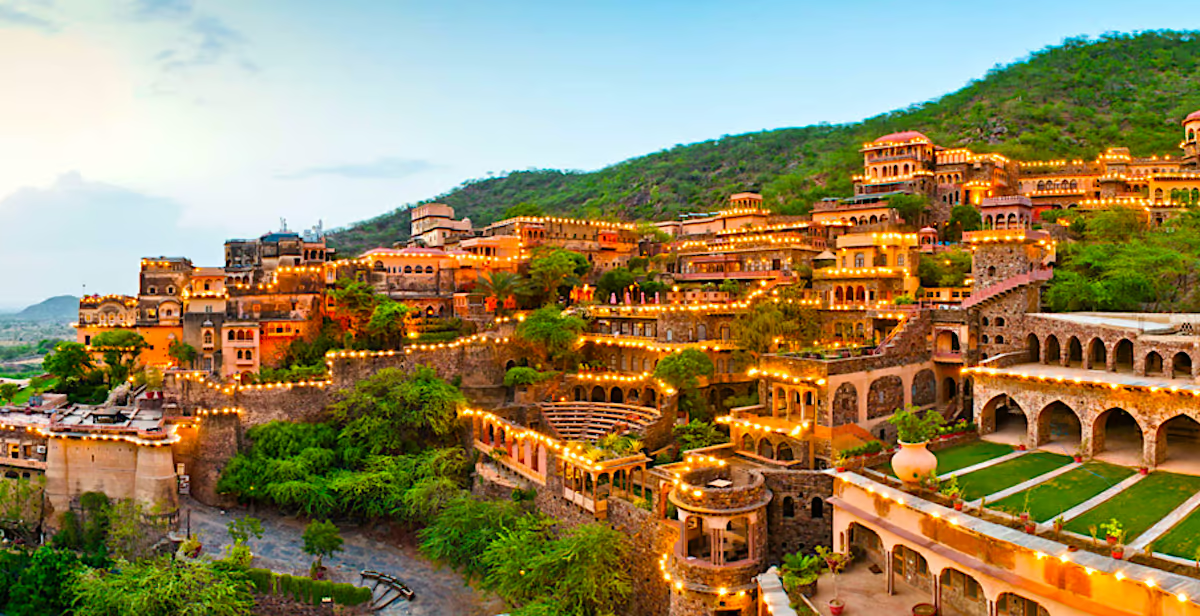
For travellers who want to make the journey to Alwar even more extraordinary, the Fairy Queen train can be combined with our complete Neemrana Fort and Alwar tour from Delhi, turning an already remarkable private heritage journey into something genuinely unlike any other experience available from the capital.
Arrive in Alwar on the Guinness-certified oldest steam locomotive in regular service on Day 1. Spend the day at the Bala Quila fort, the City Palace, Siliserh Lake and the Moosi Maharani Chhatri with an expert 5 Senses Tours cultural guide. Stay overnight at Dadhikar Fort, a heritage property whose history stretches back a thousand years, and wake up inside a Rajput fort with the Aravalli Hills visible through the windows. Continue by private car on Day 2 to the 15th-century Neemrana Fort Palace and its extraordinary medieval stepwell before returning to Delhi.
The Fairy Queen train departs on select dates from October to March and seats are very limited. Contact 5 Senses Tours and we will check the available dates and build the complete two-day heritage journey around your travel window.
For travellers wanting the most complete Sariska wildlife experience alongside the Fairy Queen journey, our new Sariska Tiger Reserve and Alwar tour combines two jeep safaris, morning and afternoon, inside the fifty-tiger reserve with an overnight stay inside the forest itself, making it the most immersive wildlife experience available from Delhi and the perfect companion to the Fairy Queen train arrival.
Experience the Fairy Queen Train Heritage With 5 Senses Tours
Combining the Fairy Queen Train With the Complete Delhi and Rajasthan Circuit
The Fairy Queen train journey is the most extraordinary single entry point into the complete Delhi and Rajasthan heritage circuit that 5 Senses Tours offers for international travellers.
Our Delhi tours cover the complete heritage of one of the world’s most layered cities, from the Red Fort and Humayun’s Tomb to the Qutab Minar iron pillar and the extraordinary street food tradition of Old Delhi, with expert cultural guides who bring every layer of the city’s three-thousand-year history to life.

The National Rail Museum in Delhi, where the Fairy Queen train is housed when not on its seasonal runs, is one of the most extraordinary railway heritage museums in Asia. A visit to the National Rail Museum on the day before or after the Fairy Queen journey gives the locomotive its complete historical context.
For travellers wanting the complete Rajasthan royal heritage experience beyond Alwar, our Jaipur tours cover the complete circuit of India’s most extraordinary royal state. The pink city of Jaipur with its Amber Fort and Hawa Mahal. The blue city of Jodhpur with its magnificent Mehrangarh Fort. The lake city of Udaipur with its floating palace. And the golden city of Jaisalmer at the edge of the Thar Desert.
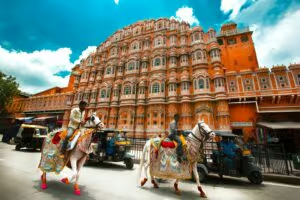
The Fairy Queen train journey from Delhi to Alwar is the most extraordinary introduction to the Rajasthan heritage circuit available from the capital. It delivers you to the edge of Rajasthan in the most historically resonant manner possible, on a 171-year-old Victorian locomotive, and connects you immediately to one of the most underappreciated royal cities in the state and one of the most significant wildlife reserves in northern India.
5 Senses Tours is recognised by India’s Ministry of Tourism, winner of the Tripadvisor Travellers Choice Award and the Outlook Responsible Tourism Award. Every tour is private, expert-guided and completely customised for your group.
Contact 5 Senses Tours to begin planning your Fairy Queen train heritage experience today