Odyssey vs Ramayana: Two Epics, Two Exiles, One Famous Bow

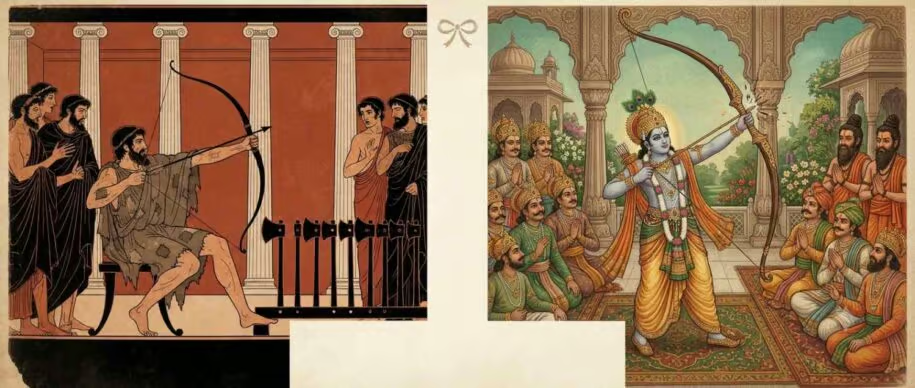
A split illustration of two heroes stringing a great bow, one in the style of Greek vase painting and one in the style of an Indian miniature, showing the Odyssey vs Ramayana comparison.

Odyssey vs Ramayana: both are ancient epics about a hero who spends years away from home, is helped by divine allies, and is reunited with a faithful wife, and both feature a hero who strings a bow that no one else can. The Odyssey, attributed to Homer, was written down in the late 8th or early 7th century BCE. The Ramayana, attributed to Valmiki, took shape between the 8th and 4th centuries BCE, and rests on an oral tradition that may be older. Scholars have noticed the parallels for generations, and have not established that either epic borrowed from the other. The differences matter as much as the likenesses: Odysseus wins his way home by cunning, and Rama keeps his word at any cost. You can travel through the world of the Ramayana on our 14 day Ramayana tour of India.

A stranger in rags sits at the edge of a great hall. Around him, the men who have been eating his household bare try, one after another, to string a mighty bow, and fail. The beggar asks to try. He strings it as easily as a musician strings a lyre, and sends an arrow clean through the rings of twelve axes set in a row.

Now travel thousands of miles east. In a royal hall in Mithila, kings from across the land have come to lift a great bow, and none can. A young prince asks to try. He lifts it, strings it, and it breaks with a crack like thunder.

The first man is Odysseus. The second is Rama. Neither epic knew the other, and yet readers who meet them side by side feel a jolt of recognition. This is the Odyssey vs Ramayana question, and this year, when Christopher Nolan’s film of the Odyssey reached cinemas, readers around the world asked it again.

Odyssey vs Ramayana: why the comparison will not go away
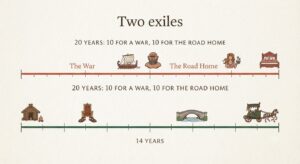
A comparison graphic of the twenty year journey of Odysseus and the fourteen year exile of Rama, with small icons for each stage.

Both epics were sung long before they were written. The Odyssey, attributed to Homer, was set down in the late eighth or early seventh century BCE. The Ramayana, attributed to Valmiki, took shape between the eighth and fourth centuries BCE, and its oral tradition may be older still (we set out every estimate in our blog on how old the Ramayana is). Both follow a hero through years of separation. Both are crowded with monsters, magic and divine helpers. Both end with a return.

That is the heart of the Odyssey vs Ramayana comparison. Two civilisations, thousands of miles apart, reached for the same deep human story: a good man torn from his home, a faithful wife, a long road back. The details differ in fascinating ways, and we will meet them one by one.

The bow that no one else can string
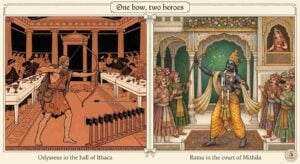
A split illustration of two bow scenes, a Greek hero in a beggar’s cloak shooting through twelve axe heads and an Indian prince breaking a great bow in a royal court

Start with the bow, because it is the parallel everyone notices first. In the Odyssey, the bow of Odysseus is set before the suitors of his wife Penelope as a test. None of them can string it. Odysseus, still disguised as a beggar, does so with ease, and shoots his arrow through twelve axes. In the Ramayana, King Janaka of Mithila declares that whoever can string the great bow of Shiva will win the hand of his daughter Sita. Every prince fails. Rama lifts it, strings it, and it snaps in his hands.

The pattern is the same, but the meaning is different. Odysseus uses the bow to take back a wife he already has, and to prove who he is. Rama uses it to win a wife he has just met, and to prove he is worthy of her. Scholars of old storytelling traditions note that a bow too hard for anyone but the hero turns up in other traditions too, from Greece to India to northern Europe, so it may simply be one of humanity’s oldest story ideas.

The long way home: twenty years against fourteen

Odysseus is away from Ithaca for twenty years: ten fighting at Troy and ten trying to get home. Rama is away from Ayodhya for fourteen years. In both epics, the hero is held far from his throne, and a kingdom waits.

The reasons for the delay show how the two epics differ. Odysseus is kept from home by the anger of the sea god Poseidon, whose son, the Cyclops Polyphemus, he blinded, and by his own pride and curiosity. He spends seven years as the guest and captive of the nymph Calypso. Rama is kept from home by a promise. His father King Dasharatha, bound by a vow to his queen Kaikeyi, must send Rama into the forest, and Rama accepts at once, because a son keeps his father’s word. One hero is delayed by fate and folly, the other by duty.

The kingdoms they left behind tell the same story from the other side. In Ithaca, over a hundred suitors crowd the palace, eat the household’s wealth and press Penelope to marry one of them and take the throne. In Ayodhya, the man who could have taken the throne refuses. Rama’s brother Bharata walks to the forest to beg Rama to return, and when Rama will not, Bharata takes Rama’s sandals home, places them on the throne and rules in their name for fourteen years. Few contrasts between the two epics are as striking as a house full of men who want the crown, and a brother who will only touch it through a pair of sandals.

Penelope and Sita: two faithful wives
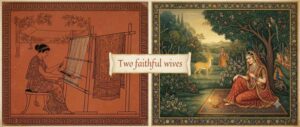
A tall illustration of two faithful wives from ancient epics, one at a loom in Greek style and one in a forest grove in Indian miniature style.

Penelope waits twenty years. To hold off her suitors she promises to choose one of them when she has finished weaving a shroud, and each night she secretly unpicks the day’s work. Sita is not left behind. She follows Rama into the forest, and is then carried off by the demon king Ravana to his island city of Lanka, where she is held in a grove and refuses every offer he makes. Of the two faithful wives, one wins by patience and cunning, and the other by sheer unyielding resolve.

A subtle contrast follows. When Odysseus returns, it is Penelope who tests him. She asks that their bed be moved, and Odysseus, who built it around a living olive tree, knows at once that it cannot be, proving his identity with a secret only the two of them share. In the Ramayana, after the war, it is Sita who is put to the test, in the ordeal by fire. It is an episode that Indian readers and poets have debated for centuries, and it is one of the great questions that the epic leaves with its audience.

Islands of enchantment and a leap across the sea

Both epics send their heroes across the water, and the sea is almost a character in each. Odysseus sails among lotus eaters, a one eyed giant, the enchantress Circe and the singing Sirens, and is held for years on the island of Calypso. In the Ramayana, the whole second half turns on a crossing. Hanuman, the devoted ally of Rama, leaps across the sea to Lanka, finds Sita in her grove and carries word back to Rama. Rama’s army then builds a bridge across the strait, and the war for Lanka begins.

Lanka itself is one of the great islands of enchantment, a city of gold with lotus filled moats. Scholars have argued for centuries about where it might have been, and we explore four theories in our blog on where Ravana’s Lanka may have been. Each hero must pass through an island of wonders and temptation before he can go home.

Divine help matters as well. Odysseus is guided by the goddess Athena and opposed by Poseidon. Rama has the devotion of Hanuman and the support of gods and sages, and Ravana, though a villain, is a scholar and a devotee of Shiva. The line between helper and hindrance is never as simple as it first seems.

The scar, the ring and the bed

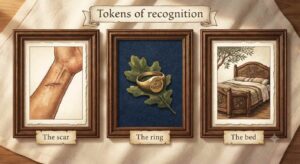
Three illustrated objects, a scar, a ring and a carved bed, showing the recognition tokens in the Odyssey and the Ramayana.

Both epics love a recognition scene. When Odysseus finally returns, no one knows him. His old nurse knows him by a scar. His dog Argos knows him by his voice, and dies content. Penelope knows him by the bed. In both epics, every great reunion depends on a token that only the right person could carry.

In the Ramayana, the token is a ring. When Hanuman reaches Sita in Lanka, she cannot know whether he is a friend or a trick of Ravana, so he shows her the ring that Rama gave him. She trusts him, and sends back a jewel from her hair as proof that he found her. The ring goes one way and the jewel comes back. Two small objects carry the whole weight of two lovers who cannot see each other.

Songs that built a world

Both poems remember that they were sung. The Odyssey is full of bards. Demodocus sings of Troy at the court of the Phaeacians, and Odysseus weeps to hear his own story. Phemius sings for the suitors in Ithaca. The Ramayana, in the same way, carries its own origin inside it. Tradition says that Valmiki taught the epic to Rama’s twin sons, Luv and Kush, who sang it in Ayodhya before their father without knowing who he was. And Valmiki’s first verse is said to have been born of grief, when he saw a bird shot as it called to its mate.

The two poems share a deep trust in the power of the singer. Both epics are about a hero, but both are also about the people who keep the hero’s story alive.

Odyssey and Ramayana: did one borrow from the other?

An illustration of two trees, a Greek olive and an Indian banyan, whose roots meet in one shared underground spring of story symbols, showing the shared roots of the Odyssey and the Ramayana.

People have asked this for nearly two centuries. In the nineteenth century, the German Indologist Albrecht Weber tried to show that the plot of the Ramayana owed something to Homer, and later commentators have described his attempt as unsuccessful. In India, tradition places Rama in the Treta Yuga, an age long before Homer (see our blog on how old the Ramayana is), and holds that the story was told long before it was written.

The scholarly evidence points both ways at once. The two epics seem to belong to a broadly similar period, and the evidence has not settled the question of influence. It may be that both draw on a wide human store of stories, such as the long journey, the faithful wife and the hard bow, that peoples in many places have told for as long as there have been people. For a reader, the more interesting question is not who came first, but why both stories grip us so hard.

The Iliad question

Strictly speaking, one part of the Ramayana fits the Iliad better than the Odyssey. In the Iliad, a wife is carried away across the sea and a great war follows. In the Ramayana, Sita is carried across the sea, and Rama’s army crosses the strait to bring her back. It is worth remembering that the Ramayana holds both of Homer’s poems inside one: the war for a stolen wife, and the long road home.

Where the two heroes part ways

For all the likenesses, the two heroes are very different men. Odysseus is the man of many turns. He lies, disguises himself, bargains and tricks his way through danger, and the epic admires him for it. Rama is the ideal of the dutiful king. He keeps his word even when it costs him his throne, and the epic admires him for that.

The endings differ as well. Odysseus returns home to a bloody reckoning, in which he and his son kill the suitors, and the poem ends with an uneasy peace. Rama returns to Ayodhya to a city that lights lamps along every street, a memory that India still celebrates every year as Diwali. One hero wins his home back by force and cunning, and the other is welcomed back by love.

Odyssey vs Ramayana: see the Ramayana’s world for yourself
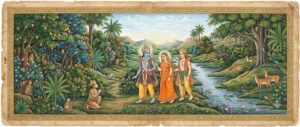
Miniature style painting of Rama, Sita and Lakshmana walking through a forest by a river, with Hanuman kneeling in devotion, the epic journey followed on a Ramayana tour of India


If the Odyssey has ever moved you, the Ramayana is waiting, and unlike Ithaca, it is not a ruin. It is a living epic. In India, people still keep Rama’s story alive in temples, festivals and village theatre, and you can watch leather puppeteers at Nimmalakunta tell it with shadows.

On our 14 day Ramayana tour of India, you travel the road of Rama’s exile, from Ayodhya, where the story begins, to Nandigram, where Bharata ruled in the name of a pair of sandals. You cross the Ganga near Shringverpur, take a boat on the Sangam at Prayagraj, and visit Chitrakoot, Panchavati near Nashik, Lepakshi, Hampi, Rameswaram and Dhanushkodi, where the road meets the sea, ending in Madurai. Three domestic flights cover the longest legs, and you travel the rest by private air conditioned car with a driver. Every group is private, with never more than eight guests and a local guide at each stop.

Yes. Both are ancient epics about a hero who spends years away from home, is helped by divine allies and is reunited with a faithful wife, and both include a famous scene in which the hero strings a bow that no one else can. They also differ in important ways, such as the reasons for the hero’s absence and the character of the hero himself.

The closest match is Sita, the devoted wife of the exiled hero. The two women are very different: Penelope waits at home and tests her husband, while Sita follows him into exile, is carried off and is tested herself.

Both. The abduction of a wife and the war across the sea recall the Iliad, and the long exile and return home recall the Odyssey. The Ramayana holds both stories in a single poem.

Our 14 day Ramayana tour of India visits Ayodhya, Nandigram, Shringverpur, Prayagraj, Chitrakoot, Panchavati, Lepakshi, Hampi, Rameswaram and Dhanushkodi, ending in Madurai.

To travel through the world of the Ramayana yourself, join our 14 day Ramayana tour of India. Read how we found the route in our blog on the Ramayana trail, meet the poet in our blog on Valmiki, follow the search for the golden city in our blog on where Ravana’s Lanka may have been, and explore every estimate in our blog on how old the Ramayana is. Every 5 Senses tour is built to benefit the people who live along the route, and you can read how in our responsible tourism approach. To plan a longer journey, talk to us about a custom itinerary.

One hero strings a bow to win his way home. Another strings a bow to win a bride, and loses a kingdom for a promise. Whichever epic you meet first, the other is waiting. In the great Odyssey vs Ramayana debate, the best way to settle it is to come to the land of the Ramayana and see it for yourself.

Listen to a podcast

Comments are closed.
Pay in your Currency