
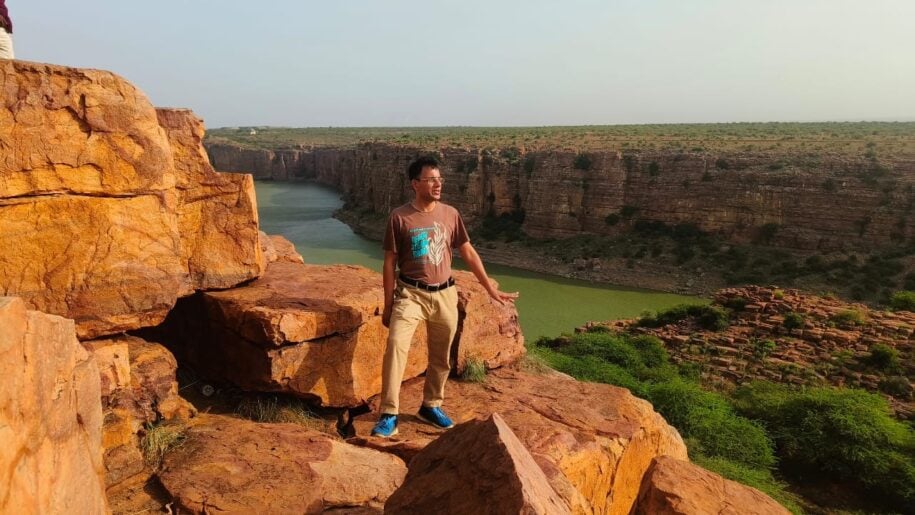
The Ramayana trail is the route across India that tradition links to Lord Rama’s fourteen years of exile, from Ayodhya through Nandigram, Shringverpur, Prayagraj and Chitrakoot to Panchavati near Nashik, then south through Lepakshi, Nimmalakunta and Hampi to Rameswaram and Dhanushkodi at the sea. The exact route is held by text, tradition and living memory and not by a single survey, and some places, such as the spot where Jatayu fell, are claimed by several regions. 5 Senses Tours built a 14 day private Ramayana tour of India that follows the Ramayana trail from Ayodhya to Rameswaram, ending in Madurai.
It began in a cinema.
This Diwali season I watched the Ramayana return to the big screen, and something stirred. The film sent me back to the Ramanand Sagar serial of the 1980s, the version that carried the story into so many homes. And the serial sent me back to the source, so I brushed up on the Valmiki Ramayana, the whole epic, about 24,000 verses in seven books.
Somewhere between the film, the serial and the verses, a thought took hold and would not let go. Rama walks. For fourteen years, the hero of the greatest story in India is a man on foot. Could I follow him? Could anyone stand, today, where he stood, from Ayodhya all the way to the sea?
This is the story of how I went looking for the Ramayana trail, what I found, what I could not find, and how a question became a fourteen day journey.
The Ramayana trail starts with a question and three tests
I did not set out to build a tour. I set out to answer a question. The tour came later, as the answer.
The first problem was obvious. The Ramayana is a poem, and poems do not come with a survey map. No one has proved where Rama slept on any particular night. So I gave myself three tests. Does Valmiki’s text point to this place or this kind of place? Do people still keep the story alive there? And can a traveller actually stand on the spot and feel it?
Where all three agreed, a place went onto the map. Where they did not, it became a case file, and some case files stayed open. Here is what the investigation turned up, clue by clue.

Clue 1: Ayodhya, where the Ramayana trail begins
Every trail needs a first step, and this one starts on the banks of the Sarayu.
Ayodhya is traditionally Rama’s birthplace, and at dusk the ghats near Ram ki Paidi glow with the lamps of the Sarayu aarti. The new Ram Janmabhoomi Mandir, built in pink sandstone and consecrated in January 2024, draws pilgrims from across the world. But the story I found here was a smaller one. On a hill nearby stands Hanuman Garhi, reached by 76 steps. Tradition says that after Ravana’s defeat, Hanuman settled in a cave here to guard Ramkot. The main image is just six inches tall, a child Hanuman seated on his mother’s lap.
The guardian of the city, in other words, is a child on his mother’s knee. It is a detail no film would invent.

Clue 2: Nandigram, the king who ruled with a pair of sandals
About 15 kilometres south of Ayodhya lies a village that most visitors skip. It gave me my favourite story on the whole trail.
When Rama went into exile, his brother Bharata refused the throne. According to Valmiki, he walked back from Chitrakoot carrying Rama’s sandals, installed them on the throne at Nandigrama, held the royal canopy and fan over them, and ruled as Rama’s trustee. He reported every significant matter of state to the sandals. He did this for fourteen years.

Think about that for a moment. A ruler who governs for fourteen years in the name of a pair of shoes. Today the village keeps the memory at Bharat Kund, where he is said to have bathed, and at Bharat Gufa, where he is believed to have practised austerity. Several temples each claim to be his home, and I have learned not to demand that any one of them prove it. Two or three kilometres away, in the fields, lies Jata Kund, where the brothers are said to have shed their matted hair on Rama’s return.
Clue 3: Shringverpur, where the matted hair began
The first great obstacle on the trail is a river. At Shringverpur, about 45 kilometres from Prayagraj, the Ganga is wide, and this is where Rama met his friend Guha, the king of the boatmen.
In Valmiki’s telling, Rama slept on the bare ground by the river, while Lakshmana and Guha kept watch through the night. In the morning he sent his charioteer Sumantra back to Ayodhya, which meant there was no turning back. Then Rama took the sticky milk of the banyan tree and matted his hair, taking the vow of an ascetic. He would not undo it until his coronation, fourteen years later. Sita offered a prayer to the river as the boat pulled out.

The village has a small shrine to Guha, a ghat and a statue honouring him. It is a story about friendship that ignores every boundary society draws, and it is told at the edge of a great river.
Clue 4: Prayagraj, the feast that conjured a forest
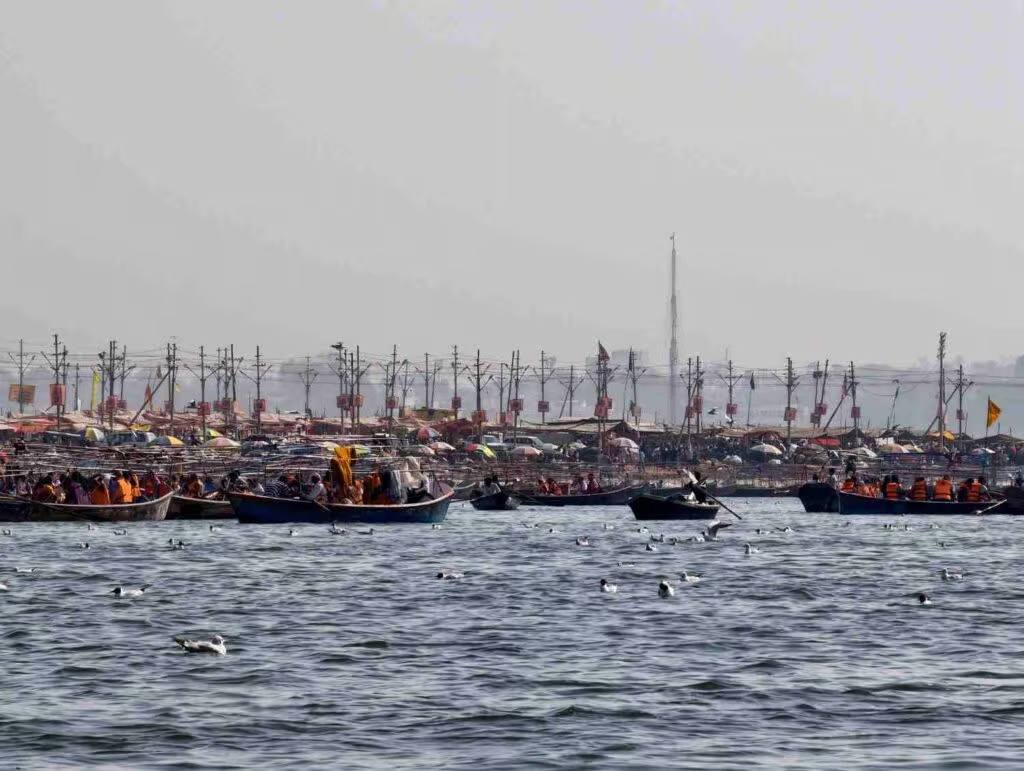
At Prayagraj, where the Ganga and Yamuna meet, I found a story that I think should be more famous than it is.
After Rama had passed through, Bharata came to the hermitage of the sage Bharadvaja with his entire army. The sage insisted on feeding all of them. Using the power of his penance, he summoned the gods and the rivers. Within a few miles, a meadow appeared, with palaces, groves, streams of milk and lakes of wine, dancers and musicians. The soldiers were so happy that many of them said they would never go back to Ayodhya, and shouted that this must be heaven.
And Bharata? In one of the mansions he found a throne, and he walked around it as though Rama were sitting on it, then took a lower seat and held the fan himself. In a hall of miracles, he was still thinking about his brother.
Today you can visit the Bharadwaj ashram and take a boat out to the Sangam at dusk.
Clue 5: Chitrakoot, the long middle of the exile
If the exile had a home, it was Chitrakoot.
Valmiki calls it a holy place inhabited by sages, and one account says Rama, Sita and Lakshmana spent close to eleven and a half of their fourteen years here. They came after meeting the sage Atri and his wife Anusuya, who advised them to stay. It was here that Bharata came to plead with Rama to return, and here, tradition says, that Rama performed his father Dasharatha’s last rites on the banks of the Mandakini.
The town still circles Kamadgiri, a hill with a five kilometre path of prayer, and still gathers on the ghats of the Mandakini for the evening aarti. It also carries two literary secrets. The poet Kalidasa called the hill Ramgiri, and Tulsidas is said to have written the Ram Charit Manas here.
Clue 6: Panchavati, and the line that was never drawn
Now the trail turns far south, to the Godavari at Nashik, and the mood of the story changes.
Panchavati is named for five banyan trees. Tradition says Rama built his cottage beneath them, and visitors climb the narrow steps into Sita Gufa, Sita’s cave. This is where Surpanakha, Ravana’s sister, appears. When she turns violent, Lakshmana cuts off her nose, and one tradition says the city takes its name from the Sanskrit word for nose, nasika.
And here I made a discovery that startled me. Almost everyone remembers the Lakshman Rekha, the line that Lakshmana draws around Sita before leaving her. It is the most famous boundary in India. But when I went back to Valmiki, I found that in the epic, Lakshmana leaves without drawing any line. Even Tulsidas does not describe it at that moment, and it surfaces only as an allusion later, when Mandodari mocks Ravana. The most famous line in the Ramayana, it seems, was drawn by memory and retelling and not by Valmiki.

That is the kind of clue that makes the trail worth walking. It reminds you that the epic is a river, and that many hands have shaped it.
Clue 7: Lepakshi, a bird, a blinded treasurer and five rival claims
In southern Andhra Pradesh the Ramayana trail turns into a full scale mystery.
At Lepakshi stands the Veerabhadra Temple, built in the 16th century under the Vijayanagara kings, and beside it a huge stone Jatayu. Local tradition says that when Rama found the wounded vulture who had fought Ravana, he said, “Le pakshi,” rise, bird, and the village took its name. A second, speculative reading says the name comes from words meaning embalmed eye. That leads to another legend. The temple’s builder, the treasurer Virupanna, is said to have spent the royal treasury on it. When the king ordered him blinded, he put out his own eyes and dashed them against the wall, where two dark stains are still shown. Nearby is an unfinished wedding hall, said to have been meant for the marriage of Shiva and Parvati.

Then the plot thickens. Within days of the film, social media in Kerala, Andhra Pradesh and Tamil Nadu began arguing over where Jatayu actually fell. Kerala has Chadayamangalam, with a vast Jatayu sculpture that opened in 2018. Tamil Nadu has two temples that claim his last rites. Near Nashik, Janasthana is called his home. A historian quoted in the coverage says no historical evidence supports any of these places, and that the claims come from local lore. Another says the choice of where to stand is up to the visitor.
So I stopped trying to prove one answer. I put Lepakshi on the trail, and marked the other claims as an open case.
Nimmalakunta, where Ravana needs four skins
Not every clue on the Ramayana trail is a monument. Some are a village.
In Nimmalakunta, families keep alive Tholu Bommalata, the leather shadow puppet theatre of Andhra Pradesh. Their shows retell the Ramayana and the Mahabharata through the night, with sung verses and live music. The puppets are made from antelope, spotted deer and goat skin, and Ravana, being so huge, needs at least four pieces of leather. Some scholars believe this art travelled east and became Indonesia’s wayang.
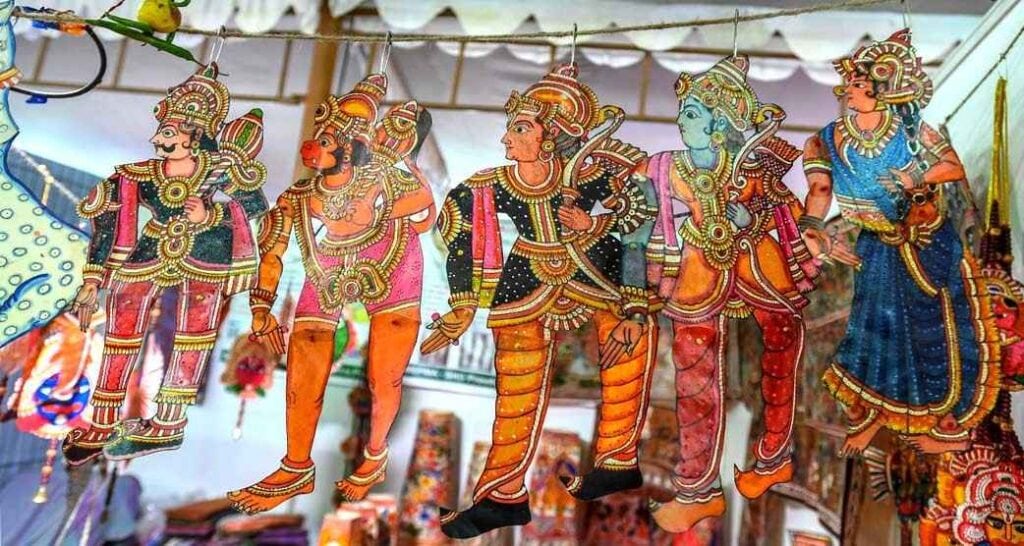
I added it to the trail because it answers a question the temples cannot. How does a story survive three thousand years? The answer, here, is that families tell it again every night.
Clue 9: Hampi and Anegundi, a bundle of jewellery
Across the Karnataka border the trail reaches a landscape of boulders so strange that it could have been made for a legend.
Anegundi, on the northern bank of the Tungabhadra, is widely believed to be Kishkindha, the kingdom of Sugriva. And it holds the saddest story on the whole route. According to Valmiki, as Ravana carried Sita through the sky, she saw a group of monkeys on a mountain. She wrapped her jewellery in her upper cloth and dropped it. Sugriva’s companions kept the bundle safe in a cave. When Rama saw it, he clutched it to his chest and fell to the ground weeping. He asked Lakshmana to identify the ornaments. Lakshmana said he could not recognise the bracelets or earrings, but he knew the anklets, because he had only ever bowed at her feet!

Near Anegundi lie Pampa Sarovar, where the devotee Sabari is said to have met Rama, and the Valikote cave. An ash mound in the nearby village of Nimvapuram is said to hold Vali’s remains. And on Anjanadri Hill, believed in Karnataka to be Hanuman’s birthplace, the climb is about 570 steps. It is optional, but at sunset it is unforgettable.
Clue 10: Rameswaram and Dhanushkodi, where the trail meets the sea
The last clue is at the edge of the land.
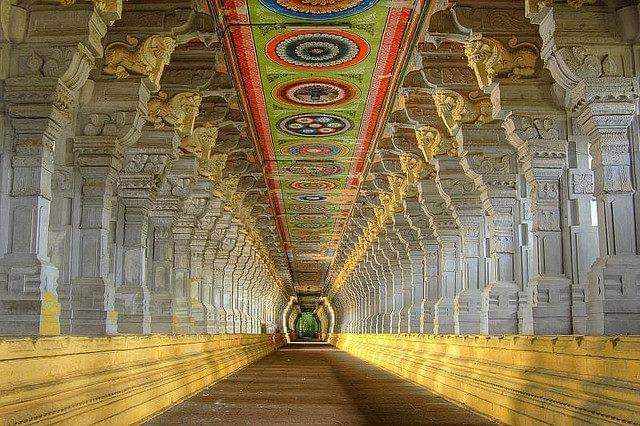
At Rameswaram, Rama is said to have worshipped Shiva at the Ramanathaswamy Temple, and at the Kothandaramaswamy Temple tradition says Vibhishana came to him for refuge. Then comes Dhanushkodi, where tradition says the bridge toward Lanka began, and where Sri Lanka lies only about 24 kilometres across the water.
Dhanushkodi has a second story, told in ruins. On the night of 22 to 23 December 1964, a cyclone struck, with waves of about seven metres. An estimated 1,800 people died across the region. A passenger train was overturned near the station. The town was declared a ghost town and was never rebuilt. Four radio operators stayed at their posts and kept broadcasting at great risk to themselves. Today you can walk among the walls, and look out toward the horizon where, if the epic is right, an island of gold once stood. Where exactly that island lay is a mystery we explore in our blog on where Ravana’s Lanka may have been.
Fourteen years, fourteen days
By now a pattern had appeared, and it would not leave me alone.
Fourteen. Rama walked for fourteen years. Bharata ruled in the name of his sandals for fourteen years. Rama’s hair stayed matted for fourteen years. The number runs through the epic like a drumbeat.
I could not give anyone fourteen years. But I thought I could give them fourteen days. Not a day for every year, because the years and the miles do not match, but fourteen days in which the road unfolds in the same order the epic does, from the Sarayu to the sea.
That is how the Ramayana trail became a tour. Here is what I put together. It begins in Ayodhya and ends in Madurai. Along the way, you cross the Ganga near Shringverpur, take a boat on the Sangam, climb among the temples of Chitrakoot, stand in Sita Gufa at Panchavati, meet the stone Jatayu of Lepakshi, watch the leather puppeteers of Nimmalakunta, walk Hanuman’s kingdom at Hampi, and end at the water’s edge at Dhanushkodi.

Frequently Asked Questions
The Ramayana trail is the route across India that tradition links to Rama’s fourteen years of exile, from Ayodhya in Uttar Pradesh to Rameswaram and Dhanushkodi in Tamil Nadu.
Yes. The route is held by text, tradition and living memory and not by a single survey, so many places are claimed by local tradition. You can visit them and stand where the stories say Rama stood.
Ayodhya, Nandigram, Shringverpur, Prayagraj, Chitrakoot, Panchavati near Nashik, Lepakshi, Nimmalakunta, Anegundi near Hampi, Rameswaram and Dhanushkodi are the main stops of our tour.
Ramayana tour of India takes 14 days, from Ayodhya to Madurai, with three domestic flights.
It is the name given to the route Rama is said to have taken to the forest. Nandigram, near Ayodhya, is described as lying on it.
Several places claim it, including Lepakshi in Andhra Pradesh, Chadayamangalam in Kerala, two temples in Tamil Nadu and Janasthana near Nashik. Historians say none of these claims has historical evidence.
To walk the Ramayana trail yourself, join our 14 day Ramayana tour of India. Read about the poet who first sang the story in our blog on Valmiki, and follow the search for the golden city in our blog on where Ravana’s Lanka may have been. Every 5 Senses tour is built to benefit the people who live along the route, and you can read how in our responsible tourism approach. To plan a longer journey, talk to us about a custom itinerary.
Rama was given fourteen years and a road. I invite you to take out fourteen days and take the same road. Come and walk the Ramayana trail from the Sarayu to the sea, and tell me which clue stays with you.