
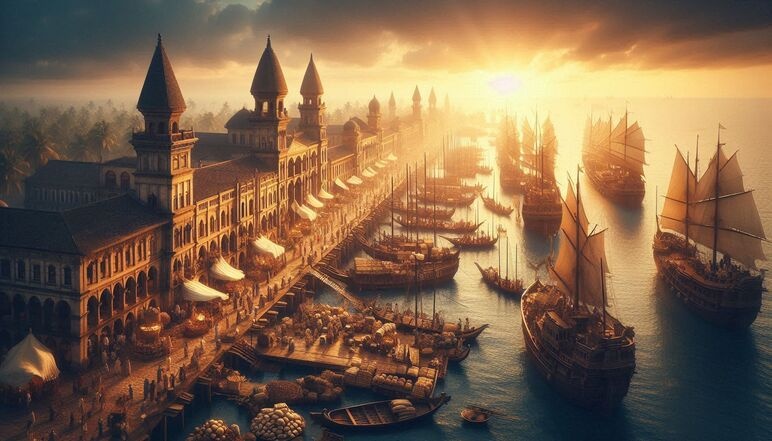
Close your eyes for a moment and imagine the distant shores of Kerala, two thousand years ago. The sun glints off the calm waters of the Arabian Sea, and the air is thick with the scent of pepper, cardamom, and cinnamon. Wooden ships with billowing sails glide into a bustling harbour. Merchants shout in Greek, Arabic, and Chinese. Roman coins change hands alongside pearls from Arabia and silk from China. This was Muziris, a city that was once the beating heart of India’s spice trade, and one of the most magnificent ports the world had ever seen.
Muziris was not just a port; it was a crossroads of cultures. Greek geographers called it “an emporium of trade,” while travelers from faraway lands marveled at its wealth and sophistication. Roman historian Pliny the Elder wrote about Muziris as a thriving hub for spices — especially pepper, which was known as “black gold” in the Roman world. Archaeologists have unearthed Roman coins, amphorae, and beads along the Periyar River, evidence of a trading network that spanned continents. Traders from Arabia, Egypt, China, and Greece mingled with local rulers, exchanging goods, knowledge, and stories.
For a private tour of Muziris from Kochi, please visit Lost Port of the Spice Route.
The city’s streets, now vanished beneath centuries of sand and river silt, once thrummed with life. Merchants sold spices in open-air markets, artisans crafted exquisite jewelry and textiles, and the aroma of roasted pepper mingled with incense from temples and mosques. Ships laden with treasures departed for Rome, Alexandria, and Arabia, carrying the fame of Muziris across continents. It was a city that symbolized Kerala’s golden age — a place where commerce, culture, and religion intertwined seamlessly.
Even today, remnants of that grandeur remain scattered along the banks of the Periyar River in Kodungallur, Chendamangalam, and Paravur. Visiting these sites is like stepping into a living history book.
Cheraman Juma Masjid
Built in 629 CE, it is India’s first mosque. Legend has it that King Cheraman Perumal traveled to Arabia, met the Prophet Muhammad, and returned to Kerala as a convert. The mosque’s brass lamp, kept burning for centuries, is a testament to the enduring faith of the region.
Chendamangalam Synagogue
Dating back to the 17th century, it is a window into the Jewish community that flourished in Kerala. Its distinctive blue-and-white tiles, hand-carved wooden ark, and Hebrew inscriptions tell stories of merchants who lived in harmony with their Hindu and Muslim neighbors.

Paliyam Palace and Kottappuram Fort
Once the seat of the Paliath Achans, hereditary prime ministers of the Kochi royal family, these sites highlight Kerala’s feudal history and the influence of Portuguese and Dutch traders.
And then there are the people — the artisans who still weave cotton on wooden looms, creating patterns that have survived for generations; the fishermen who set out at dawn in traditional boats, much like their ancestors did; and the chefs who serve Kerala Sadya, a banquet of rice, curry, and spices, echoing the very flavors that made Muziris legendary.
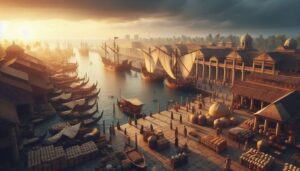
For travelers today, a day trip from Kochi to the Muziris Heritage Trail is more than sightseeing. It is a journey through time, a chance to walk the paths where Roman coins once jingled, spices were traded for silk and gold, and ideas flowed as freely as the backwaters. You will see temples, mosques, and synagogues standing side by side, experience the rhythm of traditional village life, and even drift along serene backwaters once used by the great trading ships. Every moment brings you closer to the story of a city that shaped not only Kerala, but the world’s perception of it.
Muziris was magnificent. It was a beacon of trade, culture, and faith — a city that invited the world to its shores. And though the port has long vanished, its spirit remains, waiting for travelers to rediscover its glory.
Step into history. Walk the streets of Muziris. Taste the flavors, hear the stories, and feel the echoes of one of the greatest trading cities the world has ever known.
Fascinating Muziris Facts:
- Muziris was one of the earliest places in India to have direct trade with the Roman Empire, and Roman coins have been found buried in the soil here.
- Pepper from Muziris was so prized that it was worth its weight in gold in Europe.
- Arab traders brought Islam to Kerala, Chinese traders brought silk and porcelain, and Jewish merchants established some of the oldest synagogues in India.
- Archaeological digs along the Periyar River have revealed ancient pottery, coins, and beads that date back over 2,000 years.

Why visit Muziris?
- Witness living heritage: Temples, mosques, synagogues, and crafts that have survived centuries.
- Step onto the ancient spice route, once a hub for Roman, Arab, and Chinese trade.
- Experience Kerala’s cultural harmony, where diverse faiths and traditions coexist beautifully.
- Enjoy authentic local cuisine and the scenic backwaters.
Join the Muziris Heritage Day Tour from Kochi
Explore the ancient spice route, visit historic mosques, temples, and synagogues, witness traditional crafts, and enjoy a sumptuous Kerala Sadya — all in one unforgettable day. Step into history, and let Muziris tell its story. Book your tour now and experience the lost port that once connected India to the world.
For details of a private tour of Muziris, please visit Lost Port of the Spice Route.
Leave a Reply