
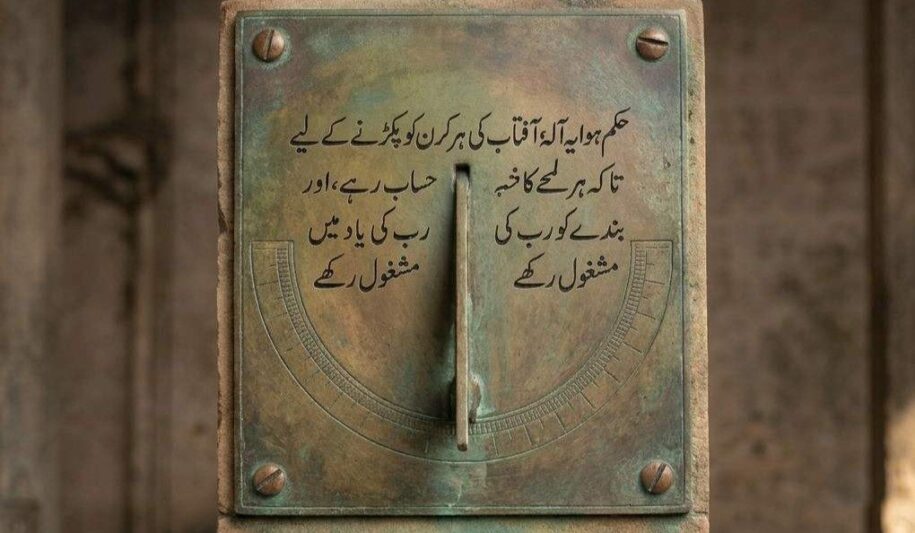
How a Small Mosque in Pulicat Told Its Town the Time, Using Only the Sun

Mosque with a sun dial in Pulicat

A town needs to agree on the time before it can pray together, trade together or do anything together. Before wristwatches and wall clocks and phones, the agreement came from the sky.

In Pulicat, on the Coromandel coast north of Chennai, one small mosque still holds the answer in stone: a sundial, installed in 1914, to show the hour and to call the community to prayer.

This is the story of the sundial at Chinna Pallivasal, one of the main mosques of Pulicat (Pazhaverkadu), a lagoon town on the Coromandel coast north of Chennai, and of the Muslim trading community that built the town’s mosques. Arab maritime traders had settled in Pulicat by the 9th century, adopted Tamil and became leading traders and boat builders. In 1606 local Muslims helped the Dutch begin trading at the port. The sundial was installed in 1914 to show the time by which the community assembled for prayer, replacing an earlier marker. The mosque can be seen on a private responsible tourism day trip from Chennai that also includes a meeting with the community and its senior teacher.

Why a Mosque Needs the Sun
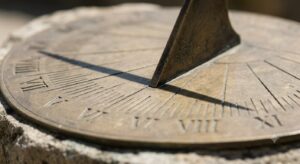
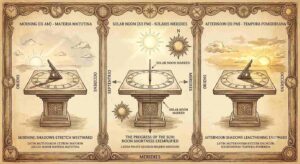
Illustration of a sundial shadow moving across the dial through the day with solar noon marked

The sun is the original clock of Islam. Several of the five daily prayers are defined by where the sun stands in the sky, and the afternoon prayer is traditionally tied to the length of shadows. For a mosque in the days before mechanical clocks, reading the sun was a practical necessity.

That is why a sundial belongs in a mosque compound as naturally as it does anywhere. Heritage writers on Pulicat note that the Chinna Pallivasal had a marker used to work out the time before the sundial was installed. In 1914 the marker gave way to the sundial, installed to show the time by which people assembled for prayer.

For a guided tour of the Sundial and other fascinating experiences at Pulicat, visit Port to Palm Experience.

How a Sundial Actually Works
Small group with a guide watching the shadow on the Pulicat mosque sundial

A sundial has two parts: a raised edge that throws a shadow, and a surface marked with lines for the hours. As the sun crosses the sky, the shadow moves across the marks, and where it falls tells you the time.

What it tells you is local solar time, which is not quite the time on your phone. India runs on a single standard time set for a meridian well to the east of Pulicat. By a simple longitude calculation, local solar noon at Pulicat falls roughly nine minutes after 12:00 on standard time. The sun’s pace also shifts through the year, by up to about a quarter of an hour either way. A sundial does not make mistakes. It simply reads the sky at one particular place, and standing at it you feel how far a town once was from the idea of a single time for everyone.

How Muslim Traders Came to Pulicat

Arab maritime traders had settled in Pulicat by the 9th century, according to histories of the town. More arrived in the centuries that followed. By the 12th and 13th centuries, Pulicat and the other Coromandel port towns had come to be identified as centres of formal Islam in South India, and between 1225 and 1275, Arab ships carrying tin from Malaya to Oman and Dhufar regularly called here on the way.

The newcomers did not remain visitors. Over generations, settled families adopted Tamil as their language and married locally, forming the Tamil speaking Muslim communities of this coast, known in different places as the Labbai, the Marakkayar and others. One historical study traces how the first settlers came up the coast from Kayalpattinam through Nagore, Thanjavur and Mylapore before reaching Pulicat. Another notes that a chain of Muslim trading settlements grew along the east coast from Pulicat all the way to Colachel in Kanyakumari.

The community kept its own memory. A history of Pulicat held by local Muslims was written in Arabic Tamil, a language that blends Arabic script with Tamil. Today only a handful of people in Pulicat can read it, which makes it one of the quieter losses of the town.

What the Muslim Community Built in Pulicat
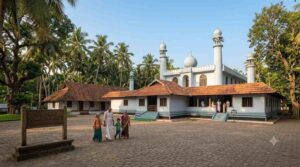
A Pulicat mosque and a temple sharing a compound wall, showing how neighbouring faiths lived side by side

Historians describe Pulicat’s Muslims as traders, merchants and expert boat builders. They worked alongside Hindu merchants in controlling the internal commerce of the town, and in the early 16th century a Muslim served as the Port Captain of Pulicat. The cloth trade gave the port its wealth. At its peak, Pulicat’s textile makers worked a thousand handlooms, and the exports included muslin, pearls and edible oils.

When the Dutch arrived, the community mattered even more. According to the town’s histories, a Dutch ship put in near Karimanal village, just north of the lake, in 1606 in search of water. Local Muslims offered food and shelter and formed a partnership to procure and supply local goods for Dutch trade. One historical study names a Muslim merchant of Pulicat, Maraikkaiyar, as the Dutch company’s main contact, and local accounts say the community helped the Dutch obtain their trading grant from the Vijayanagara ruler. The Portuguese, reports suggest, had tried to remove the Arab traders who served as middlemen. The Dutch later employed the Lebbai as boat builders. Sources differ on the details, but they agree on the role: the Muslim community was the bridge between the port and the ships.

The mosques are the lasting record. The three main mosques are the Periya Jamiya Pallivasal, the Chinna Pallivasal and the Keela Pallivasal. Like many mosques on this coast, they drew on the local building traditions of the Tamil country, because Islam has no equivalent of the temple texts that dictate how a sacred building must look. The century old Keela Pallivasal shares a compound wall with the Samayeswarar temple, which dates to Chola times, a quiet sign of neighbours who shared a small town for centuries. Muslim homes still stand between the old Dutch quarter of Kottai Street and the mosques, and they keep their traditional character.

Published accounts of Pulicat’s palm leaf cooperative add one more thread: it initially employed Muslim women of the village. The sundial at Chinna Pallivasal belongs to this long story of a community that traded, built boats, wove cloth and kept the time for its town.

On the Port to Palm day trip, you spend time with the community and its senior teacher, who carries this history in the community’s own voice. Each host decides what to share.

Where Pulicat Sits Among the Sundials of Madras
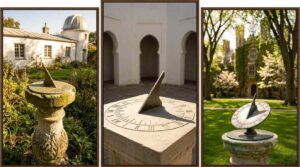
Triptych of three sundials from the Madras region: an 18th century observatory sundial, the 1914 sundial at Chinna Pallivasal mosque in Pulicat, and a sundial on a college campus

Sundials had a long afterlife in this region. Writers on the public clocks of Madras place the Chinna Pallivasal sundial alongside others in the city, including one at the old Madras Observatory dating to the 1790s and another acquired by Madras Christian College in Tambaram. Sundials retained their fascination into the 20th century, and Pulicat’s was part of that.

It stands apart because it serves a living community and its prayer, not an observatory or a college, and because of where it is: a fishing town that was once the Dutch headquarters on this coast.

Standing at the Sundial
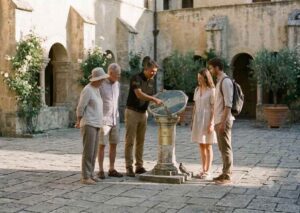
Small group with a guide watching the shadow on the Pulicat mosque sundial

On the Port to Palm day trip, your guide shows you how the shadow falls and what each mark means, explaining in a few minutes what an entire town once lived by. The visit is arranged with the community, and your guide explains the etiquette of a place of worship before you arrive.

The sundial is one stop in a day that also includes a boat across Pulicat Lake, fishermen mending nets, palm leaf weaving with a women’s group, the Adinarayana temple, the lighthouse and the Dutch cemetery. Every host is paid directly.

Frequently Asked Questions

The sundial is at Chinna Pallivasal, one of the main mosques of Pulicat, also called Pazhaverkadu, a lagoon town on the Coromandel coast north of Chennai.


It was installed in 1914 to show the time by which the community assembled for prayer. Before it, the mosque used a marker to work out the time from the sun.

A raised edge throws a shadow onto a surface marked with hour lines. As the sun moves, the shadow moves across the marks, and its position shows the time. A sundial reads local solar time, which differs slightly from standard clock time.

Several daily prayers in Islam are defined by the position of the sun and the length of shadows, so reading the sun was essential before mechanical clocks. A sundial gave a community a shared, visible way to know when to gather.

Yes. The Chinna Pallivasal sundial is one stop on Port to Palm, a private responsible tourism day trip from Chennai run by 5 Senses Tours. It leaves at 7 AM, returns between 7:15 and 7:30 in the evening. Visit https://5sensestours.com/tour/port-to-palm/

Somewhere in Pulicat, a shadow is moving across a set of marks, exactly as it did when the mosque installed the dial in 1914. It asks nothing of anyone. It does not need power or repair or a signal.

It is a small reminder that for most of human history the sky kept the time, and that towns like this one, on a coast the sea trade built, once ran on it together.

For a guided tour of the Sundial and other fascinating experiences at Pulicat, visit Port to Palm Experience.

The sundial is one chapter in the story of Pulicat. To see how this port rose and faded, read the history of Pulicat and its lighthouse. The Arab traders who settled here followed sea routes that Tamil merchants had sailed to Rome centuries earlier, a story told in the ancient trade between Tamil Nadu and Rome. Those same routes carried Indian crucible steel west to Persia, where it became Damascus steel, as you can read in the story of Wootz steel. On the other side of the peninsula, Kochi shows how the Malabar coast built its own sea trading history, and Chennai is the base for Pulicat.

Listen to a podcast

Comments are closed.
Pay in your Currency