
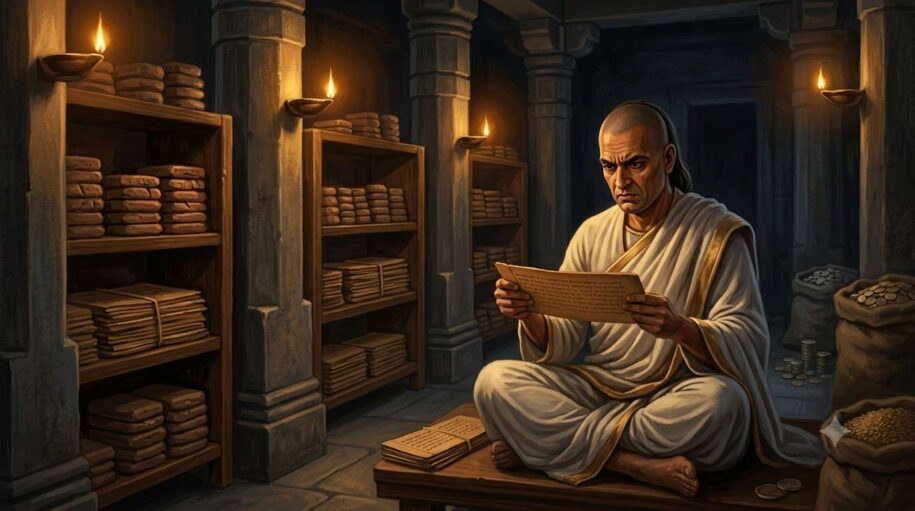
In the year 1905, a young Sanskrit scholar named Rudrapatna Shamasastry was working through a heap of palm leaf manuscripts in the newly opened Mysore Oriental Library, cataloguing them one by one for the Maharaja’s collection. The manuscripts had arrived years earlier, a gift from a Tamil Brahmin in Thanjavur, and most of them were the kind of devotional and literary texts a librarian in early twentieth century India would expect to find in any temple’s collection.
Then Shamasastry opened one written in the Grantha script of South India, and the words he was reading stopped being routine.
He was holding the Arthashastra. The lost political treatise of Chanakya, written for the Mauryan Empire roughly twenty four centuries earlier. A book European scholars had assumed was a myth, known only through scattered references in other ancient texts, because the actual manuscript had vanished from circulation sometime around the 12th century and had not been seen by a single scholar anywhere on earth for nearly eight hundred years.
Shamasastry transcribed it. He published the Sanskrit edition in 1909. He spent the following years translating the entire text into English, finishing in 1915. And when scholars around the world finally read what he had found, they discovered something that changed how the world understood ancient India.
Buried within its second book is a chapter Chanakya titled, with characteristic bluntness, Detection of Embezzlement by Government Officials. In it, the man who built and ran the administration of one of the largest empires in the ancient world set out, in exhaustive, almost gleeful detail, exactly forty distinct ways a government treasury official could steal from the state.
This is the story of that chapter, the empire it was written to protect, and the librarian who rescued it from eight centuries of silence.
The Arthashastra’s 40 Ways to Steal: Ancient India’s Catalogue of Corruption
Who Was Chanakya and Why Did He Need to Catalogue Theft
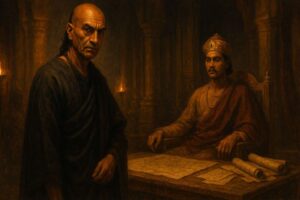
Chanakya, also known as Kautilya or Vishnugupta, was the chief strategist and adviser who helped a young Chandragupta Maurya seize the throne of Magadha around 321 BCE and build the Mauryan Empire, the first great political unification of the Indian subcontinent. Chanakya is believed to have studied and possibly taught at the ancient university of Takshashila, the same intellectual hub connected to Panini and Charaka, before becoming the architect of an empire that would eventually stretch from Afghanistan to Bengal.
The Arthashastra, whose title translates roughly as the science of material gain or the science of statecraft, was his operating manual for running that empire. It covers diplomacy, military strategy, taxation, law, urban planning and the conduct of spies, but its second book, concerned entirely with the day to day administration of the state, contains one of the most remarkable pieces of practical writing to survive from the ancient world: a chapter dedicated entirely to enumerating every method a corrupt official might use to defraud the royal treasury.
Chanakya did not write this chapter as a moral lecture. He wrote it as a working reference document for royal auditors, because he understood something that every finance minister in every government since has had to confront. You cannot stop theft you cannot first imagine.
The Forty Ways, and Why They Read Like a Modern Forensic Accounting Textbook
Kautilya’s catalogue, found in Book Two, Chapter Eight of the Arthashastra, lists forty distinct techniques by which government officials of his era enriched themselves at the state’s expense. Read today, the list is startling not for being primitive but for being almost completely current.
Officials recorded that what is payable was not paid, and that what was not payable was paid. They recorded small gifts as large gifts, and large gifts as small ones. The item actually gifted was one thing, while the item entered in the official books was something else entirely. The true recipient of a payment was one person, while the recipient named in the records was someone else. Raw materials that had never actually been paid for were entered in the accounts as paid, while materials that genuinely had been purchased were left out of the books altogether.
Read that list again, and you are reading a description of phantom vendors, mismatched invoices, fictitious recipients and unrecorded liabilities, the precise vocabulary of a modern forensic audit, written for a treasury that had never seen a coin minted with a number printed on it.
Kautilya was equally exact about who needed to be interrogated when fraud was suspected. He named the treasurer, the official who authorised the transaction, the person who received the goods, the person who made the payment, the person who caused the payment to be made, and the servants attached to the officer in question, specifying that each one be questioned separately rather than together, precisely the modern investigative principle of preventing collaborators from coordinating their stories before they are caught.
The Auditor’s Manual Behind the List
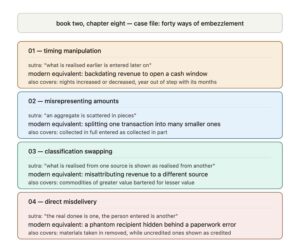
It is worth being precise about what kind of document this actually is, because that is what makes it so unusual. Chanakya did not write Chapter Eight of Book Two as a sermon on honesty. He wrote it as a working manual for the king’s auditors, a reference document meant to be consulted whenever the treasury’s numbers looked wrong, structured exactly the way a modern fraud examiner’s handbook is structured: define the categories of manipulation, list the specific techniques within each, then prescribe exactly how to investigate and exactly how to punish.
Grouped by the kind of manipulation involved, his forty methods fall into four clear categories that any modern forensic accountant would recognise immediately.
Manipulating timing.
Officials altered the calendar itself to create windows where cash could vanish unnoticed. Kautilya’s text lists what is realised earlier entered as later, and what is realised later entered as earlier, alongside number of nights increased, number of nights decreased, and the year not in harmony with its months, the month not in harmony with its days, a direct ancient description of calendar manipulation used to justify extra wage payouts or to pocket the difference between a lunar reckoning and the standard year.
Misrepresenting amounts.
Officials manipulated the gap between what was actually collected and what was written down. The text lists what is collected in part entered as collected in full, and what is collected in full entered as collected in part, allowing the remainder to be written off as an uncollectable loss. It also lists an aggregate scattered in pieces, and scattered items converted into an aggregate, the ancient equivalent of splitting a single large transaction into many small ones specifically to slip beneath a spending threshold that would otherwise trigger scrutiny, a technique modern auditors still call structuring.
Swapping classifications.
Officials disguised what was actually moving in or out of the treasury. The text lists commodities of greater value bartered for those of small value, and what is of smaller value bartered for one of greater value, alongside misrepresentation of the source of income, where revenue from one prosperous source was recorded as having come from an entirely different, weaker one.
Direct misdelivery.
This was theft in plain sight, hidden only by a paperwork error. The text lists the real donee is one while the person entered as donee is another, raw materials that are not paid for are entered, while those that are paid for are not entered, and what has been taken into the treasury is removed while what has not been credited to it is shown as credited, a category of fraud that depends entirely on someone trusting the ledger over their own eyes.
How Chanakya Built a System to Catch What He Knew Was Almost Unfindable
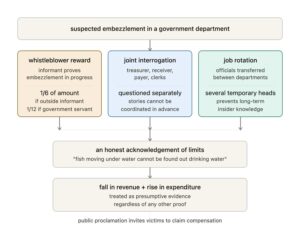
Chanakya did not stop at description. He built three specific enforcement mechanisms directly into the text, and each one would be recognisable to a modern compliance officer.
The first was a financial incentive for whistleblowing, and the precise numbers matter. Any informant who supplied information about an embezzlement actually in progress and succeeded in proving it received, in Chanakya’s exact words, one-sixth of the amount in question as reward. If that informant happened to be a government servant himself, reporting on his own colleagues, the reward dropped to one-twelfth, since exposing wrongdoing from inside the system carried less personal risk than doing so as an outsider. The system cut both ways. An informant who failed to prove the charge faced monetary or corporal punishment and could never be acquitted, and anyone who withdrew their accusation after being pressured by the accused faced a death sentence, a brutal but deliberate design preventing the reward from being weaponised as a tool of harassment or extortion.
The second was the joint interrogation principle. When fraud was suspected, Chanakya specified that the treasurer, the official who prescribed the transaction, the receiver, the payer, the person who caused the payment, and the ministerial servants attached to the office were each to be separately examined. If any one of them lied, his punishment was raised to match that of the chief officer actually responsible for the crime, a structure built specifically to prevent conspirators from coordinating a single, consistent false story.
The third was job rotation, and on this point Chanakya’s own words are unambiguous. Government servants, he wrote, shall not only be confiscated of their ill-earned hoards, but also be transferred from one work to another, so that they cannot either misappropriate government money or vomit what they have eaten up. He understood that the greatest danger was not a new official discovering loopholes quickly, but a long-serving one accumulating, year after year, an intimate knowledge of exactly where a system’s weaknesses lay. The text explicitly directs that each department be officered by several temporary heads, not permanent ones, precisely to prevent that accumulation of dangerous expertise.
How Chanakya Knew the Limits of Detection, and Designed the System Anyway

What makes Chanakya’s chapter genuinely sophisticated, rather than merely thorough, is that he was honest about how difficult fraud actually is to catch, and built his system around that honesty rather than around false confidence.
He wrote that it is possible to know the movements of birds flying in the sky, but it is exceedingly difficult to know the doings of government servants who hide their real purpose while discharging their duties. In a passage that has been quoted by Indian administrative researchers for over a century, he compared the task of detecting an embezzling official to determining whether a fish swimming underwater has actually swallowed any of the water around it, a problem that is, by its very nature, almost impossible to observe directly.
Chanakya’s answer to this problem was not a single foolproof test. It was redundancy. If revenue collection fell while expenditure rose, that pattern alone was treated as presumptive evidence of embezzlement, requiring investigation regardless of any other proof. Officials suspected of dishonesty were also to be tested, in calmer times, through what later commentators called the four upadhas, indirect tests of character designed to discover whether an official could be tempted into disloyalty, susceptible to fear, vulnerable to flattering suggestions of romantic favour from someone claiming royal connection, or willing to join a conspiracy, long before any actual crime had occurred.
And once a fraud was confirmed, Chanakya built in a final, strikingly modern safeguard. After the investigation concluded, a public proclamation was to be made, inviting any member of the public who believed they had been cheated by the embezzlement to come forward and claim compensation, treating the state’s victims as people with standing to be made whole, not merely as a footnote in the punishment of the official responsible.
The Book That Vanished for Eight Hundred Years
How the Most Important Political Text in Indian History Simply Disappeared
The Arthashastra was a working document for centuries after Chanakya wrote it, referenced and quoted by later authors including the poets Dandin and Bana and the philosopher Mallinathasuri. Then, sometime around the 12th century, for reasons no historian has been able to fully establish, it stopped being copied, stopped being quoted, and effectively vanished from circulation entirely.
For nearly eight hundred years, the Arthashastra existed only as a rumour. Scholars knew it had existed because other ancient writers mentioned it. They knew roughly what it claimed to contain. But not a single complete copy of the actual text was known to survive anywhere in the world, and an entire tradition of European Indology grew up believing, incorrectly, that ancient India had learned its principles of statecraft from the Greeks, simply because the one document that would have proven otherwise could not be found.
The Librarian Who Found It in a Pile of Manuscripts He Was Just Cataloguing
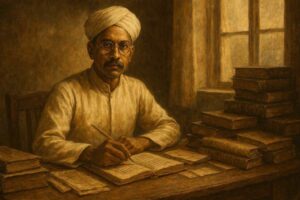
Rudrapatna Shamasastry was born in 1868 in a small village on the banks of the Kaveri river in what is now Karnataka. He lost his father young, studied with extraordinary determination, mastered Sanskrit, Vedic literature, Prakrit, English, German and French, and eventually came to the attention of Sheshadri Iyer, the Dewan of Mysore State, who helped secure him a position in the palm leaf manuscript division of the newly established Mysore Oriental Library.
It was, by any measure, a quiet job. Thousands of fragile palm leaf manuscripts had been accumulated by the library, most of them religious or literary texts of the kind found in temple collections across South India, and Shamasastry’s task was simply to work through them, transcribing and cataloguing their contents one leaf at a time.
In 1905, working through a manuscript that had been donated years earlier by an unnamed Tamil Brahmin pandit from the Thanjavur district, written in the Grantha script used across South India for recording Sanskrit texts, Shamasastry began to realise that what he was reading did not match anything he had catalogued before. It was Chanakya’s Arthashastra. The lost political treatise that Western scholarship believed might never have survived in complete form at all.
He had found it in a heap of manuscripts he had been assigned to sort through as a matter of routine.
From a Mysore Library Shelf to a World Historical Discovery

Shamasastry’s discovery has been described by Indian historians as nothing less than an epoch making event in the history of the study of ancient Indian polity. He transcribed the Grantha script text into standard Devanagari, published the Sanskrit edition in 1909, and then spent years more producing a complete English translation, finally published in 1915, making Chanakya’s text available to scholars worldwide for the first time in roughly eight centuries.
The discovery overturned a settled assumption in European scholarship of the time, the belief that ancient India had learned the principles of organised statecraft from contact with the Greeks following Alexander’s invasion. The Arthashastra, written before that contact and describing a state bureaucracy of extraordinary administrative sophistication, including its forty catalogued methods of treasury fraud, demonstrated conclusively that ancient India had developed its own complete and independent science of governance, centuries before any such exchange could have occurred.
Shamasastry became, almost overnight, one of the most celebrated scholars in the world. Calcutta University recognised his work in 1921. The Royal Asiatic Society admitted him the same year and awarded him its Campbell Memorial gold medal. He went on to become Director of Archaeological Research in Mysore, continuing his scholarship until his retirement in 1929.
The actual palm leaf manuscript he discovered still exists today, preserved at the Oriental Research Institute in Mysore, the same institution founded as the Mysore Oriental Library where Shamasastry once sat cataloguing a heap of unremarkable looking leaves and found, inside them, the lost operating manual of one of the greatest empires the ancient world ever produced.
Experience Chanakya’s Mysore With 5 Senses Tours
Visit the Library Where the Lost Manuscript Was Found

The Oriental Research Institute in Mysore, a magnificent heritage building blending Gothic, Corinthian and Romanesque architectural styles, still holds the palm leaf manuscript Shamasastry discovered in 1905 with Chanakya’s 40 ways to steal, alongside nearly sixty thousand other manuscripts spanning the breadth of classical Indian scholarship. Standing before the very leaves that preserved Chanakya’s forty ways to steal and his entire science of statecraft, after eight centuries of complete silence, is one of the most quietly extraordinary heritage experiences available anywhere in South India.
Our Royal Mysore tour connects travellers directly to this remarkable story, alongside the Mysore Palace, the royal Wadiyar dynasty’s architectural legacy, and the city’s deep intellectual heritage as a centre of Sanskrit scholarship under princely patronage.
Walk the Capital Chanakya Actually Built
The Arthashastra was not written as a theoretical exercise. It was the operating manual for a real empire, governed from a real city, and that city still exists. Our Patna tours take you to Pataliputra, the extraordinary Mauryan capital where Chandragupta Maurya put Chanakya’s principles into daily practice, including the excavated remains of the great pillared assembly hall at Kumrahar and the wider story of Vaishali and Bihar’s extraordinary ancient past.
For travellers wanting the complete sacred and intellectual circuit of ancient Magadha, our Bodhgaya Buddhist pilgrimage tour extends naturally from Patna, covering the Mahabodhi Temple where the Buddha attained enlightenment, alongside a full day exploring Rajgir, the ancient capital of the Magadha Empire where the Buddha himself once taught, and the ruins of Nalanda, once the greatest university in the ancient world. This entire region, the heartland Chanakya administered, the city the Buddha walked, and the university that drew scholars from across Asia, sits within a single, extraordinary travel circuit in Bihar.
A Story That Begins Beyond India’s Borders
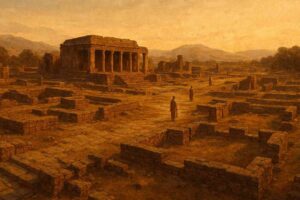
Chanakya’s own education is believed to trace back to Takshashila, the great ancient university located in what is present day Pakistan, the same intellectual centre connected to the Sanskrit grammarian Panini and the physician Charaka. It is a reminder that the story of Indian thought did not begin or end at any modern border, even though the empire Chanakya went on to build, and the manuscript that preserved his ideas, both belong entirely to India’s own heritage landscape, from Pataliputra to Mysore.
5 Senses Tours is recognised by India’s Ministry of Tourism, winner of the Tripadvisor Travellers Choice Award and the Outlook Responsible Tourism Award. Every tour is private, expert guided and completely customised for your group.
Talk to a 5 Senses Tours expert about experiencing the complete story of Chanakya, from the manuscript’s discovery in Mysore to the empire’s actual capital in Bihar, for yourself.
Contact 5 Senses Tours to begin planning your Chanakya heritage journey today.
Leave a Reply