
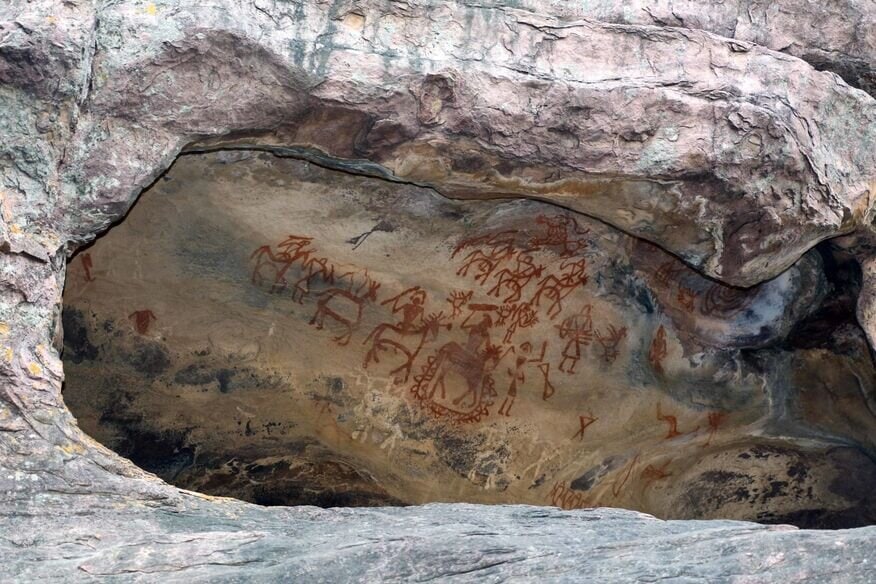
Ever wondered if those ancient handprints on cave walls were actually prehistoric high-fives? Probably not, but India’s cave paintings are far weirder than you’d expect.
When you’re standing in Bhimbetka looking at 10,000-year-old rock art, you’re not just seeing pretty pictures. You’re decoding India’s mysterious cave paintings that have survived earthquakes, empires, and endless monsoons.
The coolest part? These aren’t random doodles. They’re calculated messages using sophisticated visual language systems that archaeologists are only beginning to understand.
And here’s where it gets truly wild – the same symbols appear across sites separated by hundreds of miles, without any evidence of contact between communities.
So what exactly were they trying to tell us?
The Ancient Canvas: India’s Major Cave Painting Sites
A. Bhimbetka Rock Shelters: The Oldest Stories in Stone
Ever walked through a museum and wondered what life was like 30,000 years ago? At Bhimbetka, you don’t need to wonder – you’re literally standing in it.
These rock shelters in Madhya Pradesh aren’t just old – they’re mind-blowingly ancient. We’re talking about paintings created when humans were still figuring out this whole “civilization” thing. Discovered accidentally in 1957 by archaeologist V.S. Wakankar (who was actually just looking out a train window), these shelters contain over 700 rock shelters with paintings dating from the Mesolithic to medieval periods.
The artwork? Absolutely fascinating. You’ll see hunters chasing deer with spears, community dances, childbirth scenes, and animals that no longer roam the area. The red and white pigments have somehow survived millennia, telling stories of a world we can barely imagine.
What’s crazy is how familiar some images feel. A mother holding a child. Hunters celebrating a successful hunt. People dancing together. Some things about being human never change.
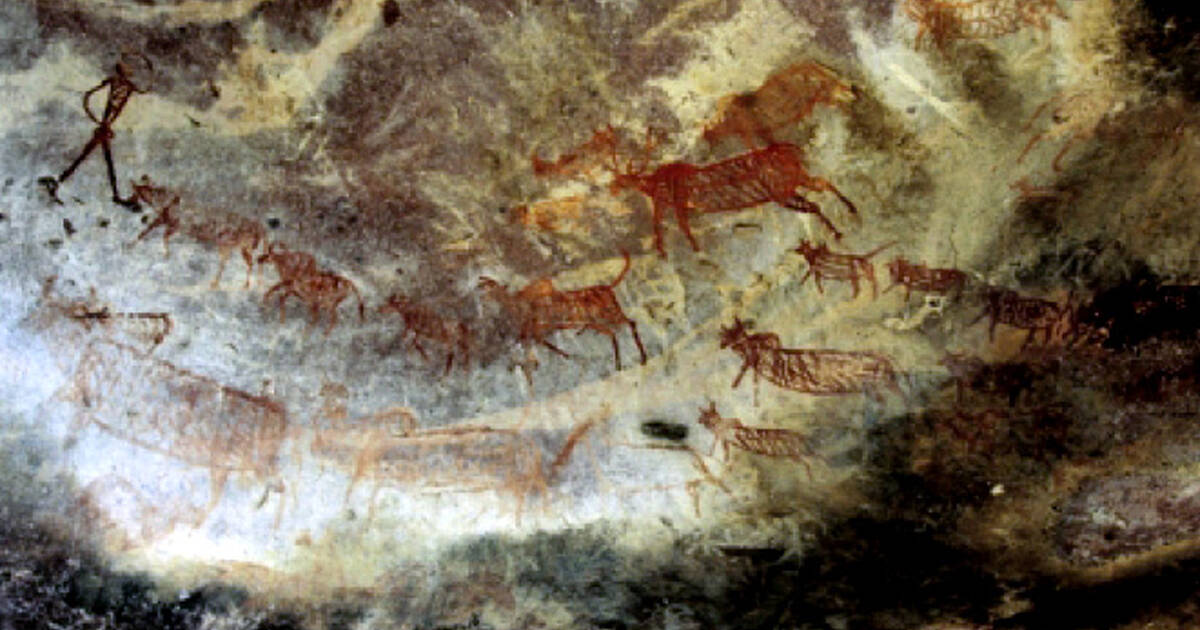
For a guided tour of these caves visit Bhimbedka Tours.
B. Ajanta Caves: Buddhist Art and Narratives
The Ajanta Caves hit different. Cut into a horseshoe-shaped cliff along the Waghora River in Maharashtra, these 30 rock-cut Buddhist cave monuments span from the 2nd century BCE to about 650 CE.
Unlike Bhimbetka’s simple stick figures, Ajanta showcases sophisticated artistry that’ll leave you speechless. The paintings use the Fresco technique (basically painting on wet lime plaster) and depict elaborate Buddhist legends and Jataka tales – stories of Buddha’s previous lives.
What makes Ajanta special isn’t just artistic skill – it’s the storytelling. These walls tell complete narratives through visual sequences, following characters through their spiritual journeys. You’ll see the Bodhisattva Padmapani holding a lotus, the temptation of Buddha, and everyday scenes of royal courts and village life.
The most famous painting? Probably the Dying Princess (actually depicting Maya’s dream). The emotion captured in these ancient pigments feels incredibly modern – grief, compassion, wonder – all perfectly preserved.
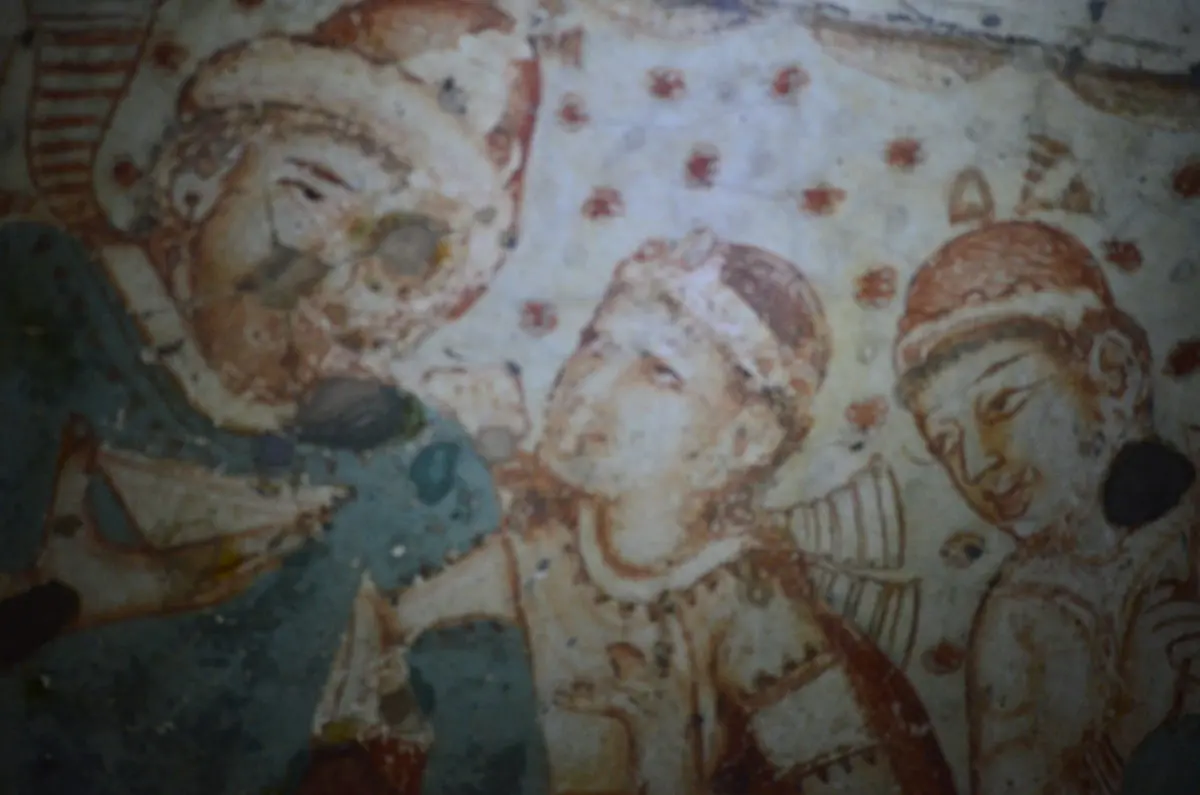
For a guided tour of these caves, please visit Ajanta Caves.
C. Ellora’s Hidden Galleries: Beyond the Temples
Everyone knows Ellora for its magnificent temple architecture, especially the mind-boggling Kailasa Temple carved from a single rock. But the lesser-known treasure? The painted galleries hiding within.
Located near Aurangabad, these 34 caves span Buddhist, Hindu, and Jain traditions created between the 6th and 10th centuries CE. While many visitors focus on the architectural marvels, the painted interiors tell equally impressive stories.
Cave 16’s surviving paintings show vivid scenes of Shiva and Parvati, with details so fine you’d think they were created yesterday, not 1,200 years ago. The Buddhist caves contain mandalas and depictions of bodhisattvas with expressions so serene they seem to follow you around the room.
What’s fascinating about Ellora’s paintings is how they showcase religious harmony. Hindu, Buddhist, and Jain artistic traditions blend and borrow from each other, showing that artistic exchange was happening even back then.
For a tour of Ellora, please visit Ellora Caves.
D. Lesser-Known Sites Across the Subcontinent
Beyond the famous sites, India’s landscape is dotted with hidden painted treasures that barely make it into guidebooks.
The Edakkal Caves in Kerala feature petroglyphs (rock carvings) dating back to 6000 BCE, showing human figures with raised hair and unique geometric patterns found nowhere else.
In Chhattisgarh, the newly discovered paintings at Singhanpur and Raigarh reveal fascinating connections to still-practicing tribal art traditions. Some local communities create remarkably similar designs today, suggesting artistic continuity spanning thousands of years.
Tamil Nadu’s Jain caves at Sittanavasal contain delicate paintings of lotus ponds and dancers from the 7th century, using a technique where paint was mixed with egg whites for durability.
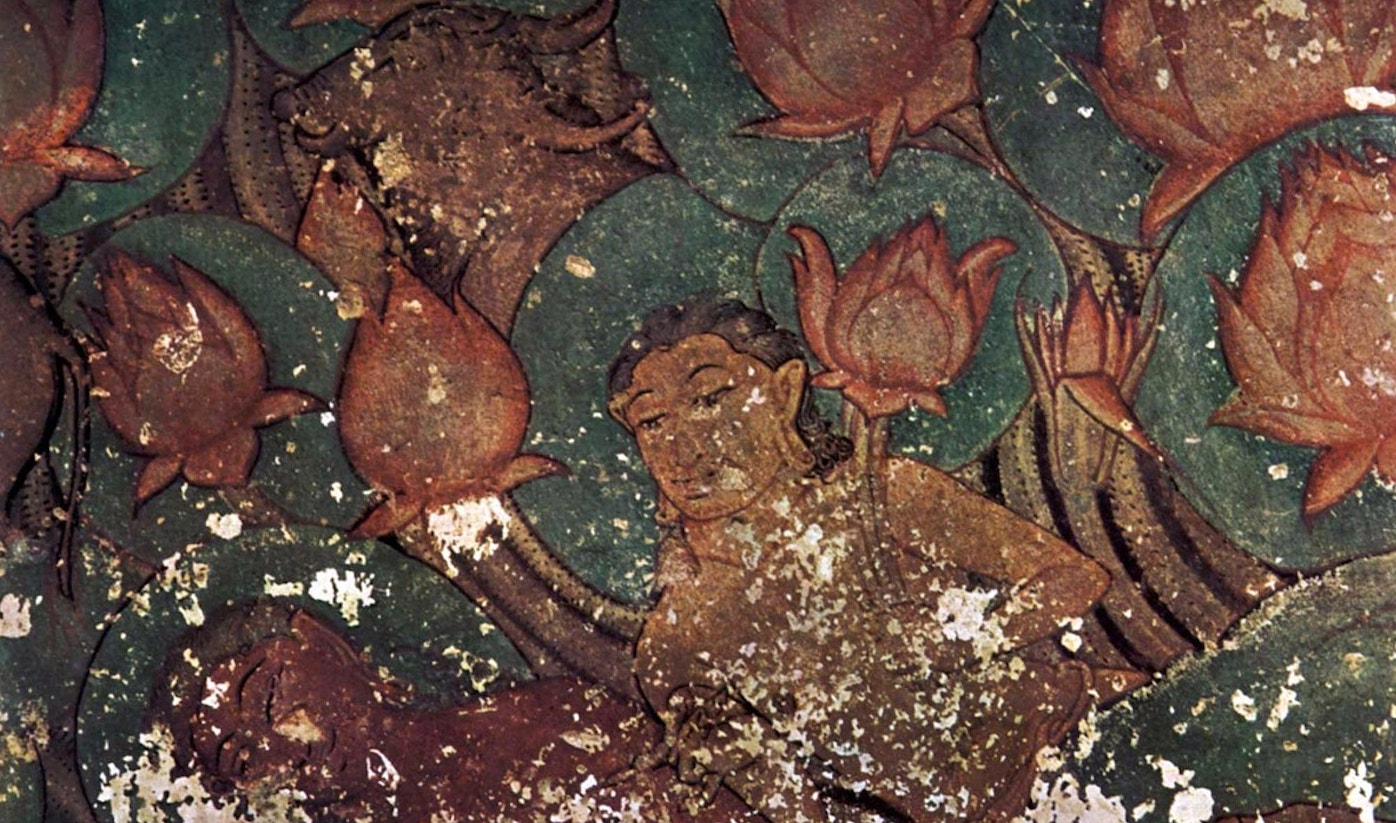 Sittanaval Cave
The Ganjad caves near Mumbai contain what archaeologists believe are astronomical charts and calendars, suggesting these weren’t just decorative but functional paintings tracking celestial movements.
What makes these lesser sites special is how they’re still being interpreted. New discoveries happen yearly, forcing us to rewrite what we thought we knew about ancient Indian society with each new painted handprint from the past.
Deciphering the Timeline: Evolution of Indian Cave Art
A. Prehistoric Expressions (10,000+ BCE)
Ever wonder what our ancestors were trying to tell us thousands of years ago? India’s prehistoric cave paintings are like time capsules from 10,000+ BCE. At Bhimbetka rock shelters in Madhya Pradesh, red and white pigments bring to life hunting scenes with stick-figured humans pursuing bison and wild boar.
These weren’t random doodles. They were deliberate communication systems—stories of successful hunts, warnings about dangerous animals, or perhaps spiritual rituals to ensure good fortune.
The oldest paintings used simple red hematite, with basic handprints and geometric patterns. Artists created these masterpieces using animal hair brushes, feathers, and even their fingers dipped in natural pigments mixed with water or animal fat.
B. Early Historic Period Developments
By 3000-1000 BCE, things got interesting. Cave art evolved from simple stick figures to more complex scenes with detailed human forms and elaborate hunting tactics.
Colors expanded beyond red to include yellow ochre, white kaolin, and black manganese. The artists began showing social hierarchies—distinguishing chiefs from hunters, and depicting domestic scenes alongside the traditional hunting narratives.
At sites like Ajanta in Maharashtra, we see the beginnings of narrative art, where paintings tell sequential stories rather than isolated moments. The influence of early civilizations started appearing in the artistic style, with more sophisticated composition and intentional spacing between figures.
C. Gupta Era Artistic Flourishing
Talk about a creative explosion! The Gupta period (320-550 CE) revolutionized Indian cave art.
Artists abandoned primitive styles for refined techniques that included:
- Sophisticated perspective
- Detailed facial expressions
- Elaborate clothing and jewelry
- Rich narrative compositions
The Ajanta Caves transformed during this golden age. Paintings now depicted Buddhist Jataka tales and scenes from Buddha’s life with unprecedented detail. The artists mastered the technique of applying multiple layers of pigment to create depth and dimension.
The color palette expanded dramatically, incorporating greens from copper compounds, blues from lapis lazuli, and complex mixtures for skin tones and shading. Religious patronage fueled this artistic renaissance, with wealthy donors commissioning elaborate cave temples adorned with intricate artwork.
D. Medieval Additions and Transformations
By medieval times (8th-14th centuries), cave art shifted dramatically. New religious influences—particularly Hinduism and Jainism—introduced fresh iconography and themes.
The Ellora Caves showcase this transformation perfectly. Artists integrated sculptural elements with paintings, creating multidimensional storytelling. Techniques became more sophisticated, with artists applying preliminary sketches before final painting and using burnishing to create glossy finishes.
What’s fascinating is how these artists adapted earlier spaces. Many medieval artists painted over prehistoric or early historic works, sometimes incorporating elements of the original paintings into their new compositions—an ancient form of artistic recycling!
Regional styles emerged too, with distinctive characteristics developing in Karnataka, Tamil Nadu, and Maharashtra, each reflecting local cultural influences and artistic traditions.
E. Dating Techniques That Reveal The Past
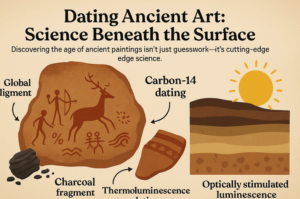
How do we know when these paintings were created? It’s not like the artists signed and dated their work!
Carbon-14 dating revolutionized the field by analyzing organic components in pigments containing charcoal or bone. For paintings without organic material, scientists turn to thermoluminescence dating of nearby pottery fragments or optically stimulated luminescence to date the last time surrounding sediment was exposed to light.
Stylistic analysis complements scientific methods by comparing artistic techniques, subject matter, and compositional elements across different sites. Sometimes, the paintings themselves provide clues—superimposed layers reveal chronological sequences, with newer paintings overlapping older ones.
Recent technological breakthroughs are changing the game. Portable X-ray fluorescence now identifies pigment composition without damaging the artwork, while digital enhancement using specialized software reveals faded elements invisible to the naked eye.
For immersive culture walks in India, visit 5 senses walks.
Symbolic Language of Ancient Artists
A. Common Motifs and Their Significance
Ever looked at these ancient cave paintings and wondered why certain images keep popping up? India’s prehistoric artists weren’t just doodling—they were speaking a visual language that’s taken archaeologists decades to decode.
Handprints appear everywhere from Bhimbetka to Mirzapur. These aren’t just random stamps—they’re signatures, saying “I was here” thousands of years before Instagram. When you spot these handprints, you’re literally touching palms with our ancestors across millennia.
Animal imagery dominates most cave walls, but not just any animals. Bison, elephants, and tigers appear frequently because they weren’t just food sources—they were power symbols. A hunter painting a mighty bison wasn’t just bragging about dinner; he was capturing its strength.
The dancing human figures tell us something profound too. These stick-figure-like formations show communal ceremonies and hunting parties. What’s fascinating is how they capture movement with such minimalist strokes—proving these artists understood the essence of visual storytelling.
Geometric patterns might look decorative to our modern eyes, but they held coded information about seasonal changes, territorial boundaries, and possibly even shamanic journeys into spiritual realms.
B. Color Choices and Their Cultural Meanings
The color palette of Indian cave art wasn’t limited by artistic choice—it was defined by what Mother Nature provided. But don’t think for a second these artists didn’t make deliberate choices with their limited options.
Red ochre dominates these ancient galleries—and for good reason. This iron-rich pigment symbolized blood, life force, and fertility. When an ancient artist chose red to depict a hunting scene, they weren’t just being practical; they were invoking the life essence of both hunter and hunted.
White, derived from limestone, typically appears in celestial imagery or spirit figures. The contrast between earthy red and ethereal white created a visual language distinguishing the physical from the spiritual world.
Black, made from charcoal or manganese, often outlines figures or appears in scenes depicting night rituals. Some archaeologists believe these color combinations weren’t just aesthetic choices but coded information about seasonal ceremonies and astronomical events.
Yellow ochre appears less frequently but carries special significance in fertility symbols and solar imagery. The rarity of certain pigments also tells us about resource availability and trading networks that existed even in prehistoric times.
C. The Sacred Geometry in Cave Compositions
The compositions in these caves aren’t random scribbles—they’re carefully planned visual stories that follow patterns we’re still discovering today.
Spiral motifs appear consistently across sites separated by hundreds of miles. These weren’t just decorative elements but possibly represented cyclical time, seasons, or even celestial movements. Some spirals align perfectly with equinox sunlight, proving these weren’t accidental placements.
Triangular formations frequently frame important scenes, creating visual hierarchies that draw your eye to central figures. This technique appears so consistently it suggests formal artistic training passed down through generations.
Concentric circles often mark what archaeologists believe were gathering spaces for rituals. The placement isn’t random—many align with acoustic sweet spots where voices carry particularly well, suggesting these artists understood both visual and auditory dimensions of sacred space.
Height placement matters too. The most elaborate scenes typically appear at eye level, while simplistic motifs occupy higher, harder-to-reach areas. This vertical stratification suggests different artists with varying skills or possibly age-based artistic permissions within the community.
D. Regional Variations in Artistic Expression
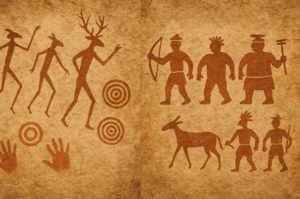
Step from the caves of Bhimbetka to those in Pachmarhi just a few hundred miles away, and you’ll notice distinct stylistic differences that tell us these weren’t isolated communities but distinct cultural groups with their own artistic dialects.
The stick figures in Maharashtra’s caves appear elongated and dynamic, while those in Madhya Pradesh tend toward stouter, more grounded forms. These aren’t just stylistic quirks—they reflect different physical builds, clothing styles, and possibly even philosophical views about the human form.
Animal depictions vary significantly too. Northern sites favor realistic proportions, while southern cave paintings often exaggerate certain features like horns or tusks. These embellishments weren’t artistic license but likely emphasized culturally significant attributes.
Coastal cave sites incorporate more marine imagery—fish, boats, and water symbols—while inland caves focus more on forest animals and hunting scenes. This environmental influence shows how deeply connected these artists were to their immediate surroundings.
The density of imagery varies dramatically too. Some caves contain carefully spaced, individual scenes, while others show generations of overlapping images—a prehistoric palimpsest that suggests different attitudes toward sacred space and artistic permanence across regions.
The People Behind the Paintings
The People Behind the Paintings
When you stand in front of India’s ancient cave paintings, you’re not just looking at pretty pictures. You’re peering through a window into the lives of people who walked these lands thousands of years ago.
Daily Life Revealed Through Art
The scenes captured on these stone canvases tell us more about prehistoric life than any textbook ever could. Hunters chasing deer with spears. Women grinding grain. Children playing. These weren’t created as masterpieces for museums – they were snapshots of everyday existence.
At Bhimbetka, you’ll find hunting scenes where groups of stick-figured humans surround animals with remarkable strategic formations. These paintings don’t just show us what they hunted, but how they did it – working together, using specialized tools, sharing responsibilities.
Food gathering activities appear frequently too. People collecting honey, picking fruits, and fishing. One particularly touching scene shows a mother carrying a child while collecting something from a tree – multitasking hasn’t changed much in 10,000 years!
Spiritual Beliefs and Ritual Practices
Death, life, and everything supernatural – these ancient artists were deeply spiritual beings.
Many paintings depict what archaeologists believe are shamanic rituals. Figures with animal heads (part human, part beast) dance in strange positions. These were likely medicine men or spiritual leaders channeling animal spirits during ceremonies.
At sites like Chaturbhujnath Nala, you’ll find recurring motifs of concentric circles and spirals – symbols linked to cosmic forces across many ancient cultures. Small handprints scattered throughout cave sites might represent initiation ceremonies where young tribe members literally left their mark.
The positioning of some paintings isn’t random either. Many appear in the deepest, darkest parts of caves – places that would have required torches to reach and work in. These weren’t casual doodles but deliberate journeys into Earth’s womb for sacred purposes.
Social Hierarchies and Community Structures
Look closely at these paintings and patterns emerge about who did what in these prehistoric communities.
Larger figures often appear to direct smaller ones during hunts or ceremonies – early evidence of leadership roles. In some scenes, individuals wear elaborate headdresses or carry special objects, suggesting status differences existed long before written records.
Family groups appear frequently, with clear depictions of men, women, and children engaged in different activities. Women typically appear in gathering and domestic scenes, while men dominate hunting imagery – though not exclusively. Some paintings show what appear to be mixed-gender hunting parties, challenging simplistic views of prehistoric gender roles.
Community celebrations are among the most vibrant scenes. Rows of figures holding hands in dance circles speak to the universal human need for togetherness and shared joy.
Evidence of Migration and Cultural Exchange
These ancient artists weren’t isolated. Their work shows they interacted with other groups and moved across landscapes.
The stylistic evolution visible across different painting layers tells stories of cultural transformation. Earlier paintings tend to feature large animal figures in dark red, while later periods show more complex human activities in white and yellow pigments.
Paintings of boats and river scenes in regions now far from water bodies hint at climate changes and population movements. At sites across central India, you can see how painting techniques evolved when new groups arrived, bringing different artistic traditions.
The appearance of certain animals in regions where they no longer exist – like rhinoceroses in central Indian paintings – documents changing environments and the human adaptations that followed.
Most fascinating are the shared symbols that appear across sites hundreds of miles apart. Geometric patterns, hand symbols, and specific animal representations recur throughout the subcontinent, suggesting widespread communication networks existed long before modern transportation.
Modern Interpretations and Ongoing Mysteries
Astronomical Connections and Calendar Systems
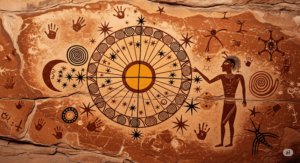
Ever noticed those strange spiral patterns and celestial symbols in India’s ancient cave art? They’re not just pretty designs. Many archaeologists now believe our ancestors were serious sky-watchers who tracked celestial movements with impressive accuracy.
At Bhimbetka, certain paintings align perfectly with the summer solstice – when sunlight penetrates specific chambers only on that exact day. Mind-blowing, right? These weren’t random placements. They were deliberately created astronomical markers.
Some rock art in Madhya Pradesh shows distinctive circular patterns with radiating lines that mirror constellations visible during specific seasons. These weren’t just decorative – they were functional calendars helping communities track planting seasons and migrations.
What’s fascinating is how these astronomical observations were encoded into storytelling through art. A painting might show animals moving beneath star-like dots in patterns that match seasonal constellations. These weren’t separate systems – the art, the stories, and the sky knowledge were all interconnected.
The real genius? These systems worked accurately for thousands of years without written language or modern tools. Next time someone talks about “primitive cave dwellers,” remind them these folks could predict seasonal changes with precision that would impress modern astronomers.
Unsolved Symbols and Contested Meanings
Some symbols in Indian cave paintings remain complete head-scratchers. Take the mysterious “X” shapes found at sites across central India – are they territorial markers? Spiritual symbols? Early writing? Nobody knows for sure.
The debate gets heated when examining the strange humanoid figures with elongated heads in Chhattisgarh’s caves. Some researchers argue they’re shamanic representations, while others suggest they might depict visitors wearing special headgear. A few fringe theorists even point to them as evidence of ancient alien contact (though most serious archaeologists roll their eyes at this one).
Here’s what makes interpretation so tricky – we’re viewing these symbols through our modern lens. The mental world of someone from 10,000 BCE was fundamentally different from ours. Their concept of what was important to record and how to represent it doesn’t match our categories.
Another contested area? The meaning of handprints found throughout cave sites. Some scholars see them as signatures of artists, while others interpret them as spiritual markers connecting the living to the supernatural world through the cave wall as a membrane between realms.
The frustrating truth is that some symbols may never be fully understood. The cultural context that gave them meaning is largely lost to time. What we’re left with are educated guesses and competing theories – which honestly makes these mysterious paintings even more fascinating.
Indigenous Knowledge and Oral Traditions
The biggest mistake researchers made for decades? Ignoring the people whose ancestors actually created these paintings. When archaeologists finally started listening to indigenous communities living near these sites, whole new layers of meaning emerged.
The Gond people of central India, for instance, maintain oral traditions that offer interpretations of symbols that had baffled outside experts. Their stories speak of specific animals as clan totems – explaining why certain creatures appear repeatedly in nearby cave art. This isn’t coincidence; it’s cultural continuity.
Community elders from tribal groups near Bhimbetka have shared creation stories that align remarkably with painting sequences found in the caves. These narratives weren’t written down – they were transmitted through thousands of years of oral tradition, preserved with astonishing fidelity.
Take the handprints we mentioned earlier. While academics debated their meaning, some indigenous traditions explained them simply: they represent a covenant between humans and the spirit world, a practice that continued until recent times in certain ceremonies.
The traditional knowledge doesn’t just help interpret the art – it provides insight into techniques too. Some tribal communities still use natural pigments prepared using methods identical to those used in prehistoric paintings. The red ochre processing methods used by certain communities today match exactly what archaeological evidence shows was used 12,000 years ago.
This collaborative approach between scientific archaeology and indigenous knowledge isn’t just more respectful – it’s yielding far better results in decoding these ancient masterpieces.
Technological Breakthroughs in Cave Art Research
Digital Mapping and 3D Documentation
Gone are the days when researchers had to sketch cave paintings by hand. Digital mapping has completely changed the game for studying India’s ancient rock art. High-resolution photogrammetry now captures every crack, curve, and pigment stroke with millimeter precision.
In 2024, the Bhimbetka caves project used drones equipped with LiDAR to create detailed 3D models of previously inaccessible chambers. These models revealed hidden paintings that had escaped detection for centuries.
The real magic happens when these 3D models are enhanced with RTI (Reflectance Transformation Imaging). This technique manipulates virtual light sources to expose faint pigments invisible to the naked eye. At Ajanta, this approach uncovered ghost images beneath the visible paintings – earlier drafts the artists painted over!
Spectroscopic Analysis of Pigments
The palette of prehistoric Indian artists tells us more than just their color preferences. Using portable X-ray fluorescence (pXRF) devices, researchers can now identify chemical compositions without damaging the artwork.
A breakthrough came when scientists analyzed the red ochre from Madhya Pradesh caves and traced it to specific mineral deposits over 30km away. This proved prehistoric communities traveled significant distances for their art supplies.
Raman spectroscopy has been another game-changer. This technique identified organic binders mixed with mineral pigments – revealing sophisticated knowledge of materials. The discovery of protein-based binders suggests prehistoric artists understood how to make their work last millennia.
AI-Assisted Pattern Recognition
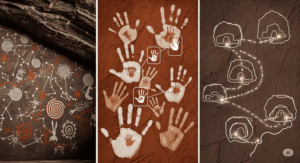
AI algorithms are spotting patterns in Indian cave art that humans have missed for centuries.
Machine learning models trained on thousands of cave paintings now identify recurring symbols across different sites. In 2023, an AI system recognized a constellation pattern repeated across sites separated by hundreds of kilometers and thousands of years.
The most exciting application? Neural networks that can differentiate between handprints of different individuals. This technology has identified specific “artist signatures” across multiple sites, suggesting some prehistoric painters were traveling artists who worked in multiple locations.
Computer vision systems are also reconstructing faded paintings by analyzing trace pigments and predicting the original designs with remarkable accuracy.
Non-Invasive Dating Methods
Dating cave art used to mean taking samples and potentially damaging the artwork. Not anymore.
Optical Stimulated Luminescence (OSL) now dates the sediment layers covering paintings without touching the art itself. At Maharashtra’s Konkan caves, OSL pushed back dating estimates by nearly 10,000 years!
Portable Raman spectrometers can now estimate age by measuring the crystallization of pigment minerals – a process that happens predictably over time.
The newest breakthrough? Biofilm dating. Microscopic biological growth on cave surfaces provides chronological markers that, when analyzed with genomic sequencing, creates a biological timeline without disturbing the artwork.
These technologies aren’t just academic tools – they’re revealing that India’s prehistoric artists were far more sophisticated, connected, and technically advanced than we ever imagined.
Preserving India’s Fragile Artistic Heritage
A. Environmental Threats to Cave Paintings
These ancient masterpieces have survived for thousands of years, but they’re now facing unprecedented challenges. Climate change is the silent destroyer of India’s cave paintings. Rising temperatures and shifting rainfall patterns have accelerated the natural weathering process, causing flaking and color fading across sites from Bhimbetka to Ajanta.
Moisture is perhaps the biggest enemy. During monsoon seasons, water seepage through rock cracks creates the perfect breeding ground for damaging algae, fungi, and lichen. These organisms literally eat away at the pigments our ancestors so carefully applied.
Air pollution doesn’t spare these remote locations either. Acid rain and particulate matter from nearby industrial zones settle on the paintings’ surfaces, chemically altering the mineral pigments. At Ellora, conservationists have documented accelerated deterioration patterns that weren’t present even twenty years ago.
And then there’s the silent menace of microorganisms. Bat colonies, while important to cave ecosystems, leave droppings that foster microbial growth. These microbes slowly digest the organic components in the ancient paints.
The damage is heartbreaking:
- Vibrant ochre hunting scenes faded to barely visible outlines
- Geometric patterns disappearing under salt deposits
- Handprints of our ancestors literally dissolving before our eyes
B. Tourism Impact and Sustainable Visitation
Mass tourism is a double-edged sword for India’s cave paintings. Sure, these sites deserve to be seen and appreciated, but at what cost?
The simple act of breathing introduces moisture and carbon dioxide into cave environments. With hundreds of daily visitors at popular sites like Ajanta, this creates a microclimate that speeds up deterioration. And despite “no touching” signs, the oils from countless fingertips have permanently damaged sections of paintings at Bhimbetka.
Camera flashes are another culprit. The intense light causes pigment photodegradation – basically, the colors get bleached with each unauthorized snapshot. At some sites, you’ll notice patchy discoloration where this damage is most severe.
Smart tourism strategies have emerged in response:
- Visitor caps limiting daily entries
- Timed entry slots reducing crowding
- Protective barriers keeping tourists at optimal viewing distances
- Enhanced ventilation systems in heavily trafficked caves
- Guide-only access to the most vulnerable areas
Some sites now offer virtual tours and detailed replicas of the most fragile paintings. Ellora’s interpretation center lets visitors experience the art through high-resolution displays without endangering the originals.
The most successful approach? Education. When tourists understand the irreplaceable value of what they’re seeing, they become part of the preservation solution, not the problem.
C. Community Involvement in Conservation Efforts
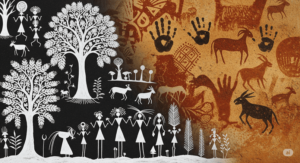
The people who live near these ancient sites have become their most passionate guardians. In villages surrounding Bhimbetka, local residents serve as unofficial watchmen, alerting authorities to any suspicious activity or environmental threats.
These communities possess invaluable traditional knowledge. In Madhya Pradesh, tribal elders have helped conservationists identify natural substances used in the original pigments, enabling more authentic restoration work. Their insights into seasonal patterns also help predict and prevent weather-related damage.
Several innovative programs have emerged:
- “Heritage Guardians” training local youth as certified guides
- Community-managed visitor facilities generating sustainable income
- Collaborative documentation projects recording oral histories related to the sites
- Intergenerational workshops where elders teach traditional art methods
The Warli tribe near Maharashtra’s cave sites demonstrates this beautifully. They maintain artistic traditions remarkably similar to nearby prehistoric paintings, creating a living connection to the past. Their involvement has transformed conservation from a purely scientific endeavor into a cultural revival.
When conservation provides economic benefits, local buy-in skyrockets. Handicraft initiatives inspired by cave art motifs have created livelihoods while raising awareness. These communities now see themselves not just as neighbors to these sites, but as their rightful stewards.
D. Digital Preservation for Future Generations
Technology has revolutionized how we safeguard India’s prehistoric art. Advanced photogrammetry and 3D scanning now capture every millimeter of these paintings at microscopic resolution, preserving them digitally even as their physical forms deteriorate.
The Digital Cave Art Archive of India, launched in 2023, houses terabytes of ultra-high-definition imagery. These aren’t just pretty pictures – they’re scientific baselines allowing conservationists to track degradation with unprecedented precision. Comparing scans taken months apart reveals changes invisible to the naked eye.
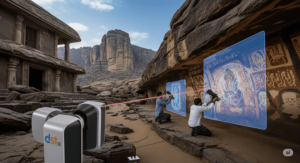
AI algorithms are now analyzing these massive datasets to:
- Enhance barely visible pigments in badly faded sections
- Reconstruct missing portions based on surviving patterns
- Identify previously unnoticed connections between geographically distant sites
- Predict vulnerable areas before visible damage occurs
Virtual reality has transformed education about these sites. Students from Mumbai to Minnesota can now “walk through” Bhimbetka, examining every brushstroke as if they were centimeters away from the real thing.
The most groundbreaking projects combine digital and physical preservation. At Ajanta, non-invasive spectroscopic analysis identified the exact mineral composition of original pigments, allowing conservationists to develop stabilizing treatments tailored to each chemical profile.
Will these digital twins ever replace the originals? Absolutely not. But they ensure that even if the worst happens – if climate change, pollution, or human negligence claims these irreplaceable treasures – their messages won’t be lost to time.
The Art of Ancient Voices
India’s cave paintings represent an extraordinary testament to human creativity and spiritual expression across millennia. From the prehistoric masterpieces of Bhimbetka to the sophisticated compositions of Ajanta, these ancient artworks reveal the remarkable journey of human expression, belief systems, and daily life. Through careful study of their symbols, pigments, and artistic techniques, researchers continue to unravel new insights about our ancestors while modern technology offers unprecedented opportunities to document and understand these fragile treasures.
As we marvel at these ancient messages, we must recognize our responsibility as temporary custodians of this irreplaceable heritage. The stories etched and painted on cave walls connect us directly to our shared human history, transcending time and cultural boundaries. By supporting conservation efforts, promoting responsible tourism, and encouraging further research, we ensure that future generations can continue to decode the mysteries hidden within India’s extraordinary cave paintings – allowing ancient voices to speak clearly across the ages.
For tips on travel planning to India, please visit India Travel.
Leave a Reply