
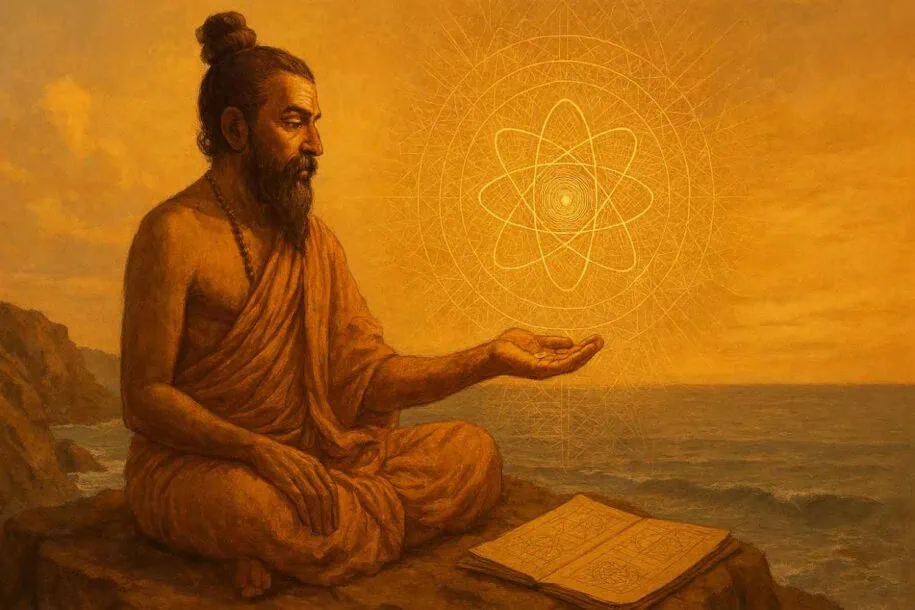
John Dalton is credited with discovering atomic theory in 1808.
He was 2600 years late.
In approximately 600 BCE, in a small town near what is now Dwaraka in Gujarat, a philosopher named Kanada sat down, wrote the Vaisheshika Sutras and proposed a theory of matter so complete, so logically rigorous and so remarkably close to what modern physics eventually confirmed that reading it today produces the same cognitive dissonance as discovering that someone in ancient India had drawn a map of DNA.
Kanada discovered the concept of the atom which he referred to as paramanu, a fundamental particle that forms all matter. He proposed that these atoms are indivisible and combine in various ways to create complex substances. His work laid the foundation for the Vaisheshika school of thought which explored the nature of the universe through atoms matter and their interactions.
The name Kanada itself means atom eater in Sanskrit. The traditional name Kanada means atom eater and he is known for developing the foundations of an atomistic approach to physics and philosophy in the Sanskrit text Vaisheshika Sutra.
The legend behind the name is as extraordinary as the science. Walking one day and eating grain, Kanada noticed that however many times he broke the grain into smaller and smaller pieces, each piece retained the essential character of grain. He kept breaking. The pieces grew smaller. And at some point he reached a theoretical limit, the point at which the grain could no longer be divided without ceasing to be grain at all. That limit, he concluded, must be real. It must be a physical fact about the universe rather than merely a limitation of his fingers and his tools. And he called it paramanu.
Para means beyond. Anu means atom. Paramanu means that which is beyond division. The ultimate particle.
Modern physics arrived at the same conclusion using particle accelerators, quantum mechanics and two centuries of experimental science. Kanada arrived at it by thinking very carefully about a piece of grain on a dusty road in Gujarat.
This blog is the complete story of Kanada’s atomic theory, how it compares to the Greek tradition of Democritus, how it relates to the modern atomic theory of John Dalton and why the ancient Indian heritage landscape that produced it is one of the most extraordinary and most completely undervisited intellectual destinations in the world.
Ancient Indian Science Atomic Theory: Who Was Kanada and What Did He Actually Propose
Who Was Kanada the Ancient Indian Philosopher Who First Proposed Atomic Theory
Kanada, also known as Kashyapa, Uluka and Kanabhuj, was an ancient Indian philosopher and natural scientist who lived approximately between 600 BCE and 200 BCE. He founded the Vaisheshika school of Indian philosophy that also represents the earliest Indian physics. Estimated to have lived sometime between the 6th century to the 2nd century BCE, little is known about his life.
He was born near Dwaraka in Gujarat and spent his life developing and teaching the Vaisheshika philosophical system, a complete framework for understanding physical reality that placed the atom at the foundation of everything that exists.
The precise dates of Kanada’s life remain contested among scholars. Kanada’s atomic theory proposed over 2600 years ago shares remarkable similarities with modern atomic theory. While his ideas were based on philosophical reasoning rather than experimentation, many of his concepts align with today’s scientific understanding of atoms.
What is not contested is the content of the Vaisheshika Sutras and their extraordinary prescience.
At the core of the Sutras is the atomic theory of matter. The idea that an Anu or atom is an unbreakable particle of matter came from Kanada. He came up with the idea while he was walking one day. There was food in his hand that he was nibbling on as he walked. He tossed out the small bits that were left once he was done with it. This is when the light bulb turned on and he came up with the concept that matter can only be divided so far. At some point the matter could not be divided further. He would call the last bit of matter that could not be divided an atom.
What Is Paramanu and What Did Kanada’s Ancient Indian Atomic Theory Actually Propose
Paramanu is the Sanskrit term that Kanada used to describe the smallest indivisible particle of matter. The word combines para meaning beyond and anu meaning atom to create paramanu, that which is beyond division. It is the ultimate particle, the irreducible foundation of all physical reality.
Kanada’s atomic theory in the Vaisheshika Sutras covers ground that western science would not reach until the 19th and 20th centuries. Here is what he proposed.
First. Subsection of any particle has an end and cannot be carried infinitely. This is the foundational claim of atomic theory. Matter is not infinitely divisible. There is an ultimate particle beyond which division is impossible.
Second. Paramanu atoms are eternal. They cannot be created and they cannot be destroyed. They were here before the universe as we observe it and they will be here after it. This maps directly onto the law of conservation of matter that Antoine Lavoisier articulated in 1789 and that John Dalton incorporated into his atomic theory in 1808.
Third. Atoms combine. These atoms combine in various ways to form the objects and substances that we see in the world around us. The properties of an object or substance are determined by the type and number of atoms it is made up of as well as the arrangement of these atoms. This is chemical bonding theory, articulated in ancient India two thousand years before modern chemistry.
Fourth. Atoms have qualities. Kanada suggested that atoms as building blocks differ both qualitatively and quantitatively while Greeks suggested that atoms differed only quantitatively but not qualitatively. This is the most sophisticated element of Kanada’s atomic theory and the one that most clearly separates it from the Greek tradition. Kanada understood that different substances have different fundamental properties, not just different sizes and shapes of the same kind of particle. This insight anticipates the periodic table of elements and the understanding that different atoms are fundamentally different kinds of things.
Fifth. Atoms combine in definite ratios. The Vaisheshika Sutras describe the process by which two atoms combine to form a binary compound called a dvyanuka and how dvyanukas combine to form larger structures. This maps directly onto Dalton’s law of definite proportions, arguably the most practically significant element of modern atomic theory, in which different elements always combine in fixed and predictable ratios.
The Vaisheshika school posited that there were seven categories within the universe: Dravyam matter, Guna Quality, Karma Action, Samanya Generic species, Vishesha Unique trait, Samavaya Inherence or integrated part of the whole, and Abhava Non-existence.
The seven categories of the Vaisheshika school are a complete ontological framework, an attempt to classify everything that exists in the universe systematically and exhaustively. This is not merely a theory of matter. It is a theory of everything, an attempt to provide a complete account of physical reality through logical analysis rather than divine revelation. It is one of the earliest known systematic realist ontologies in human history and it was written in Gujarat over two thousand years before the European Enlightenment invented the intellectual vocabulary we still use to describe this kind of thinking.
5 Senses Tours takes international travellers to the Gujarat landscape where Kanada was born, to the Indus Valley civilisation sites of Dholavira and Lothal that preceded him by two thousand years and to the sacred coast at Prabhas Kshetra near Dwaraka where this extraordinary intellectual tradition began. If this story has moved you, the place that produced it is one of the most historically layered landscapes in India.
Plan your Gujarat ancient science heritage visit with 5 Senses Tours.
Ancient Indian Atomic Theory Compared: Kanada, Democritus and the World’s Two Independent Discoveries
Did Kanada’s Atomic Theory Develop Independently From Democritus
Almost certainly yes. Their atomic theories developed independently in India and Greece at approximately the same period in human history, making them one of the most extraordinary examples of parallel intellectual development ever recorded.
In the 5th and 6th centuries BCE, in two civilisations that had essentially no direct contact with each other, two philosophers independently arrived at the same extraordinary conclusion about the nature of physical reality.
Before Democritus there was Leucippus also in Greece as well as seemingly independently Kanada in India.
Democritus of Abdera, who lived from approximately 460 to 370 BCE in what is now northern Greece, proposed that all matter consists of indivisible particles called atomos, from the Greek for uncuttable, that move through empty space. The atomos of Democritus differ in shape, size and arrangement. Different combinations of differently shaped atoms produce different substances. Water atoms are smooth and round, which is why water flows. Fire atoms are spiky, which is why fire hurts.
Kanada’s paramanu are conceptually similar in their indivisibility and their eternal character. But here is where the two traditions diverge in a way that is philosophically and scientifically significant.
Kanada suggested that atoms as building blocks differ both qualitatively and quantitatively while Greeks suggested that atoms differed only quantitatively but not qualitatively.
Democritus believed that all atoms are made of the same fundamental stuff, differing only in shape, size and arrangement. There is only one kind of atom. Its different configurations produce the different substances we observe.
Kanada believed that atoms of different substances are fundamentally different kinds of things, not just differently configured versions of the same material. An atom of earth is a different kind of entity from an atom of water, not merely a differently shaped piece of the same substance.
Two thousand years of scientific progress eventually confirmed that Kanada was closer to the truth. The periodic table of elements is a table of qualitatively different kinds of atoms, each with its own fundamental character. An atom of hydrogen is not a differently configured atom of iron. It is a fundamentally different kind of thing with different properties, different mass and different behaviour.
Kanada intuited this. Democritus did not.
What Democritus Understood That Kanada’s Framework Addressed Differently
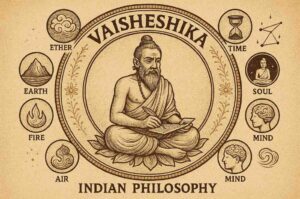
Intellectual honesty requires acknowledging what Democritus understood that Kanada’s framework addressed differently.
Democritus proposed that atoms move through empty space, the void. This is a crucial physical insight. The void between atoms is not nothing. It is the space through which atoms travel, collide and combine. The concept of the void as a physically real entity, necessary for atomic motion to occur, is a genuine contribution to physical thinking that Democritus articulated with particular clarity.
Democritus was one of the first people to propose the term atoms. As an alternative to the beliefs of the Greek philosophers he suggested that atomos or atomon, tiny indivisible solid objects, make up all matter in the universe.
The Democritean atom moves through empty space with equal physical precision. The Vaisheshika paramanu also moves and Kanada identified two states of atomic motion, but the relationship between the atom and the space through which it moves is articulated with different emphasis in the two traditions.
This is not a competition with a winner. It is a parallel intellectual exploration of the same profound question, conducted independently on different sides of the world by different philosophical traditions, each revealing aspects of the truth that the other addressed less completely. The complete picture of ancient atomic thought requires both.
Ancient Indian Science vs John Dalton: What Changed Between Kanada and Modern Atomic Theory
Why John Dalton Is Called the Father of Modern Atomic Theory Despite Coming 2600 Years After Kanada
John Dalton is called the father of modern atomic theory not because he was the first to propose that atoms exist but because he was the first to connect atomic theory to measurable experimental evidence.
What made Dalton’s theory revolutionary was not just the idea that atoms exist. Democritus had said that over two millennia earlier. It was that Dalton connected atoms to measurable quantities. He introduced the concept of atomic weights assigning relative masses to different elements based on how they combined in chemical reactions. This gave chemists a quantitative framework for understanding chemical processes turning chemistry from a largely qualitative discipline into a mathematical science.
This is the critical distinction and it does full justice to both Kanada’s genius and Dalton’s specific contribution.
Kanada’s atomic theory is philosophy of the highest order. It is reasoning of extraordinary quality, working from first principles and logical analysis to conclusions about the fundamental nature of reality. It does not involve experiments, measurements or predictions that can be tested and falsified. It is a philosophical framework rather than a scientific theory in the modern sense.
Dalton’s atomic theory is science in the modern experimental sense. It emerges from careful observation of the behaviour of chemical elements, from the laws of definite and multiple proportions that Lavoisier and others had established through measurement and from Dalton’s own meticulous experimental work. It makes specific quantitative predictions that can be tested and proved or disproved.
Dalton’s idea of atoms correlated with Lavoisier’s experimentally grounded definition of elements. Building from the idea of atoms Dalton’s idea of molecules correlated with Lavoisier’s experimentally grounded idea of compounds. Building further Dalton correlated these atomic and molecular ideas with the experimentally grounded chemical stoichiometric observations.
The honest and complete account of atomic theory acknowledges all three traditions. Kanada proposed the framework first and with extraordinary philosophical sophistication. Democritus proposed it independently and contributed important physical insights about motion and the void. Dalton connected the ancient philosophical insight to experimental science and gave it the quantitative precision that made modern chemistry possible.
All three are necessary parts of the story. And the fact that Kanada’s story is the least known of the three is not a reflection of its significance. It is a reflection of whose histories have been told most loudly and most consistently in the educational traditions of the modern world.
What Modern Quantum Physics Says About Kanada’s Ancient Indian Atomic Theory

The ultimate irony of the atomic theory story is that modern quantum mechanics has in some respects moved closer to Kanada’s qualitative distinction between different kinds of atoms than to the purely quantitative tradition of Dalton.
The Standard Model of particle physics identifies twelve fundamental types of fermion and four fundamental force-carrying bosons. These are not differently configured versions of the same substance. They are genuinely different kinds of things with different fundamental properties, different masses, different charges and different interactions with the physical world.
Kanada said that atoms differ qualitatively between different substances. Modern physics confirms that the fundamental particles of the universe are indeed qualitatively different from each other in ways that cannot be reduced to differences of size, shape or arrangement alone.
The philosopher on the dusty road in ancient Gujarat, eating grain and thinking about division, was onto something that two and a half thousand years of scientific progress has continued to find useful. The Higgs boson discovered at CERN in 2012, the God Particle whose name contains the word boson honouring the Bengali physicist Satyendra Nath Bose who theorised the class of particles it belongs to, is itself a qualitatively distinct kind of thing. It is not a differently configured version of any other particle. It is a new kind of thing altogether. Exactly as Kanada said atoms would be.
Experience Kanada’s Ancient Indian Science Heritage With 5 Senses Tours
Where Kanada Was Born and Why It Is One of India’s Most Extraordinary Heritage Destinations
Kanada was born in Prabhas Kshetra near Dwaraka in Gujarat. This places the birthplace of atomic theory in the same sacred landscape as the Somnath temple, the first of the twelve Jyotirlingas destroyed and rebuilt seventeen times across a thousand years of history, and within reach of the extraordinary Indus Valley civilisation sites of Dholavira and Lothal.
Acharya Kanada was born in 600 BC in Prabhas Kshetra near Dwaraka in Gujarat.
The Prabhas Kshetra near Dwaraka in Gujarat is one of the most historically layered landscapes in India. It is the same sacred geography where Lord Krishna is believed to have established his capital, where the Somnath Jyotirlinga has drawn pilgrims for millennia and where the ancient Indus Valley civilisation demonstrates that Gujarat was home to sophisticated urban culture four thousand years before Kanada was born.
The intellectual tradition that produced Kanada’s atomic theory did not emerge from nothing. It emerged from a civilisation of extraordinary depth and continuity. The Indus Valley people of Dholavira and Lothal had already developed standardised weights and measures, a sewage system more sophisticated than anything contemporary Rome would produce and a maritime trade network extending to Mesopotamia and the Persian Gulf. When Kanada sat on his dusty road and thought about the division of matter, he was the inheritor of three thousand years of accumulated human intelligence in the same landscape.
Our Dholavira tour takes you to the extraordinary Indus Valley city on the island of Khadir in the Rann of Kutch, a UNESCO World Heritage Site and one of the five largest cities of the ancient world. Standing in the ruins of a city that was sophisticated and cosmopolitan two thousand years before Kanada was born gives the ancient Indian science story a physical and geographical dimension that reading about it cannot provide.
Our Lothal tour covers the ancient Indus Valley port city near Ahmedabad whose dry dock, the world’s earliest known, demonstrates the extraordinary maritime engineering capability of the civilisation that preceded and shaped the world Kanada inhabited.
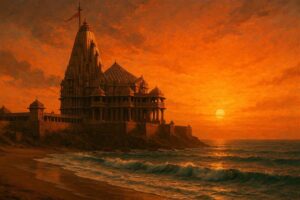
Our Somnath temple tour which includes Gir Forest Tour, connects the birthplace of atomic theory to the most indestructible sacred site in India, the first Jyotirlinga on the Arabian Sea coast of Gujarat, destroyed and rebuilt seventeen times and still standing.
The Kolkata Connection: How Kanada’s Ancient Indian Science Legacy Lives in Modern Physics
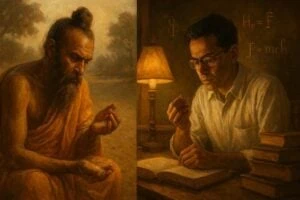
The story of ancient Indian atomic theory does not end with Kanada. It continues through twenty-five centuries of intellectual tradition to the classrooms of Presidency College in Kolkata where Jagadish Chandra Bose, Satyendra Nath Bose, Meghnad Saha and CV Raman transformed modern physics. To read more about 6 Bengali Scientists from Presidency College who changed the world, please visit Nobel Laureates of Kolkata.
The Vaisheshika philosophical tradition that Kanada founded remained active and influential in Indian intellectual life for over two thousand years, shaping the context in which the scientists of Presidency College were educated. The Bengal Renaissance of the 19th century, which produced the extraordinary concentration of scientific genius at Presidency College, was deeply engaged with the question of how ancient Indian philosophical traditions related to modern western science.
The answer that Bengal’s scientists gave, through their work on bosons, on stellar composition and on the Raman Effect, was that the ancient Indian philosophical tradition had been asking the right questions all along. Satyendra Nath Bose’s work on quantum statistics, which gave the boson its name and which Einstein recognised as fundamentally new, operates in exactly the territory of qualitative distinction between different kinds of fundamental particles that Kanada’s Vaisheshika philosophy had identified as the core question of physical reality two and a half thousand years earlier.
Our Kolkata tours cover the complete Bengali scientists heritage trail including Presidency College, the Bose Institute and the Indian Museum, connecting the modern scientific tradition of Bengal to the ancient philosophical tradition of Gujarat in a complete and continuous story of Indian intellectual achievement.
The Complete Kanada Atomic Theory and Ancient Indian Science Heritage Journey
For travellers who want to experience the complete arc of the ancient Indian science story, 5 Senses Tours can create a customised private heritage journey that connects the Gujarat birthplace of atomic theory to the Kolkata classrooms where Indian science reshaped the modern world.
The Gujarat section covers the Dholavira Indus Valley UNESCO site, the Lothal ancient dock, the Somnath Jyotirlinga at Prabhas Kshetra near the birthplace of Kanada, the extraordinary Rani ki Vav stepwell at Patan and the UNESCO World Heritage pols of Ahmedabad. Our Ahmedabad tours hub covers the complete Gujarat heritage circuit with expert cultural guides who bring the full depth of the ancient Indian science story to life.
The Kolkata section covers Presidency College and the Baker Laboratory, the Bose Institute, the Indian Museum and the complete Bengali scientists heritage trail with expert cultural guides who connect the modern scientific tradition of Bengal directly to the ancient philosophical tradition that Kanada established in Gujarat.
This is perhaps the most intellectually extraordinary heritage journey available anywhere in India. From the dusty road in Gujarat where a philosopher ate grain and thought about division to the Baker Laboratory in Kolkata where a physicist made sunlight speak and won India its first Nobel Prize in science. Two and a half thousand years of the most remarkable intellectual tradition in Asian history, experienced across the physical landscapes where it actually happened.
To learn about Madhava, the ancient Indian mathematician who invented Calculus 200 years before Newton, visit Madhava’s invention of Calculus. You might also like to read about Panini, the world’s first programmer who wrote code in Sanskrit, 2500 years ago! Visit Panini’s Code.
5 Senses Tours is recognised by India’s Ministry of Tourism, winner of the Tripadvisor Travellers Choice Award and the Outlook Responsible Tourism Award. Every tour is private, expert-guided and completely customised for your group.
Talk to a 5 Senses Tours expert about your ancient Indian science heritage experience today. Contact us and we will build the journey around your specific interests, travel dates and time available.
Contact 5 Senses Tours to begin planning your ancient Indian science heritage journey today.