
Indus Valley Threads and the Deep Roots of the Story of Mysore Silk
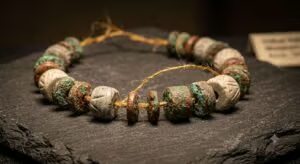
For most of modern history, silk was considered the exclusive invention of China, and in one sense it is. China domesticated the mulberry silkworm, Bombyx mori, and built the sericulture that would one day reach Mysore. But in 2009, researchers Irene Good, Jonathan Mark Kenoyer and Richard Meadow published a discovery that changed the picture. Microscopic analysis of thread fragments preserved inside copper alloy ornaments from Harappa and steatite beads from Chanhudaro revealed silk fibres dating to around 2450 to 2000 BCE.
These threads came from native South Asian wild silkmoths, not the Chinese mulberry worm. The study offers the earliest evidence for silk anywhere outside China, and it is roughly as old as the earliest Chinese evidence. Four thousand years ago, the people of the Indus were already stringing their beads on silk.
India’s Four Silks in the Story of Mysore Silk
That ancient familiarity never faded. India today is the only country that commercially produces all four major natural silks: mulberry, tasar, eri and muga. Tasar comes from the forests of central and eastern India, and eri and muga from the Northeast, where muga’s natural golden sheen is found nowhere else. Mulberry silk, the finest and most even of them all, is the silk of Karnataka, and the silk of the story of Mysore silk.
Silk Before the Sultans in the Story of Mysore Silk
South India had long traded and worn silk. Under the Vijayanagara Empire, whose capital at Hampi was one of the richest cities of the medieval world, silk moved through bustling markets alongside horses, spices and precious stones. After Vijayanagara fell in the sixteenth century, silk production in the Mysore region declined, and it would take a ruler of unusual vision to revive it.
To walk through the markets where that earlier silk trade flourished, our six day Hampi Bewitching Ruins Trail takes you deep into the Vijayanagara capital, from its royal enclosure to its bazaar streets.
The Sultan’s Chapter in the Story of Mysore Silk
A Gift That Opened the Story of Mysore Silk
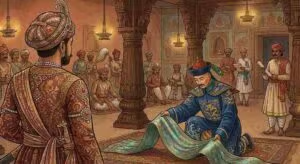
The story of Mysore silk is usually told as beginning with a gift. According to a tradition preserved by families long associated with the Mysore silk trade, an envoy from Qing dynasty China presented Tipu Sultan with a length of silk in the early 1780s. Tipu, a ruler fascinated by technology, trade and self sufficiency, is said to have resolved that Mysore would produce its own.
The gift is tradition, and its exact date is unknown. What followed is documented.
Tipu Sultan’s Letters in the Story of Mysore Silk
On 24 April 1786, Tipu wrote to Mir Kazim, his agent at Muscat on the Gulf of Oman, instructing him to collect silkworms along with people who knew how to rear them and send them to Mysore. The letter survives among Tipu’s papers seized after the fall of Srirangapatna, and it is recorded by the historian Simon Charsley in his study of South Indian sericulture. It is one of the earliest firm dates in the story of Mysore silk.
Tipu did not rely on one source. He sent a deputation to Bengal, then the heart of Indian silk production, which returned after four years, and another to China, which according to Charsley’s research took twelve years to come back. Imagine the patience of a ruler waiting more than a decade for a delegation to return with the secrets of a caterpillar.
Channapatna and the First Silk Farms in the Story of Mysore Silk
Mulberry was planted across Tipu’s dominions, and a network of silkworm breeding stations was established, most commonly counted at twenty one. The Mysuru district sericulture department dates the founding of sericulture at Channapatna to 1785, and a silk farm has worked on silkworm breeding there ever since. Silk became one of the state monopolies of Tipu’s kingdom, alongside sandalwood, pepper and cardamom.
Even as the Anglo Mysore wars raged, the industry grew. When Tipu fell defending Srirangapatna in 1799, his sultanate ended, but the mulberry fields did not. The same turbulent century shaped the forts of the Deccan, a story we tell in our blog on Chitradurga Fort and the legend of Onake Obavva, the Nayaka stronghold seized by Tipu’s father Hyder Ali in 1779.
Tipu’s world lives on in the Mysore countryside, from the ruins of Srirangapatna to the old mulberry belts. Our private Mysore tour from Bangalore brings that history alive alongside the sandalwood and royal heritage of the city.
The Maharaja’s Chapter in the Story of Mysore Silk
A Silk Farm in Bangalore Before the Story of Mysore Silk Went Royal
At the turn of the twentieth century, a surprising figure joined the story. Jamsetji Tata, founder of the Tata group, had seen Japan’s highly skilled sericulture on a visit in 1893. He chose Bangalore for a silk farm because of its favourable climate, its mulberry, and the silk industry Tipu had seeded a century earlier. The Tata Silk Farm was established in 1902 to 1903, and it helped modernise silkworm rearing in the region.
Nalvadi Krishnaraja Wadiyar IV and the 1912 Looms
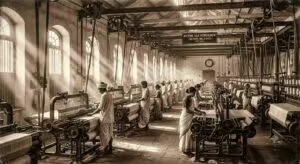
A century after Tipu, the Wadiyar dynasty was back on the throne, and Mysore was entering a golden age under Maharaja Krishnaraja Wadiyar IV. Remembered as Nalvadi, the good king, he presided over a remarkable burst of modernisation guided by his celebrated Dewan, Sir M. Visvesvaraya. Hydroelectric power, banks, universities and industries were all part of his vision.
Silk was central to it. Inspired by the mechanised silk production he had seen abroad, the Maharaja imported 32 power looms from Switzerland and in 1912 founded the Mysore Silk Weaving Factory. It is a lovely coincidence of history that 1912 is also the year the present Mysore Palace was completed. The palace and the factory were born together, and the royal household became one of the factory’s most exacting customers. In 1914 a dedicated Department of Sericulture was established in the state, strengthening the farms that fed the looms.
Wartime Lore in the Story of Mysore Silk
Local tradition in Mysore holds that during the Second World War the factory’s looms produced silk for British military parachutes. It is certainly true that Britain lost access to its usual silk sources after 1941 and turned to India and the Middle East for high grade raw silk for parachutes. The Mysore connection is widely repeated locally, a thread of the story still waiting for its archival confirmation.
From Royal Enterprise to KSIC in the Story of Mysore Silk
After Independence, the factory passed to the Department of Sericulture of what was then Mysore State. Since 1980 it has been managed by the Karnataka Silk Industries Corporation, known as KSIC, which also runs silk reeling at T. Narasipura and further units at Channapatna. More than a century on, the Maharaja’s factory is still weaving in the heart of Mysore.
You can stand on that factory floor yourself. Our Mysore Silk Tour from Bangalore follows the thread from a cocoon auction to the Maharaja’s looms and on to the Mysore Palace, all in a single day.
The Science Behind the Story of Mysore Silk
Bombyx Mori, the Hero of the Story of Mysore Silk
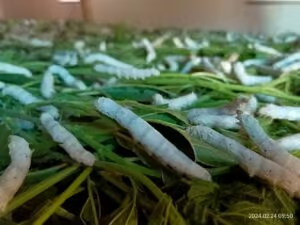
Every thread of Mysore silk begins with the domesticated silkworm, Bombyx mori, a caterpillar so thoroughly tamed over thousands of years that it no longer exists in the wild. It eats only mulberry leaves, and it eats them with astonishing appetite, growing and moulting over about four weeks. Farmers in the region describe the sound of a rearing house at full feed as soft, steady rain on a roof.
The Chandrike and the Spinning of the Story of Mysore Silk
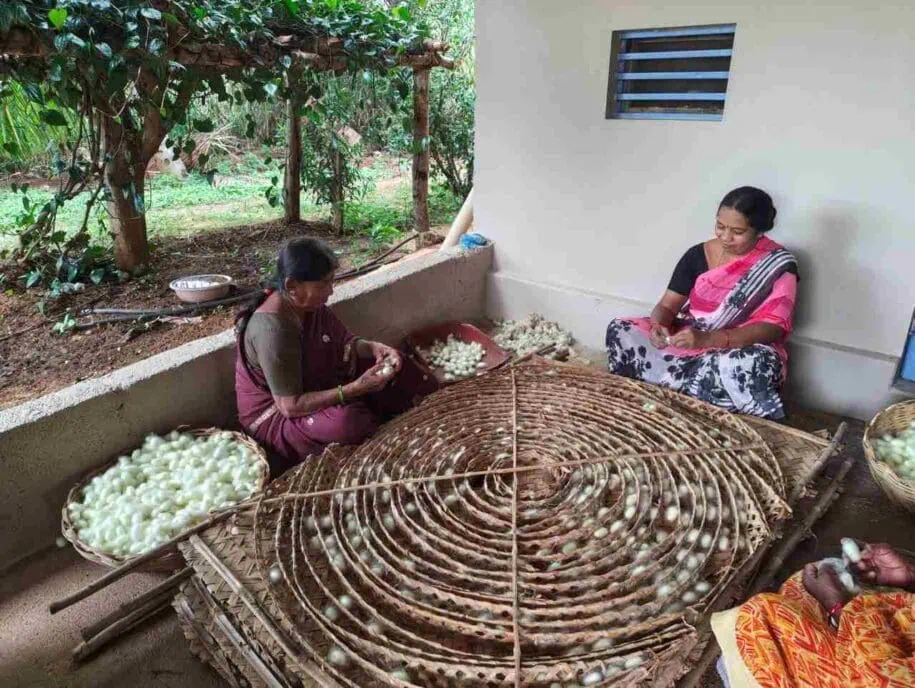
When a silkworm is ready to spin, it is placed on a chandrike, the traditional spiral bamboo mountage of Karnataka. Each worm finds its corner and wraps itself in a single continuous filament, made of a protein called fibroin bound by a natural gum called sericin. That filament averages around 900 metres and can reach 1,500 metres. It is one of the longest natural fibres known.
Reeling: Where the Story of Mysore Silk Becomes Thread
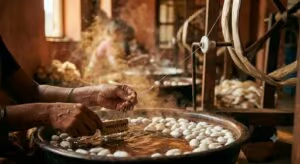
To keep the filament whole, cocoons are heated before the moth can emerge, then boiled to soften the sericin. A reeler finds the loose end of each cocoon and unwinds several together, twisting them lightly into a single strand of raw silk. For Mysore silk, this happens at KSIC’s reeling unit at T. Narasipura, from where the raw silk travels to the weaving factory in Mysore.
This is the one uncomfortable truth in the story. Conventional mulberry silk requires the pupa to die so the thread remains unbroken. Silk made after the moth has emerged, known as ahimsa or peace silk, avoids this but produces shorter spun threads with a different texture. Travellers who care about this question will find it openly discussed in the silk country of Karnataka.
The Marketplace in the Story of Mysore Silk
Cocoon Auctions, the Trading Floors of the Story of Mysore Silk
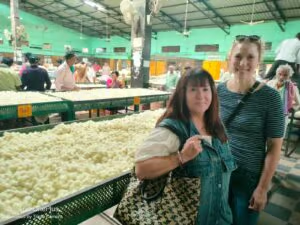
In Karnataka, silk cocoons are sold through government run cocoon markets, where farmers and reelers meet under the supervision of the Department of Sericulture. The largest, at Ramanagara on the Bengaluru Mysore highway, is widely regarded as Asia’s biggest cocoon market and handles around 40,000 to 50,000 kilograms of cocoons a day. It works almost every day of the year, closing only on Republic Day and Independence Day.
Walk into any of these halls in the morning and you see the story of Mysore silk at its most elemental. Lots of cocoons fill metal trays. Brilliant white bivoltine cocoons sit beside pale yellow multivoltine ones, which usually fetch less. Reelers press cocoons between their fingers to judge shell thickness, and bids flash across screens in an electronic auction that settles in minutes. Payment reaches the farmer quickly, making these markets some of the most transparent agricultural exchanges in India.
The Farming Families Behind the Story of Mysore Silk
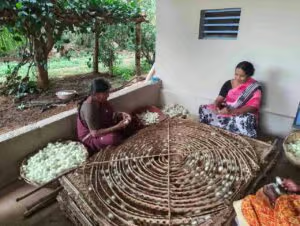
Behind every lot in the auction hall is a farming household, often in the Mysore, Mandya or Ramanagara countryside, whose year is measured in mulberry harvests. It is demanding work. Recent years have brought pests and diseases in mulberry fields, fluctuating cocoon prices and rising input costs, and some families have switched to other crops. Every silk saree carries the invisible labour of these households.
A short drive from Bengaluru, the great cocoon market at Ramanagara is where our Mysore Silk Tour from Bangalore begins. There is time to watch the auction and to meet a family who rears the silkworms behind every lot.
The Story of Mysore Silk Today
Karnataka’s Place in the Story of Mysore Silk
India is the world’s second largest silk producer after China, and also one of its largest consumers. Karnataka leads the country, producing roughly a third of India’s raw silk and a larger share still of its mulberry silk. The mulberry belt of southern Karnataka, around Mysore, Mandya, Ramanagara, Kolar and Chikkaballapura, is one of the most important silk landscapes on earth.
The Future of the Story of Mysore Silk
Mysore silk sarees remain in high demand, and genuine KSIC sarees sell steadily through the corporation’s showrooms. The pressures lie further back in the chain, with farmers facing crop diseases and uncertain prices. Their survival depends partly on buyers who know where silk comes from and value it accordingly. Every traveller who understands the journey from leaf to loom becomes part of the answer.
Experience the Story of Mysore Silk With 5 Senses Tours
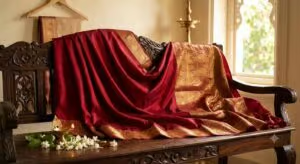
Reading the story of Mysore silk is one thing. Holding a cocoon fresh from the farm, watching its price flash across an auction screen, hearing a family loom at work and then standing inside the Maharaja’s factory is something else entirely. It is the difference between knowing a fact and feeling a civilisation.
Our private Mysore Silk Tour from Bangalore is a full day journey along Karnataka’s silk route. It begins with hotel pickup in Bengaluru at 7:30 am. At Ramanagara, widely regarded as Asia’s largest cocoon market, you watch the auction and meet the silkworm rearing families who supply it. You then meet a silk weaving family, walk through the Mysore Silk Weaving Factory, explore Mysore’s old bazaar and end at the magnificent Mysore Palace. You are back at your hotel by 7:30 pm. A private air conditioned vehicle, an English speaking cultural guide, all entry fees and a South Indian vegetarian lunch are included.
To extend your time in the old kingdom, pair it with our private Mysore tour from Bangalore or explore all our Bangalore tours.
5 Senses Tours is a Ministry of Tourism approved cultural tour operator, an IATO member, a TripAdvisor Travellers’ Choice 2025 recipient and a winner of the Outlook Responsible Tourism Award. Every tour is private, every guide is a storyteller, and every rupee spent with farming and weaving families stays with the communities who keep this story alive.