
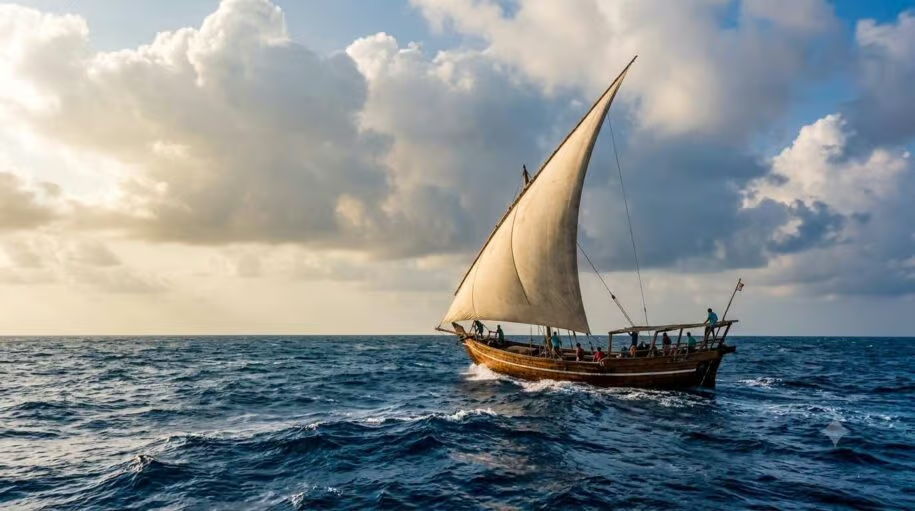
The Pepper That Rome Could Not Live Without

Black pepper, Piper nigrum, is native to the Western Ghats of Kerala and has been cultivated on the Malabar Coast of South India since at least 1000 BCE. In the ancient Mediterranean world it was not a condiment. It was a currency, a medicine, a preservative and a status symbol simultaneously, and its value relative to gold fluctuated but was consistently extraordinary by any modern standard of commodity pricing.
Roman coins bearing the images of emperors from Augustus to Nero have been found in large numbers across Tamil Nadu, and this numismatic evidence is the most tangible measure of how the pepper trade actually worked. Roman ships arrived at Indian ports carrying gold coins. Indian merchants accepted Roman gold and provided pepper, cotton, ivory, pearls and other goods in return. The gold stayed in India. The pepper went to Rome. Pliny’s 50 million sesterces was not an exaggeration. It was an accounting.
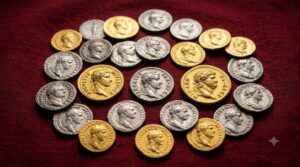
The Roman demand for Indian pepper was so foundational to the late antique economy that when Alaric the Visigoth besieged Rome in 408 CE and negotiated the terms under which he would not sack the city, his demands included 3,000 pounds of pepper alongside 5,000 pounds of gold and 30,000 pounds of silver. Pepper was ransom material. It was valued alongside gold as a negotiating chip in one of the most consequential diplomatic moments in the history of the western world.
The Roman cook Apicius, whose cookbook De Re Coquinaria is the oldest surviving recipe collection in the world, uses pepper in 349 of his 468 recipes. Not as an occasional seasoning. As a fundamental ingredient without which Roman cuisine as he understood it was impossible. The Roman kitchen was built on Indian pepper. Every Roman banquet, every feast celebrating a military victory, every dinner at which the fate of the empire was discussed over food, was seasoned with a spice that had travelled from the Malabar Coast of South India across the Arabian Sea, up the Red Sea, overland to Alexandria and then by ship or road to Rome.
The Periplus of the Erythraean Sea: The World’s First Trade Manual
The most vivid contemporary guide to the mechanics of those voyages and the ports they serviced is the Periplus of the Erythraean Sea, a pragmatic merchant’s handbook written in Greek in the first century CE.
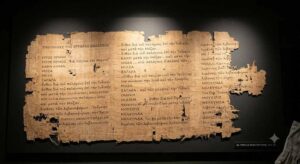
The Periplus, whose title translates roughly as the Circumnavigation of the Erythraean Sea, the ancient Greek name for the Indian Ocean and the Red Sea combined, is one of the most remarkable documents to survive from the ancient world. It is not a work of literature or philosophy or history. It is a practical guide for merchants, describing the ports of the East African coast, the Arabian Peninsula and the Indian subcontinent in terms of what can be bought there, what should be brought to trade, the quality of the anchorage, the political situation and the character of the local rulers. It reads, in places, like a combination of a modern trade directory and a travel safety advisory.
The Periplus documents an agreement between a merchant from Muziris and another from Alexandria concerning goods purchased and shipped from India to Egypt. Muziris, long considered the primary Roman-era entrepôt in southern India, appears repeatedly in the Periplus as a hub for pepper, pearls, timber and other highly prized products. The Muziris Papyrus, a 2nd century CE document discovered in Egypt, describes a single shipment from Muziris to Alexandria that included 60 talents of nard, one and a half talents of ivory and a substantial quantity of textiles. The total value of the cargo was calculated at approximately 1,137 talents of silver, an extraordinary sum that gives a concrete sense of the scale of this trade at the level of a single voyage.
The Periplus also describes the Coromandel Coast of what is now Tamil Nadu, mentioning the port of Poduke, identified with the site of Arikamedu near modern Pondicherry, as a significant node in the eastern Indian trade network. The region also exports pearls of inferior quality, ivory, silk cloth, spikenard from the Ganges, and stone beads of various colors. The casual precision of this description, the distinction between the quality of pearls from different regions, the specific identification of spikenard as a Gangetic product, reveals a level of commercial knowledge about India that was built on decades of direct trading experience rather than secondhand reports.
Arikamedu: Where Rome Met India
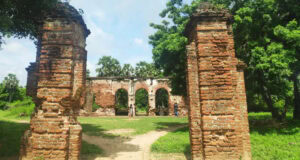
Arikamedu was a key node on the monsoon-driven trade routes connecting India with Arabia, East Africa, and Southeast Asia.
The site of Arikamedu, located on the Coromandel Coast approximately three kilometres south of modern Pondicherry, was excavated by the French archaeologist Sir Mortimer Wheeler in 1945 and subsequently by a series of Indian and international teams. What Wheeler found transformed the understanding of ancient India’s engagement with the Roman world: large pottery vessels used for storing wine and oil, providing evidence of Mediterranean trade connections. arikamedu
The amphorae found at Arikamedu are not isolated curiosities. They are evidence of direct, sustained commercial engagement between Roman merchants and the Tamil trading community of the Coromandel Coast. Spanish amphorae found at Arikamedu once contained Roman fish sauce, a product with little known market in the subcontinent, suggesting that Roman merchants were living at Arikamedu for extended periods, bringing their own provisions from home, conducting their business over seasons rather than single voyages. cambridge
Alongside the amphorae, excavations at Arikamedu have produced Roman glass, Roman lamps, Roman terracotta figurines and fragments of Roman Arretine ware, a fine red-gloss pottery produced in the Italian city of Arezzo that was among the most fashionable tableware in the Roman world. Finding Arretine ware in Tamil Nadu is the archaeological equivalent of finding Wedgwood china in a 1st century CE Bengali trading post. It is evidence not just of trade but of Roman merchants bringing the material culture of home to a distant commercial outpost on the other side of the world.
Tamil Inscriptions in Egyptian Tombs: The Merchants Who Left Their Names in the Desert
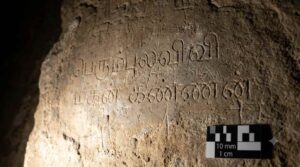
Recent archaeological findings, shared by Swiss professors Ingo Strauch and Charlotte Schubert alongside Indian archaeologist Dr. Ramakrishnan and Tamil Nadu Minister Thangam Thenarasu, have reignited curiosity about ancient transcontinental networks. moroccoworldnews
Among the most extraordinary recent discoveries in the archaeology of ancient Indian Ocean trade are Tamil Brahmi inscriptions found in Egyptian desert tombs and cave sites. Tamil Brahmi inscriptions discovered in Egypt shed light on the Indo-Roman maritime trade of the 1st to 3rd century CE, linking Tamilakam’s Malabar and Coromandel coasts with Roman Egypt via monsoon-driven routes. legacyias
The inscriptions, found at sites including Berenike on the Red Sea coast of Egypt, are graffiti, the ancient equivalent of I was here, scratched into tomb walls and cave surfaces by Tamil merchants who had sailed from South India to Egypt and were leaving a record of their presence. Graffiti functioned as identity markers, similar to modern travel inscriptions, revealing presence of an early Indian mercantile diaspora in Roman domains. legacyias
The names in these inscriptions match known Tamil names from the Sangam era epigraphic record. Name elements appear in the Berenike sherd from 1995 and Pugalur Tamil Brahmi inscriptions of the 2nd to 3rd century CE, aligning Egyptian finds with known Chera-era onomastics. Other names like Kopan, Catan and Kiran match Tamil Nadu epigraphic records, strengthening attribution to Tamilakam visitors. legacyias
These are Tamil merchants, two thousand years ago, scratching their names on the walls of Egyptian tombs to say: we were here. We sailed from the Coromandel Coast across the Indian Ocean, up the Red Sea, to the port of Berenike, and we traded with Rome. And we want whoever comes after us to know that we did this.
The Indian Ocean was not a frontier. It was a highway. And Tamil merchants were among its most confident navigators.
The Monsoon Secret That Made It All Possible
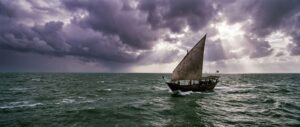
The ancient India-Rome trade did not happen despite the Indian Ocean. It happened because of it. Specifically because of the monsoon.
Hippalus is credited in Greco-Roman sources, notably the Periplus of the Erythraean Sea and writings of Pliny the Elder, with identifying the regular seasonal winds that blow across the Arabian Sea. This discovery, traditionally dated to approximately 45 CE, is described in Greek and Roman sources as a revolutionary navigational breakthrough: a Roman sailor named Hippalus realised that the monsoon winds blow predictably from the southwest across the Arabian Sea from May to September and from the northeast from November to March, and that a ship that understood this pattern could sail directly from the Red Sea to the Indian coast in approximately forty days rather than following the slow coastal route that had been the only option before. historyisnowmagazine
What the Greek and Roman sources do not acknowledge, and what Indian and recent scholarship has increasingly established, is that Indian merchants had been using the monsoon winds for direct ocean crossings for centuries before Hippalus. The Tamil Sangam literature, which describes the trade routes, the ports and the merchant communities of the Coromandel and Malabar coasts in the centuries before the common era, contains detailed references to ocean voyaging that presuppose exactly the kind of monsoon navigation that Greek sources credit to Hippalus. The knowledge of the monsoon was not a Roman discovery. It was an Indian operating reality that Roman merchants eventually learned and then, in the characteristic manner of ancient historiography, credited to one of their own.
The seasonal rhythm of the trade was entirely determined by the monsoon. Ships left the Red Sea ports of Berenike and Myos Hormos in July, carried by the southwest monsoon to Indian ports in approximately forty days. They spent the commercial season in India, purchasing pepper, cotton, ivory, pearls and steel. They departed in November, carried home by the northeast monsoon. The entire cycle was annual, predictable and extraordinarily profitable. Archaeological excavations in Berenike have uncovered black peppercorns from India dating to the first century CE. Meanwhile, Roman gold and silver coins have been found in large quantities across Tamil Nadu, particularly in Karur and Arikamedu, suggesting not sporadic contact but sustained commercial engagement.
The Ports of Ancient Tamilakam: A Network, Not a Single Point
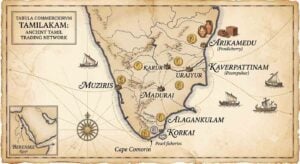
The India-Rome trade was not channelled through a single port. It was distributed across a network of coastal and inland trading centres that collectively constituted one of the most sophisticated commercial systems in the ancient world.
Archaeology has confirmed the Sangam poets’ depictions. Arikamedu in Pondicherry, active from the 2nd century BCE to the 2nd century CE, was the major trading port between Rome and the east coast of the Indian subcontinent. Similar evidence has been unearthed at Alagankulam, Korkai, Karur, and Madurai, suggesting a network of interconnected coastal and inland trading hubs. Substack
Korkai, near the Tamirabarani River mouth in Thoothukudi district, the same region where the Adichanallur and Sivagalai Iron Age sites are located, was the ancient capital of the Pandya kingdom and one of the most significant pearl fishing centres in the ancient world. Korkai, associated with the pearl fisheries of the Pandya kingdom, has yielded evidence of shell-working and trade-related activity, reinforcing its importance in overseas commerce. The pearl divers of the Tamirabarani coast supplied pearls to Rome that were described in Roman sources as among the finest in the world. The same river valley that was smelting iron 5,300 years ago was also producing the pearls that adorned the necks of Roman senators’ wives. irjhis
Karur, in the interior of Tamil Nadu on the Kaveri River, was the ancient Chera capital of Vanji and a major inland trading centre where goods from the Malabar Coast were aggregated for distribution. Roman coins found at Karur in large quantities indicate that Roman merchants penetrated deep into the Tamil interior, not just the coastal ports. Madurai, the Pandya capital, is mentioned in the Periplus and in Sangam literature as a city of extraordinary commercial vitality, its streets thronging with merchants from across the known world.
The Tamil coast thus became the new hinge of the maritime Silk Route, bridging the Far East and the Roman world. Chinese silk arrived on the Tamil coast from the east. Roman gold arrived from the west. Tamil merchants positioned themselves at the intersection of both and extracted value from both directions simultaneously.
What India Sent to Rome and What It Reveals

The commodity list in the Periplus and in Roman sources reveals the extraordinary range and sophistication of what the Tamil and Indian trading world was producing for export to Rome.
Pepper was the largest single commodity by value but not the only one. Cotton textiles from the Indian subcontinent were so highly valued in Rome that Roman writers repeatedly lamented the fashion for Indian muslin, a fabric so fine it was described as woven air and which, like pepper, was considered a drain on Roman gold. Ivory from Indian elephants reached Rome in such quantities that it became the standard material for luxury furniture, musical instruments and the diptychs on which Roman officials recorded their appointments. Indian pearls, particularly from the Pandya fisheries of the Tamirabarani coast, were worn by the Roman elite as the supreme symbol of wealth. Indian gemstones, particularly beryl and sapphire from South Indian deposits, were incorporated into Roman jewellery at every level of the social hierarchy.
Steel is perhaps the most revealing item on the list. The Periplus specifically mentions steel among the exports from the Indian east coast, and this steel, as the previous blog on Wootz established, was not generic iron. It was Wootz, the crucible steel produced in Tamil Nadu and Karnataka whose properties would not be matched by any other metallurgical tradition until modern industrial processes. Rome was importing not just a commodity but a technology, one whose underlying chemistry it would not understand for another two thousand years.
The picture that emerges from this commodity list is not of an underdeveloped peripheral economy supplying raw materials to a sophisticated imperial centre. It is of a highly developed productive economy that was manufacturing finished goods of extraordinary quality, pepper processed and graded, cotton woven to specifications that Roman buyers could not meet domestically, steel produced to standards that Roman smiths could not replicate, pearls harvested and sorted by quality that Roman merchants understood well enough to distinguish between grades and pay accordingly.
The New Discovery That Extends the Story to Morocco
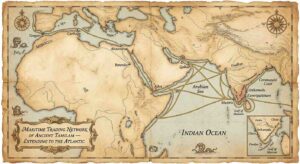
New archaeological discovery traces Tamil-Egyptian ties to Morocco’s forgotten past. Recent archaeological findings have reignited curiosity about ancient transcontinental networks. Such discoveries could further strengthen the thesis that ancient Tamil maritime traders were not confined to South Asia but were active participants in a vibrant Afro-Eurasian trade system. moroccoworldnews
The 2026 findings reported by Swiss professors Ingo Strauch and Charlotte Schubert alongside Indian archaeologist Dr. Ramakrishnan suggest that the reach of Tamil maritime trade extended even further west than Egypt. The presence of Tamil-related material evidence at sites connected to Morocco’s Atlantic coast, if confirmed by ongoing analysis, would mean that Tamil merchants were operating at the far western edge of the ancient world, at the Pillars of Hercules, the boundary that Roman geography considered the limit of the known world.
This finding is still being evaluated and should be understood as preliminary rather than confirmed. But it fits a pattern that the Berenike inscriptions, the Arikamedu amphorae and the Roman coins of Tamil Nadu have already established: that Tamil maritime traders of the Sangam era were more mobile, more globally engaged and more commercially sophisticated than any account of the ancient world that centres on the Mediterranean has ever acknowledged.
The Indian Ocean was not a frontier. It was one of humanity’s earliest highways. The Tamil merchants who sailed it knew this two thousand years before the discipline of world history existed to describe what they were doing.
Why This Story Was Forgotten and Why It Matters Now
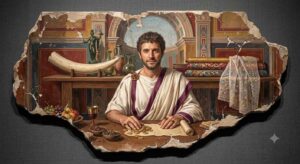
The story of the ancient India-Rome trade did not disappear from the historical record. It was written out of it.
The historiography of the ancient world was written primarily by Greeks and Romans, and these accounts systematically positioned the Mediterranean as the centre of civilisation and everywhere else as its periphery. India appears in Roman sources as a distant land of wonders, of gold and spices and elephants and philosophers, never as an equal trading partner whose economic decisions affected Roman fiscal policy. The fact that India was consistently in surplus with Rome, that Indian merchants were accumulating Roman gold while Roman merchants were dependent on Indian goods, was acknowledged by Pliny as a complaint about Rome’s weakness rather than as recognition of India’s commercial sophistication.
The archaeology has been correcting this narrative for decades. The Roman coins of Tamil Nadu, the amphorae of Arikamedu, the Tamil Brahmi inscriptions in Egyptian tombs, the peppercorns in Berenike, the Muziris Papyrus: each of these discoveries has added a piece to a picture that looks less like Rome trading with a peripheral provider and more like two sophisticated commercial civilisations engaged in a mutually constitutive relationship, with India holding the stronger position.
This matters for exactly the same reason that the Iron Age story matters and the Wootz steel story matters. It repositions South India not as a recipient of ancient world history but as one of its primary makers. The Tamil merchants who left their names on the walls of Egyptian tombs were not witnessing the ancient world from the outside. They were participating in it at its highest level, connecting its eastern and western extremities through the monsoon routes they had navigated for centuries, accumulating Roman gold in Tamil Nadu while Rome complained about the bill.