

For centuries, whispers of a lost land, swallowed by the relentless embrace of the ocean, have permeated the cultural consciousness of South India. This isn’t merely a fleeting myth, but a profound narrative deeply embedded within ancient Tamil literature, oral traditions, and even certain geological theories. Known as Kumari Kandam – the “Maiden Continent” or “Kumari Land” – this submerged territory represents far more than just a geographical mystery; it embodies a Golden Age, the birthplace of an advanced Tamil civilization, and a testament to cataclysmic natural events.
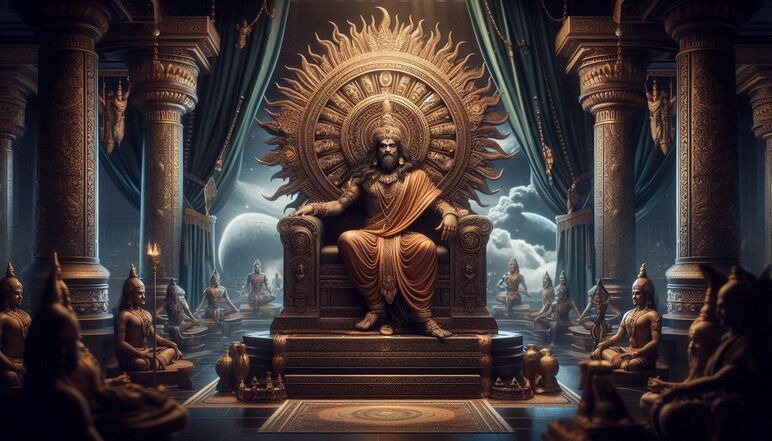
Kumari Kandam as per literature
The legend of Kumari Kandam is primarily found in ancient Tamil texts, particularly those from the Sangam period (roughly 3rd century BCE to 3rd century CE). These texts, rich in poetry, grammar, and historical accounts, speak of a vast landmass that once extended south of present-day Kanyakumari, stretching towards the equator. This sprawling continent was said to have been the original home of the Tamil people, a vibrant civilization that flourished with unparalleled wisdom, artistry, and linguistic prowess. The Silappatikaram, one of the Five Great Epics of Tamil literature, vividly recounts the city of Puhar (also known as Kaveripoompattinam), a major port city that was later submerged by the sea, an event often linked to the receding land of Kumari Kandam.
Central to the narrative are the legendary Pandyas, a powerful dynasty of Tamil kings believed to have ruled Kumari Kandam. These monarchs were not only mighty warriors but also patrons of arts and learning, fostering the famous Tamil Sangams (academies or assemblies). The Sangam literature describes three such academies: the First Sangam (Mudhal Sangam), the Second Sangam (Idai Sangam), and the Third Sangam (Kadai Sangam). The first two, it is said, were held in cities within Kumari Kandam, particularly in the now-submerged capital of Tenmadurai (Southern Madurai) and later Kapadapuram. These academies were instrumental in refining and preserving the Tamil language, producing vast quantities of literature, much of which is now lost to time, having perished along with the continent itself.

For guided tours from Chennai to heritage sites across Tamil Nadu, please visit Touring the land of Tamils.
Fall of Kumari Kandam
The demise of Kumari Kandam is consistently attributed to a series of devastating deluges, or kadalkol (swallowing by the sea). These cataclysmic tsunamis or rising sea levels are depicted as monumental events that repeatedly consumed portions of the land, forcing the surviving inhabitants northward. Each kadalkol led to a relocation of the Sangam and a rebuilding of civilization, carrying with them the remnants of their knowledge and culture. The cumulative effect of these deluges eventually submerged the entire continent, leaving behind only the fragmented memories preserved in their oral traditions and written texts.
Lemuria connection
While the primary source of the Kumari Kandam narrative is rooted in Tamil literary and mythological traditions, the idea of a lost continent in the Indian Ocean gained significant traction during the 19th century through Western scholarship. The concept of “Lemuria” – a hypothetical land bridge or continent proposed by zoologists and geologists to explain the distribution of lemurs and other species across India, Madagascar, and Africa – inadvertently intersected with the Kumari Kandam legend. Ernst Haeckel, a German naturalist, first posited Lemuria in 1868, suggesting it as a submerged landmass. Later, H. P. Blavatsky, founder of Theosophy, adopted Lemuria into her esoteric cosmology, linking it to ancient, advanced root races. While Lemuria was a scientific hypothesis (later disproven by plate tectonics) and Theosophy an esoteric philosophy, their existence created a fertile ground for the Kumari Kandam narrative to find wider acceptance and exploration, sometimes leading to an unfortunate conflation of the two distinct concepts.

Scientific evidence
From a modern scientific perspective, the existence of a vast continent like Kumari Kandam as described in ancient texts is largely unsupported by current geological understanding of plate tectonics. The Indian subcontinent’s journey northward from Gondwana and its collision with the Eurasian plate is a well-established scientific theory. However, this does not entirely dismiss the possibility of smaller landmasses, islands, or coastal regions being submerged due to post-glacial sea-level rise or localized seismic activity. The last glacial period, ending around 10,000 to 12,000 years ago, saw global sea levels rise significantly as ice caps melted, which could have inundated vast coastal areas. Archaeological findings, such as the submerged city off the coast of Dwarka in Gujarat, indicate that ancient coastal settlements indeed faced destruction and inundation. While not directly linked to Kumari Kandam, these findings demonstrate the dynamic nature of ancient coastlines.
Despite the lack of conclusive geological evidence for a continent the size of Kumari Kandam, the enduring power of the legend lies in its cultural and historical significance. For many Tamils, Kumari Kandam is not merely a myth but a symbol of their ancient heritage, their resilience in the face of natural calamities, and the profound depth of their linguistic and cultural history. It fuels a sense of pride in the antiquity of Tamil civilization and reinforces the belief in a time when their ancestors were pioneers of knowledge and culture.
Conclusion
The mystery of Kumari Kandam continues to captivate scholars, historians, and enthusiasts alike. It serves as a reminder of the interplay between human memory, geological forces, and the enduring quest to understand our origins. Whether a literal continent or a symbolic representation of extensive coastal lands lost to the sea, Kumari Kandam remains a potent emblem of a lost golden age, challenging us to look beyond conventional history and consider the profound narratives that shape human identity and collective memory. The legend of Kumari Kandam, therefore, stands not just as a tale of a lost land, but as a vibrant testament to the enduring spirit of a civilization that continues to honor its ancient roots amidst the ever-changing tides of time.
For immersive culture walks in India please visit 5 Senses Walks.

Dev Deepawali 2026: Kashi’s Night of a Million Lamps, Experienced Like Royalty
There is a night each year when the oldest living city in the world seems to leave the earth and join the sky. On Kartik Poornima, the full moon of the sacred month of Kartik, Varanasi becomes Dev Deepawali, the … Read More
Where Stories Come Alive
The Koshala Literature Festival, Lucknow, Uttar Pradesh Duration 4 days, 3 nights (festival days with arrival day flexibility) Dates 27 to 30 November 2026 Destination Lucknow, Uttar Pradesh Festival 5th edition of the Koshala Literature Festival, presented by the Perspective … Read More

Himalayan Wellness Festival
Healing in the Land of Gods The Himalayan Wellness Festival, Dehradun, Uttarakhand Duration 3 days, 2 nights Dates 23 to 25 October 2026 Destination Dehradun, Uttarakhand Stay The Punarnava Wellness Resort, Dehradun (residential retreat) Festival hosts PHD Chamber of Commerce … Read More
Leave a Reply